12 Gauge vs 20 Gauge: More Shot, Not More Pressure
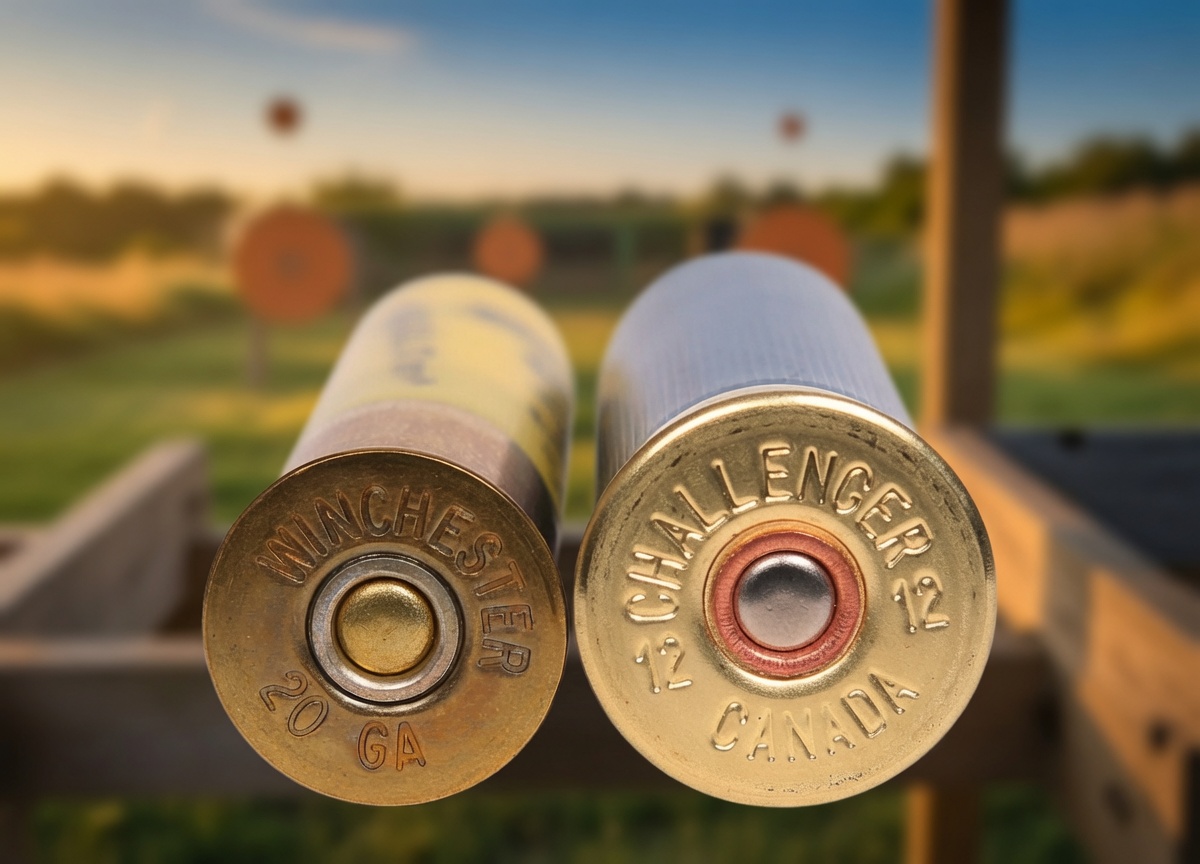
A 12 gauge throws more shot than a 20, not more pressure: both are held to the same ceiling, so the difference is payload, not force.
Last updated: September 22, 2026 · Originally published September 9, 2026
The 12 gauge and 20 gauge are not two power levels of the same thing — the 12 gauge is rated to a lower pressure than the 20. Eleven thousand five hundred psi against twelve thousand. What the bigger bore buys is room for more shot, not a harder push.
What I want you to walk away with
- Maximum average pressure: 12 gauge 11,500 psi at 2¾ and 3 inches, 20 gauge 12,000 psi at both its lengths. The smaller bore runs the higher pressure.
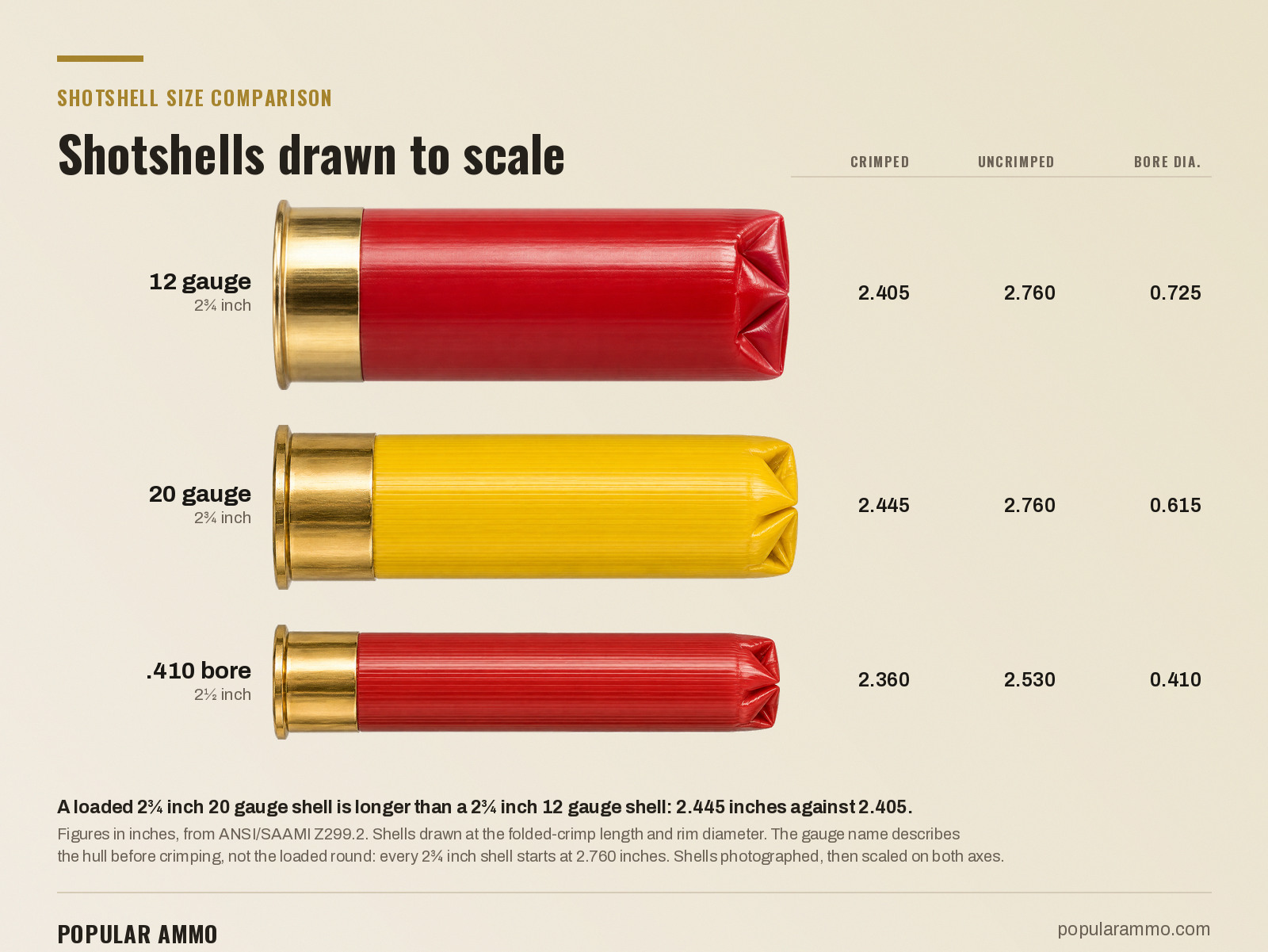
- Bore diameter is .725 against .615 inches — the 12 gauge has about 39 per cent more cross-sectional area to fill.
- The clean comparison: the same maker’s steel waterfowl load, same shot size, both at 1,550 fps — and the 12 gauge carries 29 per cent more shot.
- Only 12 gauge is standardized in a 3½ inch shell. There is no 3½ inch 20 gauge.
- A state conservation agency puts it plainly: the 12 gauge “is more powerful and more versatile”; the 20 gauge’s “recoil is lighter… and the guns are lighter, too.”

Here’s how I read this chart
Every number in this table is a published figure, copied from the source named underneath it — none of it is my own measurement. Read across a row to compare one entry, and down a column to compare them all on the same measure.
The specifications, side by side
| Specification | 12 gauge | 20 gauge |
|---|---|---|
| Bore diameter, smooth | .725 + .020 in | .615 + .020 in |
| Bore / groove, rifled barrel | .719 + .002 in | .609 / .618 in |
| Recognized shell lengths | 2¾, 3, 3½ in | 2¾, 3 in |
| Maximum average pressure, 2¾ and 3 in | 11,500 psi | 12,000 psi |
| Maximum average pressure, 3½ in | 14,000 psi | No 3½ in shell exists |
| Proof load, 2¾ in | Per the standard’s proof tables | 20,000 to 21,500 psi |
| Proof rule for 3 in guns | — | “Use 20-gauge 2¾” proof loads for firearms with 3″ chambers” |
| Maximum rifled slug diameter | — | .606 in |
The pressure comparison is the one people get backwards. Both gauges are rated within five hundred psi of each other, and the smaller one is higher. Bore size and pressure are separate questions — the 12 gauge’s advantage comes from the area it has to work with, not the intensity it works at.
The 3½ inch shell is the exception, and it is the only place the 12 gauge is loaded to a genuinely higher pressure — 14,000 psi. There is no 20 gauge equivalent.

Quick answers
How much more does a 12 gauge actually carry?
On the cleanest available comparison — Federal’s Speed-Shok steel, same #2 shot, both at 1,550 fps — the 12 gauge carries 1⅛ ounces against ⅞ for the 20. About 29 per cent more pellets, at identical velocity.
Does a 20 gauge kick less?
Less payload at similar velocity means less recoil for a given gun weight, and Missouri’s Department of Conservation states it directly. But the same source notes 20 gauge guns “are lighter, too” — and a lighter gun recoils harder for the same load, which gives some of the advantage back. No maker publishes a recoil figure for either gauge.
Is 20 gauge enough for deer?
The makers build for it. Federal’s 3-inch Trophy Copper sabot slug publishes a 275-grain projectile at 1,900 fps, matching Remington’s 260-grain Accutip at the same speed. Both gauges also get published rifled barrel specifications, which no other bore size does.
Which is better for a new shooter?
The usual recommendation is 20 gauge, and the reason given in the state material is recoil and gun weight rather than anything about the shot. Worth pairing with the point above about light guns.
Can I shoot 2¾ inch shells in a 3 inch gun?
Yes, in both gauges. The reverse is not safe, and SAAMI says so: a longer shell in a shorter chamber produces “higher-than-expected pressure… from the mouth of the shell opening into the forcing cone of the shorter chamber and creating a constriction.”
The comparison that is actually like-for-like
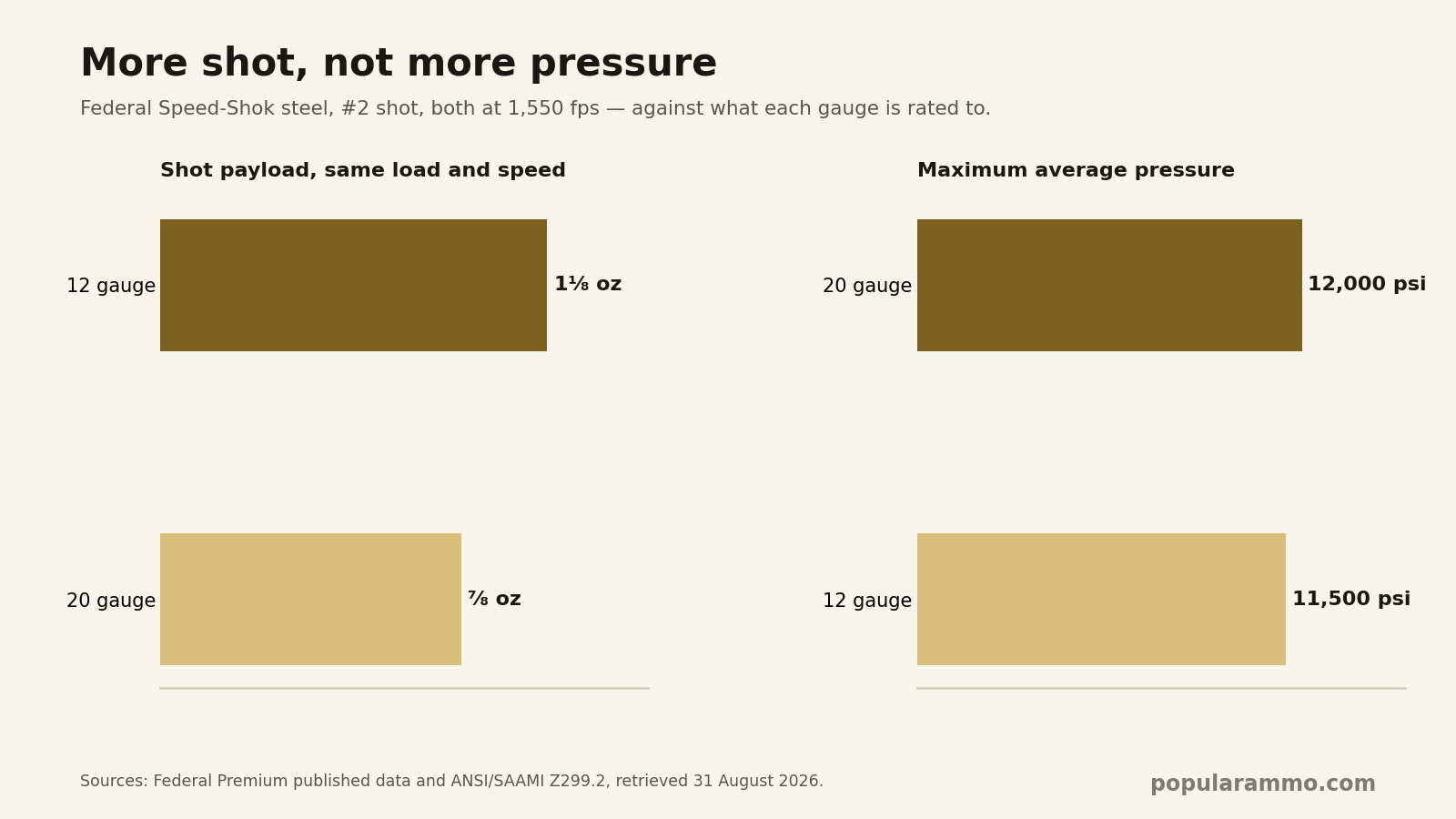
Here’s how I read this chart
Two things at once, because they point in opposite directions. On the left, how much shot each gauge carries in the same load at the same speed — the 12 gauge wins by about 29 per cent. On the right, the pressure each is rated to — and the 20 gauge is the higher of the two. Bore size and pressure are separate questions, and most comparisons get this backwards.
Most gauge comparisons are broken, because they set one maker’s 12 gauge load against another maker’s 20 gauge load at a different velocity with a different shot size. There is one pairing in the current catalog that avoids all of that.
| Gauge | Shot size | Payload | Velocity | Difference |
|---|---|---|---|---|
| 12 gauge | #2 steel | 1⅛ oz | 1,550 fps | — |
| 20 gauge | #2 steel | ⅞ oz | 1,550 fps | 29% less shot, same speed |
That is the gauge difference with everything else held constant: same maker, same product, same pellet, same speed. The 12 gauge is not throwing its pellets harder. It is throwing more of them.
Whether that matters depends entirely on the job. On a bird at 30 yards, a denser pattern means more pellets on target and a better chance of a clean kill. On a target at 20 yards, it is 29 per cent more lead than the job needs.
Where each one is the obvious answer
Turkey and long-range waterfowl favor the 12 gauge, and the catalog shows why. Winchester’s heaviest 12 gauge turkey load carries 2¼ ounces of #5 in a 3½ inch shell. The heaviest 20 gauge turkey load in the same catalog is 1⅜ ounces. There is no 20 gauge answer to a 3½ inch 12.
Upland walking favors the 20 gauge, and the reason is the gun rather than the shell — lighter to carry all day, and the payload difference is close to irrelevant at the ranges upland birds are shot.
Slugs are a genuine draw. Federal publishes the same 275-grain Trophy Copper sabot in both 2¾ and 3 inch 20 gauge, at 1,700 and 1,900 fps. SAAMI publishes rifled barrel specifications for 12 and 20 gauge and for nothing else. If you want a slug gun to a published standard, both gauges qualify.
Home defense is where the published data runs out. Both gauges have loads built for it. Neither has a published pattern percentage, which is the number that would actually answer the question, and no maker publishes one for any shotshell in any gauge.
The number that would settle it, and does not exist
Every meaningful shotgun question comes down to what the pattern does at the distance you are shooting. Not one manufacturer publishes a pattern percentage for any load, in either gauge. Not one publishes pellet energy. Not one publishes recoil.
What they publish is payload, velocity and shot size — three inputs to a calculation nobody completes in public. So the honest comparison between 12 and 20 gauge is the one above: same load, same speed, 29 per cent more shot, and a gun that usually weighs more to carry it.
What nobody publishes
- Pattern percentage — for any load, in any gauge, from any maker or from the standard.
- Recoil — no maker, either gauge. SAAMI publishes the formula and uses a 12 gauge load as a worked example, but that is a method demonstration.
- Pellet energy — never published per pellet; energy appears only on slug loads.
- Buckshot payload weight — sold by pellet count, not ounces, in both gauges.
- Test barrel length — only one load in either gauge’s catalog states one, Hornady’s 20 gauge Custom Lite slug at 24 inches.
Where to go next
12 gauge shotgun shells covers the shot size scale and the non-toxic shot law in full, 20 gauge shells covers the smaller bore in the same detail, and .410 ammo covers the one shotshell that breaks the pressure pattern. Bird hunters will find field coverage at Popular Outdoorsman.
Sources
- ANSI/SAAMI Z299.2 shotshell standard — 12 gauge and 20 gauge smooth bore and rifled barrel drawings, pressure and velocity tables, proof load tables, test barrel notes
- SAAMI, Generally Accepted Firearms and Ammunition Interchangeability, 8 October 2021
- Federal Speed-Shok, Black Cloud FS, Trophy Copper, Top Gun, Gold Medal and Prairie Storm product pages
- Winchester AA, Super X, Double X, DryLok and Xpert category pages; Remington Accutip, Slugger, Nitro Pheasant and Wingmaster HD; Hornady Custom Lite 86233
- Missouri Department of Conservation, Missouri Conservationist, “A Shotgun Approach”


Ammunition reference desk
Three charts readers come back to: what a round costs today, what a cartridge name really measures, and what shipping and tax add.
| .22 LR | 6.59¢ |
| 9mm Luger | 26.98¢ |
| 5.56 NATO | 44.95¢ |
| .270 Win | .278 in |
| .30-30 Win | .309 in |
| .308 Win | .309 in |
| Case price | $269.80 |
| Shipping and tax | +$18.89 |
| Per round | 28.87¢ |
Reader Favorites