223 vs 556: The Pressure Numbers Everyone Quotes Aren’t Measured the Same Way
If the barrel is stamped 5.56 NATO or .223 Wylde, shoot either cartridge. If it is stamped .223 Remington and nothing else, shoot .223 Remington.
Last updated: October 6, 2026 · Originally published August 29, 2026
If your barrel is stamped 5.56 NATO or .223 Wylde, shoot either cartridge. If it is stamped .223 Remington and nothing else, follow the manufacturer’s guidance and shoot .223 Remington. That rule has not changed and this page does not ask you to break it.
How to read this chart
Every number in this table is a published figure, copied from the source named underneath it — none of it is my own measurement. Read across a row to compare one entry, and down a column to compare them all on the same measure.
What has changed is the reasoning. The pressure figures the internet uses to justify that rule are measured by three different methods and cannot be compared to each other — and when a lab actually instrumented the combination, the pressure difference was smaller than the difference between two ordinary 5.56 barrels. The real distinction between these two cartridges is 0.077 inches of chamber, and the honest risk is not the one you have been told.
Are .223 Remington and 5.56 NATO the same thing?
Dimensionally, effectively yes. The two cartridges share the same case dimensions and the same 0.224 in bullet diameter. Per Wikipedia’s entry on the 5.56×45mm NATO, “the dimensional specifications of 5.56 NATO and .223 commercial brass cases are identical.”
They are not the same standard. .223 Remington is the American commercial specification maintained by SAAMI. 5.56×45mm NATO is a military specification maintained through NATO’s EPVAT testing regime. Two standards bodies, two sets of paperwork, one physical cartridge shape.
A 5.56 round will slide into a .223 chamber with no resistance and no warning. That is exactly why this question keeps getting asked.

Quick answers
Can you shoot 5.56 NATO in a .223 Remington rifle?
Not per the manufacturer’s guidance, and that is the rule to follow. A .223 chamber has roughly half the leade of a 5.56 chamber, so peak pressure arrives sooner and higher than it was designed around. When LuckyGunner Labs instrumented it the pressure rise was smaller than the variation between two ordinary 5.56 barrels — but a single test is not a warranty, and the realistic failure is a popped primer tying up your rifle. Details below.
Can you shoot .223 Remington in a 5.56 NATO rifle?
Yes. This direction is safe. The bullet simply has further to jump before it reaches the rifling, so pressure stays comfortably inside spec. You may give up a small amount of accuracy.
Can a .223 Wylde barrel shoot 5.56?
Yes — both. That is what the chamber exists for: 5.56 external dimensions and lead angle, with the tighter .223 freebore diameter.
223 vs 556 ammo — are they the same cartridge?
Same case dimensions and same 0.224 in bullet diameter — a 5.56 round chambers in a .223 rifle with no resistance. They are two different standards, not two different shapes.
How do I know which chamber my rifle has?
Read the barrel, and only the barrel. A lower receiver marked MULTI or 5.56 tells you nothing, and the upper is not the chamber. If you cannot confirm it, treat the rifle as .223 Remington until a gunsmith gauges it.
Which one hits harder?
Neither, in any way the label controls. Terminal performance follows bullet construction, weight and impact velocity. Compare specific loads, not designations.
Is one cheaper than the other?
Not reliably. Bulk .223 and bulk 5.56 from the same maker usually sit within a few cents per round, and which is cheaper flips week to week.
The pressure comparison everyone repeats is three different measurements
Search this topic and you will be told .223 Remington runs at 55,000 psi while 5.56 NATO runs at 62,366 psi — a 13% gap, apparently wide enough to matter a great deal.
Both numbers are real. They are also produced by different organizations using transducers in different places on the cartridge. Here is what the published standards actually say, side by side:
| Standard | Cartridge | Maximum pressure | Transducer method |
|---|---|---|---|
| SAAMI (US commercial) | .223 Remington | 55,000 psi | Chamber-conformal piston |
| CIP (Europe) | .223 Remington | 430 MPa / 62,366 psi | Drilled case |
| NATO EPVAT | 5.56×45mm NATO | 430 MPa / 62,366 psi | Case mouth |
| American Rifleman, converted | 5.56×45mm NATO | ~60,000 psi | SAAMI-equivalent mid-case |
How to read this table
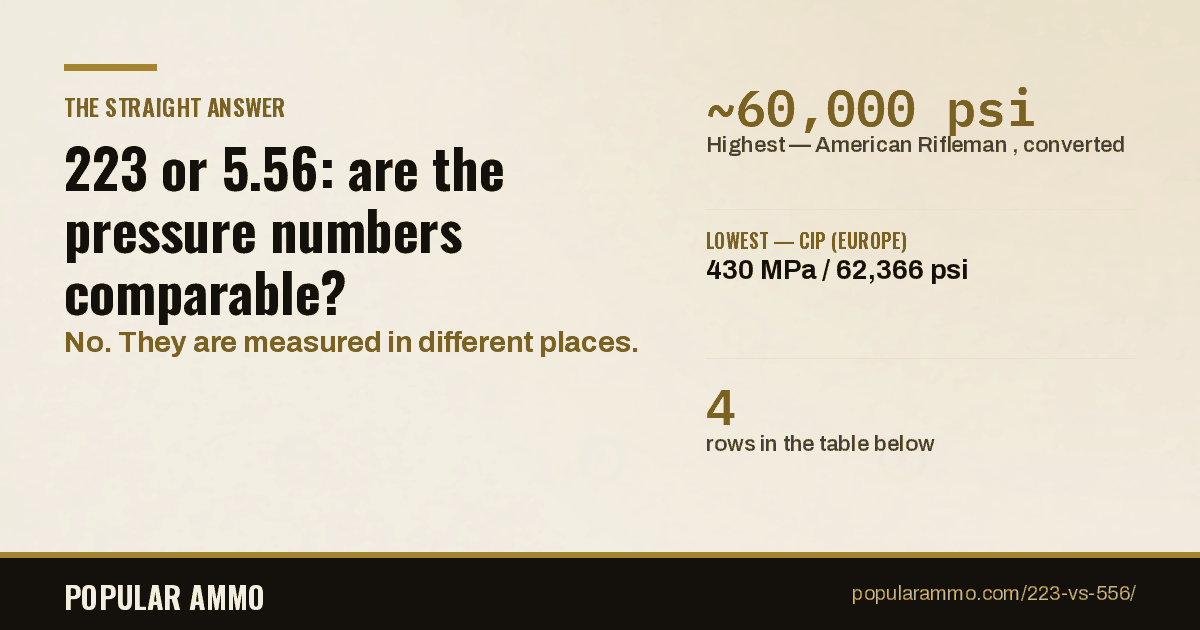
Four rows, four different rule-makers. Read the last column first, because it tells you where each organization puts its pressure sensor. Two figures only mean the same thing when that column matches. This is why the same cartridge can be listed at 55,000 in one row and 62,366 in another without either being wrong.
How to read this chart
Each bar is the pressure limit one rule-making body sets for one of these two cartridges. They look wildly different, but they are measured with different equipment in different places on the cartridge, so they cannot be lined up against each other. That is the point of the picture: the famous gap is mostly a measuring difference, not a difference in the ammunition.
Read the second row again. CIP — the European civilian standards body — rates .223 Remington at 430 MPa, which is 62,366 psi. That is the exact number quoted everywhere as proof that 5.56 NATO is the hotter cartridge. The same cartridge that SAAMI rates at 55,000 psi is rated by CIP at the figure people cite as 5.56’s ceiling. Nothing about the ammunition changed. Only the transducer moved.
Wikipedia’s entry on the .223 Remington states the principle directly: chamber pressures obtained using different methods are not comparable, and the limits for the two cartridges are very similar when measured alike.
Measured on comparable terms, the honest gap is roughly 55,000 psi versus about 60,000 psi — the NRA’s American Rifleman puts 5.56 at 58,700 psi at the case mouth and notes military ammunition converted to SAAMI’s method “can be expected to hit 60,000 p.s.i.” Call it 9%. Real, but not the cliff the raw numbers imply.
Which raises the obvious question: if the ammunition is barely different, what is the warning actually about?
The real difference is 0.077 inches of chamber
It is the leade — also called the throat or freebore. That is the short unrifled section between where the case mouth ends and where the rifling begins: the distance a bullet travels before it hits the lands and has grooves cut into it.
| Chamber | Typical leade length |
|---|---|
| .223 Remington (SAAMI) | 0.085 in |
| 5.56 NATO | 0.162 in |
| Difference | 0.077 in |
How to read this table
Three chambers, one measurement each: the length of the smooth gap in front of the cartridge before the grooves start. A bigger number means the bullet gets a longer run-up, which lowers pressure. The whole argument between these two cartridges comes down to the 0.077 of an inch between the top and bottom rows.
How to read this chart
Both chambers are drawn at the same scale. What is being measured is the short smooth run between where the cartridge case ends and where the spiral grooves in the barrel begin. The 5.56 chamber gives the bullet about twice as much of that run, and that is the actual difference between the two. Everything else is close enough not to matter.
The 5.56 leade is roughly double the .223 leade. Those figures come from American Rifleman, and they are the two most useful numbers in this entire debate.
Why a longer leade lowers pressure
Engraving a bullet into rifling takes force. While that is happening the bullet is barely moving, but the powder is still burning — so pressure climbs steeply. A longer leade gives the bullet a running start: it is already accelerating before it meets resistance, and the expanding gas has slightly more volume to occupy at the moment of peak resistance. Peak pressure comes out lower.
A shorter leade does the reverse. Put a 5.56 round — loaded warm, often with a longer bullet seated further out — into a .223 chamber and the bullet may be touching or nearly touching the rifling before the primer fires. Peak pressure arrives sooner and higher than the chamber was drawn around.
Run it the other way and nothing interesting happens. A .223 round in a 5.56 chamber simply has further to jump. Pressure stays comfortably inside spec.
What happened when a lab actually measured it
Almost every page on this subject argues from the specification sheet. LuckyGunner Labs instrumented it instead.
Their test used a Weatherby Vanguard Compact chambered in .223 Remington, two 5.56 AR-15s, strain gauges and pressure monitoring equipment, firing Federal XM855 — military-specification 62-grain 5.56 ammunition, the exact thing you are warned not to do.
Their finding:
“There was no dangerous spike in pressure from firing 5.56mm ammo in a .223 chamber. While pressures were elevated in comparison to one of the 5.56mm barrels, they were slightly below the other 5.56mm barrel.”
Read that carefully. The .223 chamber produced pressures that landed between the two 5.56 chambers. The barrel-to-barrel variation among ordinary 5.56 barrels was larger than the .223-versus-5.56 chamber difference. Velocities followed the same pattern — the .223 barrel ran the XM855 faster than one 5.56 barrel and slower than the other.
They also reported that most of the experts they consulted “did not feel that there was a major difference between .223 and 5.56 chambers in terms of pressure.”
One more data point worth knowing: Wikipedia maintains a page listing unsafe firearm and cartridge combinations. It lists firing .300 Blackout in a .223 Remington rifle — a genuinely catastrophic pairing. It does not list 5.56 NATO in a .223 chamber at all.
So why does every manufacturer still say don’t?
Because “one instrumented test found no dangerous spike” and “you should do this” are different statements, and the gap between them is where people get hurt.
- One test is one test. One rifle, one ammunition lot, one set of conditions. It is far better evidence than the spec-sheet arithmetic everyone else is doing, and it is still a single data point.
- The margin narrows even if it does not vanish. A .223 chamber running 5.56 ammunition has less headroom left for the other things that raise pressure — a hot day, a soft primer, a compressed load, a slightly tight bore, a hot barrel late in a string. Those stack.
- The realistic failure mode is unglamorous and still bad. LuckyGunner’s own caution was popped primers. A primer that backs out and falls into the fire control group ties the rifle up completely. Their framing: annoying at the range, potentially fatal in a defensive use.
- Ammunition marked “5.56” is not one thing. Loadings vary by manufacturer, lot and year. The test result for XM855 is not a warranty covering every 5.56 box on the shelf.
- Nobody will stand behind it. Fire ammunition your rifle is not marked for and you are outside the manufacturer’s stated spec. That matters for warranty, and it matters more if anything ever goes to a courtroom.
The practical upshot: if you have been lying awake because you put a magazine of green tip through a .223 bolt gun once, the evidence says relax and inspect your brass. If you are deciding what to feed a .223-marked rifle from here on, feed it .223. Those two positions are consistent, and most articles on this subject only give you the second one with a scarier justification than the evidence supports.
One neighbouring hazard worth knowing before we go further: a 300 Blackout round will also chamber in a 5.56 barrel, and unlike this pairing that one reliably destroys the rifle.
The four chamber markings you will actually encounter
1. .223 Remington
The SAAMI commercial spec — 0.085 in leade, tighter throat. Common on bolt-action varmint rifles and on some precision and budget AR uppers. Feed it .223 Remington. This is the one chamber in the list with a real restriction.
2. 5.56 NATO
The military spec — 0.162 in leade, more generous throat, designed to tolerate hot ammunition, grit and adverse conditions. The most common marking on AR-15 barrels. Takes both.
3. .223 Wylde
A hybrid developed by Bill Wylde. Per the published description it uses the external dimensions and lead angle of the 5.56 NATO chamber with the 0.224 in freebore diameter of the SAAMI .223 Remington chamber. The effect is 5.56 pressure tolerance with tighter bullet alignment than a full military chamber. Takes both, and it is the usual pick on accuracy-focused builds.
4. “5.56/.223”, “.223/5.56”, “5.56 NATO/.223 REM”
A maker telling you the barrel is throated for both. Treat as 5.56 NATO.
If a barrel is marked only “.223 REM,” the absence of the 5.56 marking is the information. Do not assume it was omitted by accident.
How to find out what your rifle actually has
This is the question behind the question, and it has one reliable answer and several unreliable ones.
Look at the barrel — and only the barrel
The chamber lives in the barrel. Nothing else on the rifle is authoritative:
- A lower receiver marked “MULTI” or “MULTI-CAL” tells you nothing. That marking exists because the lower is the serialized firearm and the maker did not want to tie it to one cartridge. It is a legal convenience, not a chamber spec.
- A lower marked “5.56” tells you almost nothing either. Lowers and barrels are routinely swapped, and on a parts-built rifle they may never have shipped together.
- The upper receiver is not the chamber. A complete upper from one brand can carry a barrel from another.
- The box and the manual describe the model as sold. If the rifle is used, that may not be what you are holding.
On an AR-15 the caliber is normally rolled onto the barrel just forward of the receiver, usually hidden under the handguard — you may have to remove or peer under it. On a bolt gun it is typically on the barrel near the chamber. On some AR barrels the marking sits under the front sight base or gas block and is genuinely awkward to reach.
If you cannot confirm it
- Check the manufacturer’s spec sheet for your exact model and year. Chamberings change between production runs under the same model name — verify the year, not just the name.
- Ask the manufacturer directly with the serial number. Most will tell you.
- Have a gunsmith gauge the chamber. A competent shop does this in minutes; a throat-length gauge answers it definitively.
- Until then, treat it as .223 Remington. That is the conservative assumption and it costs you nothing but ammunition choice.
What over-pressure looks like before anything breaks
Modern rifles usually complain before they fail. Watch for flattened or cratered primers, primers backing out of their pockets, stiff extraction, ejector swipe marks on case heads, or case head separation. Any of those means stop, unload, and find out what chamber you have.
Twist rate is a completely separate question — and people conflate the two
Chamber and twist rate are independent. A 5.56 NATO chamber can be cut with any twist; so can a .223 Remington chamber. Knowing your chamber does not tell you which bullet weights your barrel will stabilize.
The reason the two get tangled is historical. The original M193 55-grain load was optimized for a 20-inch barrel with a 1:12 twist. When 5.56×45mm was standardized under STANAG 4172 in 1980, NATO specified 1:7 — and, per the published account, it did so to stabilize the relatively long L110/M856 tracer projectile, not the M855 ball round it is usually credited to. Military-pattern rifles inherited 1:7, and 5.56-marked barrels followed.
| Twist | Commonly recommended bullet weights | Typical use |
|---|---|---|
| 1:12 | Around 55 gr and lighter | Older barrels, light varmint loads |
| 1:9 | Roughly 45–62 gr (sources disagree — see below) | General-purpose commercial barrels |
| 1:8 | Roughly 60–80 gr, up to about 90 gr | The versatile modern default |
| 1:7 | Heavier and longer bullets, 62–77 gr and up | Military pattern, tracer, heavy match |
How to read this table
Twist is how far the bullet travels while making one complete turn, so 1:7 means one turn every seven inches. A smaller number is a faster spin, and a faster spin steadies longer, heavier bullets. This is a separate question from the chamber, and mixing the two up is the most common mistake in this debate.
Where the sources disagree. The NRA puts 1:9 at 45–77 gr; Ballistic Advantage puts it at 40–62 gr. That is a wide gap on the upper end, and it matters if you are buying 77-grain match ammunition for a 1:9 barrel. Treat 1:9 as reliable through the mid-60s and verify heavier loads by shooting them — a bullet that will not stabilize announces itself as keyholing on paper.
The claim that a 1:7 barrel “over-stabilizes” and degrades light 55-grain ammunition is also contested — the NRA warns of it, Ballistic Advantage says 1:7 handles 55–70 gr fine. If you shoot bulk 55-grain through a 1:7 barrel, shoot a group before believing either camp.
Why this belongs in a .223 versus 5.56 article: the heavy bullets that made 1:7 necessary — 62-grain M855, 77-grain match — are almost all 5.56-labeled loads. The bullet weights that suit 1:12 are almost all .223-labeled varmint loads. The correlation is real, which is exactly why people mistake it for causation.
5.56 ammo vs .223 ammo: is the ammunition itself different?
Externally, no — same case dimensions, same bullet diameter. The genuine differences:
- Pressure. Military 5.56 is loaded warmer, as covered above — by less than the headline numbers suggest.
- Primer crimp. Military brass typically has a crimped primer pocket, which must be swaged or reamed before it will take a new primer. This is a real and consistent difference, and it matters to handloaders.
- Bullet weight and profile. 5.56-labeled ammunition skews heavier and longer. Where those bullets seat changes both pressure and how much leade you need. The 62-grain M855 steel-core load lives here — we cover it in our guide to green tip ammo.
The thicker-brass claim
You will read almost everywhere that military 5.56 brass has thicker walls and heads, reducing case capacity and raising pressure. We could not support that as a rule. Wikipedia’s 5.56×45mm NATO entry states that the two have “similar case capacity when measured, with variations chiefly due to brand, not 5.56 vs .223 designation.”
In other words: case capacity varies meaningfully between manufacturers, and some commercial .223 brass is heavier than some military 5.56 brass. The variable is the headstamp on the case, not the label on the box.
What this means if you handload: the correct practice is unchanged and arguably more important. Weigh and measure the brass you actually have, work up from a reduced charge for each headstamp, and do not carry a load across brands on the assumption that “military brass” is one category. The old rule of thumb pointed at roughly the right caution for the wrong reason.
Which one hits harder?
Neither, in any way the label controls. Terminal performance is a function of bullet construction, weight and impact velocity — not of which standards body the box references. A 62-grain FMJ performs like a 62-grain FMJ whether the box says 5.56 or .223, at whatever velocity your barrel produces.
Where a real difference shows up, it is because 5.56-labeled ammunition tends to be loaded a little warmer and skews toward heavier bullets. That is a tendency in what gets sold under each label, not a property of the cartridges. Compare specific loads, not designations.
Hunting: which one, and is it even legal?
For hunting the label is close to irrelevant and the bullet is close to everything. Bulk M193 and M855 are military ball designs built to penetrate, not to expand — they are poor hunting projectiles regardless of what the box says. What you want is a purpose-built expanding hunting bullet, and those are sold under both labels.
The larger question is legality, and it is genuinely a state-by-state matter. Numerous states set a minimum caliber, minimum case length, or minimum energy for deer and other big game, and .22 centerfire cartridges sit near or below those thresholds in several of them. Some states permit .223/5.56 for deer outright, some prohibit it, and some allow it only in certain zones or seasons.
We are not going to summarize fifty states from secondary sources. Regulations change annually and the versions circulating on content sites go stale fast. Pull the current regulations from your state wildlife agency for the season you are hunting, and read the caliber and ammunition sections rather than a summary of them. For field application of the .22 centerfires on predators and varmints, our sister site Popular Outdoorsman covers that ground.
Price and availability: does one cost more?
Not reliably, and not in the direction most people assume. In any given week, bulk 5.56 NATO and bulk .223 Remington from the same manufacturer usually sit within a few cents per round of each other, and which is cheaper flips depending on what is being run and what surplus is moving.
What actually drives the price of both is the same set of forces that drives all centerfire ammunition — component costs, manufacturer capacity, and demand spikes. We track conditions and current pricing across calibers in our ammo market tracker, updated as the data changes rather than left to go stale.
This reinforces the point above: if your chamber accepts both, you can always buy whichever is cheaper that week. A .223-only chamber removes that option, and over thousands of rounds that is where the real cost of the restriction shows up — not in accuracy, in flexibility.
What you give up shooting .223 in a 5.56 chamber
Accuracy, potentially — and usually less than expected. The longer 5.56 leade means a .223 bullet travels further before engaging the rifling, and a longer unsupported jump gives it more opportunity to enter the bore slightly off-axis. In a rifle capable of resolving the difference, groups can open measurably.
Two honest caveats. The effect is small relative to the shooter, the barrel, the optic and the ammunition lot — most shooters will never see it. And it is precisely the problem .223 Wylde was built to solve, which is why Wylde has become the default on accuracy-focused AR builds.
Velocity differences between the two labels are modest and vary more by individual load and barrel length than by anything printed on the box.
What we could not verify
In the interest of not simply repeating the internet back at you:
- We did not test-fire anything for this article. Popular Ammo does not operate a pressure lab. Every figure here is sourced to a published standard, to the NRA’s American Rifleman, or to LuckyGunner Labs’ published test, and we have said which is which.
- We could not obtain SAAMI’s chamber print directly to check the 0.085 in and 0.162 in leade figures against the primary document. They are consistent across authoritative secondary sources and American Rifleman is what we are leaning on. Treat them as typical, not absolute — makers cut chambers to their own tolerances within spec.
- LuckyGunner’s test is the only instrumented, published measurement of this specific question we could find. We could not locate a second independent test to corroborate it, and we did not find their raw pressure figures published as numbers. A single test is the best evidence available here, which is not the same as settled.
- The twist-rate ranges above disagree between two reputable sources and we have shown the disagreement rather than averaging it away.
- Box markings tell you which specification the maker is claiming, not the pressure of that lot. Ammunition marked “.223” is not automatically loaded to a SAAMI minimum, and some commercial “5.56” is loaded well below military pressure.
The practical rule
Buy the chamber, not the ammunition. On most AR-15 builds a 5.56 NATO or .223 Wylde barrel costs no more than a .223 Remington one and settles the question permanently — you walk into any store and buy whatever is on the shelf at whatever it costs that week. Over the life of a rifle that flexibility is worth more than any accuracy difference you are likely to shoot.
If you already own a .223 Remington rifle, you do not have a problem. You have a constraint. Buy .223 Remington, read the box rather than the headstamp, and it will serve you for decades.
And if you shoot an AR-15 suppressed, chamber and gas system interact in ways beyond this article — our sister site covers that in its guide to the best 5.56 AR-15 suppressors.
The .223 Remington sits on my rifle caliber chart beside 25 other rifle cartridges at true scale. The 5.56×45mm NATO does not, because SAAMI does not standardize it.
Sources
- SAAMI maximum pressure for .223 Remington; CIP pressure for .223 Remington and its drilled-case method; NATO EPVAT pressure and case-mouth method; .223 Wylde chamber definition; the statement that pressures measured by different methods are not comparable — .223 Remington, Wikipedia
- Identical brass dimensional specifications; case capacity varying by brand rather than designation; STANAG 4172 1:7 twist adopted for the L110/M856 tracer; original M193 1:12 optimization — 5.56×45mm NATO, Wikipedia
- Leade dimensions (0.085 in / 0.162 in); 58,700 psi case-mouth and ~60,000 psi converted figures — “.223 Remington Vs. 5.56: What’s in a Name?”, American Rifleman
- Instrumented pressure and velocity testing of XM855 in a .223 Remington chamber — “5.56 vs .223 — What You Know May Be Wrong”, LuckyGunner Labs
- Absence of 5.56-in-.223 from the cataloged unsafe combinations — Unsafe firearm and cartridge combinations, Wikipedia
- Chamber throat guidance and the interchangeability rule — “223 vs 5.56: Are They Interchangeable?”, NSSF
- Twist rate to bullet weight recommendations — NRA Blog and Ballistic Advantage


Ammunition reference desk
Three charts readers come back to: what a round costs today, what a cartridge name really measures, and what shipping and tax add.
| .22 LR | 6.59¢ |
| 9mm Luger | 26.98¢ |
| 5.56 NATO | 44.95¢ |
| .270 Win | .278 in |
| .30-30 Win | .309 in |
| .308 Win | .309 in |
| Case price | $269.80 |
| Shipping and tax | +$18.89 |
| Per round | 28.87¢ |
Reader Favorites