22 LR vs 22 Magnum: Same Pressure, Twice the Case
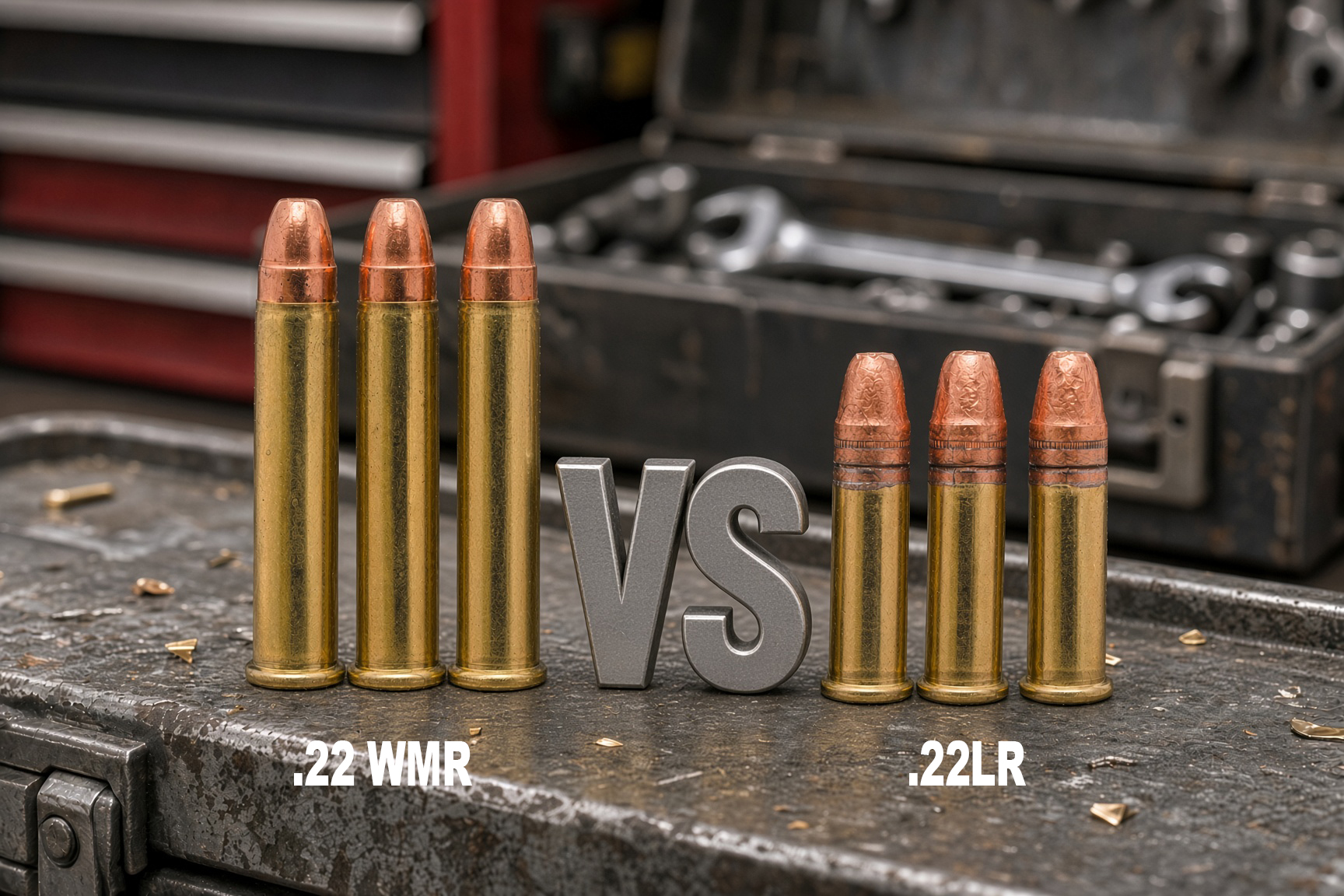
22 LR vs 22 Magnum: same pressure ceiling, but the Magnum’s longer case holds far more powder, and that is where its extra velocity comes from.
Last updated: October 6, 2026 · Originally published September 9, 2026
Both cartridges are loaded to exactly the same pressure — 24,000 psi — and tested in the same 24-inch barrel. The .22 Magnum is not a hotter .22 Long Rifle. It is a much longer case at the same ceiling, and it fires a bullet that is fractionally narrower.
What I want you to walk away with
- Maximum average pressure is 24,000 psi for both. So is the test barrel: 24 inches, both cartridges.
- The .22 WMR’s case is 1.055 inches against .613 — 72 percent longer. That, not pressure, is where the speed comes from.
- Bullet diameter runs the other way: .2245 inches for the Magnum, .2255 for the Long Rifle.
- CCI’s 40-grain loads in both, from one catalog: 1,875 fps and 312 ft-lb against 1,235 fps and 135 ft-lb. The Magnum still carries 155 ft-lb at 100 yards — more than the .22 LR has at the muzzle.
- SAAMI singles the .22 WMR out for unusually high variation and assigns it a coefficient of variation of 10 percent, against 4 percent for every other rimfire.
- .22 Long Rifle is not on SAAMI’s list of what a .22 WMR chamber may safely fire. CCI puts it plainly: it fits, and you should not do it.

Here’s how I read this chart
Every number in this table is a published figure, copied from the source named underneath it — none of it is my own measurement. Read across a row to compare one entry, and down a column to compare them all on the same measure.

22 LR vs 22 Magnum specifications, side by side
Rimfire cartridges have their own standard — ANSI/SAAMI Z299.1, separate from the pistol and rifle documents. Both of these are in it.
| Specification | .22 Long Rifle | .22 WMR |
|---|---|---|
| Bullet diameter | .2255 in | .2245 in |
| Case length | .613 in | 1.055 in |
| Cartridge overall length | .950 – 1.000 in | 1.315 – 1.350 in |
| Rim diameter | .278 in | .294 in |
| Rim thickness | .043 in | .050 in |
| Bore / groove diameter | .217 / .222 in | .219 / .224 in |
| Minimum bore and groove area | .0382 in² | .0388 in² |
| Twist | 1 turn in 16 in, right hand, marked optional — identical for both | |
| Headspace | .043 – .051 in | .050 – .056 in |
| Maximum average pressure | 24,000 psi — identical for both | |
| Maximum probable sample mean | 25,500 psi | 27,800 psi |
| Copper crusher figures | Not established — SAAMI recognizes only transducer measurement for rimfire | |
| Proof, minimum / maximum average | 31,000 / 34,000 psi | 32,000 / 35,500 psi |
| Test barrel | 24.000 in — identical for both | |
Two rows are worth stopping on. The identical 24,000 psi ceiling undoes the usual framing — the Magnum is not a higher-pressure round. And the maximum probable sample mean row is where the two part company: 25,500 psi for the .22 LR against 27,800 for the Magnum, from the same 24,000 psi average. That gap is not an accident.

The .22 Magnum is the least consistent cartridge in the standard, and SAAMI says so
Most of the rimfire standard is written once and applied to everything in it. The .22 WMR gets its own footnote, twice. Verbatim:
“Experience has shown that with the 22 Winchester Magnum cartridge, variations that are higher than normal Rimfire occur. As a result, a coefficient of variation of 0.10 has been established for this cartridge.”
And again, in the velocity and pressure table’s own footnotes: “Experience has shown the 22 WMR cartridge displays variations that are higher than other rimfire cartridges. As a result, a standard deviation of 2,400 (a coefficient of variation of 10%) has been established for this cartridge.”
Every other rimfire cartridge in Z299.1 is worked to 4 percent. The .22 WMR is worked to 10. That is why its proof and probable-mean figures are wider despite an identical average pressure, and it is the closest thing to a published statement that .22 Magnum ammunition varies more from round to round than .22 Long Rifle does.
22 LR vs 22 Magnum: quick answers
How much more powerful is a .22 Magnum?
On CCI’s own catalog, comparing 40-grain loads in both: 312 foot-pounds against 135 at the muzzle — about 2.3 times. CCI states the comparison itself: its 40-grain Maxi-Mag carries 155 ft-lb at 100 yards, and its 36-grain Mini-Mag “strikes with 80 pounds of energy at 100 yards, or about half that of 22 WMR.”
Can I shoot .22 LR in a .22 Magnum?
No. It fits, which is the problem. SAAMI’s interchangeability list gives the .22 WMR chamber exactly two acceptable alternates — .22 Winchester Rimfire and .22 Remington Special — and .22 Long Rifle is not among them. CCI states the mechanism outright: “while the 22 WMR will not fit into a 22 LR chamber, a 22 LR cartridge will, in fact, fit in a 22 WMR,” and “use caution never to fire a 22 LR in a 22 WMR rifle because of the risk of energy from escaping gasses.”
What can a .22 LR chamber fire?
Three things, per SAAMI: .22 Short, .22 Long, and .22 Long Rifle Shot. Nothing else on the list.
Does a longer barrel make .22 LR faster?
Nobody publishes a curve that answers this. I looked hard. SAAMI specifies one 24-inch test barrel and no series; Lapua publishes the only same-load two-barrel data I could find, and it is pistol lengths only — its Pistol King load runs 935 fps at 5.9 inches and 886 at 4.7. The widely repeated claim that .22 LR velocity falls in long barrels is not supported by any published maker or standards data I could locate.
What does a short barrel actually cost?
Federal states it for its Punch line, which is the clearest maker statement I found: the .22 LR load “achieves 1,070 fps through 2-inch barrel handguns, 1,650 fps out of 24-inch rifle barrels,” and the .22 WMR load “offers 1,000 fps muzzle velocity through 2-inch barrel, 1,800 fps through rifle barrels.” Same cartridge, same load, roughly 600 to 800 fps of difference.
The comparison that is actually like-for-like
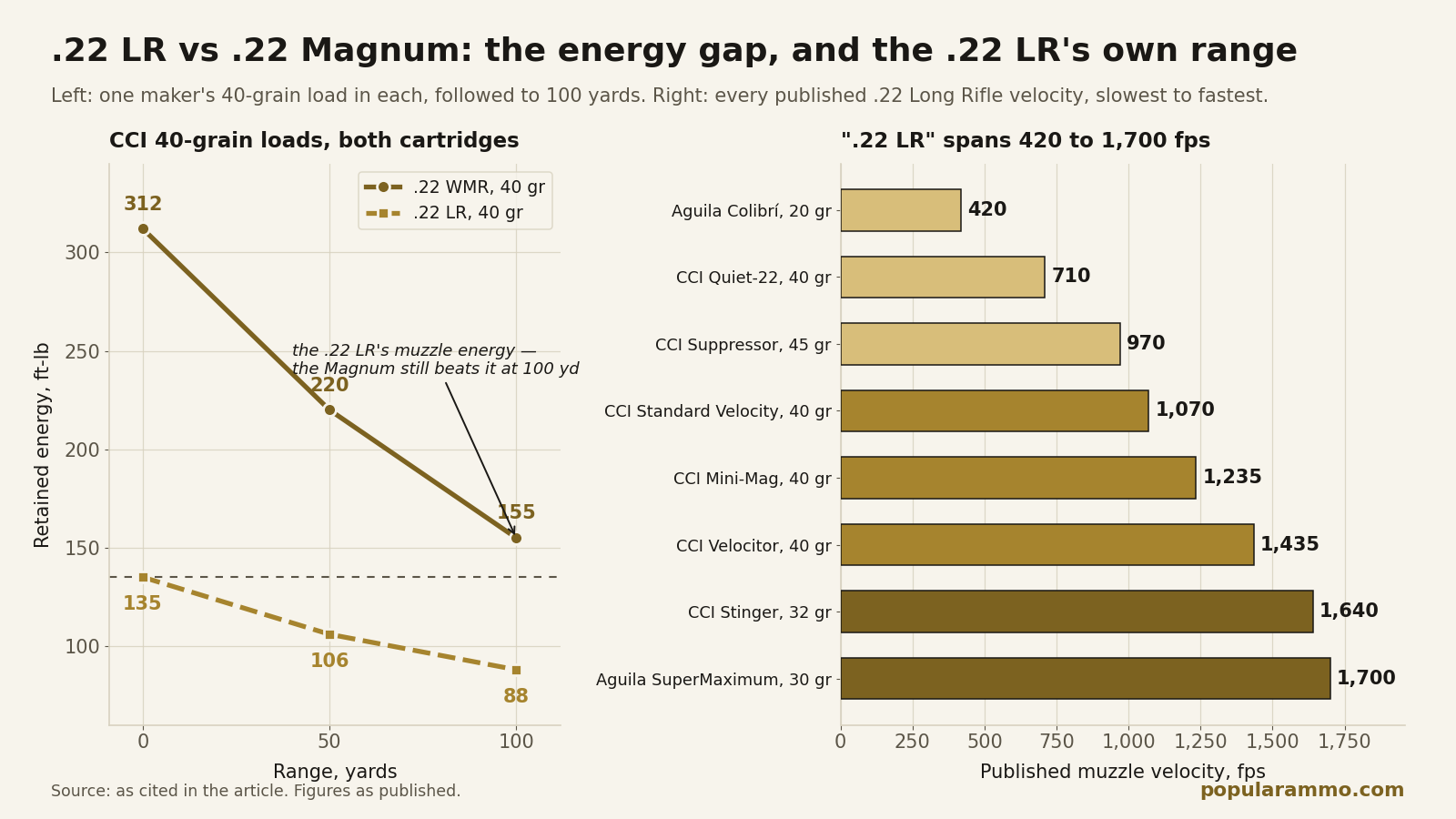
Here’s how I read this chart
On the left, how much energy one maker’s 40-grain load in each cartridge still carries at the muzzle, 50 and 100 yards, in foot-pounds. Look at where the .22 Magnum line sits at 100 yards against where the .22 Long Rifle line starts — the Magnum has more energy left at 100 yards than the Long Rifle has at the muzzle. On the right, every published .22 Long Rifle muzzle velocity I could find, sorted slowest to fastest. The point of the right panel is that “.22 LR” describes a range from 420 to 1,700 fps, not a single thing.
CCI is the useful catalog here because it publishes both cartridges in the same table, at the same bullet weights, and adds a column of estimated handgun velocities alongside the rifle figures.
| Load | Part | Weight | Muzzle | 50 yd | 100 yd | Est. handgun | Muzzle energy | 100 yd energy |
|---|---|---|---|---|---|---|---|---|
| Maxi-Mag HP (.22 WMR) | 24 | 40 gr | 1,875 | 1,574 | 1,319 | 1,425 | 312 | 155 |
| Mini-Mag (.22 LR) | 30 | 40 gr | 1,235 | 1,092 | 998 | 1,060 | 135 | 88 |
| Maxi-Mag TMJ (.22 WMR) | 23 | 40 gr | 1,875 | 1,603 | 1,366 | 1,425 | 312 | 166 |
| Mini-Mag HP (.22 LR) | 31 | 36 gr | 1,260 | 1,104 | 1,003 | 1,085 | 127 | 80 |
| Maxi-Mag Segmented (.22 WMR) | 972CC | 46 gr | 1,875 | 1,623 | 1,430 | 1,331 | 359 | 201 |
| Mini-Mag Segmented (.22 LR) | 36CC | 40 gr | 1,235 | 1,092 | 998 | 1,060 | 135 | 88 |
Same maker, same table, same bullet weight, same testing method. The Magnum roughly doubles the muzzle energy and nearly doubles it again in relative terms at distance, because it starts fast enough to still be moving well at 100 yards while the .22 LR has already dropped below 1,000 fps.
The handgun column is the honest counterweight. Out of a pistol the Magnum’s advantage narrows sharply — 1,425 fps against 1,060 — because a large part of what the longer case buys needs barrel to be realized. CCI never states what barrel length that column assumes, so treat it as directional rather than exact.
“.22 LR” is not one cartridge
Before comparing the two, it is worth knowing how much room there is inside the smaller one. This is the published span from two catalogs.
| Tier | Load | Weight | Muzzle | Energy |
|---|---|---|---|---|
| Powderless | Aguila Colibrí | 20 gr | 420 fps | 8 ft-lb |
| Quiet | CCI Quiet-22 | 40 gr | 710 fps | 45 ft-lb |
| Subsonic | CCI Suppressor | 45 gr | 970 fps | 94 ft-lb |
| Standard velocity | CCI Standard Velocity | 40 gr | 1,070 fps | 102 ft-lb |
| High velocity | CCI Mini-Mag | 40 gr | 1,235 fps | 135 ft-lb |
| Heavy hyper | CCI Velocitor | 40 gr | 1,435 fps | 183 ft-lb |
| Hyper velocity | CCI Stinger | 32 gr | 1,640 fps | 191 ft-lb |
| Hyper velocity | Aguila SuperMaximum | 30 gr | 1,700 fps | 193 ft-lb |
From 420 to 1,700 fps, and from 8 to 193 foot-pounds. The fastest .22 Long Rifle in that table is closer to a .22 Magnum than it is to the slowest .22 Long Rifle. So “is the Magnum worth it?” depends heavily on which .22 LR you were going to buy — a Stinger at 191 ft-lb narrows the gap that a Colibrí at 8 ft-lb makes look absurd.
The .22 Magnum’s own published range is far narrower: from 1,050 fps for CCI’s short-barrel Uppercut defensive load up to 2,200 fps for the 30-grain V-MAX and VNT loads, with almost everything else sitting at 1,875.
What each chamber may safely fire
SAAMI’s interchangeability document is a closed list — its wording is “these acceptable alternate cartridge/chamber combinations are limited to only the following” — and both of these cartridges appear on it, which makes the omissions unusually informative.
| Firearm chambered in | May generally safely shoot |
|---|---|
| .22 Long Rifle | .22 Short · .22 Long · .22 Long Rifle Shot |
| .22 Winchester Magnum Rimfire | .22 Winchester Rimfire · .22 Remington Special |
Neither cartridge appears in the other’s row. A .22 Magnum will not chamber in a .22 LR rifle, so that direction takes care of itself. The dangerous direction is the one that fits — and SAAMI’s answer is to leave it off the list rather than print a warning about it.
The same document adds a warning that applies here more than almost anywhere else, because rimfire cases carry no headstamp: “Some types of ammunition, most notably rimfire and cartridges produced for military use, do not have cartridge markings on the head stamp of the case. In those instances, check the original ammunition packaging to determine its proper designation.”
What nobody publishes
- Recoil — for either cartridge, from any of the eight makers I checked.
- Copper crusher pressure — not merely unpublished. SAAMI recognizes only the piezoelectric transducer system for rimfire, so no CUP figure exists for any rimfire cartridge.
- A barrel-length versus velocity curve for .22 LR, from any maker or standards body. Lapua’s pistol-length pair is the closest published thing.
- Test barrel length on most catalog pages — CCI, Winchester, Remington, Aguila and Eley all omit it for rimfire. Hornady and Lapua state it; Federal states it in prose but not in its spec table.
- What CCI’s “estimated handgun” column assumes — the column appears on every rimfire row and the barrel length behind it is never given.
- Any maker statement on .22 WMR conversion cylinders.
SAAMI’s own caution about all of this is worth quoting, because it applies to every velocity figure on this page: “there should be no expectation that these velocities can be duplicated from any test utilizing firearms. This situation is further confounded by discrepancies in barrel length.”
Where to go next
My caliber comparison chart puts both rimfires beside the centerfire cartridges, ammo types explained covers what rimfire priming actually is and why it limits pressure, and 5.7×28 ammo covers the small-bore centerfire people cross-shop against the .22 Magnum. Small-game hunters will find field coverage at Popular Outdoorsman.
Sources
- ANSI/SAAMI Z299.1 rimfire standard, approved 10 April 2026 — .22 Long Rifle and .22 Winchester Magnum Rimfire cartridge and chamber drawings, velocity and pressure tables, proof tables, test barrel drawings and headspace tables
- SAAMI, Generally Accepted Firearms and Ammunition Interchangeability, 8 October 2021; and Generally Accepted Cartridge and Chamber Names, same date
- CCI 2025 catalog, rimfire ballistics tables; CCI Mini-Mag product page; CCI, “The Magnum In Our Midst”
- Federal Personal Defense Punch Rimfire product pages PD22L1 and PD22WMR1
- Hornady Varmint Express Rimfire item 83202 and Critical Defense item 83200; Remington 22 Golden Bullet, Golden Hunter and Premier Magnum Rimfire product pages
- Aguila 2023 catalog; Lapua Rimfire Product Catalog 2022; Winchester Varmint HE, HV and LF product pages; Eley Subsonic Hollow product page


Ammunition reference desk
Three charts readers come back to: what a round costs today, what a cartridge name really measures, and what shipping and tax add.
| .22 LR | 6.59¢ |
| 9mm Luger | 26.98¢ |
| 5.56 NATO | 44.95¢ |
| .270 Win | .278 in |
| .30-30 Win | .309 in |
| .308 Win | .309 in |
| Case price | $269.80 |
| Shipping and tax | +$18.89 |
| Per round | 28.87¢ |
Reader Favorites