270 vs 308: Which Is Higher Pressure Depends on the Test
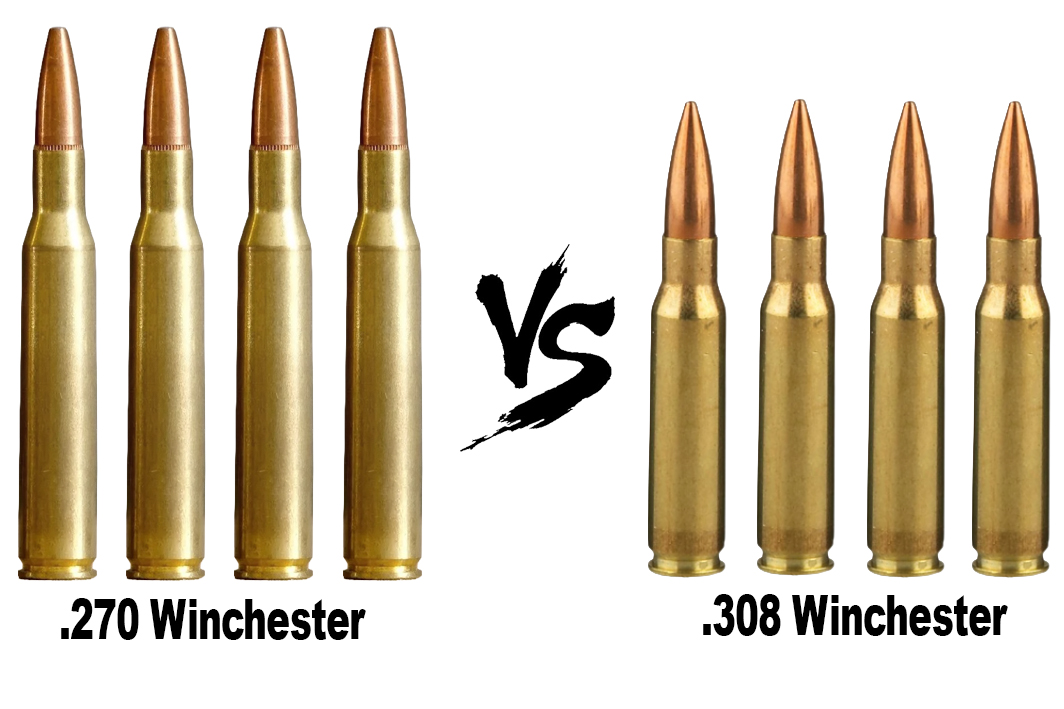
Whether 270 Winchester or 308 is the higher-pressure cartridge depends on which pressure test you read, because the two methods disagree.
Last updated: October 6, 2026 · Originally published September 9, 2026
SAAMI rates the .270 Winchester higher than the .308 — 65,000 psi against 62,000. Measure the same two cartridges the older way, with a copper crusher, and both come out at exactly 52,000. Two measuring systems, two different answers, and neither one is wrong.
What I want you to walk away with
- Transducer pressure: .270 Win 65,000 psi, .308 Win 62,000 psi. Copper crusher: 52,000 CUP for both, identical.
- Same .473-inch head diameter and the same extractor groove — SAAMI’s gauge table gives the .270 the same headspace figures as the .30-06 and the 25-06.
- The .270’s case is half an inch longer: 2.540 against 2.015 inches. Its cartridges need a longer action.
- Twist differs and it matters: 1 in 10 for the .270, 1 in 12 for the .308.
- Matched loads — Federal’s Terminal Ascent in both — start 2,718 against 2,627 ft-lb, nearly level. By 500 yards the .270 is 13 inches flatter.
- No maker publishes a recoil figure for either cartridge. I checked seven.

Here’s how I read this chart
Every number in this table is a published figure, copied from the source named underneath it — none of it is my own measurement. Read across a row to compare one entry, and down a column to compare them all on the same measure.
The specifications, side by side
| Specification | .270 Winchester | .308 Winchester |
|---|---|---|
| Bullet diameter | .278 in | .309 in |
| Case length | 2.540 in | 2.015 in |
| Cartridge overall length | 3.065 – 3.340 in | 2.490 – 2.810 in |
| Head diameter | .473 in — identical for both | |
| Extractor groove diameter | .409 in — identical for both | |
| Shoulder angle | 17° 30′ | 20° |
| Chamber headspace | 2.0487 – 2.0587 in | 1.6300 – 1.6400 in |
| Bore / groove diameter | .270 / .277 in | .300 / .308 in |
| Minimum bore and groove area | .0596 in² | .0736 in² |
| Twist | 1 in 10 in | 1 in 12 in |
| Maximum average pressure, transducer | 65,000 psi | 62,000 psi |
| Maximum average pressure, crusher | 52,000 CUP — identical for both | |
| Proof, minimum / maximum average | 87,000 / 93,000 psi | 83,000 / 89,000 psi |
| Standard test bullet and velocity | 150 gr at 2,950 fps | 150 gr at 2,900 fps |
| Test barrel | 24.000 in — identical for both | |
Three things that comparison usually misses. The head is the same size. Identical .473-inch head, identical .409-inch extractor groove, and the same headspace gauge figures the standard gives the .30-06 — these are the same case family, worked in two directions.
The pressure difference is a measuring-system artifact as much as a real one. Under the copper crusher method the two cartridges are rated identically at 52,000 CUP. Under the modern piezoelectric transducer, the .270 comes out 3,000 psi higher. Crusher and transducer figures are not convertible into one another — SAAMI publishes both because the industry moved from one to the other, not because they measure the same thing on different scales.
The .308 has more bore area. .0736 square inches against .0596, about 23 per cent more, which is why it makes comparable energy at lower velocity.

Quick answers
Which shoots flatter?
The .270, and by a consistent margin. Federal’s Terminal Ascent in both, zeroed at 200 yards, drops 38.0 inches at 500 in .270 and 51.2 inches in .308. That is 13 inches — the single clearest published difference between them.
Which hits harder?
At the muzzle they are within 4 per cent of each other on every matched pair we found. Federal Terminal Ascent: 2,718 ft-lb for the .270 against 2,627 for the .308. Hornady Precision Hunter: 2,840 against 2,671. Remington Core-Lokt 150-grain: 2,705 against 2,648. Downrange the .270 pulls ahead because it starts faster, but at ordinary hunting distances the difference is small.
Which kicks more?
Nobody publishes an answer. I checked Federal, Hornady, Barnes, Remington, Winchester, Ruger and SAAMI. Hornady’s Custom Lite line advertises “significant recoil reduction over standard loads” and attaches no number to it; SAAMI publishes a recoil formula and no cartridge values. Any recoil table you find for these two is somebody’s calculation, not a maker’s measurement.
Why does the .308 have more ammunition choice?
Bullet diameter. The .308’s .308-inch bullet is shared with the .30-06, .30-30, .300 Blackout, .300 Winchester Magnum and more, so bullet makers develop for it heavily. The .270’s .277-inch bullet has a much shorter list of cartridges behind it. That shows in the catalogs: in Barnes’s master ballistics chart the .308 Winchester has six listed loads to the .270’s five, and across Hornady and Federal the .308 consistently offers more weights.
Does the .270 need a bigger rifle?
A longer action, yes. Its cartridges run 3.065 to 3.340 inches overall against the .308’s 2.490 to 2.810 — more than half an inch. That is why the .308 fits short-action rifles and AR-10-pattern rifles and the .270 does not.
The comparison that is actually like-for-like
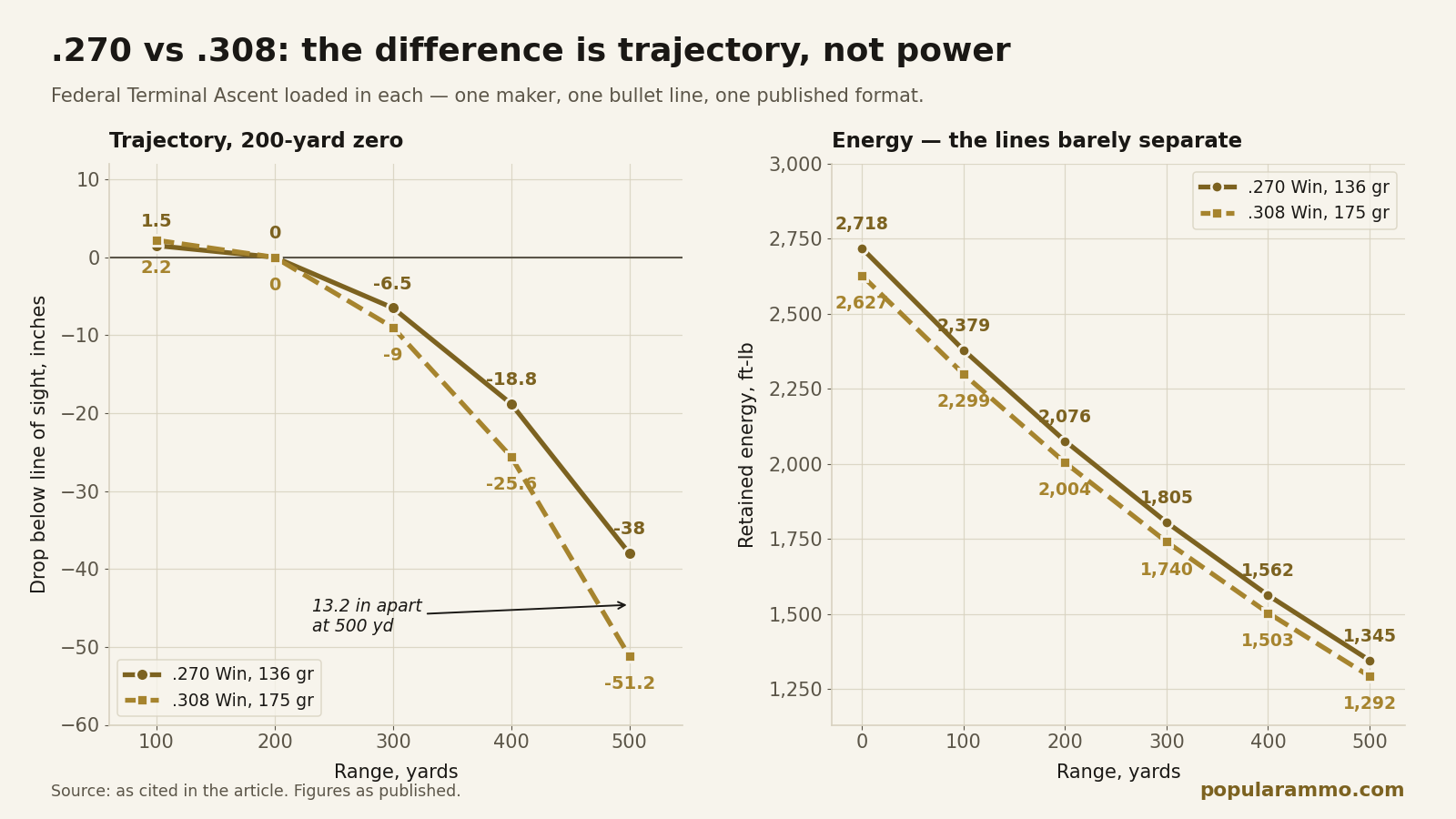
Here’s how I read this chart
Both panels follow one matched pair — Federal’s Terminal Ascent bullet loaded in each cartridge — because comparing one maker’s product line to itself is the only way to hold the testing method constant. On the left, how far each bullet falls below the line of sight at each distance with a 200-yard zero: further down the chart means more drop, and the .270’s line stays higher. On the right, how much energy each still carries. Notice they begin almost level and separate slowly — the .270’s real advantage is trajectory, not power.
| Federal Terminal Ascent | Muzzle | 100 yd | 200 yd | 300 yd | 400 yd | 500 yd |
|---|---|---|---|---|---|---|
| .270 Win 136 gr, velocity | 3,000 | 2,807 | 2,622 | 2,445 | 2,274 | 2,111 |
| .270 Win 136 gr, energy | 2,718 | 2,379 | 2,076 | 1,805 | 1,562 | 1,345 |
| .270 Win 136 gr, drop | — | 1.5 | 0 | -6.5 | -18.8 | -38.0 |
| .308 Win 175 gr, velocity | 2,600 | 2,432 | 2,271 | 2,116 | 1,967 | 1,824 |
| .308 Win 175 gr, energy | 2,627 | 2,299 | 2,004 | 1,740 | 1,503 | 1,292 |
| .308 Win 175 gr, drop | — | 2.2 | 0 | -9.0 | -25.6 | -51.2 |
| .270 wind drift, 10 mph | 0 | 0.6 | 2.5 | 5.7 | 10.5 | 17.1 |
| .308 wind drift, 10 mph | 0 | 0.6 | 2.8 | 6.7 | 12.1 | 19.6 |
Same bullet technology, same company, same published format. The energy rows nearly overlap the whole way — 91 foot-pounds apart at the muzzle, 53 apart at 500 yards. The drop rows do not: 2.5 inches at 300, 6.8 at 400, 13.2 at 500.
That is the entire argument. The .270 does not hit harder; it arrives sooner and lower, and it drifts about 2.5 inches less in a 10 mph crosswind at 500 yards. For a shot inside 250 yards neither difference is likely to change an outcome. Past 350 it starts to matter.
Matched loads across five makers
One pairing could be a coincidence of bullet selection. Five is a pattern.
| Bullet line | .270 Win | Velocity | Energy | .308 Win | Velocity | Energy |
|---|---|---|---|---|---|---|
| Federal Terminal Ascent | 136 gr | 3,000 | 2,718 | 175 gr | 2,600 | 2,627 |
| Federal Fusion | 150 gr | 2,850 | 2,705 | 150 gr | 2,820 | 2,648 |
| Hornady Precision Hunter | 145 gr ELD-X | 2,970 | 2,840 | 178 gr ELD-X | 2,600 | 2,671 |
| Hornady Superformance | 130 gr SST | 3,200 | 2,956 | 150 gr SST | 3,000 | 2,997 |
| Remington Core-Lokt | 150 gr | 2,850 | 2,705 | 150 gr | 2,820 | 2,648 |
| Barnes VOR-TX | 130 gr TTSX | 3,140 | — | 150 gr TTSX | 2,900 | — |
Every row lands in the same place: the .270 runs 150 to 400 fps faster with a bullet 20 to 40 grains lighter, and the energy comes out within a few per cent. The one row where the .308 wins outright is Hornady’s Superformance, where the 150-grain .308 SST at 3,000 fps edges the 130-grain .270 SST — and that is a lighter-for-caliber .308 bullet against a lighter-for-caliber .270 bullet, which is exactly the pairing that flatters the bigger bore.
One practical note from the same data: Barnes flags its 168-grain .308 TTSX as requiring “a 1:11″ barrel twist rate or faster.” SAAMI’s .308 standard is 1 in 12. If you are buying long, heavy .308 bullets, the twist your rifle actually has is a real constraint, and the .270’s standard 1 in 10 gives it more headroom for its caliber.
Where the .308 wins on things that are not ballistics
Action length. The .308’s 2.810-inch maximum overall length is what puts it in short-action bolt rifles and AR-10-pattern semi-automatics. The .270 at 3.340 inches needs a long action, which means a slightly longer, heavier rifle for the same barrel.
Bullet selection. Shared .308-inch bullet diameter across a large family of cartridges means more designs at more weights.
Published data. A small thing that matters when you are comparing: the .308 gets more published loads, so a like-for-like pairing is easier to find. It is also the cartridge with the military parallel — see 308 vs 7.62×51 for why that parallel is more complicated than it looks.
Where the .270 wins is narrower and clearer: trajectory, wind, and a faster standard twist for its caliber.
What nobody publishes
- Recoil — for either cartridge, from any maker. Confirmed absent at Federal, Hornady, Barnes, Remington and Winchester, and in Federal’s and Barnes’s master ballistics charts.
- Winchester Deer Season XP ballistics — both the .270 and .308 pages state, verbatim, “There is no ballistics data available at this time.”
- Federal’s and Remington’s test barrel length on most product pages. Hornady states 24 inches on every one; Barnes states it in a dedicated column.
- Terminal performance figures — no expansion diameter, penetration depth or gelatin result on any product page for either cartridge.
- Equivalent names — neither .270 Winchester nor .308 Winchester has an entry in SAAMI’s equivalent-names table, so neither has an officially recognized alternate designation.
Where to go next
6.5 Creedmoor vs 308 covers the cartridge making the same high-ballistic-coefficient argument in a short action, 308 vs 7.62×51 covers the military question, and my caliber comparison chart puts both beside everything else. Deer hunters will find field coverage at Popular Outdoorsman.
To see the .270 Winchester and the .308 Winchester beside 24 other rifle cartridges at true scale, with SAAMI case lengths and bullet diameters, use my rifle caliber chart.
Sources
- ANSI/SAAMI Z299.4-2025 centerfire rifle standard — .270 Winchester and .308 Winchester cartridge and chamber drawings, velocity and pressure tables, proof tables, headspace gauge tables and test barrel drawings
- SAAMI, Generally Accepted Cartridge and Chamber Names, 8 October 2021; SAAMI recoil formulae page
- Federal Terminal Ascent items P270TA1 and P308TA1, and Fusion items F270FS1, F270FS2, F308FS1, F308FS2 and F308FS3
- Hornady Precision Hunter items 80536 and 80994; Superformance items 80543, 80933, 80983 and 80772; Outfitter items 805294 and 809864; Custom Lite line page
- Remington Core-Lokt items 27808, 27810, 27842 and 27844, and Core-Lokt Tipped items 29019 and 29039
- Barnes master centerfire rifle ballistics chart; Winchester Deer Season XP items X270DS and X308DS; Ruger American Rifle Generation II specification sheets


Ammunition reference desk
Three charts readers come back to: what a round costs today, what a cartridge name really measures, and what shipping and tax add.
| .22 LR | 6.59¢ |
| 9mm Luger | 26.98¢ |
| 5.56 NATO | 44.95¢ |
| .270 Win | .278 in |
| .30-30 Win | .309 in |
| .308 Win | .309 in |
| Case price | $269.80 |
| Shipping and tax | +$18.89 |
| Per round | 28.87¢ |
Reader Favorites