30-30 Ammo: Ballistics, Bullets and Lever Guns
Everything about 30-30 ammo follows from the tubular magazine, where cartridges sit nose to primer, which is why the bullets are flat-nosed.
Last updated: October 6, 2026 · Originally published September 11, 2026
Every design decision in modern 30-30 ammo traces back to one constraint: in a lever gun’s tubular magazine, cartridges sit nose to primer. That is why .30-30 bullets were flat-nosed for a century, and why the fastest-shooting loads on the shelf today have soft rubbery tips instead of hard points.
What I want you to walk away with
- SAAMI sets a maximum average pressure of 42,000 psi by transducer, or 38,000 CUP by copper crusher.
- SAAMI publishes two different twist rates for this cartridge — 1-in-12 marked optional on the chamber drawing, and 1-in-10 on its own mandatory test barrel.
- Elastomer-tipped loads add real velocity: Hornady’s 160-grain FTX publishes 2,400 fps and holds 1,700 fps at 300 yards, where a 150-grain round nose is down to 1,276 fps.
- Only Hornady publishes a test barrel length (24 inches). Federal, Winchester, Remington and Barnes do not.
- Several published tables across different brands are numerically identical — they are shared corporate ballistics, not independent measurements. Do not read them as confirmation of each other.
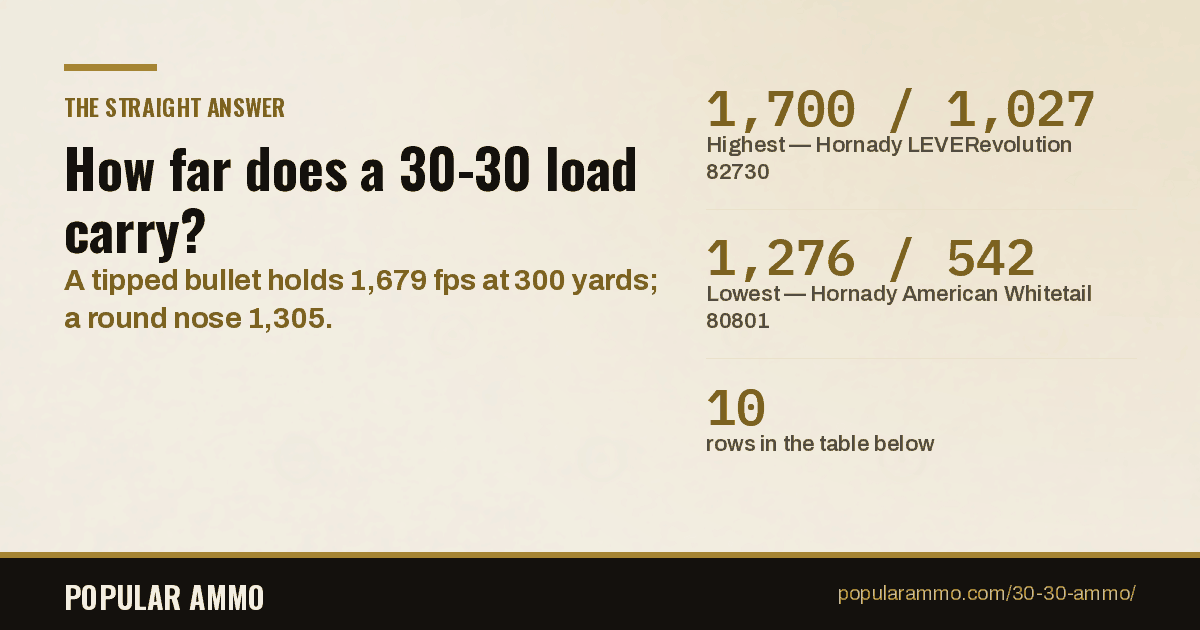
Here’s how I read this chart
Every number in this table is a published figure, copied from the source named underneath it — none of it is my own measurement. The card shows the top rows; the complete table is further down this page. Read across a row to compare one entry, and down a column to compare them all on the same measure.
What is 30-30 ammo, and why is it built the way it is?
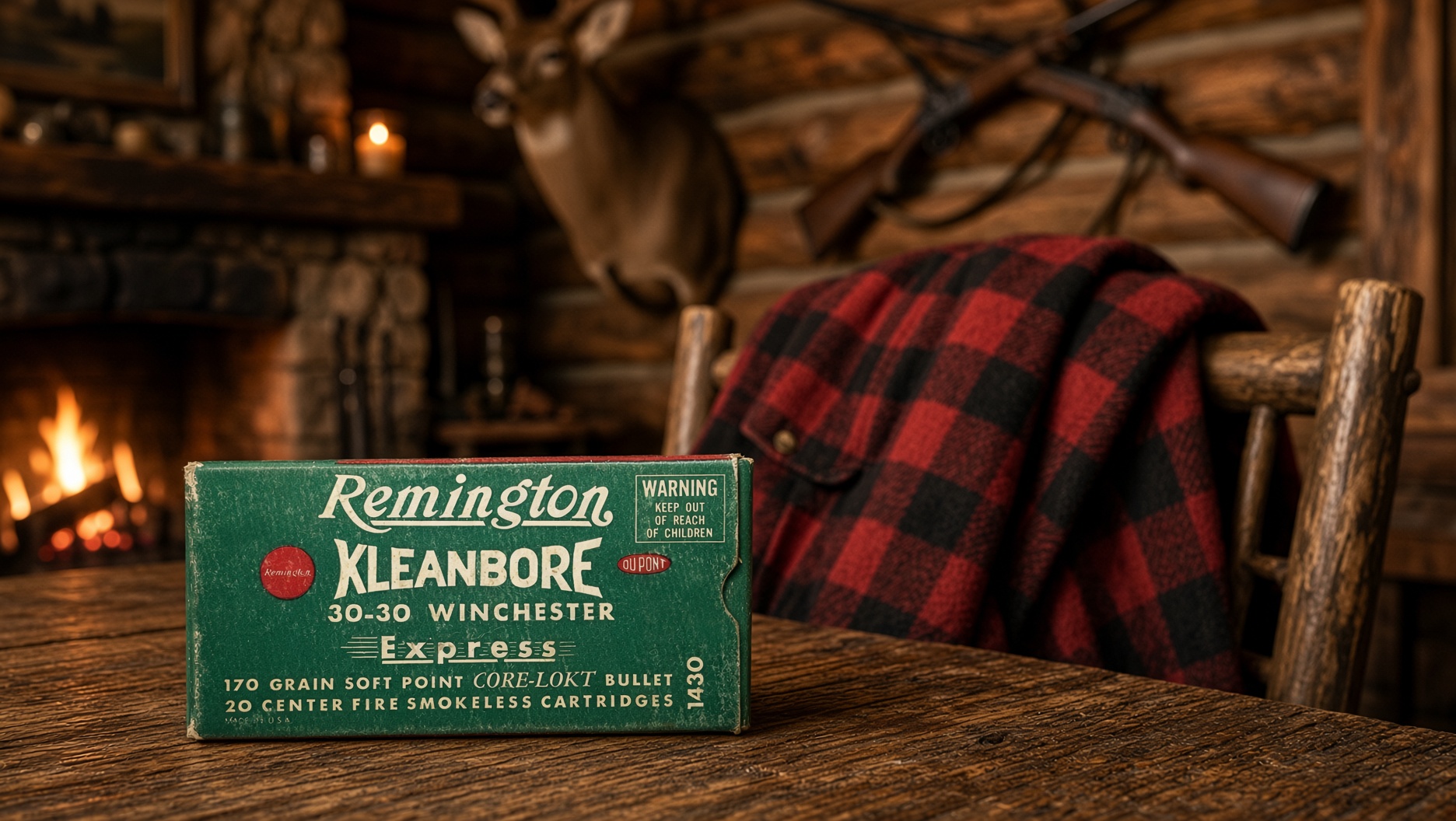
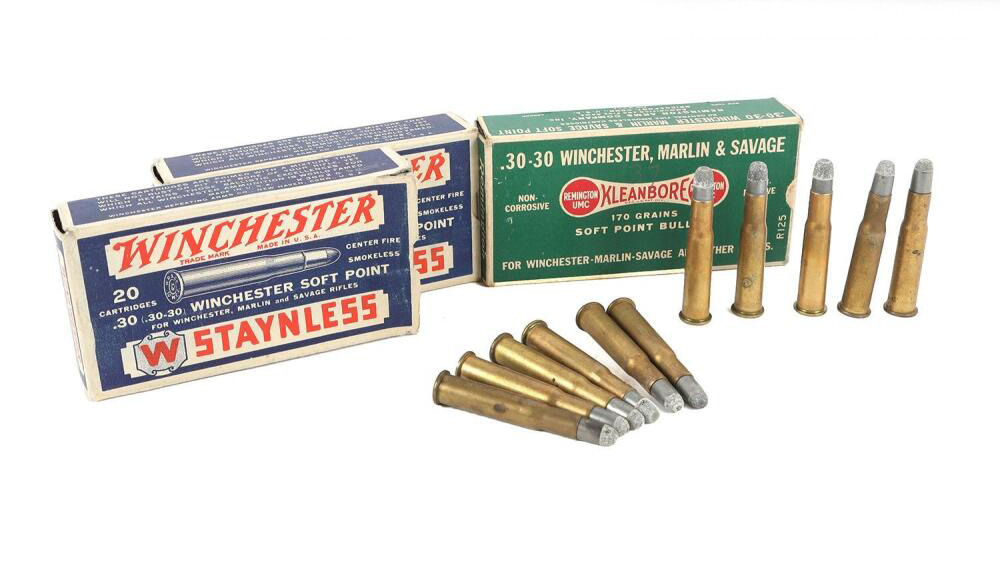
Winchester’s own product copy dates it: “The 30-30 Winchester, introduced in 1895, was the first American sporting round designed for smokeless powder – redefining performance with greater range, accuracy and dependability.” Remington’s caliber page describes it as “an iconic cartridge known for residing in the saddles of western frontiersmen… Loaded with a 30-caliber bullet in a rimmed case, this brush-bustin’ cartridge is popular in lever-action rifles.”
The rimmed case and the lever gun are the whole story. Rounds stack end to end in a tube under the barrel, and every bullet tip rests against the primer of the round in front of it. That geometry has shaped what .30-30 bullets are allowed to look like ever since.

Quick answers
Why is most 30-30 ammo flat-nosed?
Because of the tubular magazine. Manufacturers address it positively rather than describing the hazard: Hornady’s line copy says its Flex Tip bullets are “Safe to use in tubular magazines,” and that the design provides “shock-absorbing safety in tubular magazines.” No maker in this set publishes a description of the underlying risk — they describe the solution.
How much does a tipped bullet actually gain?
Hornady publishes “velocity increases of up to 250 fps over traditional flat point loads” and “up to 40% more energy than traditional flat point bullets.” On its own tables the 160-grain FTX holds 1,700 fps at 300 yards against 1,276 fps for its 150-grain round nose.
Do I need a new magazine follower for tipped 30-30 ammo?
Possibly. Hornady publishes this note directly: “The innovative LEVERevolution® FTX® and MonoFlex® bullet designs may require a newer magazine follower to provide best possible functioning of the last round out of the magazine in certain guns.”
How far will 30-30 ammo shoot?
No manufacturer in this set publishes a numeric effective range. What they publish are trajectories: Hornady’s 160-grain FTX at a 200-yard zero is 3 inches high at 100 and 12.5 inches low at 300. Winchester’s 170-grain Power-Point at a 200-yard zero is 18.1 inches low at 300 and 55.5 inches low at 400.
Is 30-30 ammo enough for elk?
Makers differ, and I report the difference rather than settling it. Buffalo Bore designed a 190-grain load specifically “so that the person who owns a 30-30 can now reliably kill elk or moose sized game,” and on another load writes, “While we feel the 30-30 is marginal for big bull elk, this is the load to use if you choose to pursue elk with a 30-30.” Federal, Remington and Winchester simply tag their loads Big Game or Deer.
What does SAAMI specify for 30-30 ammo?
| Specification | Value |
|---|---|
| Bullet diameter | .3090 − .0030 in |
| Case length | 2.0395 − .0200 in |
| Cartridge overall length | 2.450 in min – 2.550 in max |
| Rim diameter / thickness | .506 − .010 in / .063 − .010 in |
| Shoulder angle | 15° 39′ |
| Maximum average pressure, transducer | 42,000 psi |
| Maximum average pressure, crusher | 38,000 CUP |
| Twist, chamber drawing | 1 turn in 12 in, right hand — marked OPTIONAL |
| Twist, SAAMI test barrel | 1 turn in 10 in, right hand |
| Test barrel | 24.000 ± .010 in, .300 bore / .308 groove |
The two twist figures are both in the standard and I quote both rather than reconciling them: the chamber drawing offers 1-in-12 as optional guidance for a barrel maker, while SAAMI’s own velocity-and-pressure test barrel is cut 1-in-10. No ammunition manufacturer in this set publishes a recommended twist at all.
The tubular magazine, and what changed
For most of the cartridge’s life the answer to the tube-magazine problem was simply a blunt bullet, which costs velocity at distance. The current answer is a bullet with a compressible polymer or elastomer tip that behaves like a flat point in the magazine and like a pointed bullet in the air.
Hornady’s component page for the 160-grain FTX puts the claim plainly: “Lever gun enthusiasts can now harness the accuracy, power and long-range performance of a tipped bullet that’s safe to load in tubular magazines,” and, on the mechanism, “Upon impact, the soft tip compresses into the bullet, initiating immediate expansion across a wide range of velocities. Safe to shoot in tubular magazines as well as any other firearm.”
Worth noting for anyone comparing brands: Winchester’s Deer Season XP and Ballistic Silvertip .30-30 loads and Remington’s Core-Lokt Tipped Lever Gun all use tipped bullets, and none of those three product pages contains any tubular-magazine wording at all. Only Hornady and, in lever-gun terms, Federal’s HammerDown line address the magazine question in their published copy. Federal states its HammerDown “Functions flawlessly in side gate loading and tubular magazines” and was “Designed in partnership with Henry Repeating Arms.”
30-30 ammo ballistics: what the makers publish
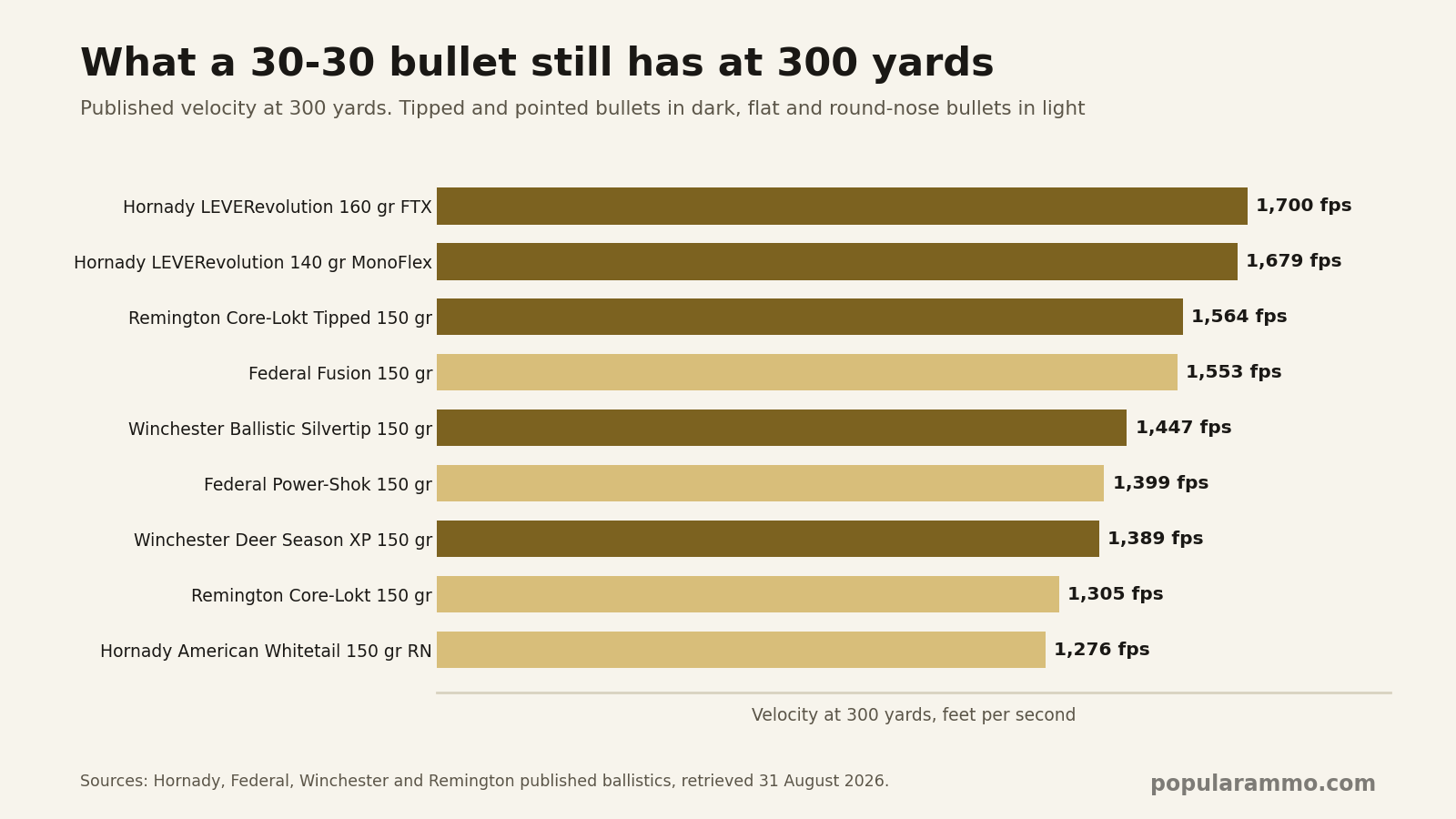
Here’s how I read this chart
Every bullet slows down as it flies. This chart shows how fast each one is still going 300 yards out — further down the bar chart means it has lost more speed. Dark bars are bullets with pointed or soft rubbery tips; pale bars are the traditional flat and round-nosed shapes. The pattern is the whole argument for tipped ammunition in a lever gun: a more aerodynamic nose keeps more of the speed it started with.
| Load | Gr | Bullet | Muzzle | 100 yd | 200 yd | 300 yd | BC |
|---|---|---|---|---|---|---|---|
| Hornady LEVERevolution 82731 | 140 | MonoFlex, tipped | 2,465 / 1,889 | 2,183 / 1,481 | 1,920 / 1,146 | 1,679 / 876 | — |
| Hornady LEVERevolution 82730 | 160 | FTX, tipped | 2,400 / 2,046 | 2,151 / 1,643 | 1,917 / 1,305 | 1,700 / 1,027 | — |
| Remington Core-Lokt Tipped R21428 | 150 | Tipped | 2,390 / 1,902 | 2,090 / 1,455 | 1,812 / 1,094 | 1,564 / 814 | .272 |
| Federal Fusion F3030FS1 | 150 | Fusion soft point | 2,390 / 1,902 | 2,086 / 1,449 | 1,805 / 1,085 | 1,553 / 803 | .268 |
| Federal HammerDown LG30301 | 150 | Bonded soft point | 2,390 / 1,902 | 2,086 / 1,449 | 1,805 / 1,085 | 1,553 / 803 | .268 |
| Winchester Ballistic Silvertip SBST3030 | 150 | Polymer tip | 2,390 / 1,902 | 2,040 / 1,386 | 1,723 / 989 | 1,447 / 697 | .232 |
| Winchester Deer Season XP X3030DS | 150 | Extreme Point, polymer tip | 2,390 / 1,902 | 2,014 / 1,351 | 1,677 / 936 | 1,389 / 642 | .215 |
| Federal Power-Shok 3030A | 150 | Flat-nose soft point | 2,390 / 1,902 | 2,019 / 1,358 | 1,686 / 947 | 1,399 / 652 | .218 |
| Hornady American Whitetail 80801 | 150 | Round nose InterLock | 2,390 / 1,902 | 1,959 / 1,278 | 1,581 / 832 | 1,276 / 542 | — |
| Remington Core-Lokt 27818 | 150 | Flat-nose soft point | 2,390 / 1,902 | 1,974 / 1,297 | 1,607 / 860 | 1,305 / 567 | .193 |
| Barnes VOR-TX 21535 | 150 | TSX flat nose, copper | 2,335 / 1,816 | 1,905 / 1,209 | 1,532 / 782 | not published | .184 |
| Federal Fusion F3030FS2 | 170 | Fusion soft point | 2,200 / 1,827 | 1,950 / 1,435 | 1,719 / 1,115 | 1,510 / 860 | .313 |
| Federal Power-Shok 3030B | 170 | Flat-nose soft point | 2,200 / 1,827 | 1,894 / 1,354 | 1,619 / 990 | 1,380 / 719 | .254 |
| Remington Core-Lokt 27820 | 170 | Flat-nose soft point | 2,200 / 1,827 | 1,894 / 1,354 | 1,619 / 990 | 1,380 / 719 | .254 |
| Winchester Power-Point X30303 | 170 | Flat-nose | 2,200 / 1,827 | 1,879 / 1,332 | 1,591 / 955 | 1,346 / 683 | .241 |
Read the 300-yard column top to bottom and the case for tipped bullets makes itself: 1,700 fps and 1,027 ft-lb for the 160-grain FTX, against 1,276 fps and 542 ft-lb for a 150-grain round nose leaving the muzzle at the same 2,390 fps. Same cartridge, same starting speed, nearly double the retained energy at distance.
One thing to be careful with. Federal’s 170-grain Power-Shok and Remington’s 170-grain Core-Lokt publish byte-identical figures at every distance, and Federal’s Fusion 150 and HammerDown 150 publish identical curves to each other despite using different bullets of different lengths. These are shared corporate ballistics tables rather than independent measurements, and two matching tables from two brands are not two confirmations of the same number.
What real rifles produce, according to Buffalo Bore
Buffalo Bore declines the test-barrel convention entirely and says why: “We believe the industry-wide use of extra long laboratory test barrels gives unrealistic high velocities that you’ll never realize in hunting rifles. So, we give you real world velocities from real world rifles.”
Its 190-grain Heavy 30-30 publishes 2,100 fps nominal and 1,860 ft-lb, with these measured figures: 2,172 fps from a 24-inch Marlin 336A, 2,146 and 2,116 fps from 20-inch Winchester 94s, 2,075, 2,071 and 2,061 fps from other 20-inch guns, 2,020 fps from a 16-inch Winchester 94AE Trapper, and 1,983 fps from a 26-inch Savage 99. Its lead-free 150-grain Barnes TSX load publishes 2,271, 2,247 and 2,198 fps from 20-inch and 16-inch Winchester 1894s.
Buffalo Bore also states that its 150-grain load “is safe to use in ANY/ALL 30-30 chambered firearms that are in normal operating condition—no exceptions,” which is the opposite of the tiered situation in .45-70 and worth knowing if you are moving between the two cartridges.
What nobody publishes about 30-30 ammo
- Test barrel length — Hornady alone publishes it, at 24 inches. Federal, Winchester, Remington and Barnes do not.
- Ballistic coefficient from Hornady — not published on either .30-30 ammunition page or on the FTX and MonoFlex component pages. Every other maker publishes one.
- Sight height — stated by Federal and Remington only, at 1.5 inches above the bore line. Hornady, Winchester, Barnes and Buffalo Bore do not state it, which makes their trajectory figures harder to compare.
- 300-yard data — missing from Barnes, whose table stops at 200 yards, and from Winchester’s American Lever Range load, which publishes muzzle figures only.
- A numeric effective range — published by nobody.
- Wind drift — Remington is the exception here and publishes it: 2.2, 9.9 and 24.3 inches at 100, 200 and 300 yards in a 10 mph crosswind for its 150-grain load. No other maker in the set publishes any.
Choosing 30-30 ammo for a lever gun
Three questions, in order. Does your rifle have a tubular magazine — almost certainly yes, in which case a pointed hard-tipped bullet is off the table and a flat point or an elastomer-tipped bullet is what you are choosing between. Do you shoot inside 150 yards or past it — inside, the difference between bullet shapes barely registers; past it, the tipped loads retain markedly more speed and energy. And is your quarry deer-sized or larger — the mainstream loads are tagged for deer and big game, and the makers who built heavier loads for larger animals say so explicitly on the product page.
What no one can tell you from a catalog is what your particular rifle likes. Twist rates vary, and SAAMI itself publishes two different figures for this cartridge.
Where to go next
My 45-70 ammo piece covers the heavier classic lever cartridge, and its three pressure tiers, in the same detail as this page. My 8.6 Blackout page covers the modern attempt at the same short-range, heavy-bullet job. For how cartridge names map to actual bullet diameters, see the rifle caliber chart, which draws the .30-30 Winchester beside 25 other cartridges at true scale. Deer hunters will find related field coverage at Popular Outdoorsman.
Sources
- ANSI/SAAMI Z299.4 centerfire rifle standard — .30-30 Winchester cartridge and chamber drawing, velocity and pressure tables, and test barrel specification
- Hornady product pages 82730, 82731 and 80801; LEVERevolution line page; component bullet pages 30395 and 30310
- Federal product pages: 3030A, 3030B, F3030FS1, F3030FS2, LG30301
- Winchester product pages and published ballistics records for X30303, X3030DS, SBST3030, X30306, X30301, W3030AL and X3030250
- Remington product pages: 27818, 27820, R21428, and the .30-30 Win caliber page
- Barnes VOR-TX 21535 product page and published ballistics table
- Buffalo Bore product pages: Heavy 30-30 190 gr (item 28A) and Buffalo-Barnes Lead-Free 150 gr (item 28B)
How the .30-30 compares with the .45-70 →


Ammunition reference desk
Three charts readers come back to: what a round costs today, what a cartridge name really measures, and what shipping and tax add.
| .22 LR | 6.59¢ |
| 9mm Luger | 26.98¢ |
| 5.56 NATO | 44.95¢ |
| .270 Win | .278 in |
| .30-30 Win | .309 in |
| .308 Win | .309 in |
| Case price | $269.80 |
| Shipping and tax | +$18.89 |
| Per round | 28.87¢ |
Reader Favorites