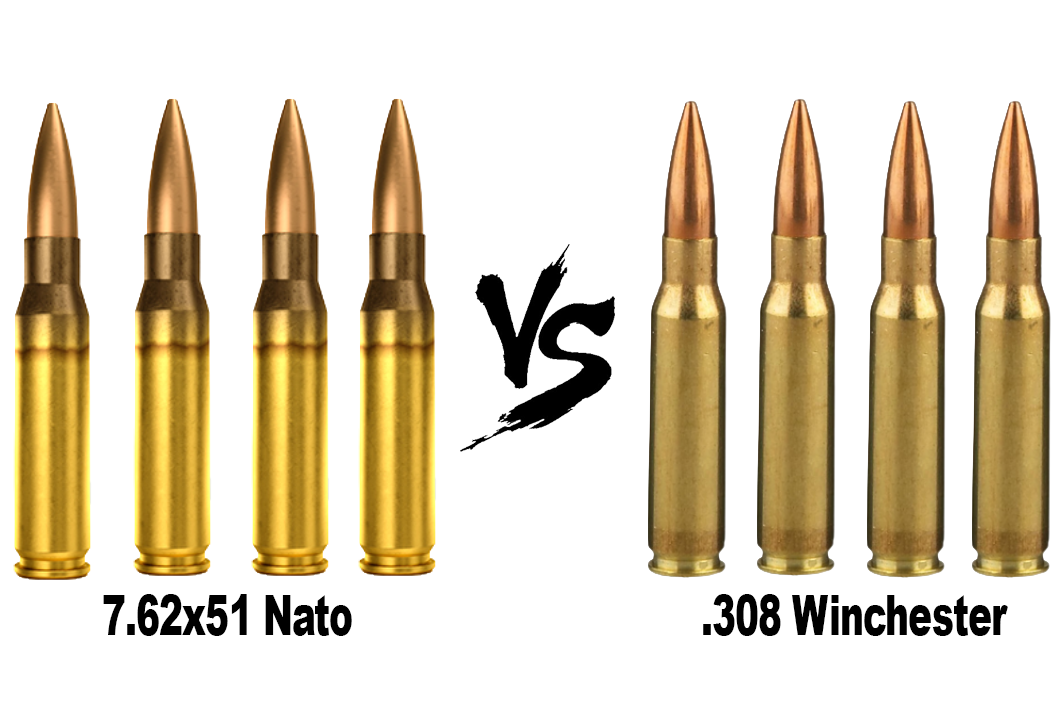
308 vs 7.62×51: There Is No SAAMI Standard for the NATO Round
There is no SAAMI standard for 7.62×51 NATO. 308 Winchester has one, which is why the two are not simply interchangeable on paper.
Last updated: October 6, 2026 · Originally published September 9, 2026
There is no SAAMI standard for 7.62x51mm NATO. The word “NATO” does not appear once in the 400 pages of the centerfire rifle standard. No drawing, no pressure limit, no proof figure, no test barrel. So every article telling you “7.62 NATO runs at X psi” is quoting something other than SAAMI — and usually not saying what.
What I want you to walk away with
- 7.62x51mm NATO appears zero times in ANSI/SAAMI Z299.4. The .308 Winchester is standardized; the military cartridge is not.
- The military specification that does exist, MIL-C-46931F, limits the M80 round to 50,000 psi average by copper crush — lower than the .308 Winchester’s 52,000 CUP.
- That is not the same as saying the military round is milder. The two documents use different measuring methods, and figures from different methods are not comparable.
- SAAMI’s own published passage on these two cartridges names headspace, not pressure, as the problem — and locates it in surplus rifles, not in the ammunition.
- SAAMI publishes a detailed FAQ on .223 versus 5.56. It publishes no FAQ at all on .308 versus 7.62×51.
- Neither cartridge appears anywhere on SAAMI’s interchangeability list.

Here’s how I read this chart
Every number in this table is a published figure, copied from the source named underneath it — none of it is my own measurement. The card shows the top rows; the complete table is further down this page. Read across a row to compare one entry, and down a column to compare them all on the same measure.
What each document actually says
This is the whole comparison, laid out by source rather than by cartridge — because the two cartridges are not described by the same kind of document, and that is the point.
| Measure | .308 Winchester | 7.62x51mm NATO M80 |
|---|---|---|
| ANSI/SAAMI Z299.4-2025 | MIL-C-46931F(AR), 1991 | |
| Kind of document | Voluntary industry standard | Military detail specification |
| Copper crusher limit | 52,000 CUP maximum average | 50,000 psi average; 55,000 psi for any individual cartridge |
| Transducer / EPVAT limit | 62,000 psi maximum average | 365 MPa (52,940 psi) average; 400 MPa (58,016 psi) maximum |
| Proof pressure | 83,000 – 89,000 psi | Not specified in the document |
| Chamber headspace | 1.6300 – 1.6400 in | Not in the specification — delegated to Drawing 10521998 |
| Case and chamber dimensions | Full drawing published | Not in the specification — delegated to Drawing 10521998 |
| Velocity requirement | 150 gr at 2,900 fps, 15 ft from muzzle | 2,750 ± 30 fps at 78 ft from muzzle |
| Test barrel | 24.000 in, 4 grooves, 1 in 12 twist | Not specified; “standard accuracy test weapons” |
| Accuracy requirement | None | Mean radius ≤ 5.0 in at 600 yd (cartons or clips) |
| Barrel life requirement | None | ≥ 5,000 rounds, averaged over three barrels |
| Action time requirement | None | ≤ 4 milliseconds |
Read the right-hand column carefully. The military specification is a procurement document. It tells a contractor what the ammunition must do — how fast, how accurately, how quickly, for how many rounds — and it hands the dimensions off to a separate engineering drawing. It is not the same kind of document as a SAAMI standard and it does not contain the same kind of information.

Quick answers
Is 7.62×51 NATO higher pressure than .308 Winchester?
You cannot answer that from the published figures, and anyone who does is comparing across measuring methods. On the copper crusher method — the only method both documents use — the military round is limited to a 50,000 psi average and the .308 Winchester to 52,000 CUP. On the modern method the .308 is rated at 62,000 psi transducer and the military round at 365 MPa, about 52,940 psi, by the EPVAT procedure. Those are different tests measuring at different points with different equipment. The honest answer is that no published, like-for-like pressure comparison exists.
Then what is the actual risk?
SAAMI names it, and it is not the ammunition. Verbatim: “surplus military firearms may have headspace dimensions that are within acceptable limits to a military standard but would be excessive for a SAAMI commercial cartridge (7.62 x 51mm NATO/308 Winchester is one example).” The concern is a rifle whose chamber is cut to military tolerances, fired with commercial ammunition — not a commercial rifle fired with military ammunition.
Can I shoot 7.62×51 in my .308?
SAAMI’s answer is a general rule rather than a specific one, and it is the same rule it gives for every military cartridge: “only use ammunition manufactured to military standards in firearms that are marked and chambered explicitly to accept that specific military cartridge.” Notably, SAAMI publishes a detailed and specific FAQ on .223 Remington and 5.56 — and none on this pair. The instruction that remains is to check the barrel marking and ask the rifle’s maker.
Do makers treat them as the same?
Some do, for specific products. Springfield Armory lists the M1A’s caliber as “.308 WIN (7.62x51mm NATO)”. Criterion Barrels sells a chamber it describes as an “M118 LR match chamber that is compatible with both 7.62×51 NATO and .308 Win ammunition.” Those are statements about those particular barrels, made by the people who cut them — which is exactly what SAAMI tells you to go and get.
Are they on SAAMI’s interchangeability list?
No. That list runs to about twenty chambers and its wording is “limited to only the following.” Neither .308 Winchester nor 7.62x51mm NATO appears in either column. Nor does .308 Winchester have any entry in SAAMI’s equivalent-names table — which is notable, because that table does list metric military designations where SAAMI considers them equivalent: the .30-06 is listed as 7.62x63mm and the .300 Blackout as 7.62x35mm. SAAMI declines to do that for the .308.
The pressure numbers, and why they will not line up
Here’s how I read this chart
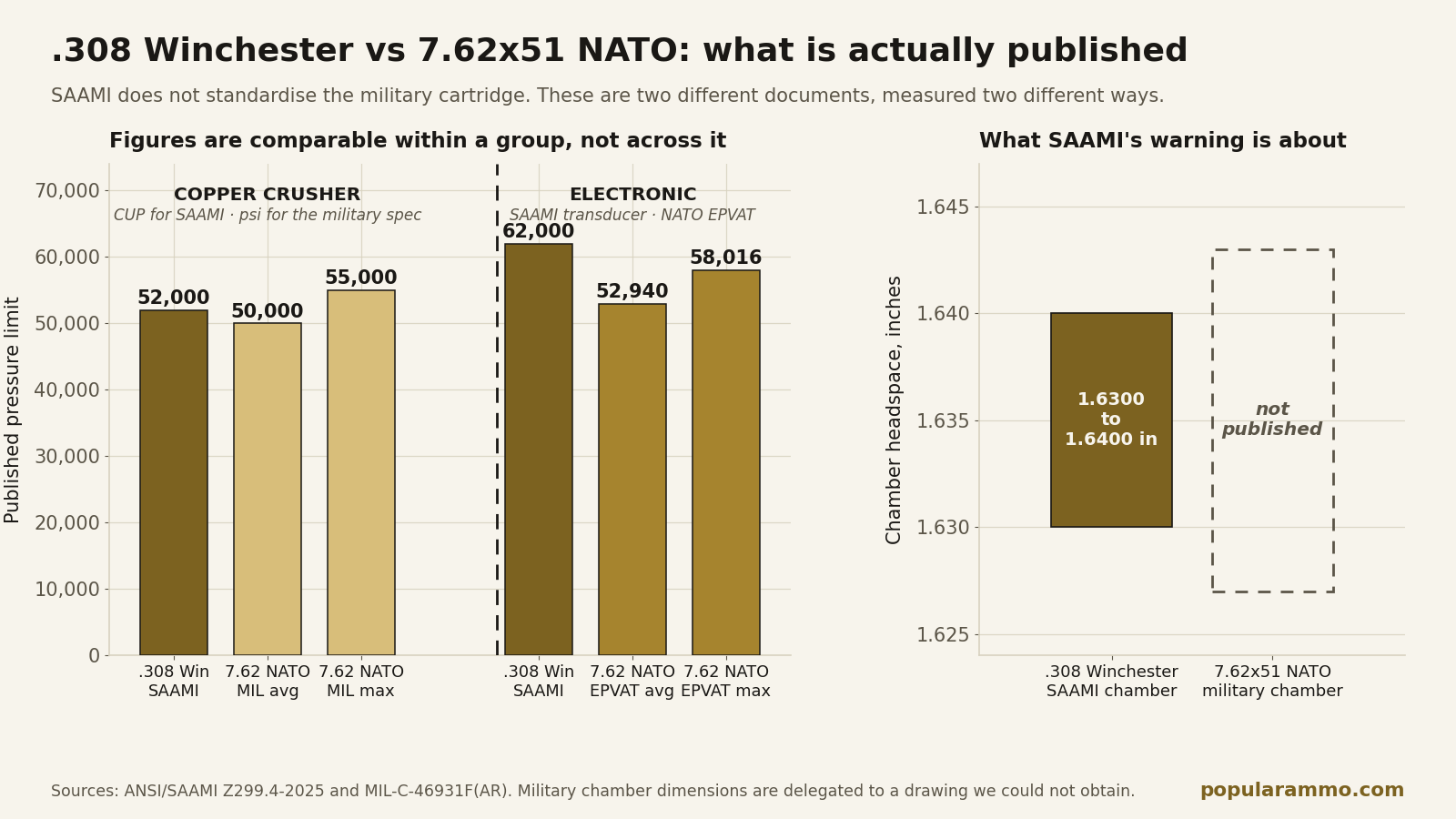
The bars are split into two groups because they were measured two different ways. Within a group the figures are comparable; across the groups they are not, and no published conversion exists between them. On the left, the copper-crusher method — the older technique both documents happen to use, and the only place a direct reading is possible. On the right, the modern electronic methods, which are not the same procedure as each other. The empty space is the honest part of this chart: SAAMI publishes no 7.62×51 figure at all, so there is no bar to draw beside its .308.
Two measurement systems appear in this comparison and they are not interchangeable.
The copper crusher method squeezes a small copper cylinder and reads pressure from how much it deforms. It is the older technique. SAAMI still publishes crusher figures alongside transducer ones for most centerfire rifle cartridges, in units called CUP.
The piezoelectric transducer method reads pressure electrically through the case wall at a specified point along the chamber. It is what SAAMI’s modern figures use, in psi. EPVAT is NATO’s own electronic procedure, and it is again not identical to SAAMI’s.
A CUP figure and a psi figure for the same cartridge are not the same number expressed differently, and there is no published formula for turning one into the other. The .308 Winchester’s own entry demonstrates it: 52,000 CUP and 62,000 psi describe one cartridge, one ceiling, measured two ways.
So when someone tells you 7.62 NATO is “lower pressure at 50,000 against 62,000,” they have taken a crusher figure from a 1991 military document and set it against a transducer figure from a SAAMI standard. The comparison is not wrong so much as meaningless.
SAAMI’s passage, in full
There is exactly one place in SAAMI’s public material where these two cartridges appear together. It is short, and it is worth reading whole rather than in the fragment that usually gets quoted.
Ammunition manufactured to military standards can, depending on the cartridge, have identical or near-identical dimensions to a SAAMI commercial cartridge, like 223 Remington/5.56 x 45mm NATO.
However, ammunition made to military standards can have higher pressure levels than their commercial counterparts, and the firearms designed to fire these military cartridges may have different construction and barrel geometry to handle these higher pressures. Similarly, surplus military firearms may have headspace dimensions that are within acceptable limits to a military standard but would be excessive for a SAAMI commercial cartridge (7.62 x 51mm NATO/308 Winchester is one example).
Therefore, only use ammunition manufactured to military standards in firearms that are marked and chambered explicitly to accept that specific military cartridge.
Failure to do so can result in serious injury or death to the user and/or bystanders, as well as damage to the firearm.
SAAMI, “Commercial vs. Military Standards”, 8 October 2021
Notice the structure. SAAMI raises pressure as a general concern about military ammunition, and gives .223/5.56 as its pressure example. It then says “similarly” and gives 7.62×51/.308 as its headspace example. The two cartridge pairs are cited for two different reasons, and the reason attached to this one is headspace in surplus rifles.
That reframes the usual question. The thing SAAMI is warning about is a rifle built to a military chamber tolerance, not a box of ammunition.
What I could not obtain, and why that matters
Most articles on this subject state a military headspace figure and a military chamber dimension with total confidence. I went looking for the primary documents and could not get them. Here is exactly what is missing.
| Document | What it would tell us | Status |
|---|---|---|
| Drawing 10521998 | The M80 cartridge and chamber dimensions, including any headspace figure | Referenced by MIL-C-46931F but not attached to it; not located on any government or standards host |
| MIL-DTL-46931 | The current successor specification | Listed by standards resellers as “Classified – See Your Contracting Officer”. No public copy. |
| STANAG 4172 and the NATO EPVAT procedure | NATO’s own pressure and dimensional requirements | No publicly fetchable copy located |
| Any military 7.62 field or reject headspace gauge dimension | The number this comparison usually turns on | Not obtained from any primary source |
| A maker statement that its .308 barrels are not rated for 7.62 NATO | The counterexample to the two makers quoted above | Not found on any manufacturer’s own site |
I am publishing that table rather than filling the gaps, because the gaps are the finding. The most-repeated numbers in this comparison — a specific military chamber headspace, a specific military case dimension — trace back to sources I could not verify against a primary document. If you have seen those figures stated confidently elsewhere, it is worth asking what they were cited to.
What I can tell you is what MIL-C-46931F contains, because it is public and I read it. Its full pressure text, verbatim: “The average chamber pressure of the sample cartridges conditioned at 70°F shall not exceed 50,000 pounds per square inch (psi). The average chamber pressure plus three standard deviations of chamber pressure shall not exceed 55,000 psi. The chamber pressure of an individual sample cartridge shall not exceed 55,000 psi.” And by the electronic method: “shall not exceed 365 MegaPascals (MPa) (52,940 psi)… The chamber pressure of an individual sample cartridge shall not exceed 400 MPa (58,016 psi).”
The specification is also, in the Army’s own words as of August 2004, “inactive for new design, however, the document is valid for use.” So it is current, and it is thirty-five years old.
What the .308 Winchester side looks like
For completeness, the commercial cartridge is fully documented, and here is what the standard specifies.
| Specification | .308 Winchester |
|---|---|
| Bullet diameter | .309 in |
| Case length | 2.015 in |
| Cartridge overall length | 2.490 – 2.810 in |
| Head diameter | .473 in |
| Shoulder angle | 20° |
| Chamber headspace | 1.6300 – 1.6400 in |
| Bore / groove diameter | .300 / .308 in |
| Rifling | 4 grooves, 1 in 12 in, right hand, marked optional |
| Maximum average pressure, transducer | 62,000 psi |
| Maximum average pressure, crusher | 52,000 CUP |
| Test barrel | 24.000 in |
That headspace window — 1.6300 to 1.6400 inches, one hundredth of an inch wide — is the figure SAAMI’s warning is implicitly about. What the corresponding military window is, I cannot tell you from a primary source.
What nobody publishes
- Any SAAMI figure of any kind for 7.62x51mm NATO. Confirmed by full-text search of the standard, not merely unfound.
- A SAAMI FAQ on this pair, despite one existing for .223 and 5.56 and being pointed to twice in SAAMI’s own documents.
- A SAAMI advisory naming these two cartridges. I enumerated all fifteen documents on SAAMI’s advisories page; the interchangeability document quoted above is the only one that touches the subject.
- Military chamber and headspace dimensions from a primary source — see the gaps table above.
- An equivalent-name relationship in SAAMI’s names table, though SAAMI does list one for the .30-06 and the .300 Blackout.
Where to go next
223 vs 5.56 covers the other half of SAAMI’s warning — the pair it cites for pressure rather than headspace, and the one it does publish a detailed FAQ about. 270 vs 308 covers the .308 against its closest commercial rival, and my caliber comparison chart puts it beside everything else. For coverage of surplus rifles and the law around them, Freedom’s Lodge follows the regulatory side.
The .308 Winchester sits on my rifle caliber chart beside 25 other rifle cartridges at true scale. The 7.62×51mm NATO does not, because SAAMI does not standardize it.
Sources
- ANSI/SAAMI Z299.4-2025 centerfire rifle standard — .308 Winchester cartridge and chamber drawing, velocity and pressure table, proof tables, headspace gauge table and test barrel drawing; full-text search for 7.62×51 and NATO
- SAAMI, Generally Accepted Firearms and Ammunition Interchangeability, 8 October 2021, “Commercial vs. Military Standards” section; Generally Accepted Cartridge and Chamber Names, same date; SAAMI advisories index; SAAMI FAQs page
- MIL-C-46931F(AR), “Cartridge, 7.62mm: NATO, Ball, M80,” 29 March 1991, sections 3.1, 3.5, 3.6, 3.7.1 to 3.7.1.6, 3.8 and 3.10; and MIL-C-46931F Notice 2, “Notice of Validation,” 13 August 2004
- Springfield Armory M1A Standard Issue .308 Rifle specification page; Criterion Barrels M118LR .308 Win / 7.62×51 NATO product pages


Ammunition reference desk
Three charts readers come back to: what a round costs today, what a cartridge name really measures, and what shipping and tax add.
| .22 LR | 6.59¢ |
| 9mm Luger | 26.98¢ |
| 5.56 NATO | 44.95¢ |
| .270 Win | .278 in |
| .30-30 Win | .309 in |
| .308 Win | .309 in |
| Case price | $269.80 |
| Shipping and tax | +$18.89 |
| Per round | 28.87¢ |
Reader Favorites