
38 Special vs 9mm: Nearly the Same Bullet, Double the Pressure
38 Special vs 9mm: nearly the same bullet diameter, but 9mm is loaded to roughly double the pressure, and that drives everything else.
Last updated: October 6, 2026 · Originally published September 9, 2026
The bullets are almost the same size. The pressures are not close. A 9mm Luger is loaded to more than double the .38 Special’s ceiling, out of a case four-tenths of an inch shorter, with a bullet two and a half thousandths of an inch narrower. Everything else about this comparison follows from that one fact.
What I want you to walk away with
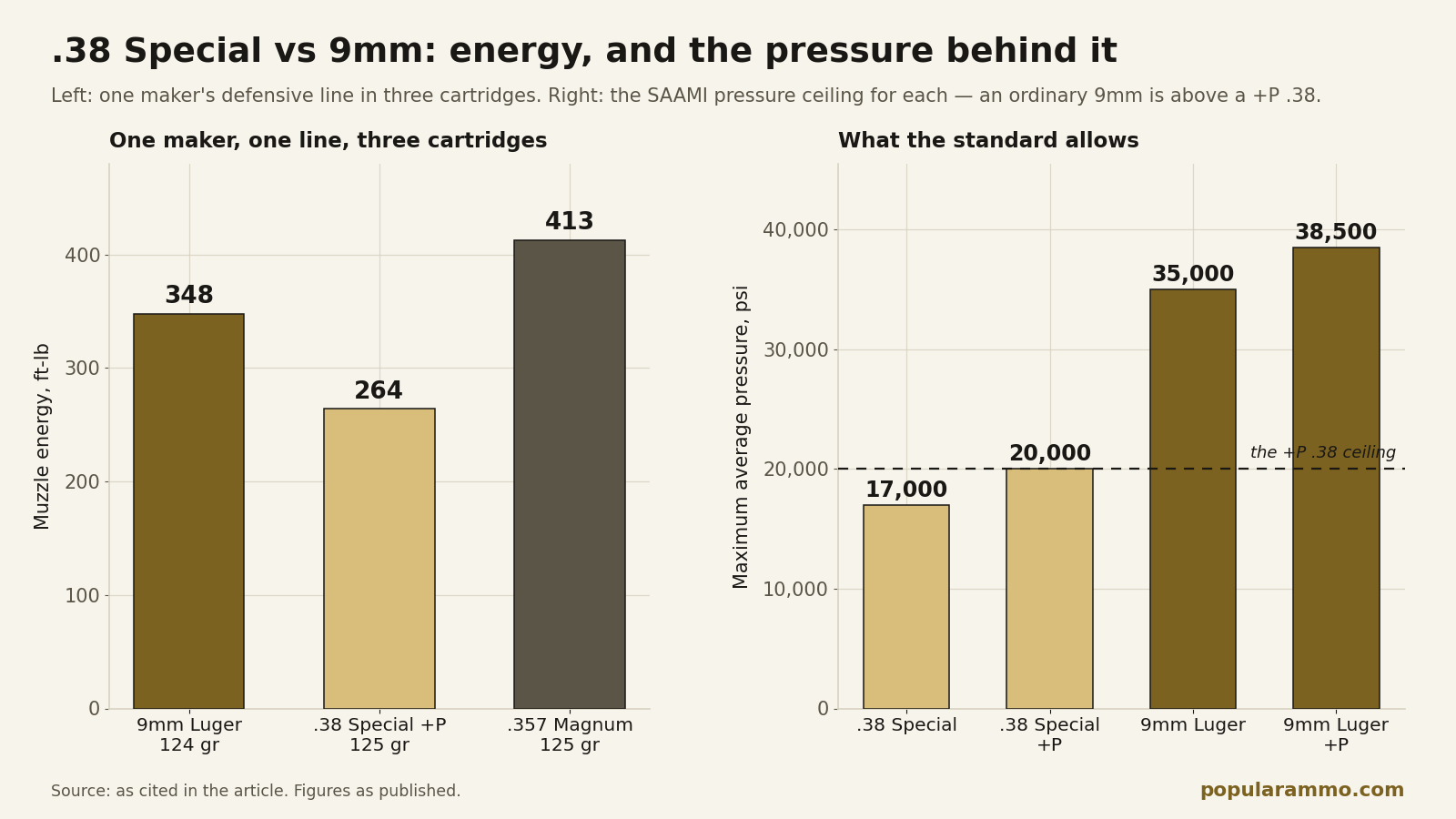
- Maximum average pressure: 9mm Luger 35,000 psi, .38 Special 17,000 psi. The +P versions are 38,500 and 20,000. A standard 9mm outruns a +P .38 by 15,000 psi.
- Bullet diameter is .3555 against .3580 inches — a difference of two and a half thousandths.
- The clean like-for-like: Remington’s Golden Saber Defense in both, 124 grains against 125, gives the 9mm 348 ft-lb against 264 — about 32 percent more.
- SAAMI’s test barrel for the .38 Special is longer than the 9mm’s — 7.71 inches solid, or 5.63 vented, against 4.00. The published .38 figures come from more barrel and still lose.
- SAAMI’s interchangeability list includes .38 Special. It does not include 9mm Luger anywhere.
Here’s how I read this chart
Every number in this table is a published figure, copied from the source named underneath it — none of it is my own measurement. Read across a row to compare one entry, and down a column to compare them all on the same measure.
38 Special vs 9mm specifications, side by side
| Specification | 9mm Luger | 9mm Luger +P | .38 Special | .38 Special +P |
|---|---|---|---|---|
| Case type | Rimless, tapered | same | Rimmed, straight | same |
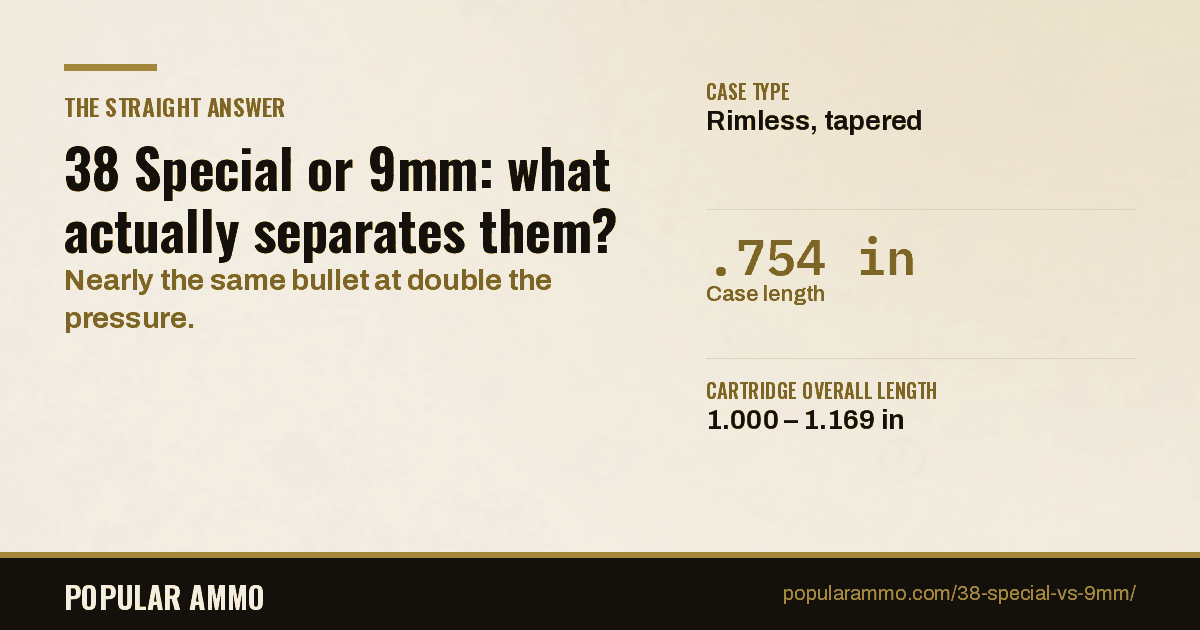
| Case length | .754 in | .754 in | 1.155 in | 1.155 in |
| Cartridge overall length | 1.000 – 1.169 in | same | 1.275 – 1.550 in | same |
| Bullet diameter, jacketed | .3555 in | .3555 in | .3580 in | .3580 in |
| Rim / head diameter | .394 in | same | .440 in | same |
| Bore / groove diameter | .346 / .355 in | same | .346 / .355 in | same |
| Twist | 1 in 10 in | same | 1 in 18.75 in | same |
| Maximum average pressure | 35,000 psi | 38,500 psi | 17,000 psi | 20,000 psi |
| Proof pressure, minimum average | 52,000 psi (+P proof used for both) | Per the standard’s proof tables | ||
| Test barrel | 4.000 in | 4.000 in | 7.710 in solid / 5.631 in vented | same |
Three rows carry the whole comparison. The bore and groove diameters are identical — .346 and .355 inches for both cartridges, which is why they shoot bullets so nearly the same size. The pressure ceilings are more than double apart. And the test barrels are not the same length, which is the detail that quietly distorts most comparisons you will read.

38 Special vs 9mm: quick answers
Is 9mm more powerful than .38 Special?
On published figures, yes, and by a consistent margin. Remington’s Golden Saber Defense line publishes 348 ft-lb for its 124-grain 9mm and 264 ft-lb for its 125-grain .38 Special +P. Federal’s HST 9mm 124-grain publishes 364 ft-lb from a 4-inch barrel. No maker publishes a .38 Special load that reaches those numbers.
Are the bullets the same size?
Almost. SAAMI specifies .3555 inches for a jacketed 9mm bullet and .3580 for a jacketed .38 Special — two and a half thousandths of an inch apart. Both cartridges use a .346-inch bore and a .355-inch groove. They are not interchangeable, and the case shapes make that obvious the moment you try.
Does .38 Special kick less?
No maker publishes a recoil figure for either cartridge, so there is no published answer. SAAMI publishes a recoil formula but assigns no values to any cartridge. What is published is that the .38 is loaded to half the pressure and is normally fired from a heavier-for-its-size revolver, both of which point the same way — but that is reasoning from adjacent facts, not a measured number.
Which name means what?
SAAMI’s own name is “9mm Luger,” and it lists 9mm Parabellum and 9×19mm as the same cartridge. It does not list “9mm Kurz” or “9mm Browning Short” there — those are alternate names for the .380 Automatic, a different and much milder cartridge. And 9×18 Makarov is a third thing again, standardized separately at 24,100 psi.
Is there a 9mm NATO standard?
Not at SAAMI. The string “NATO” appears nowhere in the pistol and revolver standard in connection with 9mm — SAAMI applies it only to .223/5.56 and .308/7.62×51. Whatever “9mm NATO” means on a box, it is not a SAAMI pressure standard.
The test barrel problem
This is the part almost every comparison gets wrong, and it is worth being blunt about.
SAAMI specifies a 4.000-inch test barrel for the 9mm Luger. For the .38 Special it specifies a 7.710-inch solid barrel and a 5.631-inch vented one — the vented barrel exists to simulate a revolver’s cylinder gap, which bleeds pressure a semi-automatic does not lose.
So when the .38 Special’s published velocity is measured to the standard, it comes from at least an inch and a half more barrel than the 9mm’s does. That flatters the .38, not the 9mm. The margin in the table below is therefore a floor, not a ceiling.
The complication: Remington does not publish a test barrel length at all. I checked every product page in the line and the field simply is not there. Federal, Speer and Hornady all publish it; Remington does not. So the matched comparison below is the cleanest one available — same maker, same bullet line, same catalog, near-identical bullet weight — but I cannot tell you what barrels produced it, because Remington does not say.
The comparison that is actually like-for-like
Here’s how I read this chart
Two panels, two different questions. On the left, muzzle energy in foot-pounds for one maker’s defensive line loaded in both cartridges at nearly the same bullet weight — the fairest single comparison available, and the 9mm is roughly a third ahead. On the right, the pressure each cartridge is allowed to reach by the standard, in pounds per square inch. Note that the ordinary 9mm bar is taller than the +P .38 Special bar: the gap is not something a hotter .38 load can close.
| Load | Item | Weight | Velocity | Energy | Difference |
|---|---|---|---|---|---|
| 9mm Luger, Golden Saber Defense | 27601 | 124 gr | 1,125 fps | 348 ft-lb | — |
| .38 Special +P, Golden Saber Defense | 27606 | 125 gr | 975 fps | 264 ft-lb | 32% less energy |
| .357 Magnum, Golden Saber Defense | 27600 | 125 gr | 1,220 fps | 413 ft-lb | for scale |
Same company, same bullet design, same product family, one grain of bullet weight apart. The 9mm gives up 84 foot-pounds to nothing but a longer case and a lower pressure ceiling. The .357 Magnum row is there for scale: it is the same 125-grain bullet in the same line, and it is as far above the 9mm as the 9mm is above the .38.

What the 9mm side looks like at its best
Remington’s is the fair comparison because both cartridges come from one catalog. But it is not the strongest 9mm data published, and readers comparing carry ammunition should see the rest of it.
| Load | Item | Weight | Velocity | Energy | Barrel |
|---|---|---|---|---|---|
| Federal Personal Defense HST | P9HST1S | 124 gr | 1,150 fps | 364 ft-lb | 4 in |
| Federal HST +P | P9HST3S | 124 gr | 1,200 fps | 396 ft-lb | 4 in |
| Federal HST | P9HST2S | 147 gr | 1,000 fps | 326 ft-lb | 4 in |
| Speer Gold Dot | 23618GD | 124 gr | 1,150 fps | 364 ft-lb | 4 in |
| Speer Gold Dot +P | 23617GD | 124 gr | 1,220 fps | 410 ft-lb | 4 in |
| Hornady Critical Defense | 90250 | 115 gr | 1,135 fps | 329 ft-lb | 4 in |
Two of those rows are the same bullet at standard and +P pressure in one line — Federal’s 124-grain HST at 1,150 and 1,200 fps, Speer’s at 1,150 and 1,220. That is what a 3,500 psi pressure increase buys: about fifty to seventy feet per second. It is a real difference and a small one, and worth remembering the next time a +P claim is made in bigger language than that.
The thing the .38 Special has that the 9mm does not
SAAMI publishes a document called Generally Accepted Firearms and Ammunition Interchangeability. It is a closed list — the wording is “these acceptable alternate cartridge/chamber combinations are limited to only the following” — and it runs to about twenty chambers.
.38 Special is on it. .38 Special +P is on it. 9mm Luger is not on it at all.
What that means in practice is that a .38 Special has somewhere to go. A revolver chambered for the .357 Magnum will safely fire .38 Special, and SAAMI says so on the record. A 9mm Luger has no such relationship with anything — no bigger chamber it can be fired in, no smaller cartridge it accepts. The same document adds the warning that governs all of it: “just because a round of ammunition can fit into a firearm’s chamber, barrel, or action – this does not necessarily mean that it is safe to use that ammunition in that firearm.”
The trade runs the other way too. The 9mm’s rimless case is what lets it stack in a magazine; the .38’s rim is what lets it headspace in a revolver cylinder. Neither is a flaw. They are two different answers to where the cartridge sits when the hammer falls.
What the FBI put in writing
The FBI Training Division’s 2014 justification memo is the most-quoted document in this argument, and most of the quoting is loose. Here is what it actually says, verbatim.
On the premise of the whole debate: “Handgun stopping power is simply a myth.” And: “Studies of ‘stopping power’ are irrelevant because no one has ever been able to define how much power, force, or kinetic energy, in and of itself, is required to effectively stop a violent and determined adversary quickly, and even the largest of handgun calibers are not capable of delivering such force.”
On what does matter: “The single most important factor in effectively wounding a human target is to have penetration to a scientifically valid depth (FBI uses 12″ – 18″).”
On the differences between service calibers: “There is little to no noticeable difference in the wound tracks between premium line law enforcement projectiles from 9mm Luger through the .45 Auto.”
Two caveats I will not skip. First, the memo compares 9mm with .40 S&W and .45 Auto — it does not discuss the .38 Special, and nobody should present it as if it did. Second, I could not find this document on any federal domain; the copy I read is an attachment published in a municipal council’s public records system. It identifies itself as originating from the FBI Academy at Quantico, and I have quoted it as found rather than as verified by the Bureau.
38 Special vs 9mm cost today
| Cartridge | Per round | Case price | Case | Load checked | Stock |
|---|---|---|---|---|---|
| .38 Special | 43.90¢ | $439.00 | 1,000 rd | 1000 Round Case - 38 Special 132 Grain FMJ PMC Ammo - 38G | 25+ in stock |
| 9mm Luger | 26.98¢ | $269.80 | 1,000 rd | 1000 Round Case - 9mm Luger 115 Grain FMJ Ammo by Magtech - 9A | 25+ in stock |
The table compares the cheapest case lot of each cartridge in stock at one store. Practice ammunition is where the price gap shows; a revolver owner who shoots a few boxes a year will barely notice it.
What nobody publishes
- Recoil — for either cartridge, from any maker. SAAMI publishes the formula and no values.
- Expansion or penetration figures — no maker page for either cartridge carries a gelatin number, an expanded diameter or a penetration depth.
- Remington’s test barrel length — absent from every page in the Golden Saber line, which is the one line publishing both cartridges.
- Winchester’s ballistics for the Defender line — the pages say, in as many words, “there is no ballistics data available at this time.”
- Any SAAMI copper crusher figure for 9mm +P — the standard states crusher pressures were never established for it.
Where to go next
38 Special vs 357 Magnum covers the upgrade path this article only touches on, 380 vs 9mm covers the cartridge people most often confuse with the 9mm, and my 9mm self-defense ammunition reference goes deeper on the loads above. For holsters and carry guns, Popular EDC covers the hardware side.
Sources
- ANSI/SAAMI Z299.3-2022 centerfire pistol and revolver standard — 9mm Luger, 9mm Luger +P, .38 Special and .38 Special +P cartridge and chamber drawings, velocity and pressure tables, proof tables and test barrel drawings
- SAAMI, Generally Accepted Firearms and Ammunition Interchangeability, 8 October 2021; and Generally Accepted Cartridge and Chamber Names, same date
- SAAMI recoil formulae page
- Remington Golden Saber Defense product pages, items 27600, 27601, 27603, 27604 and 27606
- Federal Personal Defense HST product pages P9HST1S, P9HST2S and P9HST3S; Speer Gold Dot 23617GD and 23618GD; Hornady Critical Defense item 90250; Winchester Defender product pages
- FBI Training Division, “Executive Summary of Justification for Law Enforcement Partners,” 2014, as published in a municipal council records system


Ammunition reference desk
Three charts readers come back to: what a round costs today, what a cartridge name really measures, and what shipping and tax add.
| .22 LR | 6.59¢ |
| 9mm Luger | 26.98¢ |
| 5.56 NATO | 44.95¢ |
| .270 Win | .278 in |
| .30-30 Win | .309 in |
| .308 Win | .309 in |
| Case price | $269.80 |
| Shipping and tax | +$18.89 |
| Per round | 28.87¢ |
Reader Favorites