
410 Ammo: Bore Not Gauge, and Why 3-Inch Runs Hotter
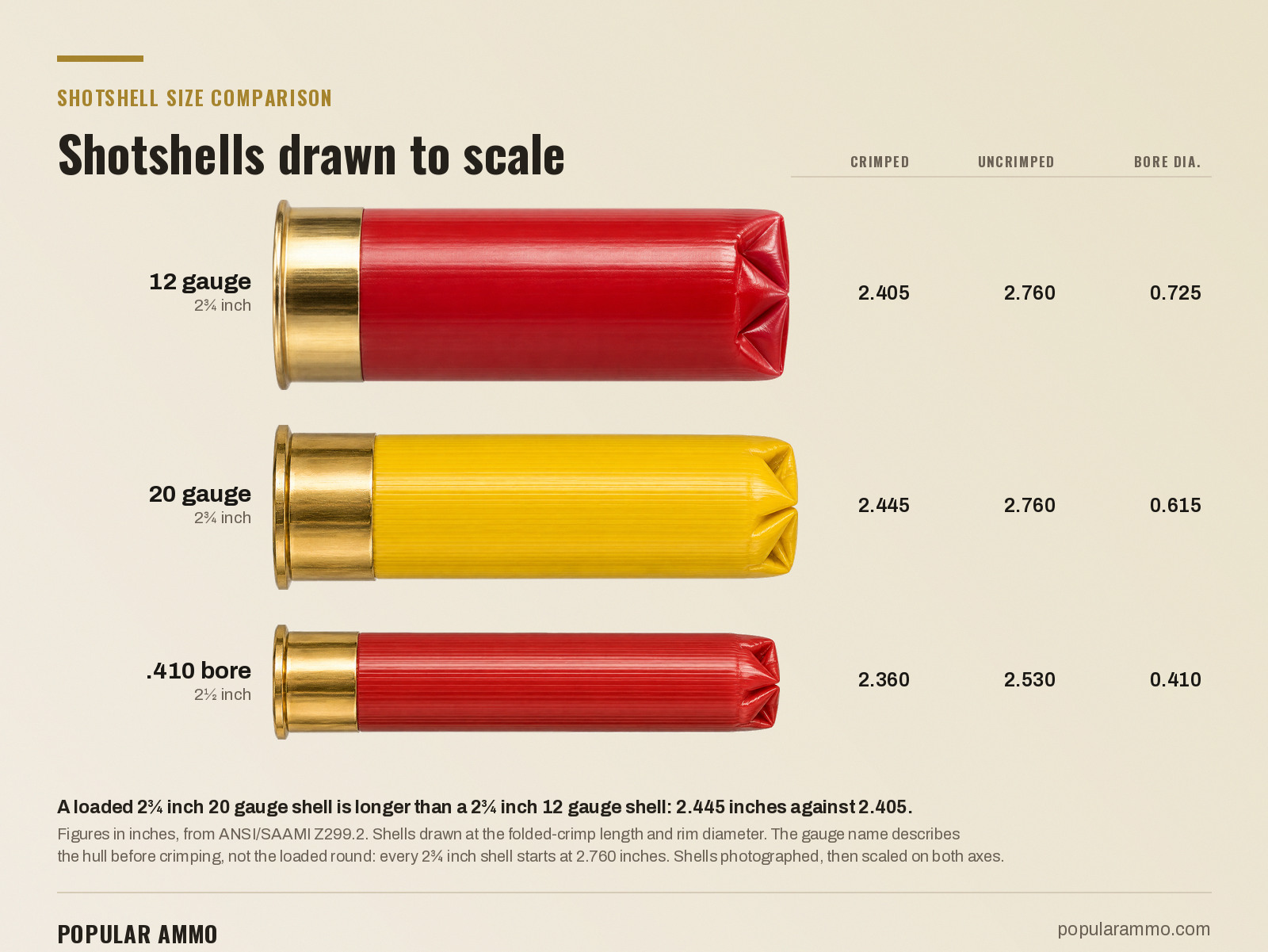
.410 is a bore, not a gauge, and it is the one shotshell whose 3-inch shell is rated higher than its 2-and-a-half: 13,500 psi against 12,500.
Last updated: September 23, 2026 · Originally published September 10, 2026
.410 is a bore, not a gauge and unusually among shotshells, its 3-inch shell is rated to a higher pressure than its 2½-inch shell. Twelve thousand five hundred psi against thirteen thousand five hundred. Every other common shotshell uses one pressure ceiling across all its lengths.
What I want you to walk away with
- SAAMI recognizes exactly two .410 lengths — 2½ and 3 inches. There is no 2¾ inch .410 in the standard.
- Maximum average pressure is 12,500 psi at 2½ inches and 13,500 psi at 3 inches, across every load class.
- The 3-inch shell gets its own proof load and its own proof marking — “DANGER PROOF LOAD 3″ GUNS ONLY”. The 20 gauge 3-inch shell does not.
- SAAMI’s own document never defines .410 as a bore rather than a gauge in prose — it carries the distinction silently, in six places, including a column header that changes from “Gauge” to “Gauge / Bore” the moment .410 appears.
- The makers do not agree on the name. Federal, Fiocchi and Estate write “.410 Bore”; Winchester writes “410 Gauge”.

Here’s how I read this chart
Every number in this table is a published figure, copied from the source named underneath it — none of it is my own measurement. The card shows the top rows; the complete table is further down this page. Read across a row to compare one entry, and down a column to compare them all on the same measure.
Is .410 a bore or a gauge?
A gauge is a count, not a measurement: 12 gauge means twelve lead balls of bore diameter weigh a pound. The .410 does not work that way. It is named for its bore diameter in inches, like a rifle caliber.
What is interesting is how SAAMI handles this. I went looking for a sentence in the shotshell standard saying so and there is not one — no glossary, no definitions section, no prose statement anywhere. Instead the distinction is carried silently through the document’s own nomenclature, and it is carried consistently:
- In the naming table, every other entry in the column headed “Gauge” is a bare number — 10, 12, 16, 20, 28. The last two rows read “410 bore”, with the word built into the name.
- On the non-lead shot pressure table, the column header itself changes to “Gauge / Bore” the moment .410 enters it.
- The rifled slug table heads its column “GAUGE/BORE”.
- A test barrel note distinguishes them in a single sentence: corrections “for 28 gauge and 410 bore non-lead shot loads”.
- The proof marking page splits its categories into “FOR 10 TO 28 GAUGE INCLUSIVE” against “FOR 410 BORE 2½” CHAMBER” and “FOR 410 BORE 3″ CHAMBER” — .410 sits outside the gauge range as a labeled category of its own.
The manufacturers are less consistent than the standard. Federal, Fiocchi and Estate all use “410 Bore” as the spec field. Winchester writes “410 Gauge” and “410-gauge PDX1” on its own product pages. Both will get you the right box off the shelf; only one matches the standard.


Quick answers
Can I shoot 3 inch .410 ammo in a 2½ inch chamber?
No. The general shotshell rule applies a longer shell in a shorter chamber raises pressure and here it is sharpened by the fact that the 3-inch shell is deliberately loaded to a higher ceiling. SAAMI gives the 3-inch shell its own proof load and its own proof marking, “DANGER PROOF LOAD 3″ GUNS ONLY”. Read the barrel.
Is there a 2¾ inch .410?
Not in the standard. SAAMI recognizes 2½ and 3 inches only.
Is .410 good for home defense?
Several makers build loads specifically for it, and they are explicit that they are designed for the .410 revolvers rather than for shotguns. Federal describes “a customized hull design, optimal brass thickness and fine-tuned payloads” for .410 handguns. Winchester says its PDX1 Defender is “highly effective in both 410 compatible handguns and shotguns.” What no maker publishes is a pattern percentage, which is the number that would actually answer the question.
What can a .410 slug do?
SAAMI’s reference figures are a ⅕ ounce slug at 1,815 fps and a ¼ ounce slug at 1,830 fps, both from the 2½-inch shell. Federal’s Power-Shok publishes 1,775 fps for a 109-grain slug; Remington’s Slugger publishes 1,830 fps for an 88-grain one.
Why is .410 ammunition so expensive for what it holds?
I publish no prices. What I can say is that a ½ ounce .410 payload is under half what a 12 gauge target load carries, so it is not economizing on materials in the way the small shell suggests.
What does SAAMI specify for .410 ammo?

Here’s how I read this chart
Each bar is the pressure ceiling the industry standard sets for one shotshell, in pounds per square inch — the maximum the load is designed and tested to. The surprise is the order: the smallest shell on the chart, the 3-inch .410, is rated the highest, and the biggest, the 12 gauge, the lowest. Bore size and pressure are separate questions, and the .410 is the only common shotshell whose two lengths carry different ceilings.
| Specification | 2½ inch | 3 inch |
|---|---|---|
| Recognized in the standard | Yes (65 mm) | Yes (76 mm) |
| Bore diameter, smooth bore | .410 + .020 in | .410 + .020 in |
| Maximum average pressure, all load classes | 12,500 psi | 13,500 psi |
| Proof load, minimum average | 20,500 psi | 22,000 psi |
| Proof load, maximum average | 22,000 psi | 23,500 psi |
| Maximum rifled slug diameter | .403 in | |
| Rifled barrel drawing | None — the standard publishes rifled barrels for 12 and 20 gauge only | |
The pressure rows are the ones to hold on to. For 12 gauge and for 20 gauge, the shorter and longer shells share a pressure ceiling. For .410 they do not — the 3-inch shell is rated a thousand psi higher, and the standard backs that up with a separate proof load and a separate proof marking. A .410 chamber length is not a convenience question.
One more detail from the test barrel notes, which explains why .410 velocity figures can look inconsistent: “All types of 410-bore 2½” rounds are tested in a 3″ chamber test barrel of the appropriate choke/bore treatment for the type of payload under test.” The short shell is measured in a long chamber.
What .410 ammo is cataloged today
| Use | Load | Length | Payload | Velocity |
|---|---|---|---|---|
| Target | Federal Top Gun TGS41214 | 2½ in | ½ oz #8 | 1,330 fps |
| Target | Federal High Over All HOA410H | 2½ in | ½ oz #9 | 1,275 fps |
| Target | Remington Premier STS 20750 | 2½ in | ½ oz #9 | 1,275 fps |
| Target | Estate Super Sport SS410 | 2½ in | ½ oz | 1,200 fps |
| Small game | Federal Game Load Hi-Brass H412 | 2½ in | ½ oz #6 | 1,200 fps |
| Small game | Federal Game Load Hi-Brass H413 | 3 in | 11/16 oz #7½ | 1,135 fps |
| Small game | Remington Premier Bismuth R20514 | 3 in | ⅝ oz #4 | 1,200 fps |
| Steel, upland and waterfowl | Federal Upland Steel USH410 and Speed-Shok WF413 | 3 in | ⅜ oz #6 | 1,400 fps |
| Turkey | Fiocchi Golden Turkey TSS 410TSS9 | 3 in | 13/16 oz #9 TSS | 1,100 fps |
| Turkey | Remington Premier TSS 28069 | 3 in | 13/16 oz #9 TSS | 1,100 fps |
| Slug | Federal Power-Shok F412 RS | 2½ in | ¼ oz, 109 gr | 1,775 fps |
| Slug | Remington Slugger 20618 | 2½ in | ⅕ oz, 88 gr | 1,830 fps |
| Defense | Federal Personal Defense PD413JGE 000 | 3 in | 000 buck, 5 pellets | 775 fps |
| Defense | Federal Personal Defense PD412JGE 4 | 2½ in | 7/16 oz #4 | 950 fps |
| Defense | Remington Ultimate Defense 20697 | 2½ in | 000 buck, 4 pellets | 1,225 fps |
| Defense | Winchester PDX1 Defender S413PDX1 | 3 in | 4 discs plus 16 plated BB | 750 fps |
| Defense | Hornady Critical Defense Triple Defense 86238 | 2½ in | One FTX slug plus two round balls | not published |
| Low noise | Remington Low Decibel R20740 | 2½ in | ½ oz #9 | 650 fps |
Two things I am flagging rather than repeating as fact. Federal’s .410 listing shows a Heavyweight TSS load at a 1 3/16 ounce payload in a 3-inch shell; that exceeds every 3-inch .410 payload SAAMI tabulates, whose maximum is 15/16 ounce of lead. And Winchester’s own PDX1 page contradicts itself, describing “four plated Defense Disc projectiles and 16 pellets” in its prose while its features block says three discs and twelve BBs. Both may have innocent explanations. Neither is something to build a decision on.

.410 ammo in a revolver
A significant share of .410 ammunition is now bought for revolvers chambered for both .410 and .45 Colt, and several makers build for that specifically. Federal’s line is literally named “Personal Defense 410 Handgun,” and describes “a customized hull design, optimal brass thickness and fine-tuned payloads” made “perfect for .410 handguns,” with “special brass heads” to “ensure smooth extraction.” Winchester positions its PDX1 as working in both: “highly effective in both 410 compatible handguns and shotguns.”
Look at what those handgun loads actually publish and the design intent is obvious. Federal’s 000 buck handgun load runs 775 fps, and its #4 shot load 950 fps, against 1,225 fps for Remington’s Ultimate Defense buckshot. Those are deliberately slow, because they are leaving a short revolver barrel rather than a shotgun.
The number that would settle the argument about .410 for defense — how the pattern actually behaves out of a short barrel at across-a-room distance — is not published by anyone, in this cartridge or any other. I am not going to fill that gap with an opinion.
What nobody publishes about .410 ammo
- Pattern percentage absent from every load, as it is across all shotshells.
- Payload weight on several buckshot and defense loads Remington’s 3-inch Ultimate Defense, Winchester’s PDX1 and Hornady’s Triple Defense publish pellet or component counts but no ounce weight, and Hornady publishes no velocity either.
- A rifled .410 barrel specification the standard has rifled barrel drawings for 12 and 20 gauge, and none for .410.
- A definition of “bore” versus “gauge” nowhere in the standard, despite the distinction being maintained throughout it.
Where to go next
My 12 gauge shotgun shells page covers the shot size scale and the non-toxic shot law in full, 20 gauge shells covers the middle option, and the caliber comparison chart puts .410 inches in context. For revolvers chambered in both .410 and .45 Colt, see Guns and Gadgets Daily.
Sources
- ANSI/SAAMI Z299.2 shotshell standard .410 bore chamber and barrel drawings, pressure and velocity tables, proof load tables and proof marking pages, rifled slug table, test barrel notes
- Federal product pages: Top Gun, High Over All, Game Load Upland Hi-Brass, Upland Steel, Speed-Shok, Heavyweight TSS, Power-Shok Rifled Slug and the Personal Defense 410 Handgun family
- Remington product pages: Premier STS, Premier Nitro Sporting Clays, Express Extra Long Range, Premier Bismuth, Premier TSS, Slugger, Ultimate Defense and Low Decibel
- Winchester PDX1 Defender product pages; Fiocchi Golden Turkey TSS; Estate Cartridge Super Sport and High Velocity Hunting; Hornady Critical Defense Triple Defense


Ammunition reference desk
Three charts readers come back to: what a round costs today, what a cartridge name really measures, and what shipping and tax add.
| .22 LR | 6.59¢ |
| 9mm Luger | 26.98¢ |
| 5.56 NATO | 44.95¢ |
| .270 Win | .278 in |
| .30-30 Win | .309 in |
| .308 Win | .309 in |
| Case price | $269.80 |
| Shipping and tax | +$18.89 |
| Per round | 28.87¢ |
Reader Favorites