45-70 vs 30-30: Power, Range and Which Lever Gun
45-70 against 30-30 is a question about which rifle you own, because 45-70 is really three pressure levels wearing one cartridge name.
Last updated: October 6, 2026 · Originally published September 10, 2026
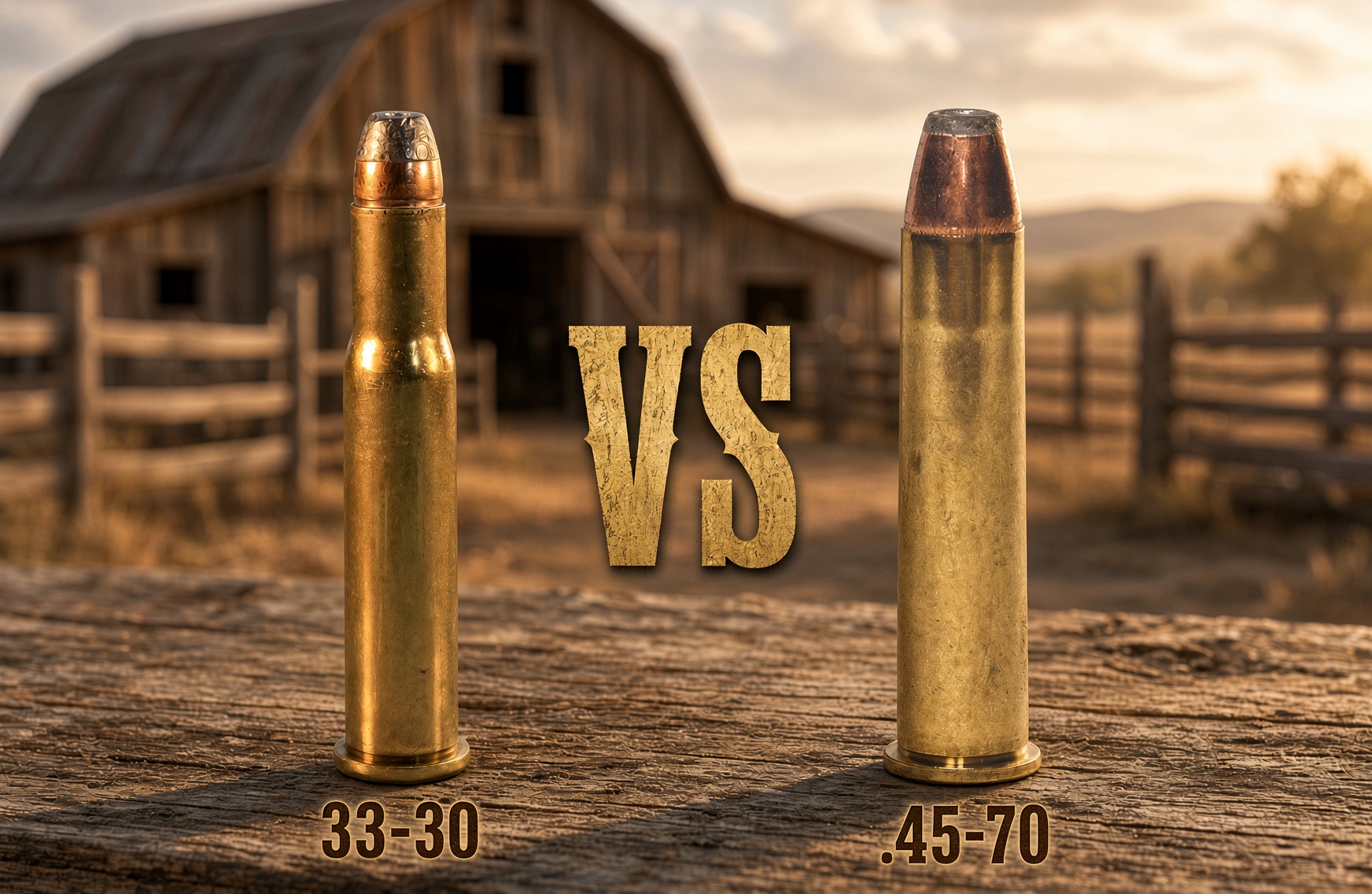
45-70 vs 30-30 is not really a ballistics question — it is a question about which rifle you own, because .45-70 is three cartridges wearing one headstamp and .30-30 is one. Every .30-30 load on the shelf is safe in any .30-30 in working order. That is emphatically not true of .45-70.
What I want you to walk away with
- SAAMI rates .30-30 at 42,000 psi and .45-70 at 28,000 — the smaller cartridge runs at half again the pressure of the bigger one.
- .45-70 is loaded at three deliberate pressure levels with different approved-rifle lists. .30-30 has one, and one maker states its load is safe “in ANY/ALL 30-30 chambered firearms that are in normal operating condition—no exceptions.”
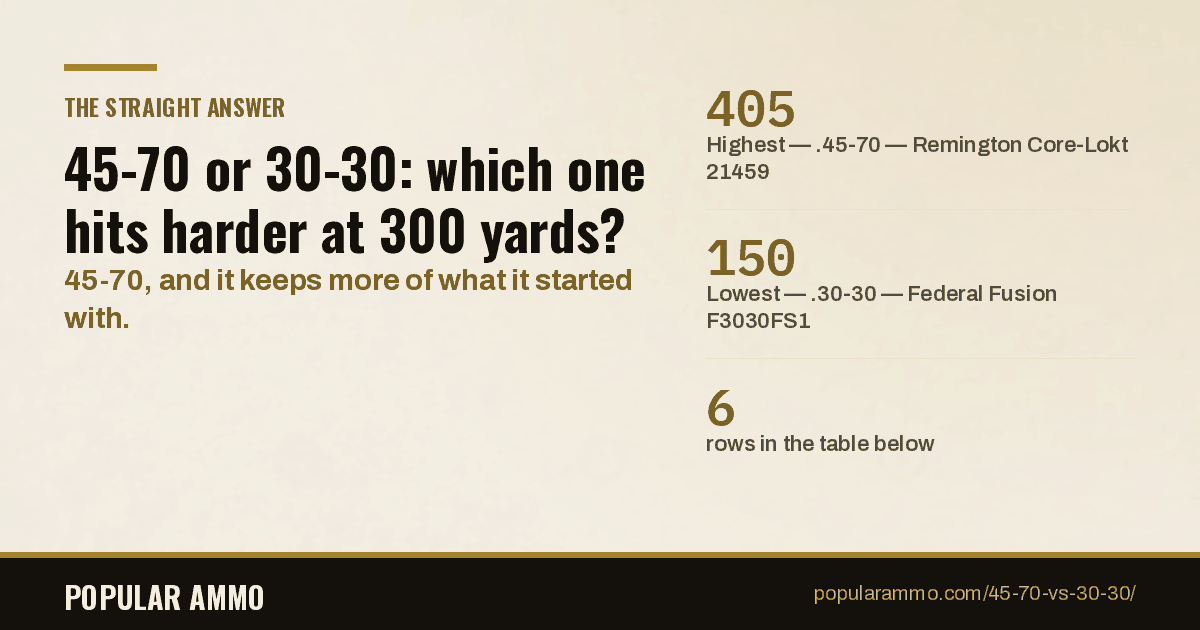
- At the muzzle the .45-70 carries far more energy. At 300 yards a tipped .30-30 load holds 1,027 ft-lb against roughly 1,035 for a 325-grain .45-70 — they converge.
- Both are limited by the same thing: a tubular magazine, which for a century meant blunt bullets.
- Both share SAAMI’s 24-inch test barrel, so their published figures are directly comparable — which is rare.
Here’s how I read this chart
Every number in this table is a published figure, copied from the source named underneath it — none of it is my own measurement. Read across a row to compare one entry, and down a column to compare them all on the same measure.
The specifications, side by side
| Specification | .30-30 Winchester | .45-70 Government |
|---|---|---|
| Bullet diameter | .3090 in | .458 in |
| Case length | 2.0395 in | 2.105 in |
| Cartridge overall length | 2.450 – 2.550 in | 2.490 – 2.550 in |
| Rim diameter | .506 in | .608 in |
| Case shape | 15° 39′ shoulder | Straight wall, no shoulder |
| Maximum average pressure | 42,000 psi | 28,000 psi |
| Maximum average pressure, crusher | 38,000 CUP | 28,000 CUP |
| Twist, chamber drawing | 1 in 12 in, OPTIONAL | 1 in 20 in, OPTIONAL |
| Twist, SAAMI test barrel | 1 in 10 in | — |
| Test barrel | 24 in | 24 in |
Two things stand out. The .30-30 runs at a substantially higher pressure than the .45-70 — 42,000 psi against 28,000 — which surprises people who assume the bigger cartridge must be the more strenuous one. And the .45-70 is a straight-wall case, which matters in several states’ deer regulations in a way the shouldered .30-30 does not.
A footnote inside SAAMI’s own standard explains the .45-70’s low ceiling: its calibration band “does not conform to the standardized guidance due to testing done on ammunition loaded to 18,000 psi.” The 1873 Springfield Trapdoor is visible inside a 2020s document.


Quick answers
Which hits harder?
At the muzzle, .45-70, by a wide margin at its upper pressure levels — up to 3,200 ft-lb from a 420-grain load against roughly 2,900 for the best .30-30. By 300 yards the gap has closed to almost nothing between a 325-grain .45-70 and a tipped 160-grain .30-30.
Which shoots flatter?
The .30-30, with a tipped bullet. Hornady’s 160-grain FTX is still doing 1,700 fps at 300 yards; the same maker’s 325-grain .45-70 is down to 1,197.
Is all ammunition safe in my rifle?
For .30-30, effectively yes. For .45-70, no — and the makers say so in capital letters. Read the load’s approved-firearm list before you buy.
Which is better for bear?
The makers position the .45-70 that way and not the .30-30. Garrett describes its top load as suited to “all North American Game and African plains game out to about 225-yards.” No maker markets a .30-30 load for dangerous game.
Which recoils more?
No maker publishes a recoil figure for either cartridge. What is published is bullet weight and velocity, and a 420-grain bullet at 1,850 fps carries far more momentum than a 160-grain at 2,400.
Ballistics, from the same 24-inch barrel

Here’s how I read this chart
At the muzzle the .45-70 leads. At 300 yards they meet. Two bars per cartridge: energy at the muzzle in dark, energy left at 300 yards in light. Foot-pounds is a measure of how much work the bullet can still do. What the chart shows is that the .45-70 starts with far more and loses far more of it — a heavy blunt bullet sheds speed quickly, and by 300 yards a tipped .30-30 has caught up.
This comparison is unusually clean, because both cartridges are measured in SAAMI’s standard 24-inch rifle barrel and Hornady publishes that barrel length on its loads for both.
| Load | Gr | Muzzle | 300 yd | Energy lost |
|---|---|---|---|---|
| .45-70 — Hornady LEVERevolution 82747 | 325 | 2,000 fps / 2,886 ft-lb | 1,197 fps / 1,035 ft-lb | 64% |
| .45-70 — Remington Core-Lokt 21459 | 405 | 1,600 fps / 2,302 ft-lb | 1,083 fps / 1,056 ft-lb | 54% |
| .45-70 — Remington reduced pressure 29473 | 405 | 1,330 fps / 1,591 ft-lb | 978 fps / 860 ft-lb | 46% |
| .30-30 — Hornady LEVERevolution 82730 | 160 | 2,400 fps / 2,046 ft-lb | 1,700 fps / 1,027 ft-lb | 50% |
| .30-30 — Federal Fusion F3030FS1 | 150 | 2,390 fps / 1,902 ft-lb | 1,553 fps / 803 ft-lb | 58% |
| .30-30 — Hornady American Whitetail 80801 | 150 | 2,390 fps / 1,902 ft-lb | 1,276 fps / 542 ft-lb | 72% |
Read the first and fourth rows against each other. The .45-70 starts with 41 per cent more energy and finishes, at 300 yards, with almost exactly the same amount. A heavy, blunt, slow bullet sheds energy fast; a lighter, pointed, faster one holds it. That is the entire ballistic argument between these two cartridges in two lines.
Read the fourth and sixth rows and you get the other half: two .30-30 loads leaving at the same 2,390 fps, one keeping 1,027 ft-lb at 300 yards and the other 542. Same cartridge, same starting speed. The only difference is the shape of the nose.
Above SAAMI pressure, the .45-70 pulls away again. Buffalo Bore publishes 2,002 fps for a 405-grain bullet from a 22-inch Marlin — but that ammunition is not usable in every .45-70 rifle, which is the whole point of the next section.
The difference that actually decides it
Buffalo Bore states the .45-70 problem more clearly than anyone: “Our 45-70 ammunition is externally identical to SAAMI spec 45-70 ammo, but internally it generates FAR more power and pressure. So, our 45-70 ammo will fit into ANY 45-70 firearm but is not safe in every 45-70 firearm.”
Garrett Cartridges sells the same 420-grain bullet at three published chamber pressures, and the approved-rifle list changes at each step:
- 18,000 CUP, 1,350 fps — “ANY FACTORY CHAMBERED 45-70 FIREARM IN GOOD CONDITION INCLUDING TRAPDOORS AND REPLICAS”
- 28,000 CUP, 1,650 fps — modern rifles by name. “UNDER NO CIRCUMSTANCES SHOULD THIS AMMO BE FIRED IN ANY TRAPDOOR SPRINGFIELDS”
- 35,000 CUP, 1,850 fps — a shorter list than the 28,000 tier, dropping the Marlin 1895 and several others
Now the same question for .30-30. Buffalo Bore’s 150-grain load: “safe to use in ANY/ALL 30-30 chambered firearms that are in normal operating condition—no exceptions.” No tiers, no lists, no exclusions.
That asymmetry is the real difference between these cartridges for most buyers. With a .30-30 you buy what is on the shelf. With a .45-70 you have to know what your rifle is first — and the box will chamber either way.
The constraint they share
Both cartridges live in lever-action rifles with tubular magazines, where rounds sit nose to primer. For a century that meant flat-nosed bullets and the ballistics penalty that goes with them.
The fix arrived for both at the same time and from the same maker: a compressible elastomer tip that behaves like a flat point in the magazine and a pointed bullet in flight. Hornady publishes “velocity increases of up to 250 fps over traditional flat point loads” and “up to 40% more energy,” and notes that “the innovative LEVERevolution FTX and MonoFlex bullet designs may require a newer magazine follower to provide best possible functioning of the last round out of the magazine in certain guns.”
Both cartridges’ best modern loads are tipped, and in both cases the gain is larger than any difference between brands within the same bullet shape.
Choosing between them
On the published figures, and stated plainly:
The .30-30 is the simpler ownership. One pressure level, no approved-rifle lists, flatter trajectory, and at 300 yards a tipped load matches a mid-tier .45-70 for energy. It is also, on SAAMI’s numbers, the higher-pressure cartridge of the two.
The .45-70 is the bigger hammer, conditionally. Its advantage at the muzzle is real and large, but the loads that deliver it are the ones with the restricted rifle lists. In a Trapdoor Springfield, the .45-70 is a 1,350 fps cartridge and the .30-30 outperforms it comfortably at every distance.
For states with a straight-wall requirement, the .45-70 qualifies and the shouldered .30-30 does not. That is a legal difference, not a ballistic one, and in the zones where it applies it settles the argument by itself.
What nobody publishes
- Recoil — for either cartridge, from any maker.
- Test barrel length — Hornady alone publishes it for both cartridges. Federal, Winchester, Remington and Barnes publish none.
- Ballistic coefficient from Hornady — absent on its .30-30 ammunition and component pages, though every other maker publishes one.
- Per-load chamber pressure — published by Garrett, and in tier language by Buffalo Bore and Underwood. Nobody else.
- Winchester .45-70 ballistics — its product pages state “There is no ballistics data available at this time.”
Where to go next
45-70 ammo covers the three pressure tiers and every approved-rifle list in full, and 30-30 ammo covers the tubular magazine problem and every current load. The caliber comparison chart shows both against everything else. Hunters choosing a lever gun will find field coverage at Popular Outdoorsman.
To see the .45-70 and the .30-30 beside 24 other rifle cartridges at true scale, with SAAMI case lengths and bullet diameters, use my rifle caliber chart.
Sources
- ANSI/SAAMI Z299.4 centerfire rifle standard — .30-30 Winchester and .45-70 Government cartridge and chamber drawings, pressure tables, test barrel specification
- Hornady product pages 82747, 82741, 82730, 82731, 80801 and the LEVERevolution line page
- Federal 3030A, 3030B, F3030FS1, LG30301; Remington 27818, 27820, 21459, 29473, R21428
- Buffalo Bore 45-70 Magnum press release and standard-pressure page; Heavy 30-30 item 28A and Buffalo-Barnes item 28B
- Garrett Cartridges 45-70 Springfield, 45-70 Government and 45-70 +P product pages


Ammunition reference desk
Three charts readers come back to: what a round costs today, what a cartridge name really measures, and what shipping and tax add.
| .22 LR | 6.59¢ |
| 9mm Luger | 26.98¢ |
| 5.56 NATO | 44.95¢ |
| .270 Win | .278 in |
| .30-30 Win | .309 in |
| .308 Win | .309 in |
| Case price | $269.80 |
| Shipping and tax | +$18.89 |
| Per round | 28.87¢ |
Reader Favorites