5.56 vs 7.62×39: One Has a SAAMI Standard, One Does Not
SAAMI standardizes 223 Remington and 7.62×39 but not 5.56 NATO, and it tests the two it covers in barrels of different lengths.
Last updated: October 6, 2026 · Originally published September 9, 2026
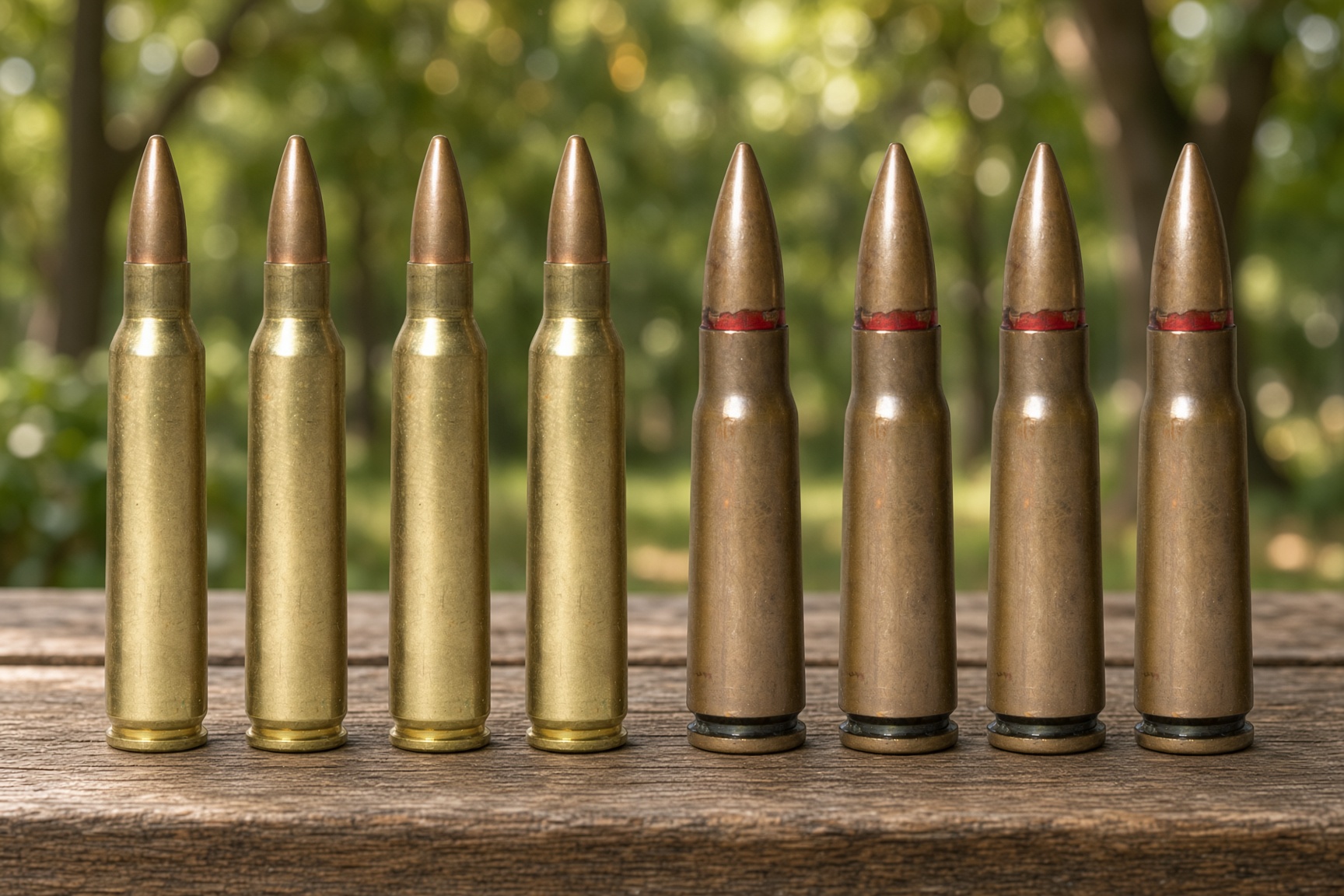
SAAMI standardizes the .223 Remington and the 7.62x39mm. It does not standardize 5.56x45mm NATO at all. And the two cartridges it does cover are tested in barrels of different lengths — 24 inches for the .223, 20 for the 7.62×39, an exception written into the standard by name. So the published velocities everyone compares were not measured the same way.
What I want you to walk away with
- Maximum average pressure: .223 Remington 55,000 psi from a 24-inch barrel; 7.62×39 45,000 psi from a 20-inch barrel. 5.56×45 NATO: no SAAMI figure exists.
- The 7.62×39’s bullet is .311 inches, not .308. It is not a .30-caliber cartridge in the American sense.
- Bore area: .0388 against .0738 square inches — the 7.62×39 has about 90 per cent more.
- SAAMI’s FAQ says .223 in a 5.56 chamber is safe and 5.56 in a .223 chamber is not — and the reason it gives is throat length, not pressure.
- Matched loads run 1,296 against 1,547 ft-lb at the muzzle, but the .223 arrives about 640 fps faster.
- In Washington state the .223 is not legal for big game and the 7.62×39 is — the minimum is .24 caliber.
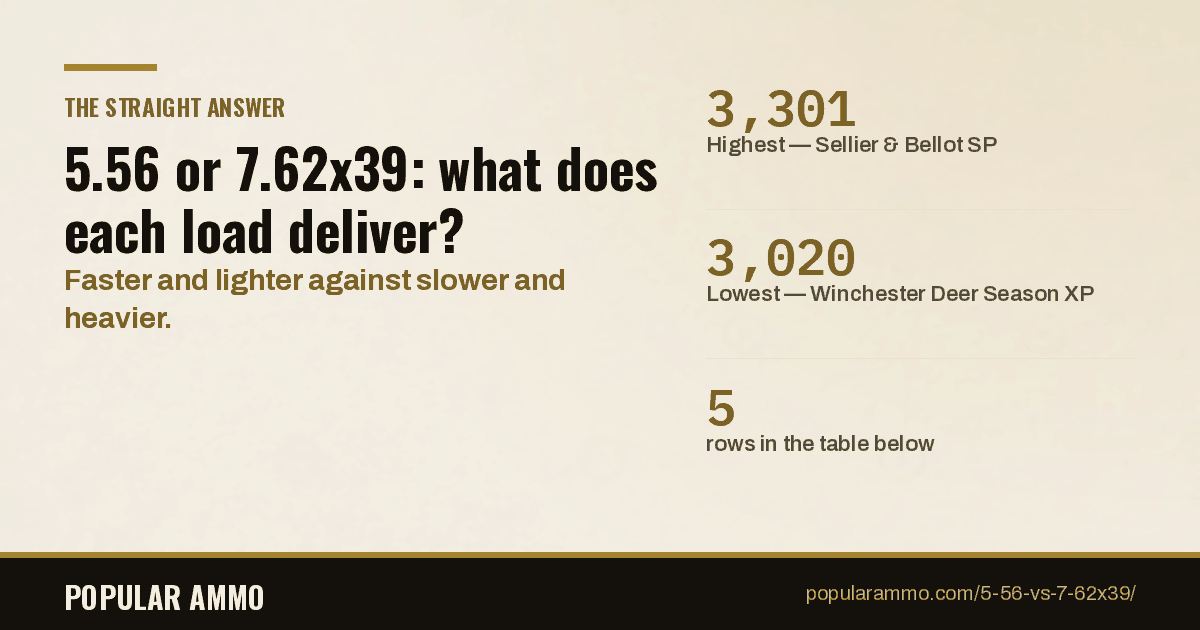
Here’s how I read this chart
Every number in this table is a published figure, copied from the source named underneath it — none of it is my own measurement. Read across a row to compare one entry, and down a column to compare them all on the same measure.
The specifications, side by side
| Specification | .223 Remington | 7.62x39mm | 5.56×45 NATO |
|---|---|---|---|
| In the SAAMI standard? | Yes | Yes | No — absent entirely |
| Bullet diameter | .2245 in | .311 in | n/a |
| Case length | 1.760 in | 1.528 in | n/a |
| Cartridge overall length | 2.125 – 2.260 in | 2.150 – 2.200 in | n/a |
| Rim diameter | .378 in | .447 in | n/a |
| Shoulder angle | 23° | 17° 30′ | n/a |
| Bore / groove diameter | .219 / .224 in | .300 / .310 in | n/a |
| Minimum bore and groove area | .0388 in² | .0738 in² | n/a |
| Rifling | 6 grooves | 4 grooves | n/a |
| Twist | 1 in 12 in | 1 in 9.45 in | n/a |
| Chamber headspace | 1.4636 – 1.4736 in | 1.252 – 1.262 in | n/a |
| Maximum average pressure, transducer | 55,000 psi | 45,000 psi | Not published |
| Maximum average pressure, crusher | 52,000 CUP | 50,000 CUP | n/a |
| Proof, minimum / maximum average | 73,500 / 78,500 psi | 60,000 / 64,500 psi | n/a |
| Test barrel | 24.000 in | 20.000 in | n/a |
| Standard test load | Multiple weights tabulated | 123 gr at 2,350 fps | n/a |
Four rows deserve attention.
The bullet is .311, not .308. This trips people constantly, because “7.62” suggests .30 caliber and the bore diameter really is .300 inches. But the groove diameter is .310 and the bullet SAAMI specifies is .311 minus .002 — a genuinely different bullet from the one a .308 Winchester or a .30-06 uses. That is why .308-inch bullets and 7.62×39 barrels are not a straightforward pairing, and why loading data for the two does not transfer.
The test barrels differ by four inches. SAAMI’s general rule is that “all standard test barrels shall be 24 inches long,” and it publishes a short list of exceptions. The 7.62×39 is on that list by name, at 20.000 inches. So the .223’s published velocities come from a 24-inch barrel and the 7.62×39’s from a 20-inch barrel — which flatters the .223 in any straight comparison of the standard’s own figures.
The bore area difference is large. .0738 against .0388 square inches, about 90 per cent more. That is the honest way to state the size gap, and it is why the 7.62×39 makes more muzzle energy at lower pressure from a shorter barrel.
5.56×45 NATO has no SAAMI pressure figure. Not a different one — none. I searched the full 400-page standard: the string “NATO” does not appear, and every occurrence of “5.56” is the millimeter conversion of the .219-inch bore. Makers use the designation commercially — Federal has a caliber filter literally named 5.56x45mm and Hornady sells a “5.56 NATO” Frontier load — but no SAAMI standardization sits behind it.

Quick answers
Can I shoot 5.56 in a .223 rifle?
SAAMI says no, and gives a specific reason. Verbatim: “it is not safe to shoot ‘5.56,’ ‘5.56 NATO,’ or ‘5.56x45mm’ ammunition in a barrel marked as being chambered in 223 Remington for a number of reasons. The main reason being that a barrel marked as chambered in 223 Remington will have a shorter throat into the rifling than a ‘5.56’ barrel which may cause increased pressure if the ‘5.56’ ammunition is fired in it.” Note what that says: the mechanism is chamber geometry, not a published pressure difference between the two cartridges — SAAMI has no 5.56 pressure figure to differ from.
And the other direction?
SAAMI: “It is safe to shoot 223 Remington ammunition in a 5.56 military specification chamber,” followed immediately by a caveat — “due to the sizeable number of ‘wildcat’ or non-military specification 5.56 chamber geometries in existence, SAAMI recommends that you consult the firearm owner’s manual or contact the firearm manufacturer.”
Which hits harder?
The 7.62×39, on every matched pair we found — by roughly 20 to 30 per cent at the muzzle. Winchester’s Deer Season XP publishes 1,296 ft-lb in .223 and 1,547 in 7.62×39. The .223 is faster: 3,020 fps against 2,380 in that same pair.
Which shoots flatter?
The .223, decisively, because it starts about 640 fps faster with a more slippery bullet. Every matched pair in the catalogs shows the same shape — the smaller cartridge trades energy for speed.
Is either legal for deer?
It depends on the state, and this is one of the few places where a real regulatory difference exists between them. Washington’s big game rules set a floor: “Big game, except cougar, must be hunted with a minimum of .24 caliber (6mm) centerfire rifle.” A .223 is .224 caliber and does not clear it. A 7.62×39 at .311 does. Check your own state — the rules vary and they change.
The comparison that is actually like-for-like
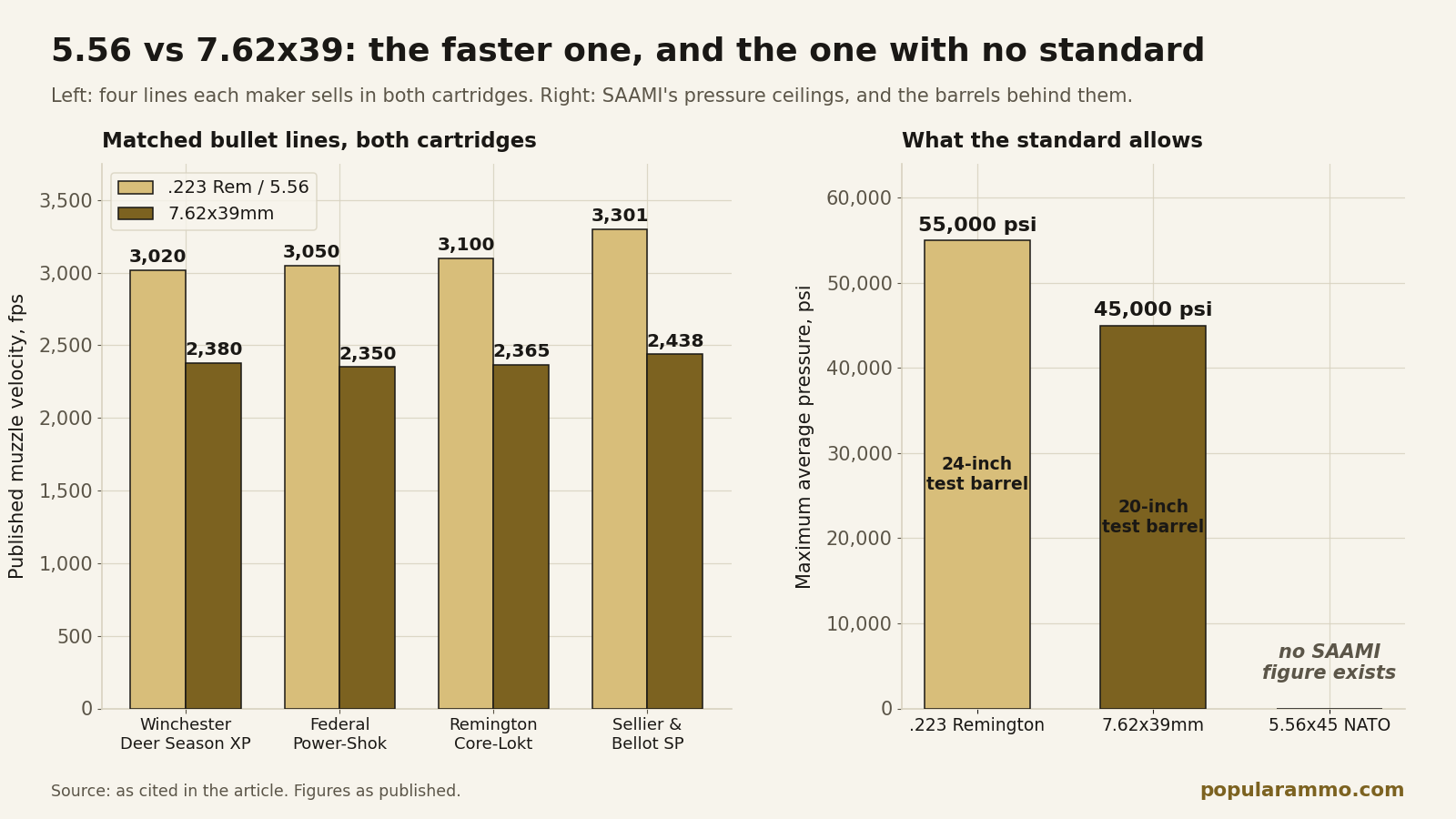
Here’s how I read this chart
On the left, four hunting bullet lines that each maker sells in both cartridges, shown as muzzle velocity in feet per second. Comparing inside a product line is the only fair method — same company, same bullet design, same test procedure — and the .223 is the faster of the pair every time, by roughly 650 to 860 fps. Read that alongside the energy table below it: the smaller cartridge is buying speed with weight. On the right, the pressure each cartridge is allowed by the standard, with the test barrel length printed on each bar. That second number is the catch: the figures were not produced in barrels of the same length, so a straight velocity comparison is not quite the apples-to-apples it appears to be.
| Bullet line | .223 / 5.56 load | Velocity | Energy | 7.62×39 load | Velocity | Energy |
|---|---|---|---|---|---|---|
| Winchester Deer Season XP | 64 gr Extreme Point | 3,020 | 1,296 | 123 gr Extreme Point | 2,380 | 1,547 |
| Federal Power-Shok | 64 gr JSP | 3,050 | — | 123 gr JSP | 2,350 | — |
| Remington Core-Lokt | 62 gr Ultra Bonded | 3,100 | — | 125 gr PSP | 2,365 | — |
| Sellier & Bellot SP | 55 gr SP | 3,301 | 1,344 | 124 gr SP | 2,438 | 1,629 |
| Hornady Frontier FMJ | 55 gr FMJ | — | — | 123 gr FMJ | — | — |
The pattern is consistent and it is the same one the specifications predict: the 7.62×39 carries a bullet roughly twice as heavy at roughly three-quarters of the speed, and comes out 20 to 30 per cent ahead on muzzle energy.
Sellier & Bellot’s pair is the most rigorous row in the table because the company publishes both a G1 and a G7 ballistic coefficient and, unusually, the test barrel length behind each figure. It also confirms the barrel problem in miniature: the .223 figure comes from a 600 mm barrel and the 7.62×39 from a 520 mm one. Even the best-documented matched pair I could find was not measured in the same barrel.
The twist story, which is real and usually garbled
SAAMI’s .223 Remington standard specifies a 1-in-12 twist. That is a slow twist by modern standards, and it is a genuine constraint: it stabilizes light bullets and struggles with the long, heavy ones that make the cartridge competitive at distance.
The military went the other way. A US Army Research Laboratory report on the M855 round describes the test weapons plainly: “Both weapon barrels had an interior bore diameter of 5.56 mm and a gun twist of 1 revolution in 7 inches (1-in-7 twist).” Barnes publishes load data for the .223 Remington from a 1:12 barrel and separate data for 5.56 NATO from a 1:7. Ruger’s current 5.56 NATO rifle ships at 1:8. Prvi Partizan footnotes its 69 and 75-grain .223 loads as requiring “9” or faster twist barrels.”
So “5.56 versus .223” is partly a twist question and not only a chamber question, and the difference is not small: a barrel that will not stabilize a bullet will not shoot it accurately no matter what the chamber is cut to.
The 7.62×39’s standard twist is 1 in 9.45. Ruger’s factory 7.62×39 rifle ships at 1:9.5, essentially the same. There is no equivalent controversy on that side.
The one federal document that covers both
Neither cartridge has an FBI comparison I could obtain, and no military document I could reach compares them directly. There is, however, one Department of Justice standard that specifies both as test threats — the National Institute of Justice’s body-armor standard.
| NIJ level | Test threat | Reference velocity |
|---|---|---|
| RF1 and RF2 | 7.62x39mm mild steel core ball, Type 56 from Factory 31 | 2,400 fps |
| RF1 and RF2 | 5.56mm M193, 56 grain | 3,250 fps |
| RF2 | 5.56mm M855, 61.8 grain | 3,115 fps |
Two things worth taking from it. First, the reference velocities are the government’s own figures for these rounds and they line up with the commercial pattern: the 5.56 is about 700 to 850 fps faster. Second, the same standard publishes measured physical characteristics for the 7.62×39 projectile — a bullet diameter window of 7.8 to 8.0 mm, which brackets SAAMI’s .311 inches (7.90 mm) and confirms it is not a .308 bullet.
What the NIJ standard does not do is rank the two for barrier performance, and no maker publishes barrier data for either. The armor standard tests armor, not cartridges.
What nobody publishes
- Any SAAMI figure for 5.56×45 NATO. Confirmed absent by full-text search, not merely unfound.
- Recoil — for either cartridge, from any maker.
- Barrier or terminal-performance data — no maker page for either cartridge carries a penetration figure, an expansion diameter or a barrier result.
- Muzzle energy from Federal or Remington for their matched Power-Shok and Core-Lokt items — velocity and ballistic coefficient only.
- Test barrel length from Winchester, Federal or Remington on these products. Hornady and Sellier & Bellot state it; Hornady’s own recommended-twist field is blank on every product we checked.
- Equivalent names — neither .223 Remington nor 7.62×39 has an entry in SAAMI’s equivalent-names table, and neither appears on the interchangeability list.
Where to go next
223 vs 5.56 goes deeper on the chamber and throat question this article only summarizes, 300 Blackout vs 5.56 covers the other cartridge built to run heavy bullets in the same rifle, and 308 vs 7.62×51 covers the same commercial-versus-military question one caliber up. Hunters weighing either for the field will find coverage at Popular Outdoorsman.
The 7.62×39mm and the .223 Remington both sit on my rifle caliber chart at true scale. The 5.56×45mm NATO does not, because SAAMI does not standardize it.
Sources
- ANSI/SAAMI Z299.4-2025 centerfire rifle standard — .223 Remington and 7.62×39 cartridge and chamber drawings, velocity and pressure tables, proof tables, headspace gauge tables and test barrel drawings, including the test-barrel-length exceptions list; full-text search for 5.56 and NATO
- SAAMI FAQs, “Are 223 Remington (223 Rem) and 5.56 (5.56x45mm / 5.56 NATO) ammunition interchangeable?”; SAAMI, Generally Accepted Firearms and Ammunition Interchangeability and Generally Accepted Cartridge and Chamber Names, both 8 October 2021
- Winchester Deer Season XP items X223DS and X76239DS; Federal Power-Shok items 223L and 76239B; Remington Core-Lokt items 22111 and 29125; Sellier & Bellot SP rifle ammunition product pages; Hornady Frontier items FR1005, FR260 and FR420
- US Army Research Laboratory, “Aerodynamic and Flight Dynamic Characteristics of 5.56-mm Ammunition: M855,” ADA530895; Barnes published load data for .223 Remington, 5.56 NATO and 7.62×39; Ruger American Rifle Generation II Ranch specification sheets; Prvi Partizan 2023 catalog
- NIJ Standard 0123.00, US Department of Justice, National Institute of Justice, Table 2 and Appendix A
- Washington Department of Fish and Wildlife, 2025 Washington Big Game Hunting Pamphlet, modern firearm regulations


Ammunition reference desk
Three charts readers come back to: what a round costs today, what a cartridge name really measures, and what shipping and tax add.
| .22 LR | 6.59¢ |
| 9mm Luger | 26.98¢ |
| 5.56 NATO | 44.95¢ |
| .270 Win | .278 in |
| .30-30 Win | .309 in |
| .308 Win | .309 in |
| Case price | $269.80 |
| Shipping and tax | +$18.89 |
| Per round | 28.87¢ |
Reader Favorites