5.7×28 Ammo: Ballistics, Loads and Barrel Length
5.7x28mm is a small, fast, light-bullet cartridge built to defeat body armor, and the confusion around it comes from decades without a standard.
Last updated: September 21, 2026 · Originally published September 1, 2026
FN Herstal designed it in the late 1980s to defeat body armor from a compact weapon — and it did not get a SAAMI standard until 21 August 2024. That gap between a cartridge being in wide use and being formally standardised explains most of the confusion around it, including why two makers can publish very different velocities for the same 40-grain bullet.
Key takeaways
- SAAMI accepted 5.7×28 FN on 21 August 2024 at a maximum average pressure of 48,500 psi, with a reference load of 40 grains at 1,750 fps.
- FN publishes velocities from named firearms rather than a test barrel — the same cartridge shows roughly 300 to 500 fps more from a PS90 than from a Five-seveN pistol.
- Not one manufacturer publishes a ballistic coefficient for a loaded 5.7×28 round. Federal, Speer and Hornady publish test-barrel lengths; FN and Fiocchi do not.
- ATF classified the military SS190 load as armor piercing in 2005 and classified SS192, SS195 and SS196 as not armor piercing. Commercial 5.7×28 ammo sold in the United States is not the SS190 load.
- No maker in this set publishes recoil or wind drift for the cartridge.
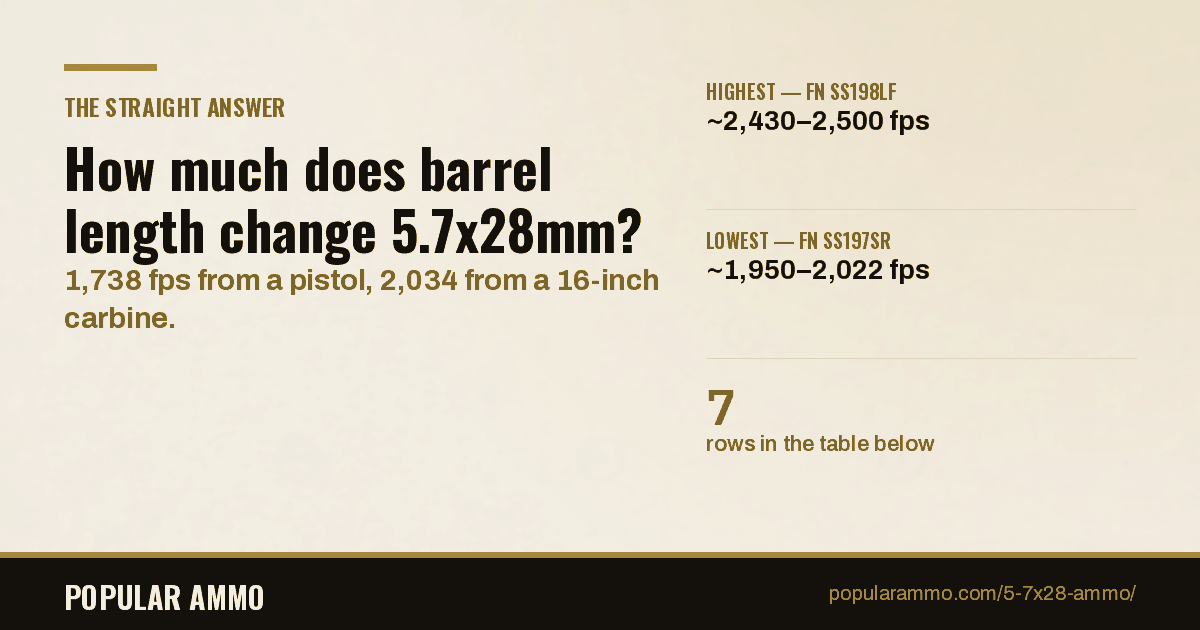
How to read this chart
Every number in this table is a published figure, copied from the source named underneath it — none of it is my own measurement. Read across a row to compare one entry, and down a column to compare them all on the same measure.
What is 5.7×28 ammo, and what was it built to do?


What it was built to do, in plain terms:
- Give a compact weapon more reach and a flatter trajectory than 9mm
- Defeat Cold War–era soft armor with a dedicated military projectile
- Cut recoil and cartridge weight so a soldier could carry more ammo and shoot faster
- Share one cartridge between a pistol and a PDW
It never replaced 9mm as NATO’s general sidearm cartridge. It did carve out a durable niche, and after FN’s patents expired the commercial market exploded: Ruger-57, Smith & Wesson M&P 5.7, PSA Rock, KelTec P50/R50/PR57, CMMG, and others.
Cartridge Specifications
|
Spec
|
Value
|
|---|---|
|
Designation
|
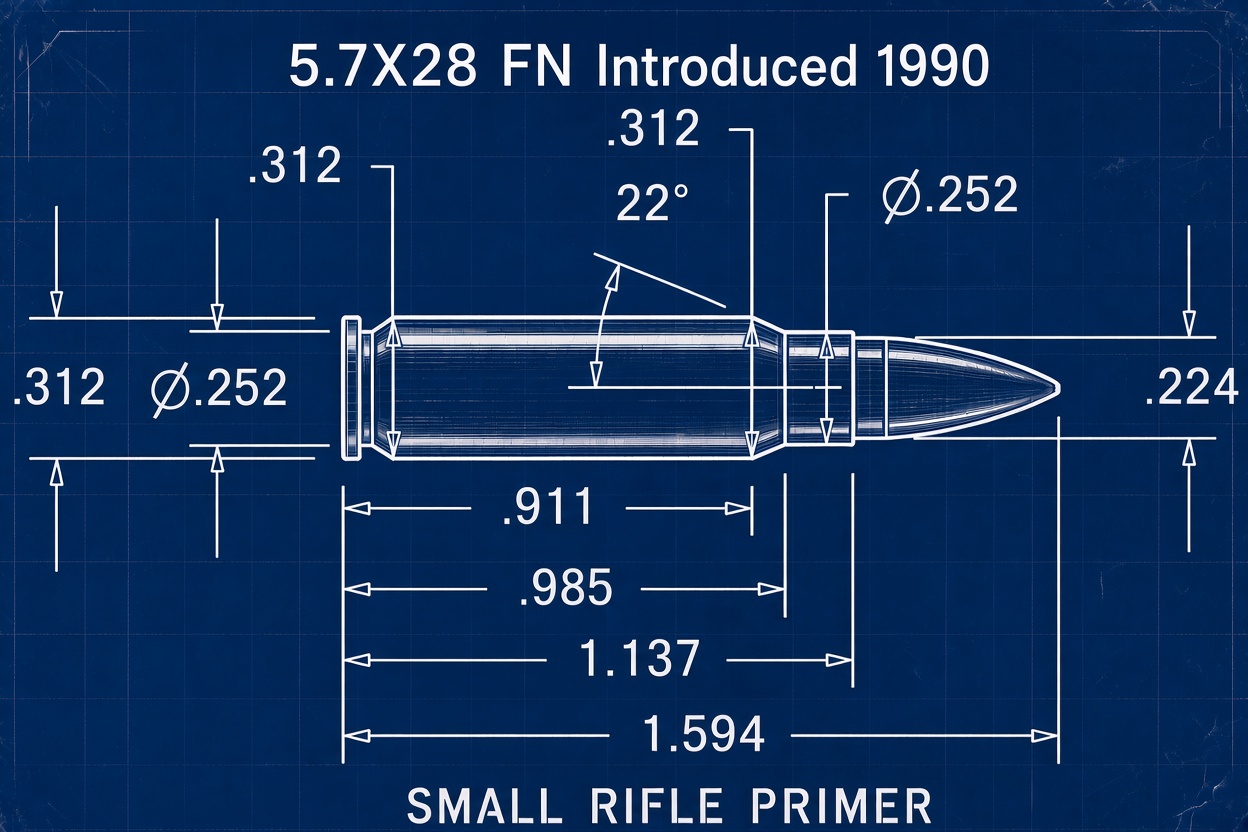
5.7x28mm / 5.7x28mm NATO
|
|
Case type
|
Rebated-rim, bottleneck, nearly straight walls
|
|
Bullet diameter
|
5.70 mm / .224 in
|
|
Case length
|
28.90 mm / 1.138 in
|
|
Overall length
|
40.50 mm / 1.594 in
|
|
Typical bullet weights
|
27–40 gr commercial; ~31 gr SS190; ~55–62 gr subsonic
|
|
Primer
|
Small rifle Boxer
|
|
Common rifling twist
|
1:9 (228.6 mm)
|
|
Max pressure (CIP)
|
345 MPa / ~50,000 psi
|
External Ballistics
|
Load
|
Bullet
|
Typical pistol (~4.8–5″)
|
P90 (~10.4″)
|
PS90 / 16″ carbine
|
|---|---|---|---|---|
|
FN SS197SR
|
40 gr V-Max
|
~1,738 fps / ~268 ft-lb
|
~1,950–2,022 fps
|
2,034 fps / 368 ft-lb
|
|
Federal AE5728A
|
40 gr TMJ
|
1,655 fps / 243 ft-lb
|
~2,000 fps class
|
~2,030 fps
|
|
Speer Gold Dot
|
40 gr JHP
|
~1,575–1,800 fps
|
~1,950 fps
|
~2,200 fps
|
|
FN SS195LF
|
27 gr lead-free HP
|
~1,890 fps / 222 ft-lb
|
~2,350–2,412 fps
|
2,132+ fps
|
|
FN SS198LF
|
27 gr lead-free HP
|
2,216 fps / 294 ft-lb
|
~2,430–2,500 fps
|
~2,530 fps / 384 ft-lb
|
|
FN SS190 (LE/mil)
|
~31 gr AP FMJ
|
~2,100–2,133 fps
|
~2,350 fps
|
~2,550–2,600 fps
|
|
Fiocchi subsonic
|
62 gr FMJ
|
~1,050 fps
|
—
|
—
|
Terminal Ballistics
Commercial 5.7 behavior in tissue depends on bullet construction and impact velocity.
- 40-grain V-Max (SS197SR and similar): Polymer tip drives rapid expansion or fragmentation on light game and gel. Excellent varmint bullet. Defensive results vary with velocity; from a pistol it can expand or come apart early.
- 40-grain bonded JHP (Speer Gold Dot, and similar defensive loads): Built to expand at 5.7 pistol speeds and hold together. This is the load class most often recommended for carry.
- 27-grain aluminum-core open-tip (SS195LF / SS198LF): Often looks like a hollow point but behaves more like an open-tip match bullet. At pistol and PDW velocity these rounds commonly yaw and tumble rather than mushroom. Gel tests frequently show dramatic upset and relatively modest penetration.
- 40-grain FMJ/TMJ (American Eagle, Fiocchi Range Dynamics, FN GUNR): Training bullets. They tend to penetrate more and expand less. Not the first choice for defense.
- SS190 (restricted): Designed to punch CRISAT/IIIA-class soft armor, then yaw. Soft-tissue penetration is often cited in the 11–13.5 inch range after armor, which is why FN marketed limited over-penetration as a feature. It is not a civilian load.

Current Loads
The ammo drought that defined 5.7 for twenty years is over. Availability in 2025–2026 is still narrower than 9mm, but the menu is usable.Training / range
- Federal American Eagle AE5728A, 40-grain TMJ, 1,655 fps from a 4.8-inch test barrel. The volume load.
- Fiocchi Range Dynamics 40-grain FMJ
- FN SS201 GUNR 40-grain FMJ
- AAC and other budget 40-grain FMJ / V-Max lines
Sporting / varmint
- FN SS197SR, 40-grain Hornady V-Max, blue tip. Still the reference commercial FN load. FN lists 1,738 fps from the pistol and 2,034 fps from the PS90.
- Fiocchi Hyperformance 40-grain polymer tip
Defense
- Speer Gold Dot 40-grain JHP
- FN SS200 DFNS 30-grain JHP
- Hornady Critical Defense 40-grain FTX
- Some Federal personal-defense 5.7 loads
Lead-free / indoor
- FN SS195LF, 27-grain aluminum-core open-tip, about 1,890 fps from the pistol
- FN SS198LF, hotter 27-grain lead-free load, 2,216 fps listed from the pistol
Suppressed / specialty
- Fiocchi 62-grain subsonic FMJ, around 1,050 fps. Trajectory and energy collapse; this is a noise load, not a PDW load.
- Restricted FN SB193 / SS193 subsonic for official users
- Boutique solid-copper and high-velocity specialty loads exist; they are not interchangeable with duty data
Barrel Length
|
Platform
|
Barrel
|
Role
|
|---|---|---|
|
FN Five-seveN
|
4.8 in
|
Original pistol
|
|
Ruger-57
|
4.94 in
|
Mainstream pistol
|
|
S&W M&P 5.7
|
5.0 in
|
Duty / range pistol
|
|
PSA Rock and similar
|
~5.1–5.3 in
|
Budget pistol
|
|
CMMG / AR-style 5.7 pistols
|
5–8 in
|
PDW-ish pistols
|
|
FN P90
|
10.4 in
|
Select-fire PDW
|
|
FN PS90 SBR / chopped
|
10.4 in
|
Civilian-legal short barrel where registered
|
|
FN PS90 carbine
|
16.04 in
|
U.S. rifle-length bullpup
|
|
Ruger LC Carbine and similar
|
~16.25 in
|
Conventional 5.7 carbine
|
- 4.8–5.3 inches: Pistol ballistics. 40-grain loads in the mid-to-high 1,600s fps. 27-grain loads from about 1,900 to a bit over 2,200 fps depending on the recipe. Fine for 25–50 yards. Recoil is soft. Muzzle blast is sharp.
- 8 inches: The first length where the cartridge starts to feel like a PDW instead of a hot .22. Expect a few hundred feet per second over a Five-seveN with the same ammo.
- 10.4 inches (P90 / PS90 SBR): The design length. This is where FN generated its original duty numbers. Independent chronograph work on a 10.4-inch PS90 SBR has shown SS197 around 2,022 fps and SS198 around 2,431 fps. SS190 in that test ran 2,279 fps.
- 16 inches: Maximum practical velocity for commercial powders in this case. FN’s PS90 figures put SS197 at 2,034 fps and 368 ft-lb. Light bullets can pick up another 150–300 fps versus the P90, depending on the load. Past 16 inches the returns flatten.
How to Think About the Caliber
Quick answers
Why do published velocities vary so much for the same load?
Because the makers are not measuring the same way. FN publishes figures from a Five-seveN pistol and a PS90 carbine and names both. Federal, Speer and Hornady publish from stated test barrels of 4.8 or 5 inches. A figure without a barrel length attached cannot be compared to one that has it.
Is 5.7×28 ammo armor piercing?
ATF’s 2005 determination classified the military SS190 as armor piercing under 18 U.S.C. 921(a)(17)(B), and classified SS192, SS195 and SS196 as not armor piercing. The loads sold commercially today are not SS190.
What does 5.7×28 ammo cost to shoot compared with 9mm?
We publish no prices — they move weekly, and any figure here would be wrong by the time you read it. What we can tell you is that 5.7×28 is loaded by a smaller number of makers than 9mm, which is the structural reason it has never been a bargain.
Does a longer barrel really help?
On FN’s own published numbers, yes, and substantially. Their SS198LF shows 2,216 fps from the Five-seveN and 2,530 fps from the PS90. That is the largest published pistol-to-carbine gain of any load in their catalog.
Where to go next
If you are weighing 5.7×28 ammo against a conventional defensive handgun cartridge, our .380 vs 9mm comparison covers how bullet weight and velocity trade against each other in a small pistol, and our 9mm vs .45 ACP breakdown covers the same argument at the other end of the weight range. For the way cartridge names map to actual bullet diameters, see our caliber comparison chart. Readers building a suppressed host around a compact cartridge may also want Popular Suppressors.
Sources
- SAAMI, Public Introduction drawing, 5.7 X 28 FN, issued 11 July 2024 (posted 23 July 2024)
- SAAMI, announcement of acceptance of the 5.7 X 28 FN cartridge, 21 August 2024
- FN Herstal, 5.7x28mm caliber pages
- FN America product pages: SS197SR, SS198LF, SS195LF, SS200, SS201
- Hornady, 5.7x28mm 40 gr FTX Critical Defense, item 90000
- Speer, Gold Dot Personal Protection 25728GD
- Federal, American Eagle AE5728A
- Fiocchi, Range Dynamics 57FMJ40
- ATF, “FR 5.7 (Fabrique Nationale) Pistol is a Semiautomatic Pistol in 5.7 X 28 MM Caliber,” 20 January 2005


Ammunition reference desk
Three charts readers come back to: what a round costs today, what a cartridge name really measures, and what shipping and tax add.
| .22 LR | 6.59¢ |
| 9mm Luger | 26.98¢ |
| 5.56 NATO | 44.95¢ |
| .270 Win | .278 in |
| .30-30 Win | .309 in |
| .308 Win | .309 in |
| Case price | $269.80 |
| Shipping and tax | +$18.89 |
| Per round | 28.87¢ |
Reader Favorites