50 BMG Ammo: Specs, Loads and Where It Is Restricted
50 BMG is not a SAAMI cartridge at all: its dimensional standard and its pressure limit both come from Europe, not the American body.
Last updated: October 6, 2026 · Originally published September 10, 2026
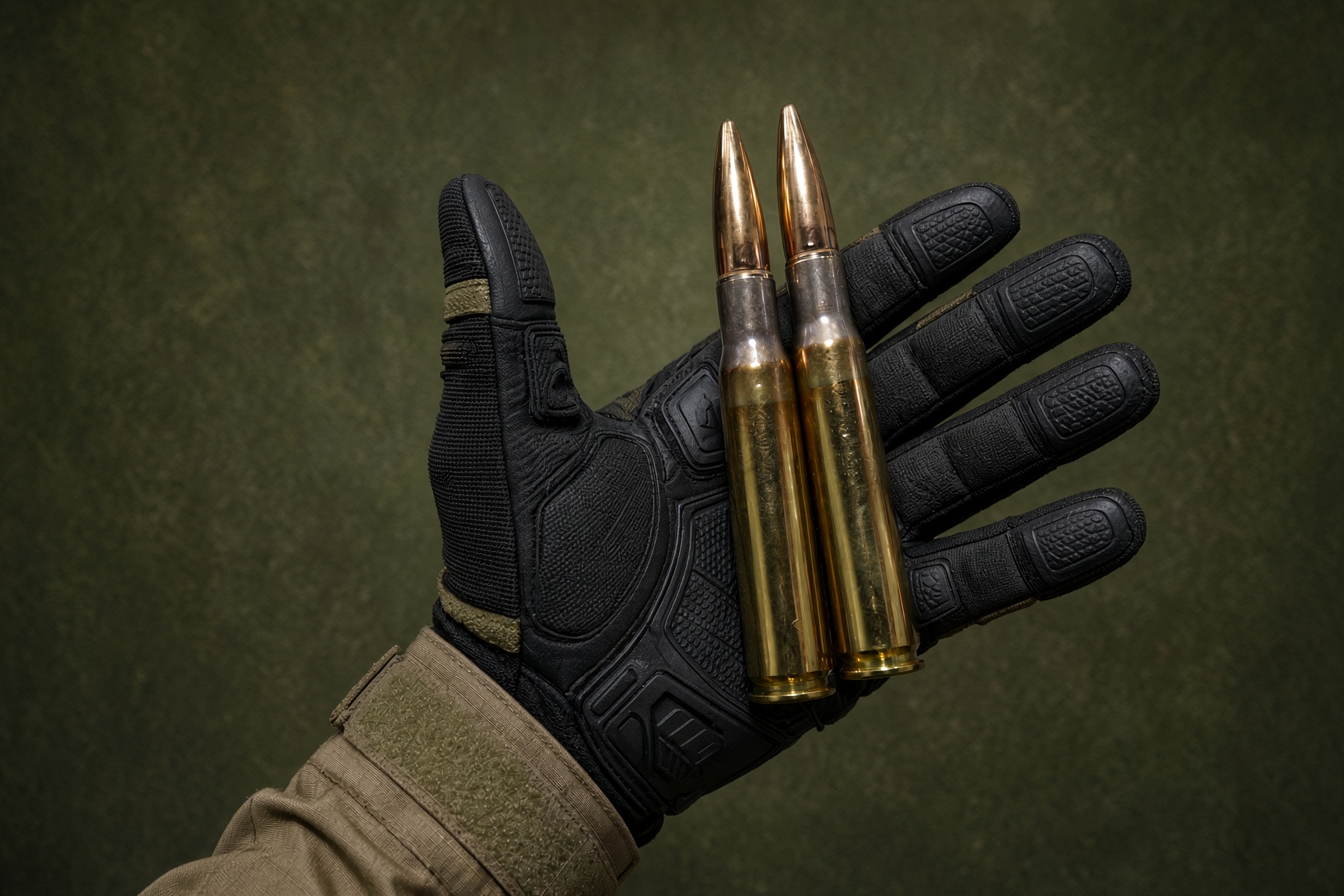
.50 BMG is not a SAAMI cartridge. I checked four separate SAAMI documents and it appears in none of them — no drawing, no pressure limit, not even a listing in the industry’s own “generally accepted cartridge names.” The dimensional standard 50 BMG ammo is actually built to comes from Europe, and the pressure limit is published in bar.
What I want you to walk away with
- SAAMI does not standardize .50 BMG. The retrievable civilian standard is the C.I.P. sheet for “50 Browning”: Pmax 3,700 bar, case 99.31 mm, twist 1 turn in 381 mm which is 1 in 15 inches.
- Every rifle maker I checked cuts 1:15, matching that sheet: Barrett, Accuracy International, ArmaLite and Serbu all publish it.
- Published civilian loads run 2,815 to 2,950 fps and 13,196 to 13,688 ft-lb from 36-inch test barrels.
- Illinois bans the cartridge itself, not just the rifle. California, DC and Connecticut each restrict differently, and Connecticut names three Barrett models by model number.
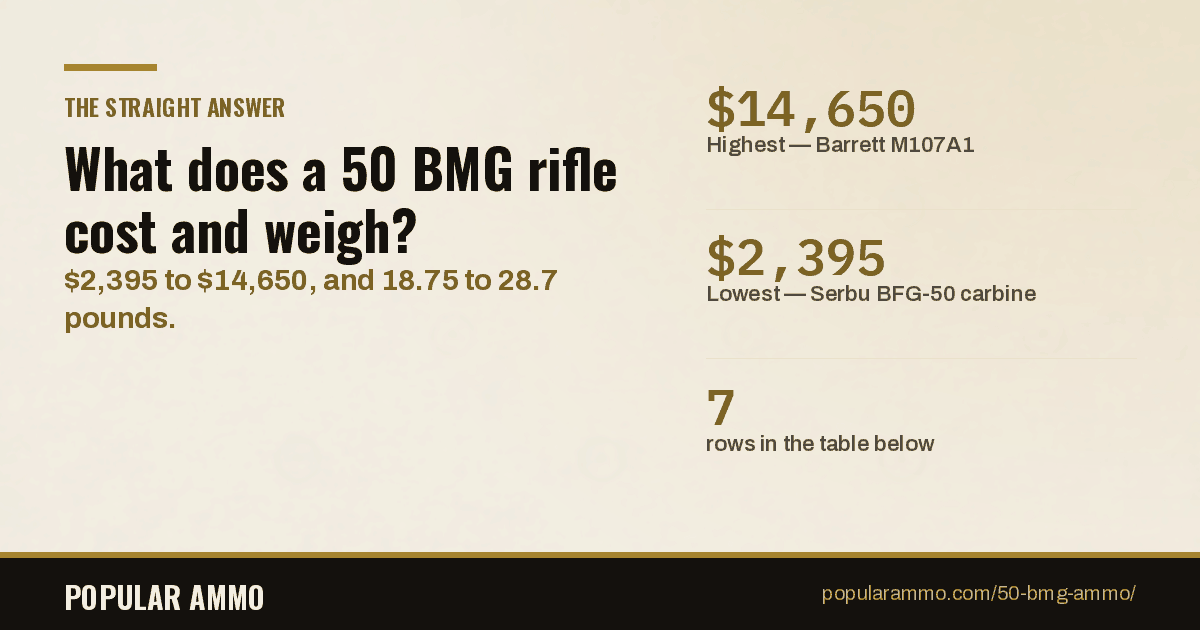
- Rifles run 18.75 to 37.1 pounds and $2,395 to $14,650 at published retail. No maker publishes a barrel life figure.
Here’s how I read this chart
Every number in this table is a published figure, copied from the source named underneath it — none of it is my own measurement. Read across a row to compare one entry, and down a column to compare them all on the same measure.
What standard is 50 BMG ammo actually built to?
This is the first surprise for anyone used to looking cartridges up in a SAAMI drawing. I searched the current ANSI/SAAMI Z299.4 centerfire rifle standard, SAAMI’s index of all six of its standards, its new-and-revised cartridge drawings page, and its Generally Accepted Cartridge and Chamber Names document. “.50 BMG”, “50 Browning Machine Gun” and “12.7×99” appear in none of them. The largest cartridges the rifle standard carries are the 500 Nitro Express and the .458 Lott.
That is not an oversight. It is a military cartridge that civilians happen to be able to buy, and the American voluntary standards body has never taken it in.
What does exist is a C.I.P. sheet — the European proof-house body whose figures govern commercial ammunition across its member states. Its “50 Browning” sheet is the retrievable dimensional standard.
| Specification | Value |
|---|---|
| Bullet diameter | 12.98 mm (about .511 in) |
| Case length | 99.31 mm (about 3.91 in) |
| Cartridge overall length | 138.43 mm (about 5.45 in) |
| Bore / groove diameter | 12.66 mm / 13.16 mm |
| Grooves | 8 |
| Twist | 381.00 mm — 1 turn in 15 inches |
| Maximum pressure, Pmax | 3,700 bar |
| Proof pressures | 4,255 bar statistical, 4,625 bar |
| Test barrel length | Not published on the sheet |
The military standards that govern the cartridge’s original life — NATO’s STANAG 4383, and the US MIL-DTL-10190 specification for the M33 ball round — are not openly published. I tried the Defense Logistics Agency’s document search, the Defense Technical Information Center and the Army Publishing Directorate; the relevant documents were either unavailable, blocked, or turned out to cover other calibers. So the figures in this article come from C.I.P. and from the ammunition makers, and where a military figure would be the right source, I say it is not available rather than substituting one.


Quick answers
Is 50 BMG ammo legal to own?
In most of the United States, yes. It is restricted in California, Illinois, the District of Columbia and — for certain projectile types — Connecticut. Illinois is the strictest: it reaches the cartridge itself, not only the rifle. See the section below, and check your own state’s current law rather than this page.
What twist rate does 50 BMG ammo need?
One turn in 15 inches. That is what C.I.P. publishes and what Barrett, Accuracy International, ArmaLite and Serbu all cut. There is no meaningful disagreement here, which makes it unusual among the cartridges I cover.
How much energy does it actually make?
Published muzzle energy runs 13,196 to 13,688 foot-pounds. For scale, a .45-70 at the top of its pressure range publishes around 3,200 ft-lb, and a heavy .44 Magnum load about 1,500.
Why is barrel length such a large part of the specification?
Because the published velocities come from 36-inch test barrels, and most rifles chambered for it wear 20 to 32 inches. Both makers who publish ballistics state the 36 inches plainly, which is more than most cartridges get.
Can I shoot it without the muzzle brake?
Barrett’s answer is unambiguous: “Never fire your rifle without the muzzle brake or with an aftermarket muzzle brake.”
50 BMG ammo: what is catalogd for civilians

Here’s how I read this chart
Muzzle energy in foot-pounds, on a scale that has to include everything. The .50 BMG bar is not a mistake — it carries roughly four times the energy of the heaviest .45-70 load and about nine times a heavy .44 Magnum. Note that these come from different barrel lengths, because that is how each maker publishes them; the .50 BMG figure is from a 36-inch test barrel.
| Load | Gr | Muzzle velocity | Muzzle energy | BC |
|---|---|---|---|---|
| PMC Bronze 50A, FMJ boat tail | 660 | 2,950 fps | 13,688 ft-lb | .701 |
| PMC X-TAC Match 50XM, solid brass | 740 | 2,830 fps | 13,337 ft-lb | .909 |
| Hornady 8270, 750 gr A-Tip Match | 750 | 2,815 fps | 13,196 ft-lb | not published |
Hornady publishes the fullest trajectory of the three: from 2,815 fps and 13,196 ft-lb at the muzzle, it is still doing 2,393 fps and 9,538 ft-lb at 500 yards, with 35.6 inches of drop from a 200-yard zero. Losing only 15 per cent of its velocity over 500 yards is what a heavy bullet with a high ballistic coefficient buys.
PMC’s Bronze load publishes velocity to 500 yards but no downrange energy, and its X-TAC Match publishes velocity only. Hornady, oddly, publishes no ballistic coefficient at all for the 750-grain projectile — not on the ammunition page, not on the component bullet page, and not in its own published BC tables, which stop at .416.
Barrett sells ammunition under its own name and publishes no ballistics for it whatsoever — no velocity, no energy, no coefficient. Winchester catalogs no .50 BMG at all. Federal’s site indexes an American Eagle XM33C but every route to its specification page returns a not-found error.
One more source worth knowing about: CBC, Magtech’s parent, publishes a defense catalog with nine 12.7×99 loadings — ball, tracer, armor piercing, incendiary and two “sniper” solids rated at 1 and 2 minutes of angle at 1,000 meters. Those are military products, quoted at 24 meters from a 45-inch barrel, and are not sold as sporting ammunition.
Where 50 BMG ammo is restricted
Four jurisdictions, four different approaches. This is a summary of what the statutes say, not legal advice, and gun law changes faster than any article.
Illinois is the broadest, because it reaches the ammunition. Under 720 ILCS 5/24-1.9, a “.50 caliber cartridge” means “a cartridge in .50 BMG caliber, either by designation or actual measurement, that is capable of being fired from a centerfire rifle,” and the statute makes it unlawful “to knowingly manufacture, deliver, sell, import, or purchase” one from January 2023, and unlawful “to knowingly possess” one from January 2024.
California bans the rifle. The state defines a “.50 BMG rifle” as “any center fire rifle that can fire a .50 BMG cartridge and that is not already an assault weapon or machinegun,” and defines the cartridge dimensionally overall length 5.54 inches, bullet .510 to .511 inch, case base .800 to .804 inch, case length 3.91 inches. Possession, manufacture, transport and import were prohibited from 1 January 2005, with a registration window for rifles already owned that closed on 30 April 2006.
The District of Columbia reaches the same result by a different route: a .50 BMG rifle cannot be issued a registration certificate, and possessing an unregistered firearm is unlawful. Its ammunition is separately swept in as a “restricted pistol bullet.”
Connecticut does not ban the caliber. It bans two ammunition types — armor piercing and incendiary .50 caliber bullets, each defined by design intent and by named military designations such as M2 AP, M8 API and M903 SLAP — and makes distribution a class D felony. Separately, its assault weapons list names the Barrett Light-Fifty model 82A1, the Barrett REC7 and the Barrett M107A1 by model.
One honesty note on sourcing. California’s official code publisher blocks automated retrieval, so the language quoted above comes from California Department of Justice publications, which are official state documents but use the pre-2012 section numbering. The current sections are 30525, 30530, 30600, 30605 and 30900; I could not retrieve their verbatim current text from an official source and am not going to quote it from anywhere else.

What a 50 BMG rifle actually is
| Rifle | Barrel | Weight | Twist | Published retail |
|---|---|---|---|---|
| Barrett M107A1 | 29 in | 28.7 lb | 1:15 | $14,650 |
| Barrett Model 82A1 | 29 in | 32.7 lb | 1:15 | $9,820 |
| Barrett Model 99 | 29 in | 23 lb | 1:15 | $5,410 |
| ArmaLite AR-50 A1 | 30 in | 37.1 lb | 1:15 | $4,750 |
| Accuracy International AX ELR | 27 in | 26.6 lb (12.06 kg) | 1:15 | not published |
| Serbu BFG-50 carbine | 22 in | 15.25 lb | 1:15 | $2,395 |
| Serbu BFG-50 standard | 29.5 in | 18.75 lb | 1:15 | $2,395 |
Two published statements from Barrett are worth carrying over, because they answer questions people ask constantly. On muzzle brakes: “Never fire your rifle without the muzzle brake or with an aftermarket muzzle brake.” And on suppressor compatibility, the two rifles differ — the M107A1’s “cylindrical muzzle brake accepts Barrett QDL Suppressor,” while the Model 82A1 “does not come equipped with a suppressor capable muzzle brake, and will not accept any large caliber suppressors including the Barrett QDL suppressor.”
Barrett also states that corrosive ammunition will damage the firearm and that resulting damage “is not covered under the warranty agreement,” and that its .50 BMG rifles “are not cut for bore rider cartridges.”
What nobody publishes about 50 BMG ammo
- Barrel life. Not one of the six rifle makers I checked publishes a round count. For a cartridge with this reputation for eating barrels, that is a conspicuous silence.
- A ballistic coefficient from Hornady for its 750-grain projectile — absent from the ammunition page, the component page and its own BC tables.
- Any ballistics at all from Barrett for the ammunition it sells under its own name.
- Downrange energy from PMC on either load.
- A test barrel length on the C.I.P. sheet.
- The military standards. STANAG 4383 and MIL-DTL-10190 are not openly published, and I could not retrieve either from an official source.
Where to go next
For the other end of the size range, my 5.7×28 ammo page covers a cartridge designed around the opposite priorities, and 45-70 ammo covers the heaviest cartridge most people will actually shoot. The caliber comparison chart puts .510 inches in context against everything else.
The .50 BMG is not in the SAAMI standard, so it is not on my rifle caliber chart, which draws 26 standardized rifle cartridges at true scale.
Sources
- ANSI/SAAMI Z299.4-2025; SAAMI standards index; SAAMI cartridge and chamber drawings index; SAAMI Generally Accepted Cartridge and Chamber Names — all four checked, .50 BMG absent from each
- C.I.P. TDCC sheet, 50 Browning
- Hornady item 8270 and its .510 component bullet page; PMC Bronze 50A and X-TAC Match 50XM; Barrett ammunition listings; CBC defense ammunition catalog
- 720 ILCS 5/24-1.9, Illinois General Assembly; California Department of Justice Firearms Division Information Bulletin 2004-FD-08 and California Firearms Laws 2007 and 2021; D.C. Official Code sections 7-2501.01 and 7-2502.02; Connecticut General Statutes sections 53-202l and 53-202a
- Barrett M107A1, Model 82A1, Model 99 product pages, FAQ and 2027 retail price list; Accuracy International AX ELR; ArmaLite AR-50 A1; Serbu BFG-50


Ammunition reference desk
Three charts readers come back to: what a round costs today, what a cartridge name really measures, and what shipping and tax add.
| .22 LR | 6.59¢ |
| 9mm Luger | 26.98¢ |
| 5.56 NATO | 44.95¢ |
| .270 Win | .278 in |
| .30-30 Win | .309 in |
| .308 Win | .309 in |
| Case price | $269.80 |
| Shipping and tax | +$18.89 |
| Per round | 28.87¢ |
Reader Favorites