
9mm Hollow Point Explained: Nosler ASP, Weights and the Law
9mm hollow point bullets carry a nose cavity built to expand; Nosler’s ASP loads them at 115, 124 and 147 grains, standard pressure.
Last updated: November 6, 2026 · Originally published November 1, 2026
Sponsor note. Nosler is a sponsor of our Giving Thanks giveaway and donated the prize this page covers. Safety and legal note. Know your target and what is beyond it, every time. Hollow point ammunition is restricted in New Jersey, so check your own state’s law before you carry it. Specs come from Nosler’s own product pages, read in October 2026. No link on this site earns us a commission.

Enter the Giving Thanks giveaway here: fill in your name, email and date of birth below.
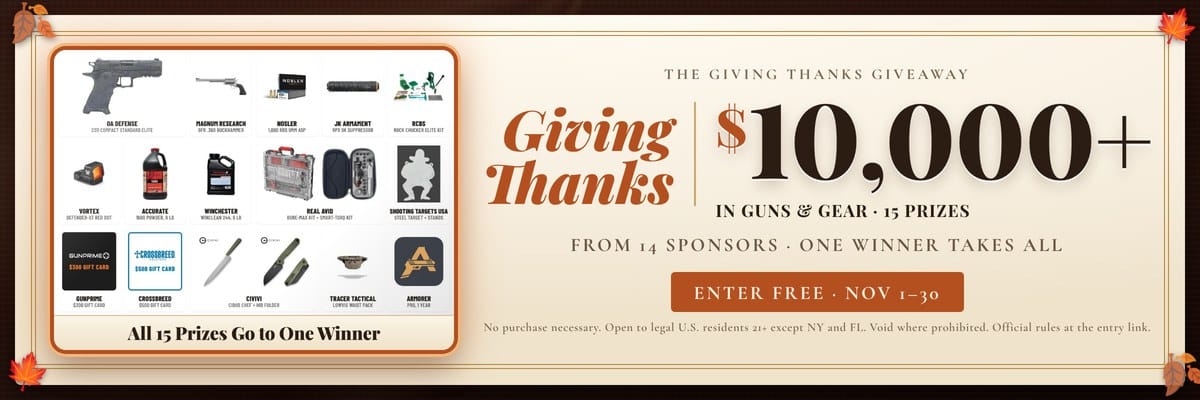
Giving Thanks $10,000+ Guns & Gear Giveaway
A 9mm hollow point, the round most counters label 9mm JHP (jacketed hollow point), is a 9mm Luger cartridge whose bullet has a cavity in the nose that SAAMI’s glossary says is there “to facilitate expansion.” That cavity is the whole difference from the round-nose full metal jacket most people buy by the case for the range, and it is why the hollow point is the one in the carry gun.
It is also the reason New Jersey treats them differently: it makes possessing hollow nose bullets outside a short list of places a fourth-degree crime, so read your own state’s law before you load a magazine. Same cartridge, different bullet, different job.
Here is the funny part. Most people who carry hollow points practice with something else, so the load they would bet their life on is the load they shoot least. A thousand rounds of carry-grade hollow points flips that around, and that is exactly what Nosler put up in our Giving Thanks giveaway.
9mm Hollow Points at a Glance
- What it is: a 9mm Luger bullet with a nose cavity made to expand (SAAMI).
- Nosler ASP: 115 gr at 1,170 fps, 124 gr at 1,150 fps, 147 gr at 950 fps, per Nosler.
- Pressure: Nosler rates all three standard pressure, even if the case says +P.
- The law: New Jersey’s 2C:39-3(f) limits where you may possess them.
- The prize: 1,000 rounds of the 115 gr ASP, one of 15 prizes in a $10,000+ giveaway.
Nosler ASP 9mm Loads
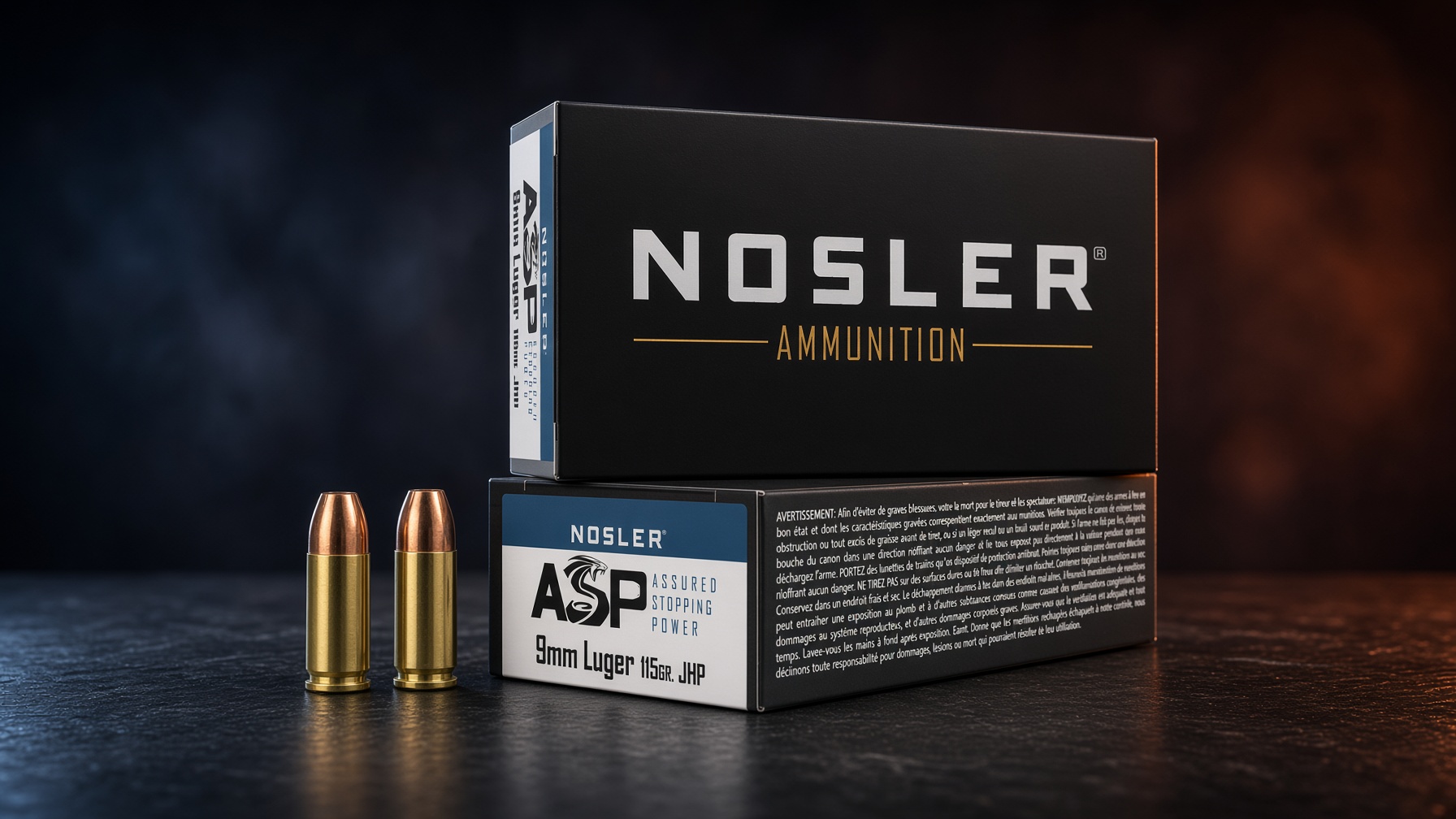
For as long as I’ve been a professional in the firearms industry, I have watched people agonize over which hollow point to carry and then never fire more than one box of it. So before we get into what the bullet does, here is what Nosler builds. ASP stands for “Assured Stopping Power,” and Nosler sells it in 9mm Luger at three bullet weights, every one a jacketed hollow point in Nosler-headstamped brass.
| Load (Nosler part, 50 count) | Muzzle velocity and energy | At 25 yards | 20-round box (Nosler part) |
|---|---|---|---|
| 115 gr JHP ASP (51017) The giveaway load |
1,170 fps; 350 ft-lbs | 1,090 fps; 303 ft-lbs | 51285 |
| 124 gr JHP ASP (51054) | 1,150 fps; 364 ft-lbs | 1,080 fps; 321 ft-lbs | 51286 |
| 147 gr JHP ASP (51325) | 950 fps; 295 ft-lbs | 924 fps; 278 ft-lbs | 51290 |
Every figure is from Nosler’s product page for that load. Nosler does not list the test-barrel length on these pages, so your own pistol’s numbers will differ.
Nosler’s Assured Stopping Power (ASP) line of 9mm Luger ammunition pairs match-grade loading practices with a purpose-built jacketed hollow-point (JHP) bullet intended for duty and defensive use. The ASP projectile uses a pure-lead core inside a gilding-metal jacket that is deeply skived to promote controlled expansion across a broad range of impact velocities (roughly 800–1,300 fps). The jacket mouth is profiled for smooth feeding, and the loads are standard-pressure (not +P), even when +P brass is used. Nosler currently offers three 9mm ASP weights: a 115-grain JHP advertised at approximately 1,170 fps and 350 ft-lbs of energy; a 124-grain JHP at about 1,150 fps and 364 ft-lbs; and a 147-grain JHP at roughly 950 fps and 295 ft-lbs that is designed to remain subsonic for suppressed use. All are loaded in Nosler-headstamped brass with carefully weighed powder charges and inspected finished rounds.
Independent tests have generally shown the ASP bullets delivering consistent expansion (often in the 1.5–1.6× original diameter range) with high weight retention and penetration that frequently falls inside the 12–18-inch window favored by many law-enforcement protocols. Real-world chronograph results from shorter barrels typically run 50–100 fps below published figures, which is common for 9mm and still leaves the lighter loads with enough velocity to expand reliably while producing milder recoil that can be advantageous in compact or lightweight pistols. Accuracy and function have been described as strong across the line, with clean-burning powders and reliable feeding. Because hollow-point designs are optimized for energy transfer and reduced over-penetration relative to full-metal-jacket rounds, they are widely issued to law enforcement and preferred by many civilians for self-defense; however, laws governing their possession and carry vary by jurisdiction. In most of the United States they are unrestricted, but New Jersey, for example, limits civilian possession of “hollow-nose” ammunition outside the home, range, or certain other narrow exceptions. Shooters should verify current local statutes before selecting or carrying any hollow-point load.

What Makes a 9mm Hollow Point Different
SAAMI (the Sporting Arms and Ammunition Manufacturers’ Institute) defines a hollow point bullet as “a bullet with a cavity in the nose to facilitate expansion,” and it lists “Open Point Expanding Bullet” as another name for the same thing. A full metal jacket bullet, by SAAMI’s definition, is one where the jacket “encloses most of the core with the exception of the base.” So the round-nose range load has its copper over the front, and the hollow point leaves the front open on purpose.
Why does that matter? A closed copper nose has nothing to start the bullet opening, so it tends to keep its shape. An open nose with a cavity behind it gives the bullet a place to start peeling back. Nosler describes the ASP jacket as “skived,” meaning it is cut at the mouth, and says it is “engineered for reliable expansion at a range of impact velocities,” with a jacket mouth “designed for smooth, reliable feeding.” That last part is the one I care about, because a hollow point that will not feed in your pistol is a very expensive paperweight.
That is the short version of hollow point vs FMJ. If you want every bullet type side by side, our ammo types explained chart lays them out, and it lands where I do: train with the cheap stuff, defend with a hollow point you have proven in your gun.
115, 124 or 147 Grain?
Nosler’s ASP line covers the three most common defensive 9mm weights, and each is tuned for a slightly different job. The 115-grain load runs the highest advertised velocity (around 1,170 fps) and produces the lightest recoil, which can make it easier to control in compact or lightweight pistols while still generating enough speed for reliable expansion. The 124-grain sits in the middle at roughly 1,150 fps and 364 ft-lbs, and is the weight many law-enforcement agencies favor for its balance of velocity, penetration, and controllable recoil in full-size service pistols. The 147-grain is the heaviest and slowest of the three (advertised at about 950 fps and 295 ft-lbs), deliberately kept subsonic so it works cleanly with suppressors and produces less noise and muzzle blast; its greater mass can also help with barrier performance in some tests. All three use the same skived-jacket ASP hollow point, so expansion and weight retention remain consistent within each load’s intended velocity window.
There is no single “correct” grain weight. A load that expands perfectly and penetrates the ideal distance in gelatin is useless if it fails to feed, extract, or cycle reliably in your particular pistol. Barrel length, recoil-spring weight, magazine design, and even the specific gun’s tolerances all affect how a given weight and profile behaves. The practical test is simple: load your defensive magazines with the candidate ammunition and verify that it functions every single time through a realistic course of fire, including one-handed manipulations and from a variety of magazine states. Once you have identified the Nosler ASP weight that your firearm runs without fail, that is the right choice for you, whether it is the lighter 115-grain for reduced recoil, the balanced 124-grain, or the subsonic 147-grain for suppressed use.
Why Practice With Your Carry Load
Think about it: you would not buy a truck and never drive it until the day you need to tow something. Yet that is how most people treat carry ammo. They load one box and do every bit of their shooting with round-nose ball.
Shooting your carry load answers two questions nothing else will. One, does this pistol feed, fire and eject this exact load, from every magazine you own? Our best 9mm self-defense page says to run at least 200 rounds of your chosen carry load through your actual carry pistol, and I agree with the spirit of that number. Two, where does it hit at the distances you would use it? If your carry load and your practice load print to different spots, you want to know that on a Saturday at the range and not on the worst night of your life.
The reason people skip it is cost, plain and simple. Round-nose ball is the cheapest practice ammo per round, and our cost per round calculator will show you exactly what each load costs per shot once shipping and tax are in. That gap is why a thousand rounds of hollow points is a bigger deal than it sounds. It is enough to function-check every magazine, confirm your point of impact, and still keep a fresh supply for the carry gun.
Are 9mm Hollow Points Legal?
New Jersey has a statute aimed squarely at these bullets. N.J.S.A. 2C:39-3(f)(1) makes it a crime of the fourth degree for anyone other than a law enforcement officer, or a person engaged in the activities listed in 2C:39-6(f), to knowingly possess “any hollow nose or dum-dum bullet.” Then the statute carves out where you may have them.
| Situation | What the law says | Where it says it |
|---|---|---|
| Keeping them at home | Allowed at your dwelling, premises or other land you own or possess | 2C:39-3(g)(2)(a) |
| Bringing them home from the store | Allowed from the place of purchase to that dwelling or land; the seller records the buyer’s name, age, address, date and quantity | 2C:39-3(g)(2)(a) |
| Range, club or target practice | Allowed for the 2C:39-6(f) activities, such as rifle and pistol club members going to target practice and travel directly to or from a range, with the firearm unloaded in a closed and fastened case or locked trunk | 2C:39-3(f)(1); 2C:39-6(f) and (g) |
| Hunting | Allowed under the 2C:39-6(f) hunting exemptions, in the field or traveling directly to or from the hunt, with a valid hunting license in your possession | 2C:39-6(f)(2) and (f)(3)(a) |
| Carrying under a permit to carry | No permit-holder exception in 2C:39-3; I searched the section’s text for “permit” and “carry” and found none that covers hollow nose bullets | 2C:39-3 (Justia, 2025 edition) |
Rows are from the text of N.J.S.A. 2C:39-3 and N.J.S.A. 2C:39-6, read on Justia’s 2025 edition. If you carry in New Jersey, confirm the current rule with a New Jersey lawyer before you load hollow points.
I am not your lawyer, so if you live or travel anywhere else, read that state’s statute the same way: find the section, read the exceptions, and believe the text over the forum post. For travel through other states, federal law (18 U.S.C. 926A) protects transport only when the firearm is unloaded and neither the gun nor the ammunition is readily accessible from the passenger compartment.
From 1,000 Rounds to 1,000 Cases
Here is the part I like most about this prize. When you shoot a thousand rounds of Nosler ASP, you are left holding a thousand pieces of Nosler brass, and that brass is a reloader’s head start. Hodgdon describes Winchester WinClean 244 as a ball powder “ideally suited to 38 Special, 45 Auto, and 9mm standard loads,” and an RCBS Rock Chucker Supreme Elite Kit is also in the same giveaway. Shoot the hollow points, keep the brass, and you have the start of a closed loop. Our guide to reloading 9mm walks through the press, the dies and where the published data lives.
I will not print a charge weight here, and neither should anyone else who has not got it from the powder maker. Get every number from Hodgdon’s Reloading Data Center, start at the starting load, and work up the way the data tells you to.
Win 1,000 Rounds in the Giving Thanks Giveaway
Nosler’s prize is two cases of the 9mm 115 grain JHP ASP, 1,000 rounds in all, and it is one of 15 prizes in the Giving Thanks $10,000+ Guns & Gear Giveaway. One winner takes all 15, worth $10,000+ together, from an OA Defense 2311 pistol package to a Magnum Research BFR revolver to this case lot of hollow points. The giveaway is free to enter and runs November 1–30, 2026, for legal U.S. residents 21 and older, excluding New York and Florida. No purchase necessary. Firearm prizes ship to the winner’s local FFL. Details and the entry are on the Giving Thanks giveaway page at Guns and Gadgets Daily.
A .30-06 or .308 led, with magnums and straight-wall cartridges tied for second.
Frequently Asked Questions
Is hollow point 9mm illegal?
In New Jersey it can be, depending on where you have it. Its statute, 2C:39-3(f), makes possession a fourth-degree crime outside your home or land, the trip home from the store, and the range, club and hunting activities in 2C:39-6(f). Everywhere else, check your own state’s statute before you carry.
What are 9mm hollow points good for?
Nosler builds its ASP line “specifically for duty and defensive use,” and New Jersey’s statute allows them for hunting with a valid license. For plain paper-punching, round-nose ball costs less, which is why most people practice with it.
Do they make 9mm hollow points in different weights?
Yes. Nosler’s ASP comes in 115, 124 and 147 grain, each in 20- and 50-round boxes, so you can try a second weight without leaving the line if your pistol does not like the first.
What is so special about hollow point bullets?
The open nose. SAAMI defines the hollow point by its cavity “to facilitate expansion,” while a full metal jacket covers everything but the base. Nosler adds a skived jacket on the ASP to help it open across a range of impact velocities.
Is Nosler ASP 9mm +P?
No. Nosler says each ASP 9mm load “may be loaded +P brass but is standard pressure,” so a +P headstamp on the case does not make the load +P.
My verdict: carry a hollow point your pistol has eaten a few hundred of, and practice with it often enough that it feels boring. If someone hands you 1,000 rounds of carry ammo, the only wrong move is saving it for a rainy day (it is supposed to be fired, people).
Sources: Nosler, “ASP Assured Stopping Power Ammunition”; Nosler product pages for the 115 gr, 124 gr and 147 gr JHP ASP; SAAMI glossary, “Hollow Point Bullet” and “Full Metal Jacket Bullet”; N.J.S.A. 2C:39-3, prohibited weapons and devices, including hollow nose bullets (Justia, 2025); N.J.S.A. 2C:39-6, exemptions (Justia, 2025); 18 U.S.C. 926A, interstate transportation of firearms; Hodgdon, “Winchester WinClean 244”; Hodgdon Reloading Data Center.
Ammunition reference desk
Three charts readers come back to: what a round costs today, what a cartridge name really measures, and what shipping and tax add.
| .22 LR | 6.59¢ |
| 9mm Luger | 26.98¢ |
| 5.56 NATO | 44.95¢ |
| .270 Win | .278 in |
| .30-30 Win | .309 in |
| .308 Win | .309 in |
| Case price | $269.80 |
| Shipping and tax | +$18.89 |
| Per round | 28.87¢ |
Reader Favorites