9mm vs 40 S&W: Same Pressure, Different Bullet
9mm and 40 S&W are rated to the same maximum pressure; the difference between them is bullet diameter and weight, not how hard they run.
Last updated: September 21, 2026 · Originally published September 9, 2026
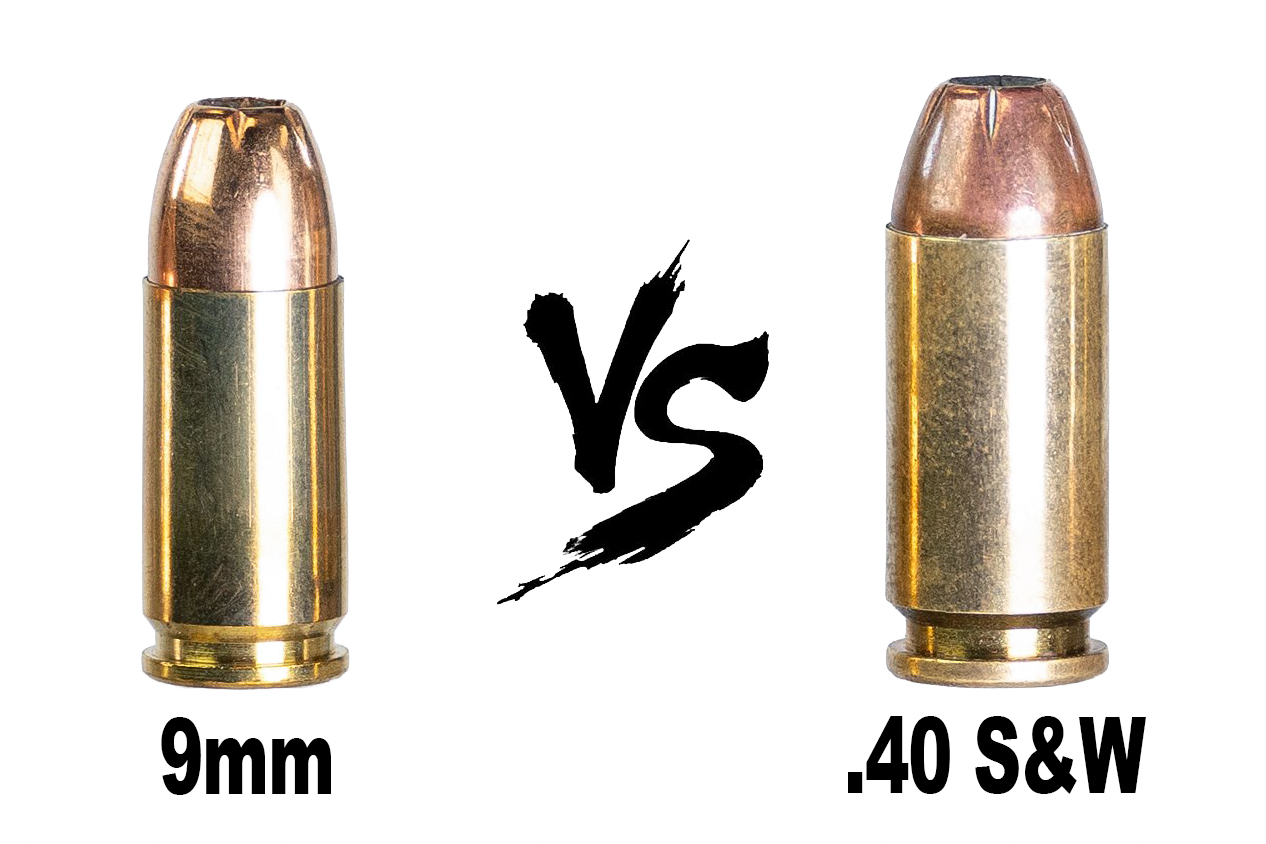
The 9mm Luger and the .40 S&W are loaded to exactly the same pressure — 35,000 psi — and tested in exactly the same 4-inch barrel. Almost nothing else about this comparison is symmetrical, but that starting point is, and it changes how you should read every velocity figure below.
What I want you to walk away with
- Maximum average pressure is 35,000 psi for both. The test barrel is 4.000 inches for both. The .40’s advantage is bullet diameter and weight, not intensity.
- SAAMI standardizes a 9mm Luger +P at 38,500 psi. There is no .40 S&W +P. The smaller cartridge is the one with a factory-standardized hot option.
- The cleanest matched pair in the industry: Hornady’s Critical Duty at 1,010 fps in both, from the same 4-inch barrel — 306 ft-lb against 396.
- The FBI’s 2014 memo is the document behind the switch back. Its own words: 9mm “offers higher magazine capacities, less recoil, lower cost… and higher functional reliability rates.”
- Speer’s consumer catalog no longer lists .40 S&W in any product line. Seven calibers are offered; the .40 is not among them.

Here’s how I read this chart
Every number in this table is a published figure, copied from the source named underneath it — none of it is my own measurement. Read across a row to compare one entry, and down a column to compare them all on the same measure.
The specifications, side by side
| Specification | 9mm Luger | 9mm Luger +P | .40 S&W |
|---|---|---|---|
| SAAMI name | 9mm Luger | 9mm Luger +P | 40 Smith & Wesson |
| Case type | Rimless, tapered | same | Rimless, straight |
| Bullet diameter | .3555 in | .3555 in | .4005 in |
| Case length | .754 in | .754 in | .850 in |
| Cartridge overall length | 1.000 – 1.169 in | same | 1.085 – 1.135 in |
| Rim / head diameter | .394 in | same | .424 in |
| Bore / groove diameter | .346 / .355 in | same | .390 / .4005 in |
| Minimum bore and groove area | .0968 in² | same | .1232 in² |
| Twist | 1 in 10 in | same | 1 in 16 in |
| Maximum average pressure | 35,000 psi | 38,500 psi | 35,000 psi |
| Maximum average pressure, crusher | 33,000 CUP | Not established | Not established |
| Proof, minimum / maximum average | 52,000 / 55,500 psi (+P proof used for both) | 47,000 / 50,500 psi | |
| Test barrel | 4.000 in — identical for all three | ||
The row that explains the .40 S&W is minimum bore and groove area: .1232 square inches against .0968. That is 27 per cent more cross-section for the same 35,000 psi to push against, which is where the extra energy comes from. Not a hotter cartridge — a wider one.
The row that quietly favors the 9mm is the +P line. SAAMI standardizes a 9mm Luger +P at 38,500 psi, proofed to 52,000. It standardizes no .40 S&W +P at all. Whatever headroom the .40 has, the standard does not describe it.

Quick answers
Does the .40 S&W hit harder?
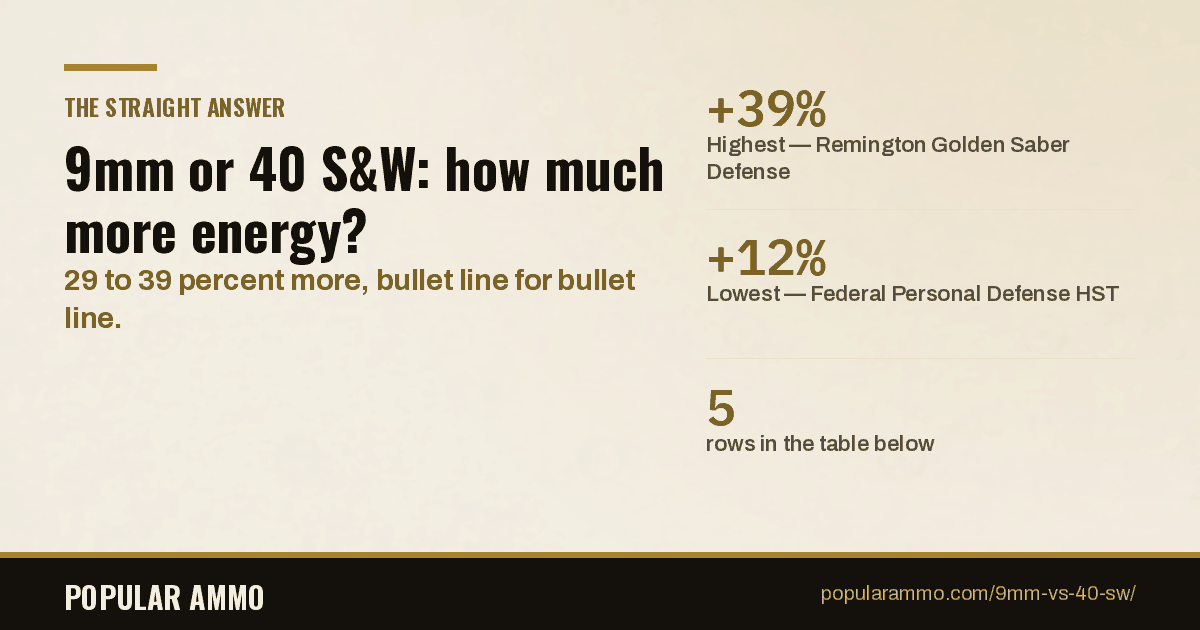
On published muzzle energy, yes, consistently — by roughly 15 to 30 per cent depending on which pair you compare. Hornady’s Critical Duty is 306 ft-lb in 9mm against 396 in .40, at identical velocity from identical barrels. Federal’s HST is 364 against 408.
Is the .40 S&W dying?
The catalogs are thinning. Speer’s consumer site now lists seven handgun calibers — 9mm Luger, 9mm Luger +P, .380 Auto, .45 Auto, 10mm Auto, .357 Magnum and .30 Super Carry — and .40 S&W is not one of them. Federal, Hornady and Remington all still publish .40 S&W defensive loads. So: reduced, not gone.
Does the .40 kick more?
No maker publishes a recoil figure for either cartridge, so there is no published number to give you. The FBI’s memo asserts the difference as a finding rather than a measurement: its shooters were “both FASTER in shot strings fired and more ACCURATE” with 9mm pistols of similar size. That is a shooting-performance claim, not a recoil figure.
Is 9mm cheaper?
The FBI memo lists “lower cost (both in ammunition and wear on the weapons)” among its reasons, but publishes no figures. No maker publishes pricing on a product page. Any specific cost comparison you read is somebody’s snapshot of retail, not a published manufacturer number.
Does .40 S&W have other names?
No. Unlike the 9mm — which SAAMI lists as equivalent to 9mm Parabellum and 9x19mm — the .40 S&W does not appear in SAAMI’s equivalent-names document at all. It has exactly one name.
The cleanest pair anyone publishes
Here’s how I read this chart
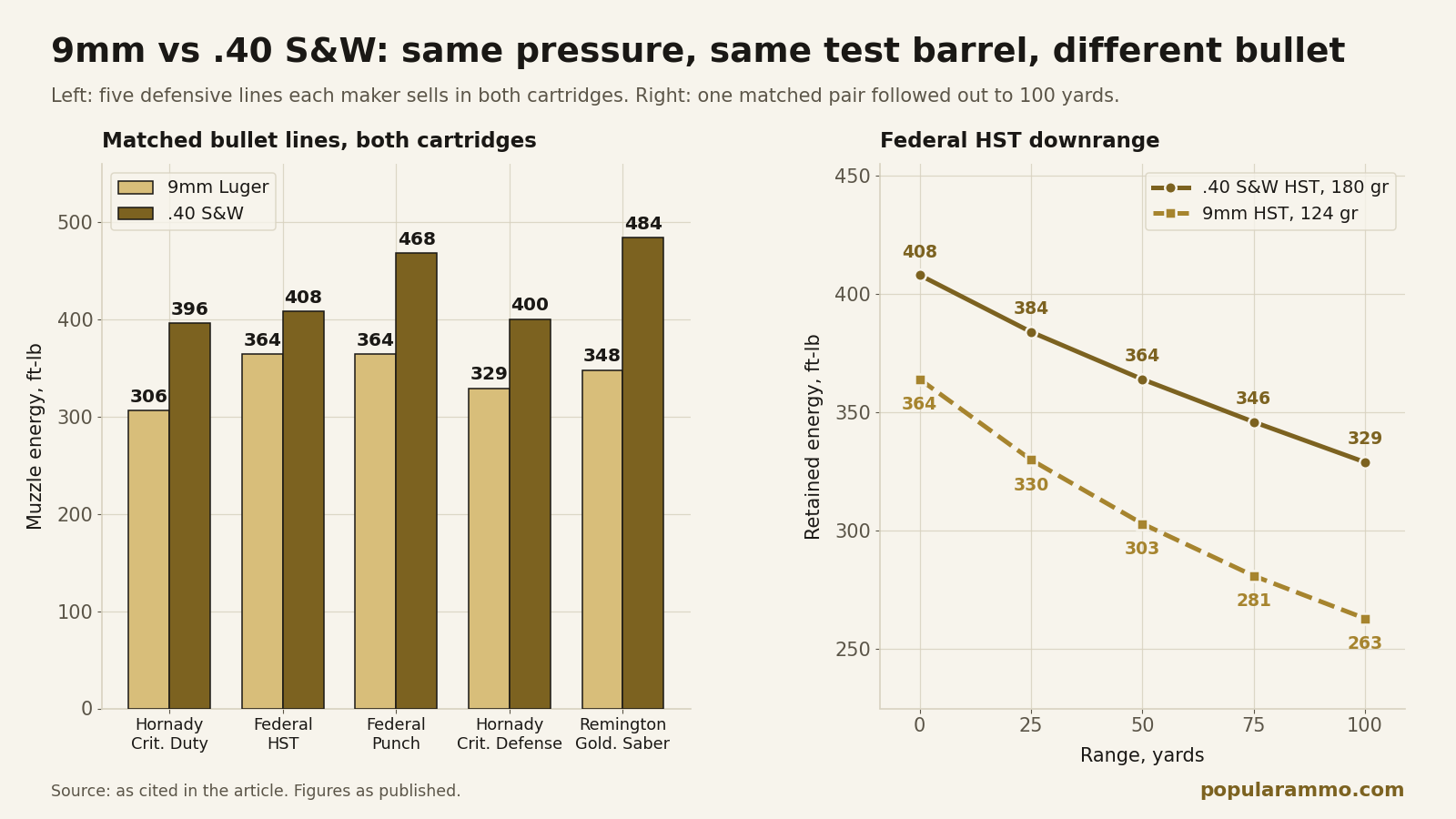
On the left, three defensive bullet lines that each maker sells in both cartridges, shown side by side in foot-pounds of muzzle energy. Comparing within a line is the only fair way to do this: same company, same bullet design, same test barrel. The .40 leads in all three, by different amounts. On the right, how much energy each of one matched pair still carries at 25, 50, 75 and 100 yards — the lines stay parallel, so the gap the .40 starts with is the gap it keeps.
| Bullet line | 9mm load | Energy | .40 S&W load | Energy | Gap |
|---|---|---|---|---|---|
| Hornady Critical Duty | 135 gr, 1,010 fps | 306 ft-lb | 175 gr, 1,010 fps | 396 ft-lb | +29% |
| Federal Personal Defense HST | 124 gr, 1,150 fps | 364 ft-lb | 180 gr, 1,010 fps | 408 ft-lb | +12% |
| Federal Personal Defense Punch | 124 gr, 1,150 fps | 364 ft-lb | 165 gr, 1,130 fps | 468 ft-lb | +29% |
| Hornady Critical Defense | 115 gr, 1,135 fps | 329 ft-lb | 165 gr, 1,045 fps | 400 ft-lb | +22% |
| Remington Golden Saber Defense | 124 gr, 1,125 fps | 348 ft-lb | 165 gr, 1,150 fps | 484 ft-lb | +39% |
The first row is the most useful data point in this whole comparison, and it is worth stating plainly: Hornady publishes both cartridges at exactly 1,010 feet per second, from exactly the same 4-inch barrel, in exactly the same FlexLock bullet design. Velocity held constant, barrel held constant, design held constant — the only variable left is 40 grains of bullet weight and five hundredths of an inch of diameter, and that is worth 90 foot-pounds.
That is the .40 S&W’s case, cleanly made, with nothing else contaminating it.
What happens past the muzzle
Federal publishes downrange figures for the HST line, which lets us follow the pair rather than freeze it at the muzzle.
| Load | Muzzle | 25 yd | 50 yd | 75 yd | 100 yd |
|---|---|---|---|---|---|
| 9mm HST 124 gr, velocity | 1,150 | 1,095 | 1,049 | 1,010 | 977 |
| 9mm HST 124 gr, energy | 364 | 330 | 303 | 281 | 263 |
| .40 HST 180 gr, velocity | 1,010 | 980 | 954 | 930 | 908 |
| .40 HST 180 gr, energy | 408 | 384 | 364 | 346 | 329 |
The .40 starts 44 foot-pounds ahead and is 66 ahead at 100 yards — the heavier bullet sheds its energy more slowly, so the gap widens rather than closes. It is also worth noticing that both loads still carry more energy at 100 yards than most people assume, and that 100 yards is far beyond any distance either cartridge is realistically used at.
Why agencies moved, and what the document actually says
The FBI Training Division’s 2014 justification memo is the source everyone cites and few quote. Here is what it says, in its own words.
On the projectiles: “9mm Luger now offers select projectiles which are, under identical testing conditions, outperforming most of the premium line .40 S&W and .45 Auto projectiles tested by the FBI.”
On the practical case: “9mm Luger offers higher magazine capacities, less recoil, lower cost (both in ammunition and wear on the weapons) and higher functional reliability rates (in FBI weapons).”
On the direct head-to-head: “The Ballistic Research Facility has conducted a test which compares similar sized Glock pistols in both .40 S&W and 9mm calibers… To date, the majority of the study participants have shot more quickly and more accurately with 9mm caliber Glock pistols.”
And the conclusion, which is more hedged than its reputation: “Other law enforcement organizations seem to be making the move back to 9mm Luger… Given the above realities… the move to 9mm Luger can now be viewed as a decided advantage for our armed law enforcement personnel.” Note “seem to be” — the memo asserts a trend it does not quantify.
Three honest caveats about that document
It contradicts itself on a headline statistic. The executive summary states officers “miss between 70 – 80 percent of the shots fired during a shooting incident.” The body states officers “strike an adversary with only 20 – 30 percent of the shots fired.” Those are the same claim stated two ways in one document, and the arithmetic only agrees at the edges. I am pointing this out because the figure is quoted constantly and rarely checked.
I could not find it on a federal domain. The copy we read is an attachment in a municipal council’s public records system. It identifies itself as originating from the FBI Academy at Quantico. I have quoted it as found and am telling you where I found it.
It is a case for a decision already made. The document’s own title is a “Justification for Law Enforcement Partners.” That does not make it wrong, but it is advocacy for a conclusion, not a neutral test report — and it should be read the way any position paper is read.
What one actual transition document says
I looked for a police agency publishing its own reasoning for a .40 to 9mm change and found one: a March 2026 city council agenda item from Port Hueneme, California, approving a move from .40 caliber SIG P320s to 9mm Smith & Wesson M&P 2.0 pistols.
Its stated reason is not about the cartridge. The document says the department was responding to “industrywide concerns… regarding a possible safety issue involving an increasing number of reported ‘uncommanded discharges'” with the existing pistol, and that “a growing number of law enforcement agencies in California, as well as across the nation, are transitioning away from” that model. The caliber change came along with the platform change; the document makes no ballistic claim and never mentions the FBI.
That is a useful corrective. Agency transitions get reported as caliber decisions, and at least one of them was not.
What nobody publishes
- Recoil — for either cartridge, from any maker. SAAMI publishes a formula page with no cartridge values on it.
- Expansion, penetration or gelatin figures — absent from every Federal, Speer, Hornady, Remington and Winchester page I checked.
- Any Winchester Defender ballistics — the pages state, verbatim, “there is no ballistics data available at this time.”
- Remington’s test barrel length — no such field on any Golden Saber page, in either caliber.
- A SAAMI .40 S&W +P standard, or any .40 S&W crusher pressure figure.
- Ammunition pricing — no maker publishes it, so the “9mm is cheaper” claim has no manufacturer source behind it.
Where to go next
38 Special vs 9mm covers the 9mm against the revolver cartridge it replaced a generation earlier, 9mm vs 45 ACP covers the other half of the FBI comparison, and my 9mm self-defense ammunition reference goes deeper on the loads above. For carry pistols and holsters in both calibers, Popular EDC covers the hardware.
Sources
- ANSI/SAAMI Z299.3-2022 centerfire pistol and revolver standard — 9mm Luger, 9mm Luger +P and 40 Smith & Wesson cartridge and chamber drawings, velocity and pressure tables, proof tables and test barrel drawings
- SAAMI, Generally Accepted Cartridge and Chamber Names, 8 October 2021; and Generally Accepted Firearms and Ammunition Interchangeability, same date; SAAMI recoil formulae page
- Federal Personal Defense HST items P9HST1S, P9HST2S, P9HST3S and P40HST1S; Federal Personal Defense Punch items PD9P1 and PD40P1
- Hornady Critical Duty items 90236, 90226 and 91376; Hornady Critical Defense items 90250 and 91340
- Remington Golden Saber Defense items 27601, 27607 and 27608; Speer shop-by-caliber listing and Gold Dot line; Winchester Defender product pages
- FBI Training Division, “Executive Summary of Justification for Law Enforcement Partners,” 2014, as published in a municipal council records system
- City of Port Hueneme, California, City Council agenda item, “Police Department Standard-Issued Firearm Replacement,” 16 March 2026


Ammunition reference desk
Three charts readers come back to: what a round costs today, what a cartridge name really measures, and what shipping and tax add.
| .22 LR | 6.59¢ |
| 9mm Luger | 26.98¢ |
| 5.56 NATO | 44.95¢ |
| .270 Win | .278 in |
| .30-30 Win | .309 in |
| .308 Win | .309 in |
| Case price | $269.80 |
| Shipping and tax | +$18.89 |
| Per round | 28.87¢ |
Reader Favorites