9mm vs 45 ACP: The Two FBI Papers Everyone Cites Disagree With Each Other
9mm vs 45 ACP: buy the 9mm. More rounds, about half the recoil energy, cheaper practice, and a wound no autopsy can tell apart from a .45’s.
Last updated: October 6, 2026 · Originally published August 29, 2026
Buy the 9mm. It holds more rounds, carries roughly 40–55% less recoil energy, costs about a third less to practice with, and the wound it makes cannot be distinguished from a .45’s at autopsy. But the popular version of why — that the FBI proved 9mm wounds better — is a misreading of the document everybody cites, and the FBI’s own earlier paper says the opposite.
How to read this chart
Every number in this table is a published figure, copied from the source named underneath it — none of it is my own measurement. Read across a row to compare one entry, and down a column to compare them all on the same measure.
This page quotes both FBI documents, because they disagree with each other and almost nobody mentions it.
Quick answers
9mm vs 45 ACP — does the .45 have more stopping power?
“Handgun stopping power is simply a myth” — FBI Training Division, 2014. The .45’s entire momentum advantage equals a ten-pound weight dropped 1.37 inches instead of 0.72.
Then is 9mm the better fight-stopper?
Equally unsupported, and now the more common myth. The 2014 document argues equivalence and justifies 9mm on capacity, recoil, cost and hit rates. Its single sentence claiming 9mm projectiles outperform .45 is backed by test data the FBI has never released.
Does the .45’s bigger bullet make a bigger hole?
Yes, measurably. We computed it from published gel data: +25.8% expanded diameter, +55% crush volume — but only 0.154 inches in absolute terms, against a 12-inch penetration requirement both calibers meet.
Is 9mm much cheaper?
For practice, yes: at the case-lot tier 9mm runs about a third cheaper per round at the same store. For defensive hollow points the gap is much smaller. That split matters and almost nobody prints it.
Is .45 quieter suppressed because it’s subsonic?
The premise is false. SAAMI lists standard .45 Auto at 120 gr / 1,200 fps and 185 gr / 1,100 fps, and .45 +P at 1,130 fps — supersonic. Meanwhile 9mm has standard 147 gr / 985 fps subsonic loads. Both calibers offer both.
How much less does 9mm recoil?
Roughly 40–55% less free recoil energy in our table: 5.21 ft-lb for a 124-grain 9mm in a Glock 17, against 8.70 ft-lb for a standard 230-grain .45 and 11.20 ft-lb for .45 +P in a Glock 21.

9mm vs .45 ACP pressure — and the barrels SAAMI measures them in
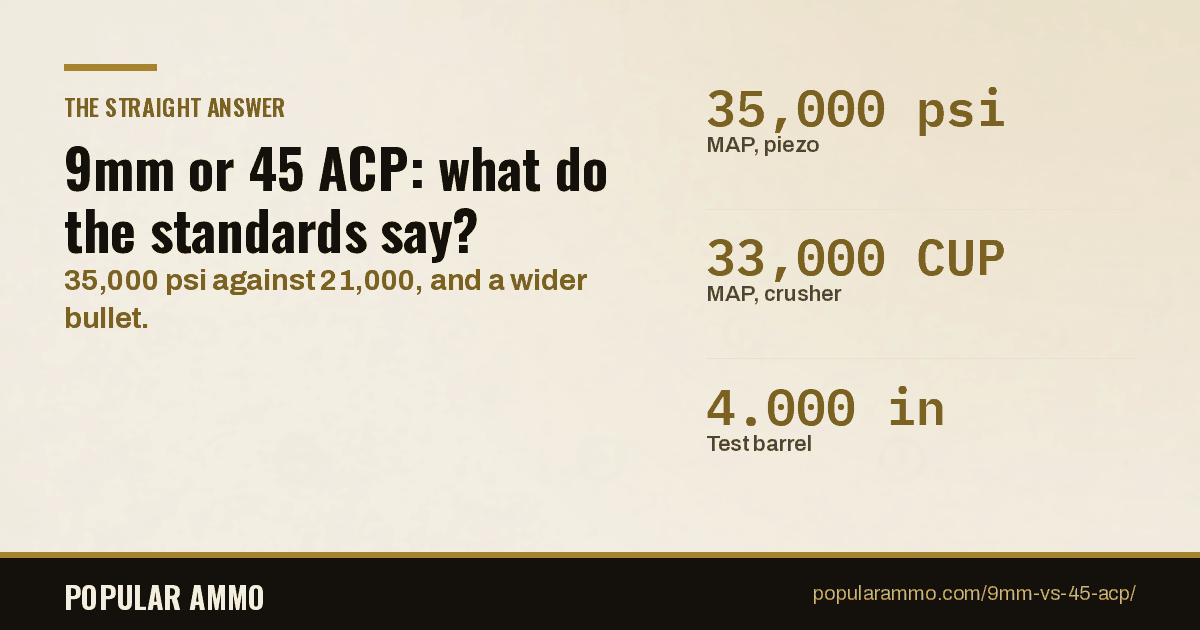
We downloaded ANSI/SAAMI Z299.3-2022 and read the tables directly.
| 9mm Luger | 9mm +P | .45 Automatic | .45 Auto +P | |
|---|---|---|---|---|
| MAP, piezo | 35,000 psi | 38,500 psi | 21,000 psi | 23,000 psi |
| MAP, crusher | 33,000 CUP | Not established | 18,000 CUP | Not established |
| Test barrel | 4.000 in | 4.000 in | 5.000 in | 5.000 in |
| Twist | 1:10 RH | — | 1:16 LH | — |
How to read this table
Four columns covering both cartridges and their higher-pressure versions, showing the pressure each is allowed to make and the barrel length it is tested in. Both matter, because a cartridge measured in a longer barrel will always look faster than one measured in a shorter barrel.
A full inch of barrel separates the two test standards. Every catalog velocity that derives from SAAMI’s method is comparing a 4-inch 9mm against a 5-inch .45. We found no article that discloses this.
Note also what the pressure numbers do and do not mean. 9mm operates at 67% higher pressure than .45. That is an engineering fact about case design and it says nothing about wounding — a point worth holding onto, because it gets recruited as evidence in both directions.
The two FBI documents disagree, and this is the story
Everyone in this argument cites the FBI. Almost nobody cites both papers.
1989 — Patrick, FBI Firearms Training Unit
“Given adequate penetration, a larger diameter bullet will have an edge in wounding effectiveness. It will damage a blood vessel the smaller projectile barely misses. The larger permanent cavity may lead to faster blood loss. Although such an edge clearly exists, its significance cannot be quantified.“
“Kinetic energy does not wound. Temporary cavity does not wound… The critical element is penetration. Of those that will penetrate, the edge is always with the bigger bullet.“
2014 — FBI Training Division executive summary
“There is little to no noticeable difference in the wound tracks between premium line law enforcement projectiles from 9mm Luger through the .45 Auto.”
“Handgun stopping power is simply a myth.“
“an operating room surgeon or Medical Examiner cannot distinguish the difference between wounds caused by .35 to .45 caliber projectiles.”
These are not the same claim. 1989 says diameter confers a real but unquantifiable edge. 2014 says there is little to no noticeable difference. The 2014 paper cites the 1989 paper as an authority twice and never addresses the contradiction. Anyone using 2014 to prove “caliber does not matter at all” is over-reading it, and is contradicted by the FBI’s own foundational document.
Two cautions about the 2014 paper
It has never been published on fbi.gov. It circulated to law-enforcement partners and lives on third-party hosts. Its authenticity is universally accepted in the industry, but it is not verifiable against an official domain. We attribute it as “an FBI Training Division document circulated to law enforcement partners” rather than as an FBI publication, and you should too.
Its central comparative claim is unsupported. The paper asserts that 9mm projectiles are “outperforming most of the premium line .40 S&W and .45 Auto projectiles tested by the FBI” — and the FBI has never released the underlying data, protocol or load list. That one sentence is the origin of an enormous amount of internet certainty. It should be reported as an unsubstantiated assertion.
One more detail routinely misstated: the faster-and-more-accurate shooting study inside that document compared 9mm against .40 S&W Glocks. Not .45. No .45 speed-and-accuracy comparison appears anywhere in it.
Does the bigger bullet make a bigger hole? We did the arithmetic.
Rather than assert, we took Lucky Gunner Labs’ published gel data, selected every expanding load in each caliber whose penetration landed inside the FBI’s 12–18 inch window — sixteen loads each — and compared them.
| 9mm (n=16) | .45 ACP (n=16) | Difference | |
|---|---|---|---|
| Mean expanded diameter | 0.596 in | 0.750 in | +25.8% |
| Mean penetration | 15.09 in | 14.86 in | −1.5% |
| Expanded frontal area | — | — | +58.3% |
| Crush cavity volume | 4.301 cu in | 6.685 cu in | +55.4% |
How to read this table
Sixteen loads of each cartridge, chosen the same way: only bullets designed to open up, and only those landing inside the accepted 12 to 18 inch depth window. The last column is the difference between the two averages. This is the arithmetic the original FBI papers left out.
The honest answer is yes, measurably — and small in absolute terms. The percentages are real and consistent. They are also 0.154 inches, against a penetration requirement both calibers meet, and against a medical consensus that wounds from .35 to .45 caliber cannot be told apart at autopsy.
That result sits closer to Patrick’s 1989 position than to the 2014 summary’s, which is worth saying out loud.
What that computation cannot tell you is whether 55% more crush volume produces any difference in how quickly someone stops. Nobody has published data linking gel crush volume to physiological outcome. That missing link is the unproven step in almost every article in this genre, in both directions — including the ones that agree with us.
Caveats on the gel data, which citing articles routinely omit
Lucky Gunner used Clear Ballistics synthetic gel, not FBI-spec 10% ordnance gelatin, and published no calibration procedure. They deliberately used compact carry pistols — a 3.5-inch S&W M&P9c and a 3.64-inch Kahr CW45 — rather than service pistols. These are not FBI-protocol results and should never be presented as such.
And note what the spread shows: within Lucky Gunner’s own data, 9mm penetration ranged from 8.28 to 26.52 inches and .45 from 9.18 to 31.16. The variation inside each caliber dwarfs the variation between them. Load selection dominates caliber selection — which is, ironically, exactly what the 2014 FBI document argues.
Working down the scale rather than up, the same penetration standard is where .380 vs 9mm is decided — and there, unlike here, one cartridge struggles to meet it.
45 ACP vs 9mm capacity and size, from the spec sheets
| G17 Gen5 (9mm) | G21 Gen4 (.45) | G19 Gen5 (9mm) | G30 Gen4 (.45) | |
|---|---|---|---|---|
| Capacity | 17 | 13 | 15 | 10 |
| Slide width | 1.00 in | 1.12 in | 1.00 in | 1.12 in |
| Weight, empty mag | 24.97 oz | 29.28 oz | 23.63 oz | 26.28 oz |
| Weight, loaded | 33.33 oz | 38.80 oz | 30.16 oz | 33.69 oz |
How to read this table
Four pistols, two of each cartridge, matched full-size against full-size and compact against compact so the comparison is fair. Read down a column to see what one gun gives you, and across to see what choosing the bigger cartridge costs you in rounds and bulk.
Same family, same grip philosophy: the .45 costs you four rounds (−23.5%) in the full-size and five (−33.3%) in the compact, plus about four ounces and an eighth of an inch of slide width. In a fight where officers are documented to hit with only 20–30% of rounds fired, four rounds is not a rounding error.
One fair note against us: the G30 is shorter and lower than the G19, so it is not simply “a bigger G19.” The .45 compacts trade capacity for a different shape, not just a larger one.
Recoil, with the assumptions shown
No ammunition maker publishes powder charge weight, so every recoil figure anywhere is modelled. We ran a sensitivity analysis instead of picking a number.
| Load and pistol | Free recoil energy |
|---|---|
| G17, 9mm 124 gr @ 1,130 | 5.21 ft-lb |
| G21, .45 230 gr @ 870 | 8.70 ft-lb |
| G21, .45 230 gr +P @ 975 | 11.20 ft-lb |
How to read this table
The push produced by three combinations of gun and ammunition. Every figure of this kind anywhere is calculated rather than measured, because it depends on a powder weight nobody publishes. Rather than pick one number and hope, the article works the sum across the whole believable range.
Varying charge weight by ±30% gives 9mm 4.83–5.61 and .45 8.15–9.27 ft-lb. Varying the gas velocity assumption from 3,000 to 5,200 fps gives 9mm 4.89–5.61 and .45 8.24–9.27. No overlap under any assumption.
That is about 67% more recoil energy for the .45 — and the G21 is four ounces heavier, which flatters it. At matched gun weight the figure is closer to 96%. Free recoil is physics, not feel: slide mass, spring rate, bore axis and grip geometry all change perception and none are in this calculation.
Once you have chosen 9mm, load selection matters far more than caliber — see best 9mm self-defense ammo.
9mm vs 45 ACP cost today
| Cartridge | Per round | Case price | Case | Load checked | Stock |
|---|---|---|---|---|---|
| 9mm Luger | 26.98¢ | $269.80 | 1,000 rd | 1000 Round Case - 9mm Luger 115 Grain FMJ Ammo by Magtech - 9A | 25+ in stock |
| .45 ACP | 41.90¢ | $419.00 | 1,000 rd | 1000 Round Case - 45 Auto 230 Grain FMJ Federal Champion Brass Case Ammo - WM5233 | 25+ in stock |
The cost gap is mostly a practice cost. At the case-lot tier above, 9mm runs about a third cheaper per round than .45 ACP at the same store, and over a thousand training rounds a year that difference is real money. On defensive hollow points the gap is much smaller and should not decide anything.
The suppressor myth, killed by SAAMI’s own table
“.45 is subsonic, so it suppresses better” is wrong on both halves.
Speed of sound is about 1,125 fps. SAAMI lists standard-pressure .45 Auto at 120 gr / 1,200 fps, 155 gr / 1,125, 185 gr / 1,100 — and .45 Auto +P 185 gr at 1,130 fps, supersonic. Meanwhile SAAMI lists 9mm at 147 gr / 985 fps and 150 gr / 900 fps, comfortably subsonic and the single most common suppressor-host 9mm load.
Both calibers offer subsonic and supersonic factory loads. The premise is false. And the .45’s larger bore — .450 groove against .3550 — passes more propellant gas, which works against suppression efficiency for a given can volume.
We are not giving you a decibel comparison, because we could not find one at citable quality. Every source we located was a retailer blog or forum post with undocumented methodology.
What we could not verify
- The 2014 FBI document on any official .gov domain. Widely accepted as authentic; not officially published. It also contains uncorrected editing errors in the original — stray words mid-sentence — so quote it carefully.
- The FBI’s underlying comparative terminal-ballistics data. Never released.
- Any citable measured decibel comparison of suppressed 9mm against suppressed .45.
- Factory powder charge weights. Not published by anyone, which is why our recoil figures come with a sensitivity range rather than a decimal point.
- Current S&W M&P45 specifications. The product page returns 404 and the .45 appears to have left S&W’s catalog. That is an interesting market signal, but we are reporting it as an observation, not a spec.
The practical rule
Buy the 9mm. Four to five more rounds, a third less recoil energy at minimum, half the practice cost, and a wound track a medical examiner cannot distinguish from the .45’s. Those advantages are documented and they compound.
Keep the .45 if you already shoot one well. The measured diameter advantage is real — we computed it rather than dismissing it — and Patrick’s 1989 conclusion that “the edge is always with the bigger bullet” has never actually been retracted, only talked past. A .45 you shoot accurately beats a 9mm you shoot poorly by a far wider margin than any of the numbers on this page.
What neither cartridge will do is stop a fight by itself. That is the one thing both FBI papers agree on, thirty-five years apart, and it is worth more than the rest of this comparison put together.
For what these two calibers mean once the pistol has to be concealed every day, Popular EDC covers the same ground from the carry side in its self-defense handgun caliber comparison.
Sources
- Maximum average pressure, test barrel lengths, twist, groove diameter, nominal velocities — ANSI/SAAMI Z299.3-2022, downloaded and read directly
- “Handgun Wounding Factors and Effectiveness,” Urey W. Patrick, FBI Academy Firearms Training Unit, 14 July 1989 — full text
- “Executive Summary of Justification for Law Enforcement Partners,” FBI Training Division, 2014 — copy hosted as a municipal agenda attachment
- Gel penetration and expansion data — Lucky Gunner Labs
- Pistol specifications — G17 Gen5, G21 Gen4, G19 Gen5, G30 Gen4
- Pricing — SG Ammo, checked 23 August 2026


Ammunition reference desk
Three charts readers come back to: what a round costs today, what a cartridge name really measures, and what shipping and tax add.
| .22 LR | 6.59¢ |
| 9mm Luger | 26.98¢ |
| 5.56 NATO | 44.95¢ |
| .270 Win | .278 in |
| .30-30 Win | .309 in |
| .308 Win | .309 in |
| Case price | $269.80 |
| Shipping and tax | +$18.89 |
| Per round | 28.87¢ |
Reader Favorites