
This calculator shows your cost per reloaded round and the number of rounds at which the press, dies and tumbler pay for themselves.
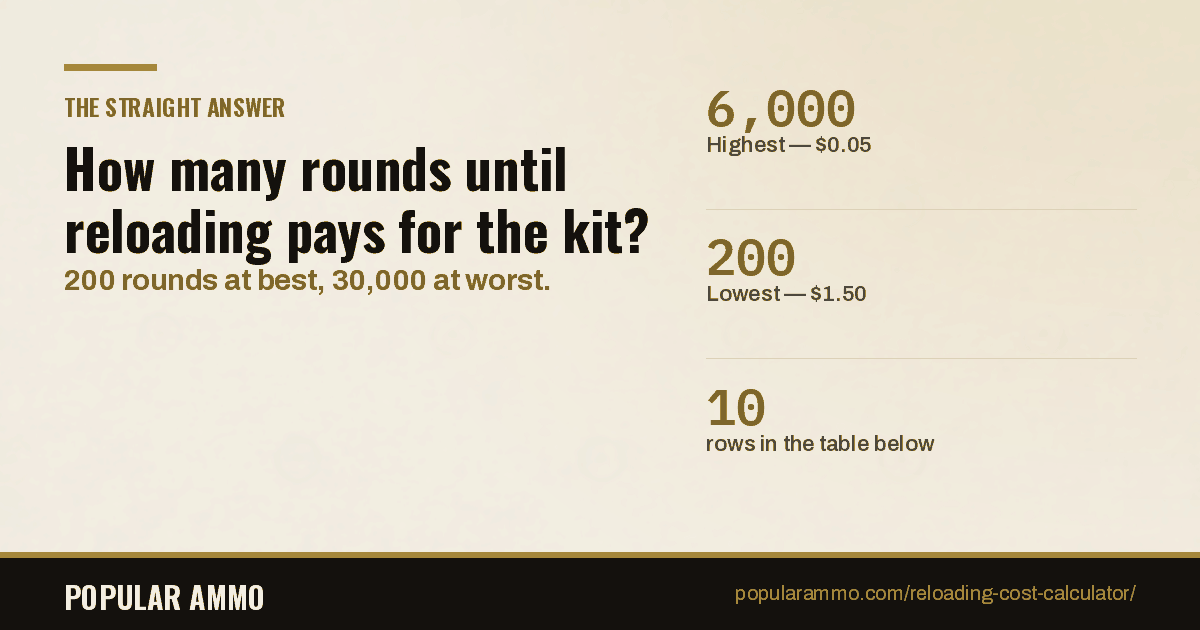
Here is how I read this chart
Every number in this table is a published figure, copied from the source named underneath it — none of it is my own measurement. The card shows the top rows; the complete table is further down this page. Read across a row to compare one entry, and down a column to compare them all on the same measure.
What a loaded round costs you, component by component — and then the part almost every reloading calculator leaves out: how many rounds you have to load before the press, dies, scale and tumbler have paid for themselves.
Type in your prices. Prices change every week, so we leave them blank. Type in what you pay for each part and the math does the rest.
Will reloading pay you back? Your gear costs money too. Type in what you spent on the press, dies, scale and tumbler, and what you pay for one store-bought round. We will show how many rounds it takes to earn that money back.
One pound of powder is 7,000 grains, exactly
This is a definition, not a measurement and not a brand figure. The grain is defined as one seven-thousandth of an avoirdupois pound, and it is the same grain in the avoirdupois, troy and apothecaries systems -- NIST Handbook 44, Appendix C, Avoirdupois Units of Mass, which also gives 437.5 grains to the ounce. So the number of rounds a pound of powder loads is 7,000 divided by your charge weight, and nothing else.
| Charge | Rounds per pound | Pounds per 1,000 rounds |
|---|---|---|
| 2.5 gr | 2,800 | 0.357 |
| 3 gr | 2,333 | 0.429 |
| 3.5 gr | 2,000 | 0.500 |
| 4 gr | 1,750 | 0.571 |
| 4.5 gr | 1,555 | 0.643 |
| 5 gr | 1,400 | 0.714 |
| 6 gr | 1,166 | 0.857 |
| 7 gr | 1,000 | 1.000 |
| 8 gr | 875 | 1.143 |
| 10 gr | 700 | 1.429 |
| 12 gr | 583 | 1.714 |
| 15 gr | 466 | 2.143 |
| 20 gr | 350 | 2.857 |
| 25 gr | 280 | 3.571 |
| 30 gr | 233 | 4.286 |
| 35 gr | 200 | 5.000 |
| 40 gr | 175 | 5.714 |
| 45 gr | 155 | 6.429 |
| 50 gr | 140 | 7.143 |
| 60 gr | 116 | 8.571 |
| 70 gr | 100 | 10.000 |
The formula
cost per round = brass price / firings expected
               + primer price per 1,000 / 1,000
               + powder price per pound / (7000 / charge in grains)
               + bullet price per 100 / 100
The only judgment call in it is the number of firings you expect from a case. Everything else is a price you paid and a definition.
The break-even nobody publishes
A loaded round costing less than a factory round is not a saving until the equipment is paid off. The round count where that happens is the outlay divided by the saving per round:
break-even rounds = equipment outlay / (factory cost per round - your loaded cost per round)| You save on each round | $300 kit | $600 kit | $900 kit | $1500 kit |
|---|---|---|---|---|
| $0.05 | 6,000 | 12,000 | 18,000 | 30,000 |
| $0.10 | 3,000 | 6,000 | 9,000 | 15,000 |
| $0.15 | 2,000 | 4,000 | 6,000 | 10,000 |
| $0.20 | 1,500 | 3,000 | 4,500 | 7,500 |
| $0.30 | 1,000 | 2,000 | 3,000 | 5,000 |
| $0.40 | 750 | 1,500 | 2,250 | 3,750 |
| $0.50 | 600 | 1,200 | 1,800 | 3,000 |
| $0.75 | 400 | 800 | 1,200 | 2,000 |
| $1.00 | 300 | 600 | 900 | 1,500 |
| $1.50 | 200 | 400 | 600 | 1,000 |
| $2.00 | 150 | 300 | 450 | 750 |
What the table shows is a ratio, and it is the whole argument. Break-even moves inversely with the saving per round, so the same $600 of equipment pays back in 1,200 rounds when you save $0.50 a round and 12,000 rounds when you save $0.05 -- 10 times the volume for a tenth of the margin. That is why the answer to "is reloading worth it" is different for a high-volume pistol caliber than it is for a magnum, a precision rifle load or an obsolete cartridge, and why an answer that does not name a caliber and a volume is not an answer.
This page deliberately does not tell you which side of that line your caliber falls on, because doing so would mean publishing prices that are wrong within a fortnight. Put your own numbers in the calculator; the arithmetic is exact.

Questions people actually ask
How many rounds does a pound of powder load?
Seven thousand grains divided by your charge weight. At 5.0 grains that is 1,400 rounds; at 50.0 grains it is 140. The table above runs from 2.5 to 70 grains. The 7,000 is not an approximation and not a brand figure -- the grain is defined as one seven-thousandth of an avoirdupois pound.
What goes into the cost of a loaded round?
Four things: the case, spread out over the number of firings you expect to get from it; the primer; the powder charge; and the bullet. The calculator prints each one as a share of the total, which is usually the more useful output -- on most loads the bullet dominates, and no amount of shopping for primers changes that.
Does reloading actually save money?
That depends entirely on the gap between what a loaded round costs you and what the factory round you would otherwise buy costs, and this page will not pretend to know either number. What the arithmetic does say is that break-even is the equipment outlay divided by that gap. A caliber where you save five cents a round needs 10 times the volume of one where you save fifty, for the same kit: 12,000 rounds against 1,200. That is why reloading pays back slowly on cheap high-volume calibers and quickly on expensive ones, and it is arithmetic rather than opinion.
Why include the press and dies? Nobody else does.
That is the reason. A cost per round that leaves out the equipment is not a saving, it is a subsidy from money already spent. Every calculator on the first page of results stops at the cost per round. Including the outlay is the difference between knowing what a round costs and knowing whether the decision was worth making.
How many firings should I expect from a case?
This page will not give you a number. It depends on the cartridge, the pressure you load to, how the case is sized and how carefully it is inspected, and a figure quoted without those conditions is worth nothing. Put in the number you actually get. If you do not know it yet, run the calculator at two values and see how much the answer moves -- on most loads brass is a small share of the total, and on some it is the largest.
Do you sell components or take a cut?
No. There are no prices on this page to be biased about.
What this page does and does not do
- It publishes no component or ammunition prices. They move weekly. The only constant printed here is definitional and cited.
- It does not estimate case life. You supply the number of firings.
- It counts equipment at what you paid, once. It does not depreciate the kit, assign it a resale value or spread it across calibers. If you load three cartridges on one press, the honest thing is to split the outlay across them yourself.
- It ignores your time, which for some people is the whole answer.
- Your inputs stay in your browser -- in the address bar so a set-up can be shared or bookmarked, and in local storage so the page remembers. Nothing is sent anywhere.
Related
- Cost per round calculator -- what factory ammunition actually costs delivered, which is the number this page compares against
- Ammunition types explained -- what the bullet you are costing out is actually built to do