
Match the bullet to the job: cheap FMJ to practice, JHP for defense, soft point to hunt, subsonic behind a suppressor, frangible on steel up close.
Match the bullet to the job. Practice and plink with cheap FMJ (full metal jacket). Load JHP (jacketed hollow point) for self-defense — it expands to transfer energy and limit over-penetration. Hunt with soft point or ballistic-tip bullets for controlled expansion. Shoot subsonic when running a suppressor, and use frangible ammo on steel up close. Search or sort the full guide below.
Ammo types & bullet types chart
Type to filter, or click a column to sort.
Here is how I read this chart
Every number in this table is a published figure, copied from the source named underneath it — none of it is my own measurement. The card shows the top rows; the complete table is further down this page. Read across a row to compare one entry, and down a column to compare them all on the same measure.
| Type | Also called | What it is | Best for |
|---|---|---|---|
| Everyday & defense | |||
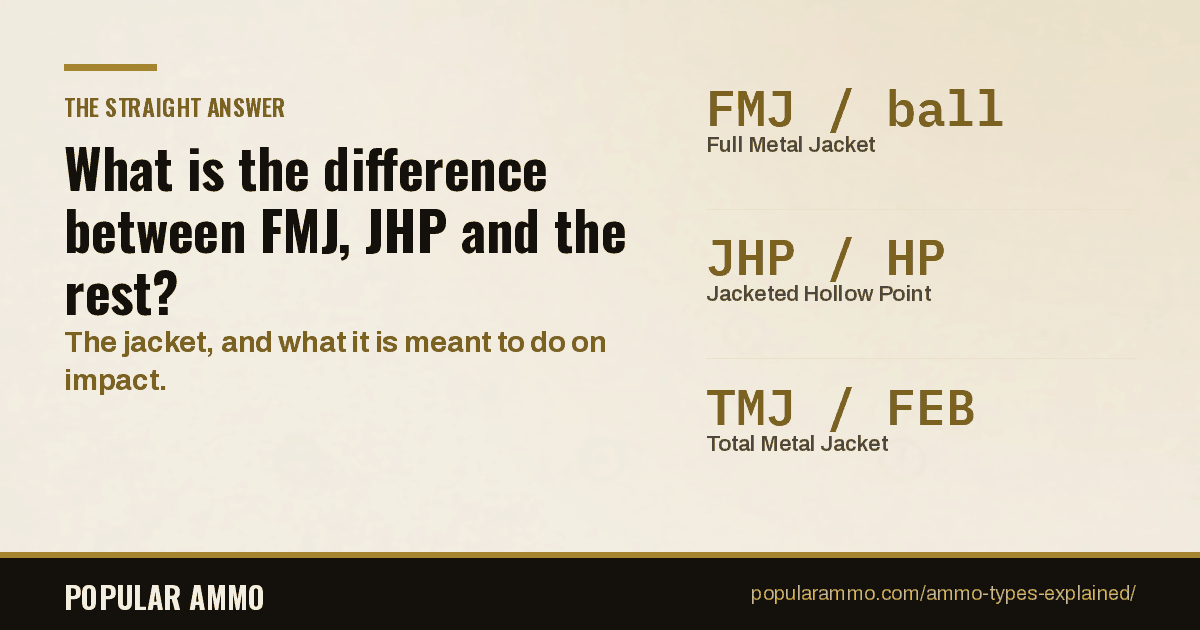
| Full Metal Jacket | FMJ / ball | A lead core fully wrapped in a copper jacket; does not expand. | Range practice, plinking, training — cheapest per round |
| Jacketed Hollow Point | JHP / HP | A hollow nose cavity that mushrooms open on impact. | Self-defense & duty — expands, dumps energy, limits over-penetration |
| Total Metal Jacket | TMJ / FEB | Bullet fully encapsulated, including the base — no exposed lead. | Indoor ranges — less airborne lead |
| +P / +P+ | Overpressure | Loaded above standard pressure for more velocity and energy. | Defense in firearms rated for it — more recoil |
| Frangible | — | A compressed metal-powder bullet that disintegrates on hard surfaces. | Close-range steel targets & training — cuts ricochet |
| Hunting | |||
| Soft Point | SP / JSP | An exposed soft-lead tip over a jacket for controlled expansion. | Hunting — deeper penetration than a hollow point |
| Ballistic Tip | Polymer tip | A polymer tip over a hollow point — flat-shooting, reliable expansion. | Varmint & big-game hunting at distance |
| Bonded / Controlled-Expansion | Bonded | Jacket chemically bonded to the core so the bullet holds together. | Larger game — deep, reliable penetration through bone |
| Lead Round Nose | LRN | A plain, unjacketed lead bullet with a rounded nose. | Cheap revolver practice & small game |
| Precision & specialty | |||
| Hollow-Point Boat Tail | HPBT / match | A tapered base plus open tip for a high ballistic coefficient (match ammo, not a defense bullet). | Long-range target & precision |
| Wadcutter / Semi-Wadcutter | WC / SWC | A flat-fronted target bullet that cuts clean holes in paper. | Bullseye & revolver target shooting |
| Subsonic | — | Ammo that stays below the speed of sound (~1,100 fps), avoiding the sonic crack. | Suppressed shooting & quiet practice |
| Green Tip | M855 / SS109 | A 62-grain 5.56 bullet with a steel-tip penetrator (a penetrator, not true armor-piercing). | Barrier penetration & general 5.56 use |
| Tracer | — | A pyrotechnic charge in the base that burns visibly in flight. | Restricted; fire risk — check local law and range rules |
How to pick the right ammo
Think in three buckets. Train with FMJ because it is cheap and shoots to a similar point of impact as your defensive load. Defend with quality JHP that is proven to feed in your gun — test at least a box. Hunt with soft-point, bonded, or ballistic-tip bullets sized to the game so they expand and penetrate reliably. Then layer in specialty rounds — subsonic for a can, frangible for close steel — as your shooting calls for them.
Ammo type FAQ
FMJ vs hollow point — what is the difference?
FMJ is a fully jacketed bullet that does not expand; it is cheap and best for target practice, but it over-penetrates and is a poor defensive choice. A jacketed hollow point (JHP) has a hollow nose that expands on impact, transferring more energy and reducing the risk of passing through the target. Use FMJ to train and JHP to defend.
What ammo is best for self-defense?
A quality jacketed hollow point that reliably feeds and cycles in your specific firearm. Expansion transfers energy and limits over-penetration, and premium bonded or controlled-expansion JHPs perform most consistently. Always test a box or two before you trust a load.
Is green-tip (M855) ammo armor-piercing?
Not by the legal definition. M855 “green tip” has a steel-tip penetrator over a lead core, which improves penetration through barriers, but it is not classified as armor-piercing ammunition. It is a general-purpose 5.56 round.
What is subsonic ammo for?
Subsonic ammunition travels below the speed of sound, so it avoids the loud sonic “crack” a supersonic bullet makes. Paired with a suppressor it is dramatically quieter, which is why heavy .300 Blackout and standard .22 LR subsonic loads are popular for suppressed shooting.
What does +P mean?
+P ammunition is loaded to a higher-than-standard pressure for more velocity and energy. Only fire it in a firearm rated for +P, and expect more recoil and muzzle blast.
This guide is educational. Always use ammunition appropriate for your firearm, follow the manufacturer’s specifications, obey all local and federal laws (some bullet types are restricted in certain areas), and practice safe handling. This is not reloading or load data.