6.5 Creedmoor vs 308: Same SAAMI Pressure, and the Bullet Does the Work
Under SAAMI both carry the identical 62,000 psi ceiling. The .308 starts with more energy; the 6.5 Creedmoor keeps more of it downrange.
Last updated: September 14, 2026 · Originally published August 29, 2026
Under SAAMI, the 6.5 Creedmoor and the .308 Winchester carry the identical maximum average pressure — 62,000 psi. The .308 starts with more muzzle energy. The 6.5 Creedmoor recoils about 15–20% less and holds velocity better downrange, but only when it is loaded with a better bullet. Match the bullets and the .308 wins at 1,000 yards.
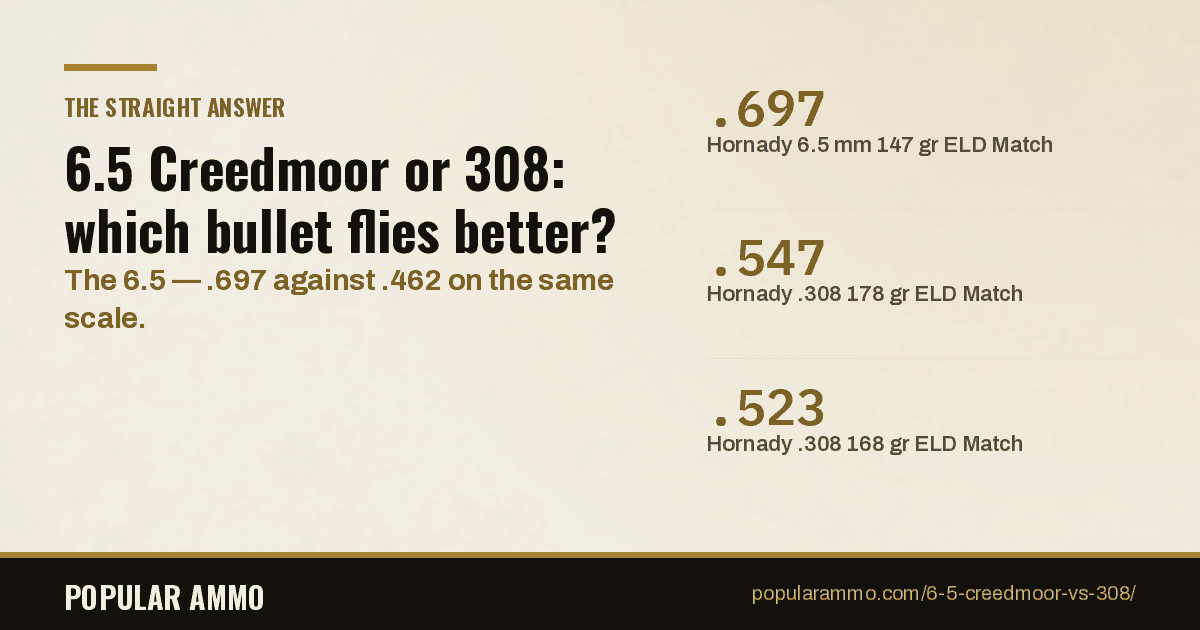
How to read this chart
Every number in this table is a published figure, copied from the source named underneath it — none of it is my own measurement. Read across a row to compare one entry, and down a column to compare them all on the same measure.
That last sentence is the part nobody prints, so this page shows the arithmetic using the manufacturers’ own published numbers.
Quick answers
6.5 Creedmoor vs 308 — which is the higher-pressure cartridge?
Not under SAAMI. We pulled the standard and both are listed at 62,000 psi maximum average pressure, same transducer method. Under the European CIP standard the 6.5 Creedmoor is rated about 4.8% higher. Any unqualified claim either way is wrong.
Does the 6.5 Creedmoor really shoot flatter?
With a high-BC bullet, yes, and substantially. With comparable bullets, no. The advantage belongs to the projectile, not the case.
Which hits harder?
The .308, at the muzzle, by 15–18% in matched factory loads. Whether the 6.5 Creedmoor catches up downrange depends entirely on which two loads you compare — and with Federal’s own numbers, it does not.
Is the 6.5 Creedmoor a necked-down .308?
No. The lineage runs .307 Winchester → .30 TC → necked to 0.264 in. The case is 1.920 in with a 30° shoulder; the .308 is 2.015 in with a 20° shoulder.
Does the 6.5 Creedmoor burn out barrels faster?
Probably, and the mechanism is sound — but we could not find a single controlled published study comparing the two. Every round-count figure in circulation is a manufacturer estimate or an anecdote.
Is 6.5 Creedmoor ammunition more expensive?
Not any more. On matched SKUs from the same maker at the same retailer today, the two are identically priced at match grade — and in the budget tier the 6.5 Creedmoor was cheaper.
6.5 Creedmoor vs .308 pressure: they are the same. We checked the standard.
The most-repeated claim in this comparison is that the 6.5 Creedmoor is a hotter, higher-pressure round. We downloaded ANSI/SAAMI Z299.4-2025 — the actual 400-page centerfire rifle standard — and read the velocity and pressure tables directly rather than citing somebody who cited somebody.
| Cartridge | MAP, piezo transducer | MAP, copper crusher | Max probable lot mean |
|---|---|---|---|
| 6.5 Creedmoor | 62,000 psi | Not established | 63,600 psi |
| .308 Winchester | 62,000 psi | 52,000 CUP | 63,600 psi |
How to read this table
Both cartridges and the pressure each is allowed to make. They are the same figure. Two of the columns are different measuring methods, so only compare numbers within a single column, never across.
Identical. Same figure, same method — a conformal piezoelectric transducer seated 0.175 in behind the case shoulder.
Two corrections fall straight out of that table. First, the .308’s crusher figure is 52,000 CUP, not the 60,000 CUP you will see quoted. Second, CUP and psi are separate measurement systems and there is no valid conversion between them — any article that “converts” one to the other is performing an operation the standard does not support.
This is a recurring problem rather than a quirk of one comparison. The same measurement mismatch is what makes .223 vs 5.56 look like a far bigger pressure gap than it is.
Where the standards genuinely disagree
Europe’s CIP rates the two differently: 4,350 bar (63,092 psi) for the 6.5 Creedmoor and 4,150 bar (60,191 psi) for the .308. So under SAAMI they are equal, and under CIP the 6.5 Creedmoor is about 4.8% higher. Both bodies are internally correct. Most articles quote one number without naming the standard it came from.
6.5 Creedmoor vs .308 ballistics: the coefficients tell the whole story
Here is what the two makers publish for their own bullets.
| Load | G1 BC | G7 BC |
|---|---|---|
| Hornady 6.5 mm 147 gr ELD Match | .697 | .351 |
| Hornady .308 178 gr ELD Match | .547 | .275 |
| Hornady .308 168 gr ELD Match | .523 | .263 |
| Federal 6.5 CM 140 gr Sierra MatchKing | .535 | .261 |
| Federal .308 168 gr Sierra MatchKing | .462 | .224 |
How to read this table
Each row is one bullet, and the two numbers rate how well it slips through the air, where higher is better. There are two columns because the industry uses two different reference shapes, and a figure from one cannot be compared with a figure from the other. Compare down a column only.
Read the two bolded middle rows. Federal’s 6.5 Creedmoor 140 grain Sierra MatchKing has a G7 of .261. Hornady’s .308 168 grain ELD Match has a G7 of .263. Aerodynamically they are the same bullet.
Now look at the spread inside 6.5 Creedmoor: from .261 to .351 is a 34% gain. The variation between bullets in one cartridge is larger than the variation between the two cartridges. That is the finding this entire debate turns on.
Swap the bullets and the .308 wins
Take Hornady’s modern .308 bullet against Federal’s conventional 6.5 match bullet — a fair fight at comparable bullet technology, and one nobody stages because it produces the wrong answer.
| At 1,000 yards | .308, 168 gr ELD-M | 6.5 CM, 140 gr SMK |
|---|---|---|
| Velocity | 1,237 fps | 1,212 fps |
| Drop | −350 in | −360 in |
| 10 mph crosswind | 93.4 in | 95.9 in |
| Energy | 571 ft-lb | 456 ft-lb |
How to read this table
The same distance and the same bullet quality on both sides. Most comparisons of these two cartridges pair a modern bullet against an older one, which settles the result before any shooting happens. This one deliberately does not.
The .308 wins on every line. Reverse the bullet quality — Hornady’s 147 grain ELD Match against a conventional .308 load — and the 6.5 Creedmoor wins decisively, reaching 1,000 yards at 1,549 fps against 1,237, with 63 inches of wind drift against 93.
The cartridge is not doing the work. The bullet is.
Those 1,000-yard figures are computed, not published — no manufacturer prints past 500 yards for these loads. We solved them with a point-mass model using each maker’s own published muzzle velocity and G7 coefficient under standard atmosphere. Run against the makers’ own 0–500 yard tables, the solver reproduced Hornady’s 500-yard velocities within 0.6% and their drop within 0.3 inches. Federal’s residuals were larger, for a reason worth knowing about — see below.
A wrinkle in the published data itself
Fitting the G7 coefficient that each maker’s own trajectory table implies produces a number consistently higher than the coefficient printed beside it: Federal’s 6.5 CM load by 4.7%, their .308 by 5.6%, Hornady’s two by about 2%. Every maker’s table implies a better bullet than the maker’s own spec sheet claims. We cannot tell whether that is coefficient optimism or an undisclosed non-standard atmosphere. Either way, you cannot reproduce these companies’ published trajectories from their published coefficients, and Federal is roughly twice as far off as Hornady.
Muzzle energy: the .308 starts ahead
All figures from Hornady’s published data, both from a stated 24-inch test barrel.
| Range | 6.5 CM 147 ELD-M | .308 168 ELD-M |
|---|---|---|
| Muzzle | 2,695 fps / 2,370 ft-lb | 2,700 fps / 2,719 ft-lb |
| 500 yd | 2,092 fps / 1,428 ft-lb | 1,912 fps / 1,364 ft-lb |
| Drop at 500 yd | −43.2 in | −47.1 in |
How to read this table
Energy at increasing distances, both measured from the same length of test barrel. Read down a column to see how each cartridge fades with range. The .308 starts ahead, so the real question is whether the 6.5 catches it before the target.
The .308 begins with 15% more muzzle energy in this pairing and 18% more in Federal’s. Where the 6.5 Creedmoor leads on energy, it is a downrange crossover, never a starting advantage — and with Federal’s own numbers the crossover never happens: at 500 yards their .308 still carries 1,179 ft-lb against the 6.5 Creedmoor’s 1,128.
Recoil: the one clear win, and why every published table is unusable
Free-recoil energy requires the powder charge weight. No ammunition manufacturer publishes it. Every recoil comparison you have read therefore rests on an undisclosed assumption.
The most-cited table in the genre — Chuck Hawks’ rifle recoil table — contains no 6.5 Creedmoor entry at all, and its .308 rows use inconsistent rifle weights (8.75 lb, 7.5 lb, 8.0 lb), which invalidates even its internal comparisons.
So we swept the charge weight across its whole plausible range instead of picking one. In an 8-pound rifle:
| Load | 38 gr charge | 42 gr | 46 gr |
|---|---|---|---|
| 6.5 CM 147 gr @ 2,695 | 13.1 ft-lb | 14.0 | 14.9 |
| .308 168 gr @ 2,700 | 15.8 ft-lb | 16.8 | 17.8 |
How to read this table
The push, worked out three times using three different powder weights. Nobody publishes the real powder weight, so instead of guessing once the article shows what happens across the whole believable range. If the answer holds in all three columns, it holds whatever the true figure is.
The 6.5 Creedmoor recoils roughly 15–20% less, and that ranking holds across every charge weight in the range. The conclusion survives the uncertainty even though no single number does. Treat any recoil claim without a stated rifle weight and charge weight as decorative.
Barrel life: the claims are real, the numbers are not
This is the weakest-evidenced part of the topic, and that is itself the finding.
Criterion Barrels publishes estimates of 5,000–8,000 rounds for a .308 AR barrel and 2,000–3,000 for a 6.5 Creedmoor — while explicitly caveating that “shot out” is defined by the shooter’s own accuracy standard, making these “estimates rather than absolute limits.” We could not locate any controlled published study measuring the two cartridges against each other under matched conditions. Every round count in circulation traces back to a manufacturer estimate or a forum post.
What is citable is the mechanism. From the SAAMI drawings, minimum bore and groove area is 0.0736 in² for the .308 and 0.0536 in² for the 6.5 Creedmoor — the .308’s bore is 37% larger. CIP’s independent figures agree almost exactly (37.1%). With broadly similar case capacity, the 6.5 Creedmoor pushes comparable propellant energy through a substantially smaller hole, which raises throat heat flux. The physics is real and sourced. The round counts attached to it are not.
If your interest in long-range shooting runs toward an AR-pattern rifle rather than a bolt gun, the cartridge question there is 300 Blackout vs 5.56, which is answered on completely different grounds.
Price: this one has reversed
Checked at Target Sports USA on 23 August 2026, matched SKUs:
| Tier | 6.5 Creedmoor | .308 Winchester |
|---|---|---|
| Hornady Match ELD-M | $2.00/rd | $2.00/rd |
| Federal American Eagle | $1.25/rd | $1.25/rd |
| Sellier & Bellot | $0.90/rd | $0.95/rd |
How to read this table
Prices from one retailer, checked on one day, matched grade for grade. Read across a row. The reversal in the bottom row is the finding: the cartridge that used to cost more no longer does.
“6.5 Creedmoor costs significantly more” is no longer supported. At match grade the two are identically priced from the same maker at the same retailer; in the budget tier the 6.5 Creedmoor is cheaper. This is a genuine reversal from a decade ago, and the date matters — check it again before you rely on it.
What the .308 still wins is catalogue depth. It has a far longer tail of imported, surplus, steel-case and hunting loads. We could not put a number on that — both retailers paginate their category pages with JavaScript and expose no totals — so we are not going to print one.
What we could not verify
- Case capacity for either cartridge. SAAMI does not specify it at all. Wikipedia’s 6.5 Creedmoor figure of 52.5 gr H₂O cites a CIP datasheet — we downloaded that datasheet and it contains no case-capacity figure whatsoever. The .308 figure cites a 1991 print handbook we could not access. Capacity varies by brand, by measurement convention, and fired versus unfired. Do not trust those numbers, including ours — we are not printing them.
- Any controlled barrel-life study comparing the two cartridges.
- Factory powder charge weights, which makes every recoil figure assumption-dependent.
- Federal’s test barrel length. It is not stated on their product pages, so their velocity data is not confirmed comparable to Hornady’s 24 inches.
- Hornady’s G7 for the 178 grain BTHP. They publish only a G1. Our 178 gr 1,000-yard row substitutes the 178 ELD Match’s G7 of .275 — that is our substitution, not Hornady’s number.
- A primary USSOCOM document on the 6.5 Creedmoor decision. Reporting says USASOC testing found 6.5 Creedmoor and .260 Remington performed identically, and that 6.5 CM was chosen for development headroom — but there was no formal public announcement and we found no primary document.
One more myth worth killing
The 6.5 Creedmoor did not out-perform the older .260 Remington. SAAMI’s own nominal velocities put the .260 Remington at 2,725 fps with a 140 grain bullet at 60,000 psi, against the 6.5 Creedmoor’s 2,690 fps at 62,000 psi — both from 24-inch barrels. The older, larger-capacity cartridge is marginally faster at lower pressure.
What the 6.5 Creedmoor actually brought was chamber geometry and factory support: a 1:8 reference twist and 0.905 inches of usable bullet protrusion against the .260’s 0.765, which is room for long high-BC bullets without eating powder space. That is a real engineering advantage. It is not ballistic superiority.
The practical rule
If you are buying a rifle to shoot past 600 yards and you will feed it good match ammunition, the 6.5 Creedmoor is the easier cartridge — less recoil, flatter, better factory bullet support, and no longer a price penalty. That is a real set of advantages and they are worth having.
If you already own a .308, you do not need to replace it. Buy better bullets. A .308 loaded with a modern high-BC projectile matches or beats a 6.5 Creedmoor loaded with a conventional one, on the makers’ own published numbers. The upgrade that actually changes your ballistics costs forty dollars a box, not two thousand dollars a rifle.
And if your shooting happens inside 400 yards, the honest answer is that this entire comparison is irrelevant to your results. Both cartridges are far more capable than the conditions most people shoot them in.
If the decision is really about which rifle to buy rather than which cartridge is faster on paper, Popular Outdoorsman reviewed the KFI Monza, a budget 6.5 Creedmoor bolt gun, including how it shoots suppressed.
Sources
- Maximum average pressure, crusher figures, bore and groove area, twist, case and cartridge dimensions, .260 Remington reference velocities — ANSI/SAAMI Z299.4-2025, Centerfire Rifle, downloaded and read directly
- European pressure ceilings — CIP TDCC 6.5 Creedmoor and CIP TDCC .308 Winchester
- Ballistic coefficients and 0–500 yard trajectory data — Hornady and Federal Premium product data
- Barrel life estimates — Criterion Barrels
- Throat erosion measurement methodology — PrecisionRifleBlog
- Cartridge lineage and design intent — American Rifleman
- USASOC test reporting — Soldier Systems Daily


The whole registration process was so smooth and I was betting within minutes. Their daily cashback keeps me coming back and the sportsbook odds are surprisingly sharp. It really feels like a platform built with regular players in mind. Stop by uw99dangnhap
VIP status actually means something here since I get priority support and faster cashouts every time. The server uptime is impressive and I never face those frustrating disconnects during live matches. It is my go to place whenever I want to unwind after work e28betvip
I’ve tried a few sites lately but this one really stands out for its smooth interface and fast payouts. Definitely my new go-to spot for some action. Check out idolxtoto for a great experience.