357 vs 44 Magnum: Same Pressure, Different Bullet
357 Magnum and 44 Magnum are held to the same maximum pressure; what separates them is bullet diameter and weight, not chamber pressure.
Last updated: September 21, 2026 · Originally published September 10, 2026
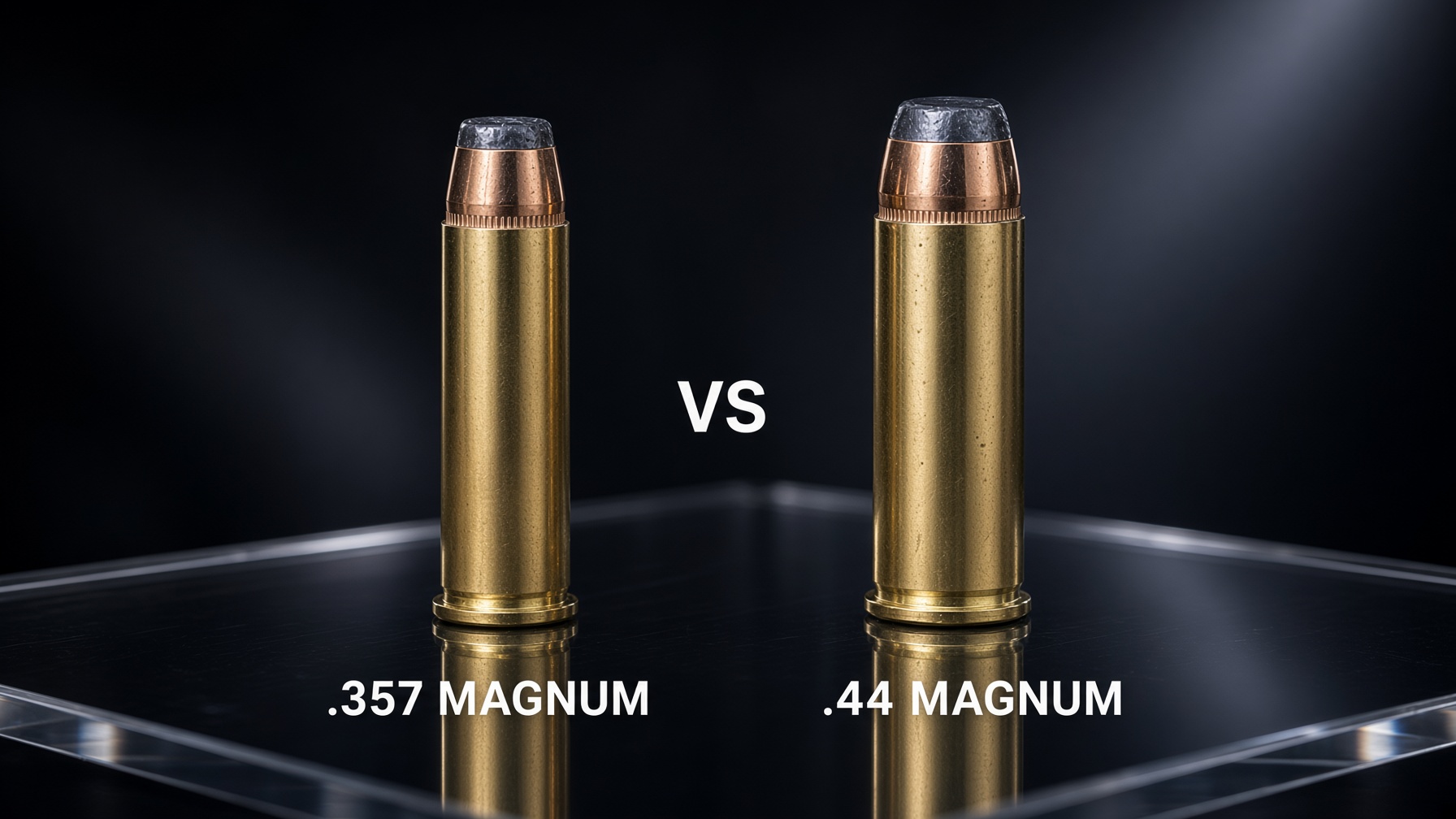
.357 Magnum and .44 Magnum are rated to almost the same pressure — 35,000 psi against 36,000 — so the difference between them is not how hard they are loaded. It is how much bullet that pressure is pushing. A 240-grain .44 against a 158-grain .357, at pressures a thousand psi apart.
What I want you to walk away with
- Maximum average pressure: .357 Magnum 35,000 psi, .44 Magnum 36,000 psi. Within three per cent of each other.
- The crusher figures diverge though — 45,000 CUP against 40,000 — a reminder that the two measuring systems are not convertible.
- Typical published energy: 539 to 645 ft-lb for .357 against 601 to 1,398 ft-lb for .44, depending heavily on the barrel each maker used.
- Both are chambered in rifles as well as revolvers, and in both the rifle changes the answer more than the cartridge does.
- Neither cartridge has a published recoil figure from any maker — which is the one number that would decide most purchases.
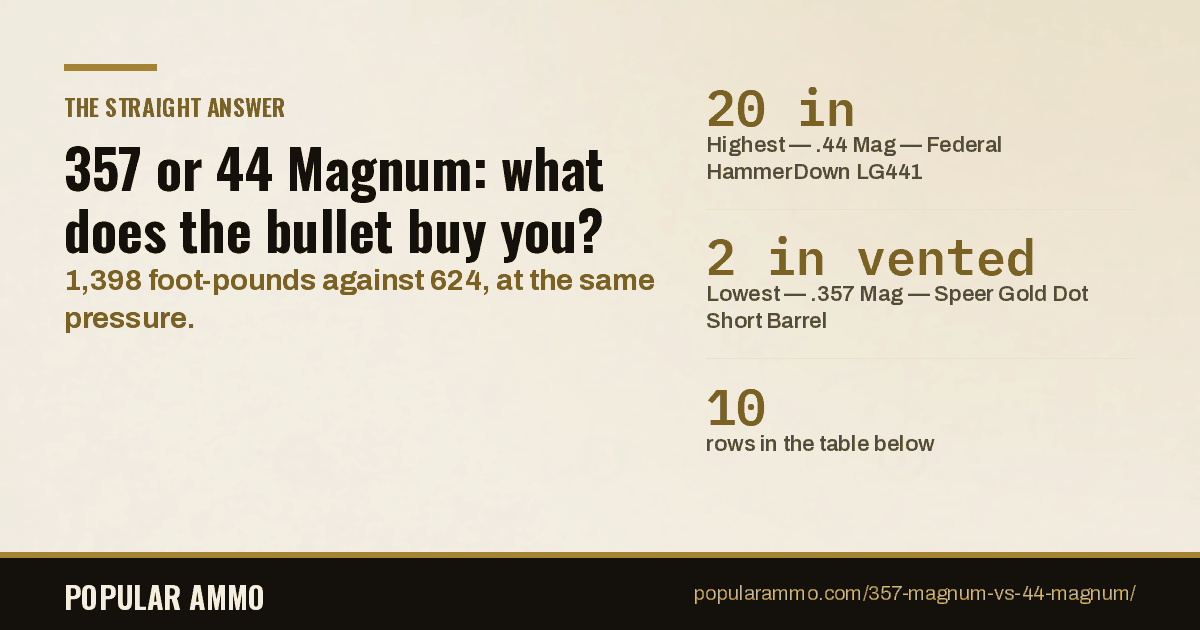
Here’s how I read this chart
Every number in this table is a published figure, copied from the source named underneath it — none of it is my own measurement. Read across a row to compare one entry, and down a column to compare them all on the same measure.
The specifications, side by side
| Specification | .357 Magnum | .44 Remington Magnum |
|---|---|---|
| Bullet diameter, jacketed | .3580 in | .429 in (component makers) |
| Case length | 1.290 in | 1.285 in |
| Cartridge overall length | 1.405 – 1.590 in | 1.535 – 1.610 in |
| Rim diameter | .440 in | .514 in |
| Bore / groove diameter | .346 / .355 in | .417 / .429 in |
| Twist | 1 in 18.75 in, OPTIONAL | 1 in 20 in, OPTIONAL |
| Maximum average pressure | 35,000 psi | 36,000 psi |
| Maximum average pressure, crusher | 45,000 CUP | 40,000 CUP |
| Solid test barrel | 10.000 in | 8.275 in |
| Vented test barrel | 5.643 in | 5.763 in, .008 in gap |
Note the case lengths: 1.290 inches against 1.285. These two cartridges are almost exactly the same length. The .44 is simply wider — .429 inches of bullet against .358 — which is where all the extra bullet weight comes from.
The pressure rows deserve a second look. By transducer they are within a thousand psi of each other. By copper crusher they are 5,000 CUP apart, in the opposite direction. That is not a contradiction; it is what SAAMI means when it says the two systems are not mathematically convertible. If you ever see these two cartridges compared in CUP and psi at the same time, the comparison is broken.
Quick answers
Which is more powerful?
The .44 Magnum, at every weight either cartridge is loaded to. Published muzzle energy for .44 runs from about 600 ft-lb in a defensive load to 1,398 in Hornady’s 240-grain from an 8-inch barrel; .357 tops out around 645 ft-lb from the same maker’s 8-inch vented barrel.
Is .357 enough for bear?
The makers answer this by what they market. Federal, Hornady, Buffalo Bore and Underwood all position .44 Magnum loads for bear and dangerous game explicitly. I could not find equivalent marketing on .357 loads. That is the industry’s own judgment, not mine.
Can I shoot .38 Special in a .44 Magnum?
No — different diameters entirely. The .357 Magnum takes .38 Special because they share a bullet and a rim; the .44 Magnum’s equivalent is .44 Special, which is a separate question.
Which is better in a lever rifle?
Both gain enormously. One published .44 Magnum load runs 1,466 fps from a 4-inch revolver and 1,935 from a 20-inch carbine; one .357 load runs 1,476 fps from a 3-inch revolver and 2,298 from an 18.5-inch Marlin. In both cases the rifle is worth several hundred feet per second.
Which kicks less?
The .357, on every account I have read — but no maker publishes a recoil figure for either, so there is no number to give you.
What each one actually does

Here’s how I read this chart
This is the same product line from the same maker in both calibers, from almost identical barrels — the fairest comparison available. The left pair is bullet weight in grains, the right is muzzle energy in foot-pounds. Both cartridges are loaded to nearly the same pressure, so the .44’s advantage comes from carrying a much heavier bullet, not from being loaded harder.
| Load | Gr | Velocity | Energy | Barrel |
|---|---|---|---|---|
| .44 Mag — Hornady Backcountry Defense 90868 | 240 | 1,620 fps | 1,398 ft-lb | 8 in |
| .44 Mag — Federal HammerDown LG441 | 270 | 1,615 fps | 1,564 ft-lb | 20 in |
| .44 Mag — Hornady Custom 9080 XTP | 200 | 1,500 fps | 999 ft-lb | 7.5 in vented |
| .44 Mag — Federal Fusion F44FS1 | 240 | 1,290 fps | 887 ft-lb | 4 in vented |
| .44 Mag — Federal Solid Core P44SHC1 | 300 | 1,150 fps | 881 ft-lb | 6.5 in vented |
| .357 Mag — Hornady Critical Defense 90500 | 125 | 1,500 fps | 624 ft-lb | 8 in vented |
| .357 Mag — Hornady LEVERevolution 92755 | 140 | 1,440 fps | 645 ft-lb | 8 in vented |
| .357 Mag — Federal American Eagle AE357A | 158 | 1,240 fps | 539 ft-lb | 4 in vented |
| .357 Mag — Federal Solid Core P357SHC1 | 180 | 1,215 fps | 590 ft-lb | 6 in vented |
| .357 Mag — Speer Gold Dot Short Barrel | 135 | 990 fps | 294 ft-lb | 2 in vented |
The cleanest pairing available is Federal’s Solid Core in both calibers: a 180-grain .357 at 1,215 fps and 590 ft-lb from a 6-inch vented barrel, against a 300-grain .44 at 1,150 fps and 881 ft-lb from a 6.5-inch one. Same maker, same product line, near-identical barrels. The .44 carries 49 per cent more energy, and it does it by carrying 120 more grains of bullet at slightly lower velocity — which is exactly what you would expect from two cartridges loaded to the same pressure.
That is the honest summary of these two: same pressure, different bore, and the bigger bore turns that pressure into a heavier bullet rather than a faster one.
The barrel matters more than the headstamp
Both cartridges are chambered in revolvers and in lever rifles, and both makers who publish gun-by-gun figures show the same thing.
For .44 Magnum, one 240-grain load across six firearms: 1,466 fps from a 4-inch Smith & Wesson, 1,535 and 1,578 from two 5.5-inch Rugers, and 1,871, 1,897 and 1,935 fps from Marlin 1894s at 16.5, 18 and 20 inches. A 469 fps spread from one box.
For .357 Magnum, four loads across five firearms show the same pattern, ending with a Marlin 1894 at 18.5 inches: a 125-grain load runs 1,476 fps from a 3-inch revolver and 2,298 fps from the rifle.
Put those two facts together and something useful falls out. A .357 Magnum out of a carbine reaches velocities a .44 Magnum revolver does not. Comparing the cartridges without naming the guns is comparing nothing.
Buffalo Bore, who publish those figures, also warn against reading barrel length alone: “Barrel length is not a stand-alone determiner of velocities and therefore energies. Factors such as barrel/cylinder gap, chamber dimensions, chamber throats, barrel throats, rifling depth and dimensions, rifling style or type, barrel material, bullet material and powder burn rate, etc., all have an impact.” Their own data shows a 6-inch Colt Python producing less velocity than a 4-inch Smith & Wesson.
Where the two diverge in practice
Heavy hard cast loads exist for .44 Magnum and come with firearm lists. Two makers sell a 340-grain load at a published 1,425 fps and 1,533 ft-lb, and both publish which revolvers it may be used in — Ruger Redhawk, Super Redhawk, Super Blackhawk and Vaquero, Freedom Arms Model 83, Colt Anaconda, Magnum Research BFR and others. Underwood adds: “Firearms outside of these categories should not be assumed safe.”
.357 Magnum has a short-barrel ecosystem that .44 does not. Speer builds a Gold Dot Short Barrel specifically for 2-inch revolvers, and Buffalo Bore publishes a flash-suppressed 125-grain load for the same use. The .44 Magnum equivalents are chambered in guns few people carry.
Both makers of hard cast .44 loads describe them by penetration rather than expansion — “5 to 6 feet of straight line non-expanded penetration” in one case. That is a different design goal from anything in the .357 catalog.
Which should you buy?
If the question is a first revolver, most of the published evidence points at .357 Magnum, and for a reason that has nothing to do with ballistics: a .357 revolver also shoots .38 Special, which means one gun covers a range from 770 fps target loads to full Magnum. A .44 Magnum revolver shoots .44 Special, which is a much smaller and more expensive market.
If the question is maximum effect on a large animal, it is the .44, and the makers agree — every dangerous-game load I found in these two calibers is a .44.
And if the question is what the numbers actually say, it is this: the two cartridges run at the same pressure, so the .44’s advantage is bullet weight, not intensity. That advantage is roughly 50 per cent more energy in a like-for-like comparison, and it comes with recoil that neither maker will put a number on.
What nobody publishes
- Recoil — for either cartridge, from any maker, in any load.
- Ballistic coefficient — absent from every loaded-ammunition page in both calibers. One exception: Underwood publishes .19 for a .357 load.
- Data past 100 yards — no maker publishes it for either cartridge.
- Test barrel length — not published by Winchester, Remington or Underwood for either caliber.
- The .44 Magnum’s date of introduction — not on any manufacturer page I could find. The only primary date available is a SAAMI drawing issue date, which is a standards date, not a birthday.
Where to go next
My 44 Magnum ammo piece covers the barrel-length problem and the hard cast firearm lists in full, and my .38 Special vs .357 Magnum comparison covers the other half of the .357’s appeal. The caliber comparison chart puts both against everything else. For revolver selection, see Guns and Gadgets Daily.
Sources
- ANSI/SAAMI Z299.3 centerfire pistol and revolver standard — .357 Magnum and .44 Remington Magnum drawings, pressure tables, solid and vented test barrel specifications
- Hornady 90500, 92755, 9080, 9085, 9088, 90868; Federal AE357A, P357SHC1, F44FS1, P44SHC1, LG441; Speer Gold Dot Short Barrel 23917GD
- Buffalo Bore .357 Magnum items 19A, 19D, 19G and 19K; .44 Magnum Deer Grenade and Heavy .44 Magnum +P+; and its published article on velocity versus barrel length
- Underwood 305 gr hard cast and 340 gr +P+; Barnes .44 Rem Mag published data
Ammunition reference desk
Three charts readers come back to: what a round costs today, what a cartridge name really measures, and what shipping and tax add.
| .22 LR | 6.59¢ |
| 9mm Luger | 26.98¢ |
| 5.56 NATO | 44.95¢ |
| .270 Win | .278 in |
| .30-30 Win | .309 in |
| .308 Win | .309 in |
| Case price | $269.80 |
| Shipping and tax | +$34.88 |
| Per round | 30.47¢ |
Reader Favorites