What Is a Caliber? The Number Is Not the Bullet
SAAMI uses the word caliber eight times in its 400-page rifle standard and never defines it. The number in a cartridge name is only approximate.
Last updated: September 21, 2026 · Originally published September 10, 2026
SAAMI uses the word “caliber” eight times in its 400-page rifle standard and never once defines it. There is no glossary in the document. The closest the standard comes to explaining the number in a cartridge’s name is a phrase buried in its ordering rules: “approximate caliber designation.” Approximate is the standard’s own word.
Here is what the number actually refers to, and why the bullet is never quite that size.
What I want you to walk away with
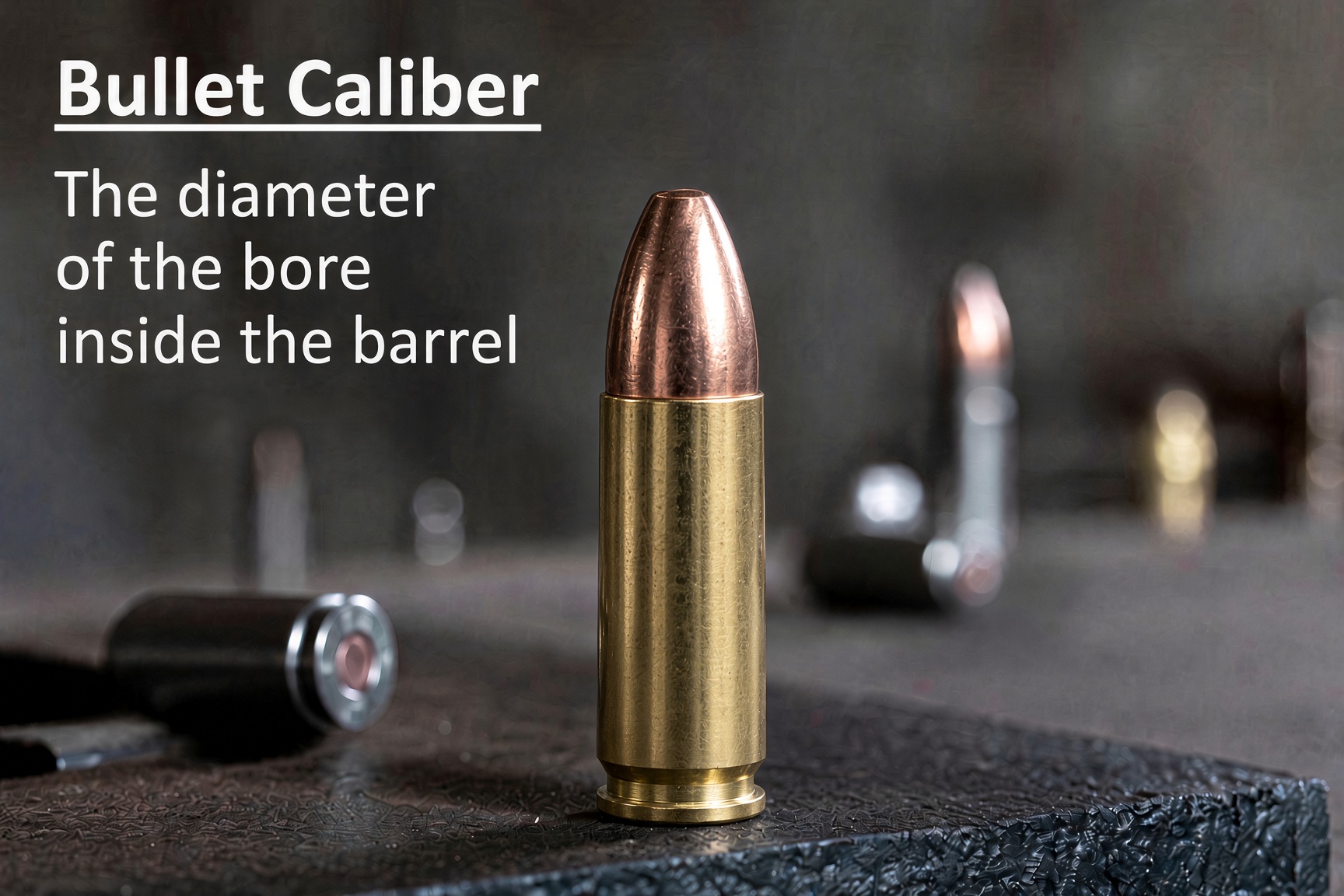
- A caliber number is usually the bore diameter — the narrow measurement across the raised ridges inside the barrel, not the width of the bullet.
- The bullet is always wider than the bore, because it has to fill the grooves cut into the barrel to seal the gas and take the spin.
- A .270 Winchester has four numbers: the name .270, a bore of .270, a groove of .277 and a bullet of .278 inches.
- Some names match nothing at all. A .444 Marlin fires a .4305-inch bullet — the name is thirteen thousandths larger than the projectile.
- The .270 Winchester and 7mm Remington Magnum have the same .277-inch bore, named in two different measuring systems.
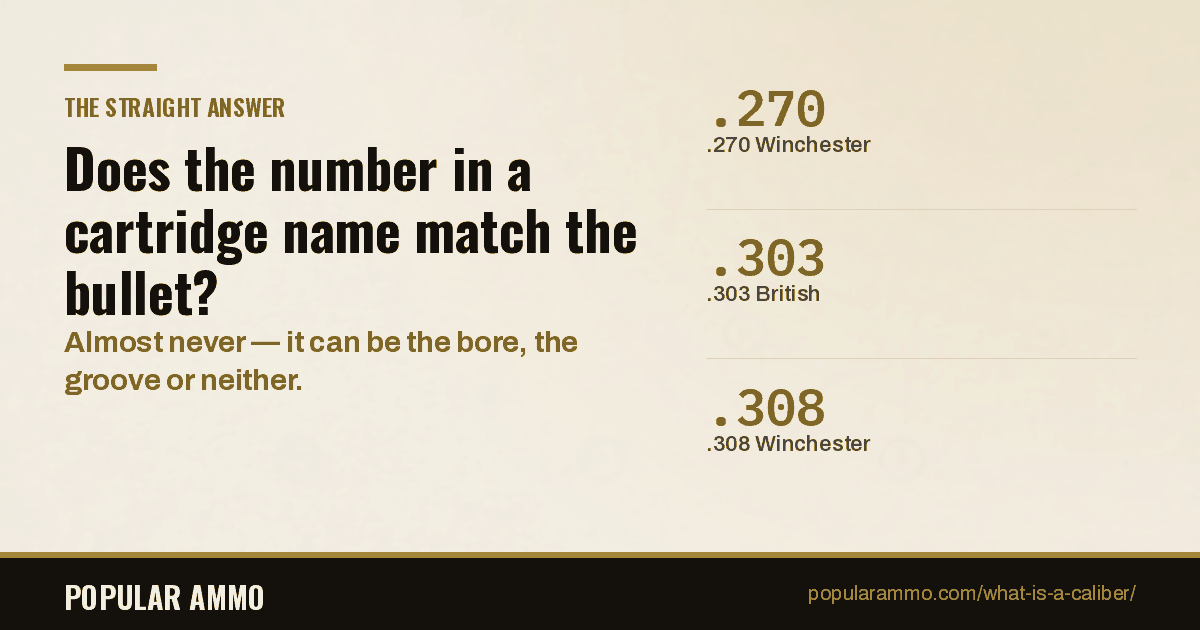
Here’s how I read this chart
Every number in this table is a published figure, copied from the source named underneath it — none of it is my own measurement. Read across a row to compare one entry, and down a column to compare them all on the same measure.
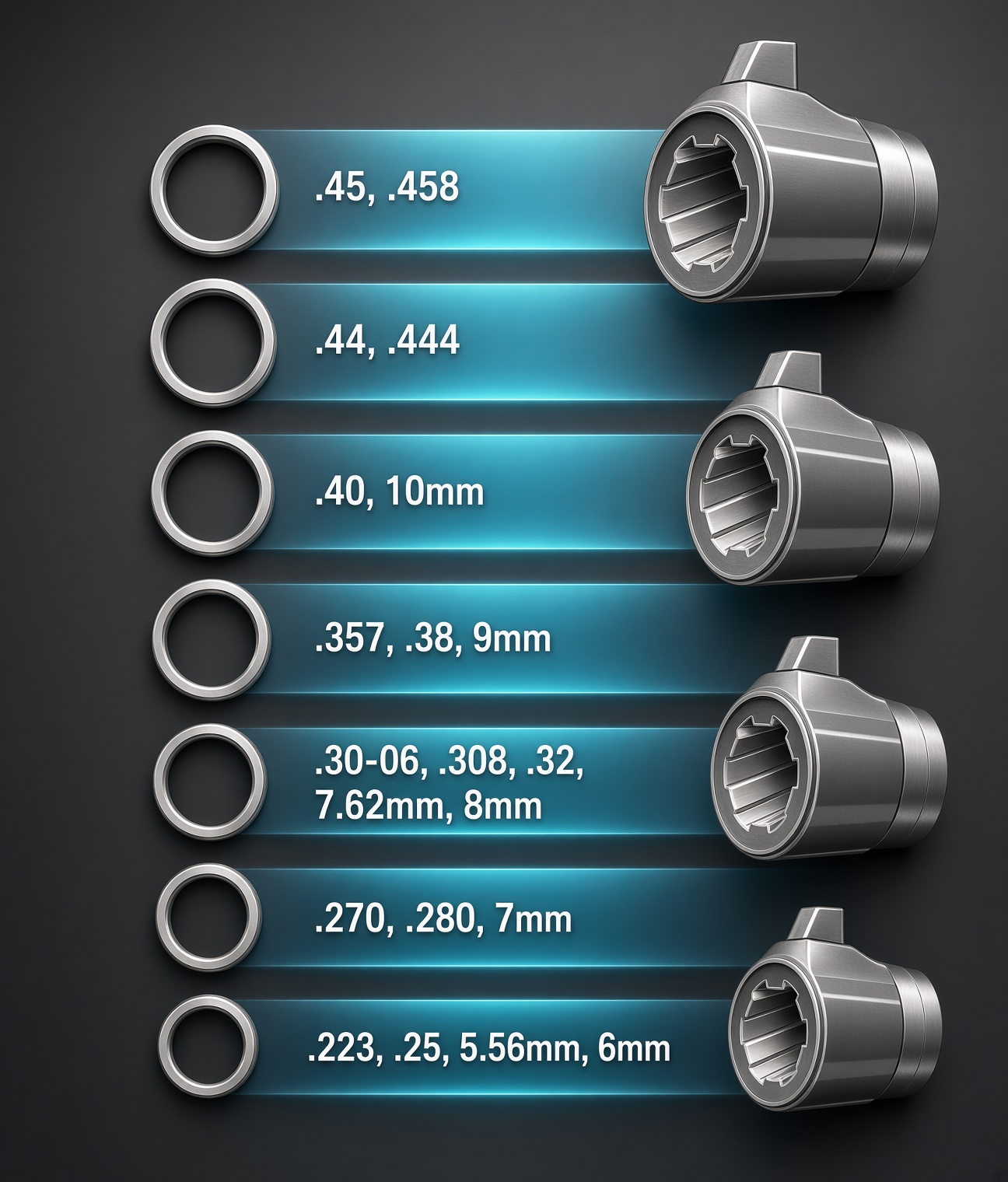
What the barrel actually looks like
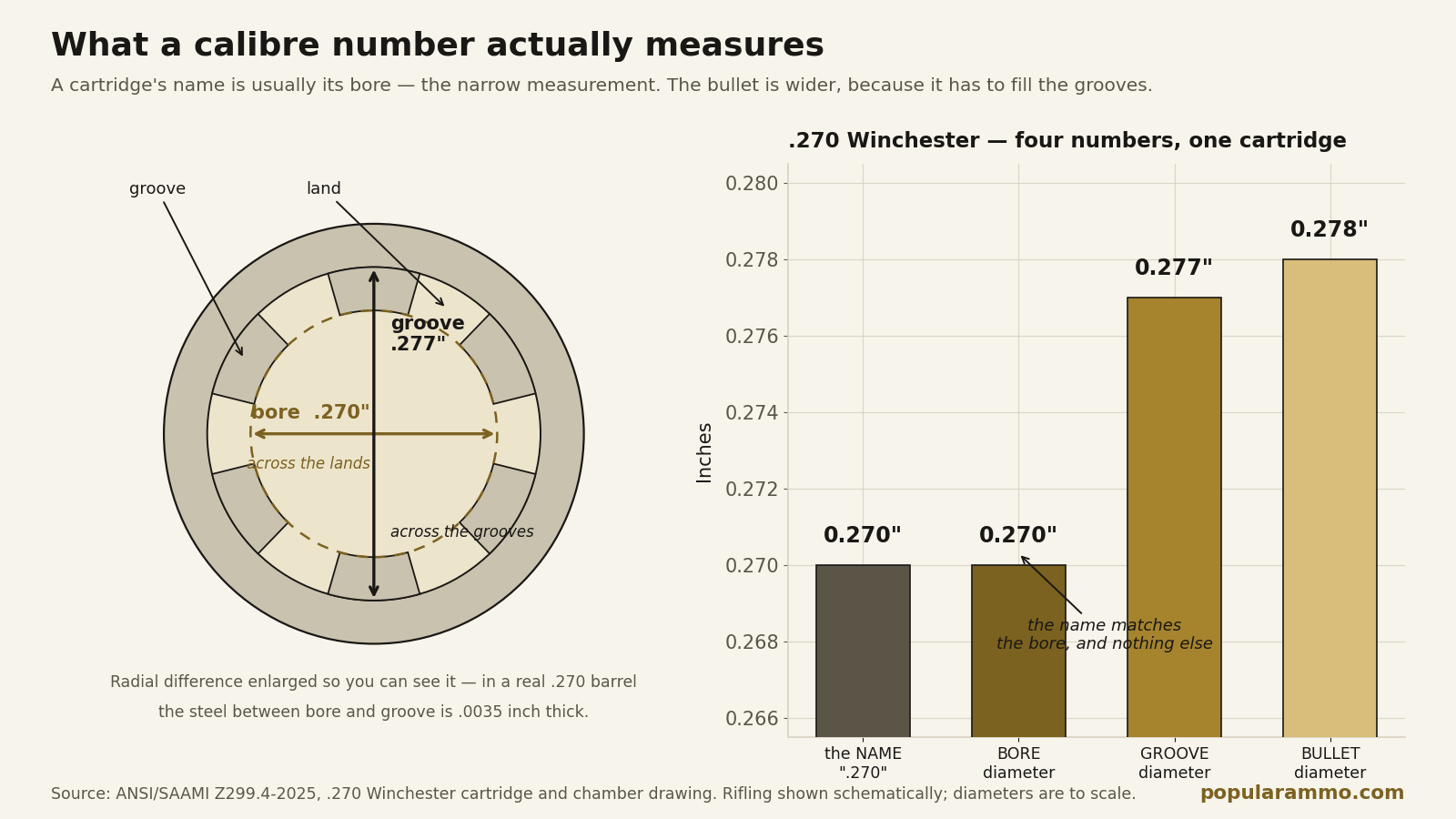
Here’s how I read this diagram
On the left you are looking straight down a rifle barrel. The steel is not smooth: grooves are cut in a spiral along its length, leaving raised strips called lands between them. Measure across the lands and you get the bore diameter — the narrow one, and usually the one in the cartridge’s name. Measure across the grooves and you get the groove diameter, which is wider. The radial difference is drawn much larger than life so you can see it; in a real .270 barrel it is about three and a half thousandths of an inch. On the right, the same cartridge’s four numbers shown to true scale — and only one of them matches the name.
The purpose of the grooves is spin. A bullet fired from a smooth tube tumbles; a bullet forced through a spiral groove comes out rotating, and rotation is what keeps it pointing forwards. To take that spin the bullet has to be bigger than the bore — big enough that the lands bite into it and the grooves are sealed. That single mechanical requirement is why a cartridge’s name and its bullet diameter are never the same number.

Quick answers
So is caliber the bullet or the barrel?
Conventionally the barrel — and specifically the bore. But it is a convention, not a rule, and it is broken often. The .243 Winchester is named for its groove diameter, which is also its bullet diameter. The .35 Remington is named for a rounding of its bore. The .444 Marlin is named for nothing measurable on the cartridge at all.
Why is a .38 Special bullet .357 inches?
Same reason, older history. The .38 Special and the .357 Magnum both fire a .3580-inch jacketed bullet through a .346-inch bore with a .355-inch groove. Neither name matches the bullet; the “.38” is inherited from a much older cartridge measured across the outside of its case rather than its bullet.
What does a name like .30-30 or .45-70 mean?
Those are two-number black-powder-era names: approximate caliber first, then the original powder charge in grains. A .45-70 was a .45 caliber bullet over 70 grains of black powder. The .30-30 followed the same convention with smokeless powder. Modern names have abandoned it — a .308 Winchester tells you nothing about its charge.
Why are some cartridges named in millimeters?
Because two measuring systems are in use side by side. The .243 Winchester and the 6mm ARC have identical bore, groove and bullet dimensions. One is named in inches, one in millimeters, and the geometry is the same.
Who decides the name?
The company that submits the cartridge. Only a SAAMI voting or associate member may introduce one, and the submission package includes what SAAMI calls “the only recognized full and abbreviated name of the cartridge.” Once the Joint Technical Committee and the Board approve it, that is the name — a process SAAMI says takes three to six months.
The .270 Winchester, in four numbers
One cartridge is enough to show the whole problem. All four of these figures appear on the same single page of the standard.
| Measurement | .270 Winchester | What it is |
|---|---|---|
| The name | .270 | A commercial designation, chosen by Winchester |
| Bore diameter | .270 in | Across the lands — the narrowest part of the barrel |
| Groove diameter | .277 in | Across the grooves — the widest part of the barrel |
| Bullet diameter | .278 in | The projectile, wider than the groove so it seals |
The name is the bore. The bullet is eight thousandths of an inch larger than the name. That is not sloppiness — it is the mechanical requirement working exactly as intended.
Where the convention breaks down
If every cartridge were named for its bore, caliber numbers would at least be consistently wrong in one direction. They are not.
| Cartridge | Name | Bore | Groove | Bullet | The name is… |
|---|---|---|---|---|---|
| .270 Winchester | .270 | .270 | .277 | .278 | the bore |
| .303 British | .303 | .303 | .314 | .3125 | the bore — bullet is .0095 in over |
| .308 Winchester | .308 | .300 | .308 | .309 | the groove |
| .30-06 Springfield | .30 | .300 | .308 | .309 | the bore — same barrel as the .308 Winchester |
| .243 Winchester | .243 | .237 | .243 | .243 | the groove and the bullet |
| .32 Winchester Special | .32 | .315 | .320 | .322 | roughly the groove — bore is under, bullet is over |
| .35 Remington | .35 | .349 | .357 | .359 | a rounding of the bore |
| 350 Legend | .350 | .346 | .355 | .357 | between bore and groove — matching neither |
| .444 Marlin | .444 | .424 | .430 | .4305 | nothing — .0135 in larger than the bullet |
| 7.62x39mm | 7.62 mm | 7.62 mm | 7.87 mm | 7.90 mm | the bore, in millimeters |
Look at rows three and four. The .308 Winchester and the .30-06 Springfield use the identical barrel — .300-inch bore, .308-inch groove, .309-inch bullet. One is named for the groove and one for the bore. They are the same caliber by every physical measurement and they carry different numbers.
Then look at the .444 Marlin, which fires a .4305-inch bullet. There is no measurement anywhere on that cartridge or its barrel that comes to .444.
The pair that settles it
If you want a single example that shows a caliber number is a name and not a measurement, here it is.
The .270 Winchester and the 7mm Remington Magnum have exactly the same bore: .277 inches. Identical groove diameter too, at .2837 inches, and identical bullet diameter at .2845.
The .270 is named for its bore in inches, rounded down from .277 to .270. The 7mm Remington Magnum is named for a nominal seven millimeters — and 7.00 mm matches neither its bore (7.04 mm), nor its groove (7.206 mm), nor its bullet (7.226 mm). The same hole in the same steel, given two names by two different companies using two different systems, neither of which is precisely a measurement of it.
How the naming actually works
There is no rule. SAAMI publishes the one recognized name for each cartridge and no reasoning behind any of them, so the conventions are simply the habits of the companies that named them. In practice you will meet:
- Bore in inches — .270 Winchester, .303 British, .30-06 Springfield
- Groove in inches — .308 Winchester, .243 Winchester
- Bore in millimeters — 6.5 Creedmoor, 7.62x39mm, 6mm ARC
- Caliber and case length in millimeters — 7.62×39, 5.56×45: the second number is the case length
- Caliber and powder charge — .45-70 Government, .30-30 Winchester, from the black powder era
- Caliber and parent cartridge — 7mm-08 Remington (a 7mm bullet in a .308 case), 25-06 Remington (a .25 bullet in a .30-06 case)
- Caliber and year — .30-06 Springfield, adopted in 1906
- A number that matches nothing — .444 Marlin, 350 Legend, .38 Special
And cartridges do get renamed. The standard notes on one of its own drawings that the .280 Remington was “previously designated 7mm Express Remington” — the same cartridge, two names, both from one company.
What SAAMI does and does not define
The standard is a dimensional and performance document, not a dictionary. Searching the full text for the terms you would expect it to define returns nothing:
| Term | In ANSI/SAAMI Z299.4-2025 |
|---|---|
| Caliber | Used 8 times. Never defined. |
| Bore diameter | Appears only as the drawing label “Bore Dia.” Never defined. |
| Groove diameter | Appears only as the drawing label “Groove Dia.” Never defined. |
| Headspace | Appears 253 times, all as dimensions and procedure. Never defined. |
| Cartridge, case, chamber | Used throughout. Never defined. |
| Leade | Does not appear at all |
| Maximum average pressure | Defined in full, with the statistics behind it |
| Commercial manufacturer | Defined — “one who produces ammunition by fabricating component parts from raw materials” |
What it does define, meticulously, is pressure. That tells you what the document is for: it is a manufacturing and safety standard, written for people who already know what a bore is. The vocabulary is assumed.
How a cartridge gets into the standard at all
SAAMI publishes this process, and it explains why plenty of cartridges you can buy are not in it.
Only a SAAMI voting or associate member company may submit a design. SAAMI’s stated reason is practical: the submission is not just drawings. Velocity and pressure limits “must both be established in a ballistics range equipped with SAAMI-compliant test equipment,” and a “reliable and quality supply of ballistic range reference ammunition must be available” so that other laboratories can validate their own equipment against it.
The package then goes to the Joint Technical Committee, which gets ninety days to review it, then votes; then to the Board of Directors. SAAMI says the whole process “can take between three and six months.” A designer who is not a member can partner with one — SAAMI notes it is “not involved in such arrangements.”
And cartridges can leave: one “no longer in production by a SAAMI-member company” and lacking a current lot of reference ammunition is classed inactive.
What nobody publishes
- A definition of “caliber” from SAAMI, in any of its documents I have read.
- A naming rule. The standard publishes names, not reasoning.
- Case capacity for any cartridge — nowhere in the standard.
- Recoil. See my rifle recoil chart, which builds it from SAAMI’s separate formula and states every input.
Where to go next
My rifle caliber chart draws twenty-six cartridges to scale with all four numbers for each, ammo types explained covers what the rest of the round is made of, and my caliber comparison chart takes in handgun and shotgun rounds too. New shooters will find gear coverage at Popular EDC.
Sources
- ANSI/SAAMI Z299.4-2025 centerfire rifle standard, approved 10 February 2025 — cartridge and chamber drawings; the full and abbreviated names list and its “approximate caliber designation” ordering rule; the .280 Remington redesignation note; full-text searches for defined terms
- ANSI/SAAMI Z299.3-2022 centerfire pistol and revolver standard — .38 Special and .357 Magnum bore, groove and bullet diameters
- SAAMI, How Does a Cartridge Become a SAAMI Standard and What is the Benefit?, 13 January 2025
- SAAMI, Generally Accepted Cartridge and Chamber Names, 8 October 2021


Ammunition reference desk
Three charts readers come back to: what a round costs today, what a cartridge name really measures, and what shipping and tax add.
| .22 LR | 6.59¢ |
| 9mm Luger | 26.98¢ |
| 5.56 NATO | 44.95¢ |
| .270 Win | .278 in |
| .30-30 Win | .309 in |
| .308 Win | .309 in |
| Case price | $269.80 |
| Shipping and tax | +$18.89 |
| Per round | 28.87¢ |
Reader Favorites