Rifle Recoil Chart: Built From SAAMI’s Formula, Inputs Shown
No ammunition maker publishes a recoil figure, so every recoil chart is calculated. This one uses SAAMI’s formula with the inputs shown.
Last updated: September 22, 2026 · Originally published September 10, 2026
No ammunition manufacturer publishes a recoil figure. Not Federal, Hornady, Winchester, Remington, Barnes, CCI, Buffalo Bore or Underwood — I have checked roughly two hundred product pages across five separate rounds of research. So there is no such thing as a recoil chart taken from published maker data. What there is, is a formula published by SAAMI, and a way of using it honestly: state every input, and let you check the arithmetic.
That is what this page does. Every number below can be reproduced from the figures printed beside it.
What I want you to walk away with
- SAAMI publishes a free-recoil formula in a separate four-page document, not in the cartridge standards. It requires a propellant charge weight — which is exactly the number factory ammunition makers do not print.
- So every row here uses a published handload recipe from Hodgdon’s Reloading Data Center, at its maximum charge, with the powder, charge weight, bullet weight and velocity all stated.
- My implementation reproduces SAAMI’s own worked example to within its published rounding — 30.17 ft-lb against the 30.22 SAAMI prints.
- The one external check available anywhere is Hornady’s published recoil figures for three cartridges. My ordering matches Hornady’s exactly; my magnitudes differ by 10 to 18 percent, and I explain why below.
- SAAMI’s formula explicitly does not account for muzzle brakes, suppressors, recoil pads, action type, or what recoil actually feels like.

Here’s how I read this chart
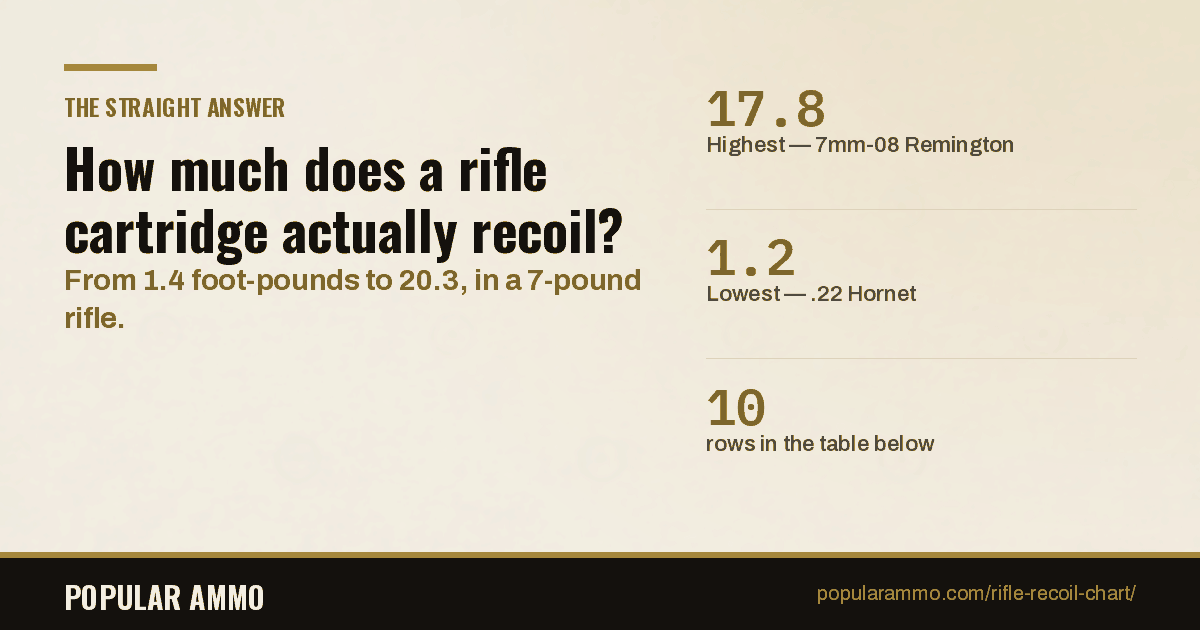
Every number in this table is a published figure, copied from the source named underneath it — none of it is my own measurement. The card shows the top rows; the complete table is further down this page. Read across a row to compare one entry, and down a column to compare them all on the same measure.
Quick answers
How much recoil is too much?
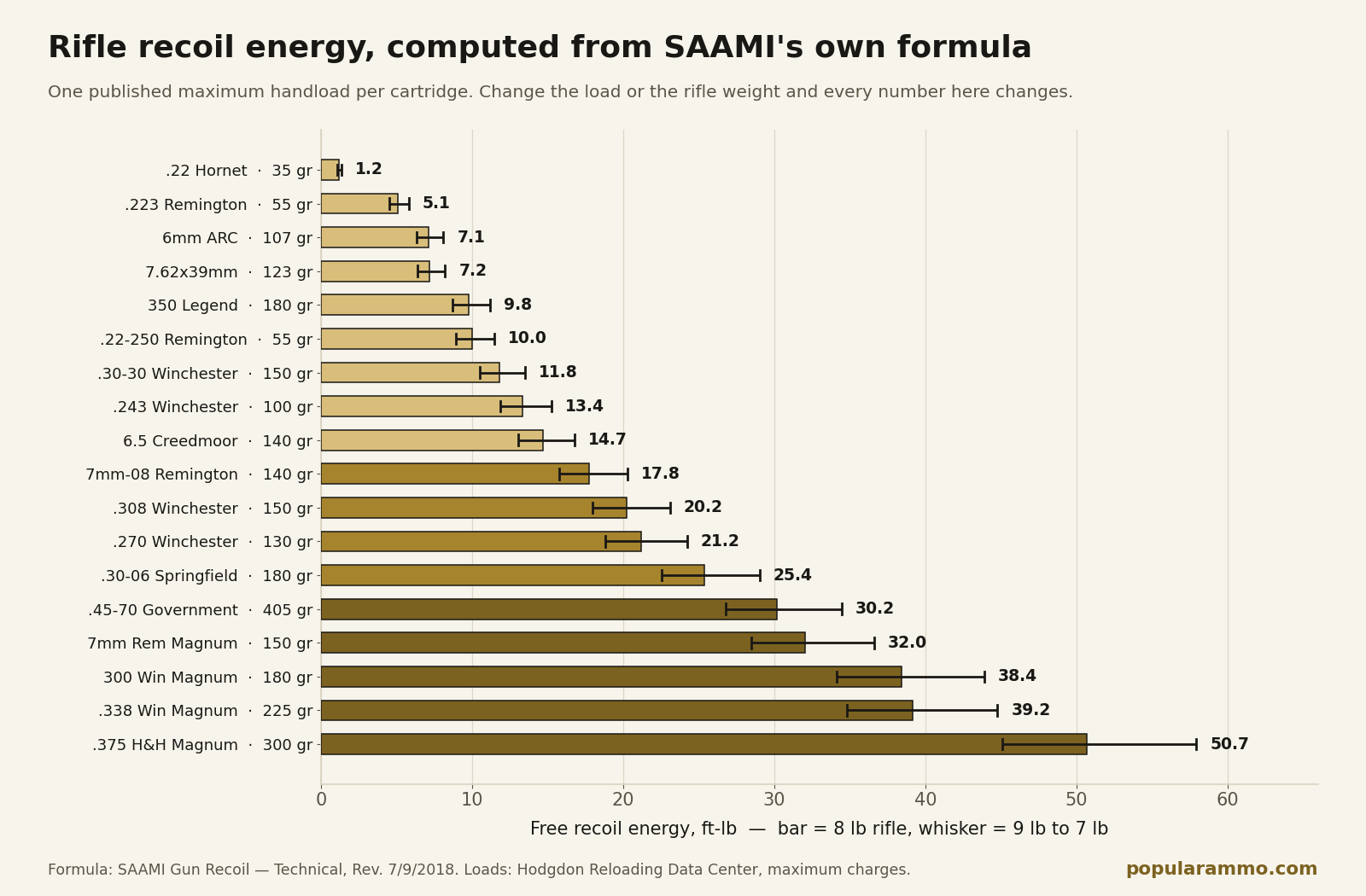
Nobody publishes a threshold, and I am not going to invent one. What the table shows is the spread: from about 1 ft-lb for a .22 Hornet to about 51 for a .375 H&H in the same 8-pound rifle. The commonly hunted middle — .243, 6.5 Creedmoor, .308 — sits between 13 and 20. Where your own limit falls is a question about you, not about the cartridge.
Why are these numbers higher than other charts I have seen?
Because every load here is Hodgdon’s maximum published charge, which sits at the top of the pressure range. Factory ammunition is generally loaded milder and will recoil less. Charts that show lower figures are using milder loads — which is fine, as long as they say so, and most do not.
Does a muzzle brake reduce recoil?
Almost certainly, but not in a way this formula can tell you about. SAAMI states the limitation directly: the approach “does not consider any impact on free recoil due to the redirection of propellant gases by attached devices such as muzzle brakes or suppressors.” A brake works by sending gas sideways, and the formula assumes it all goes forwards.
Is free recoil the same as felt recoil?
No, and SAAMI separates them explicitly. Free recoil is the energy. Felt or “perceived” recoil depends on how fast that energy arrives, which changes with recoil pads, stock design and action type — a gas-operated semi-automatic spreads the same impulse over a longer moment than a bolt gun. No maker or standards body publishes a felt-recoil figure for anything.
Why does rifle weight matter so much?
It appears twice in the formula, and the two appearances pull in the same direction. A heavier rifle both recoils more slowly and carries the energy in more mass. Across my table, moving from a 7-pound rifle to a 9-pound one removes about 22 percent of the recoil energy — more than most cartridge changes would.
The formula, as SAAMI publishes it
The recoil formulae are not in the cartridge standards. They are in a separate document called Gun Recoil — Technical, revised 9 July 2018. This is the working form, exactly as printed:
FRE = ( WF ÷ (2 × 32.17) ) × ( ( WEVE + WPCVEƒ ) ÷ ( 7000 × WF ) )2
| Symbol | SAAMI’s definition | Units |
|---|---|---|
| WF | Weight of firearm — “including all attachments such as scopes and suppressors” | pounds |
| WE | “Weight of the ejecta (bullet or shot and wad column)” | grains |
| VE | “Velocity of ejecta in feet per second” | fps |
| WPC | Propellant charge weight — SAAMI takes the weight of the propellant gases as equal to it | grains |
| ƒ | Muzzle gas velocity factor. 1.75 for high-powered rifles; 1.50 for average shotguns and for pistols and revolvers; 1.25 for long-barreled shotguns | — |
| 32.17 | Gravitational conversion (9.8 in the metric form) | — |
| 7000 | “Conversion factor for grains to pounds” | — |
SAAMI states the units requirement plainly: “Firearm weight must be in pounds; ejecta and powder charge in grains; velocity in feet per second. Free recoil energy will then be expressed in foot pounds.”
Every rifle row on this page uses ƒ = 1.75, SAAMI’s stated factor for high-powered rifles. That factor comes with a footnote of its own: SAAMI notes the gas-velocity relationships “were derived from extensive experiments by the British, published in ‘British Text Book of Small Arms’ published in 1929 and confirmed by later work in this country.”
Why a recoil chart is hard to build honestly
Look at the variable list again. WPC — the propellant charge weight — is required. SAAMI is explicit about why: “Because the propellant gases are extremely difficult to weigh, for purposes of this application, the propellant gas weight will be equated to the powder charge weight.”
There is no alternative form of the equation that drops it. And in SAAMI’s own worked example the charge contributes about eight per cent of the momentum — which, because energy goes as momentum squared, is roughly sixteen per cent of the answer. It is not a term you can quietly leave out.
No factory ammunition maker publishes a charge weight. Not one, for any cartridge. So SAAMI’s formula cannot be evaluated from factory ammunition data at all, and any recoil chart claiming to show factory loads is either using an estimated charge weight without saying so, or using a different formula without saying which.
My answer is to use published handload recipes, where the charge weight is printed, and to show you the recipe on the same line as the result.
Checking the arithmetic before trusting it
SAAMI’s document includes one worked example — a 12 gauge shotgun load. Before computing anything else, I ran that example through my implementation.
| SAAMI’s example inputs | Value |
|---|---|
| Firearm weight, WF | 7 pounds |
| Ejecta, WE | 589.9 gr — 1¼ oz of shot (546.9 gr) plus 43 gr of wads |
| Charge weight, WPC | 33.4 gr |
| Velocity, VE | 1,275 fps |
| Gas factor, ƒ | 1.50 — average-length shotgun |
| SAAMI’s printed answer | 30.22 ft-lb |
| My implementation returns | 30.17 ft-lb |
Worth being precise about that gap. SAAMI’s printed arithmetic rounds two intermediate values — it writes the leading term as 0.109 and squares 16.65 to 277.3. Carry the full precision and you get 30.17. Use SAAMI’s own rounded figures and you get 30.22. The formula is right and so is my code; the difference is a rounding decision inside SAAMI’s own worked example, and SAAMI itself closes that example by saying the answer is “about 30 ft-lb due to the uncertainty of the exact shot charge weight and velocity.”

The chart
Here’s how I read this chart
Each bar is the free recoil energy, in foot-pounds, for one specific published load in an 8-pound rifle. The line running through each bar is the range you get by changing only the rifle weight: the left end is a 9-pound rifle, the right end a 7-pound one. A heavier rifle recoils less — that is the whole reason the line slopes the way it does. Bigger numbers mean more recoil, but remember this is measured energy, not what your shoulder reports; the last section of this page explains the difference.
Every input, and every result
This is the table the chart is drawn from. The five middle columns are the inputs; the last three are the answers at three rifle weights. Take any row, put its five inputs into the formula above with ƒ = 1.75, and you will get the numbers on the right.
| Cartridge | Bullet | Powder | Charge | Velocity | 7 lb | 8 lb | 9 lb |
|---|---|---|---|---|---|---|---|
| .22 Hornet | 35 | H110 | 12.3 | 3,060 | 1.4 | 1.2 | 1.1 |
| .223 Remington | 55 | CFE 223 | 28.5 | 3,412 | 5.8 | 5.1 | 4.5 |
| 6mm ARC | 107 | CFE 223 | 28.8 | 2,687 | 8.1 | 7.1 | 6.3 |
| 7.62x39mm | 123 | H4198 | 26.7 | 2,509 | 8.2 | 7.2 | 6.4 |
| 350 Legend | 180 | Lil’Gun | 25.5 | 2,213 | 11.2 | 9.8 | 8.7 |
| .22-250 Remington | 55 | StaBALL 6.5 | 42.5 | 3,887 | 11.5 | 10.0 | 8.9 |
| .30-30 Winchester | 150 | LEVERevolution | 38.5 | 2,512 | 13.5 | 11.8 | 10.5 |
| .243 Winchester | 100 | IMR 7977 | 49.1 | 3,122 | 15.3 | 13.4 | 11.9 |
| 6.5 Creedmoor | 140 | StaBALL 6.5 | 44.0 | 2,806 | 16.8 | 14.7 | 13.1 |
| 7mm-08 Remington | 140 | StaBALL 6.5 | 48.5 | 2,976 | 20.3 | 17.8 | 15.8 |
| .308 Winchester | 150 | CFE 223 | 51.5 | 2,974 | 23.1 | 20.2 | 18.0 |
| .308 Winchester | 168 | CFE 223 | 49.0 | 2,828 | 23.3 | 20.4 | 18.1 |
| .270 Winchester | 130 | StaBALL 6.5 | 56.5 | 3,194 | 24.2 | 21.2 | 18.8 |
| .30-06 Springfield | 180 | StaBALL 6.5 | 57.2 | 2,857 | 29.0 | 25.4 | 22.6 |
| .45-70 Government | 405 | A2200 | 46.7 | 1,792 | 34.5 | 30.2 | 26.8 |
| .45-70 Government | 300 | H335 | 64.2 | 2,173 | 36.4 | 31.8 | 28.3 |
| 7mm Rem Magnum | 150 | Grand | 75.2 | 3,192 | 36.6 | 32.0 | 28.5 |
| 300 Win Magnum | 180 | Grand | 79.3 | 3,088 | 43.9 | 38.4 | 34.2 |
| .338 Win Magnum | 225 | IMR 4350 | 72.0 | 2,832 | 44.8 | 39.2 | 34.8 |
| .375 H&H Magnum | 300 | StaBALL 6.5 | 80.0 | 2,570 | 57.9 | 50.7 | 45.1 |
Two things to hold on to. First, these are maximum published handloads, not factory ammunition — Hodgdon’s maximum column, which sits at the top of the pressure range. Factory ammunition is generally loaded milder, so a factory round of the same cartridge will usually recoil somewhat less than the figure here. Second, the rifle weight matters enormously: moving from a 7-pound rifle to a 9-pound one takes about 22 per cent off every number in the table.
Checking it against the only outside figures that exist
One manufacturer, once, has published recoil figures. Hornady’s 6mm ARC recoil comparison graphic gives three cartridges on a stated 10-pound rifle basis. It is the only external check available on this entire calculation, so I ran it.
| Cartridge | Hornady, ft-lb | Ours, ft-lb | Ratio |
|---|---|---|---|
| .223 Remington | 3.7 | 4.1 | 1.10× |
| 6mm ARC | 6.3 | 5.7 | 0.90× |
| .308 Winchester | 13.7 | 16.2 | 1.18× |
The ordering matches Hornady’s exactly — .223 lightest, 6mm ARC in the middle, .308 heaviest — and the magnitudes land within 10 to 18 per cent. For a calculation done from a formula and a load recipe, against a manufacturer’s own published claim, that is a good agreement.
The remaining difference is the point of this whole page. Hornady publishes no bullet weight, no velocity and no charge weight for its three figures. The graphic states only “10 lb. rifle.” So I cannot reproduce its numbers, and neither can anyone else — not because Hornady is wrong, but because the inputs are not on the page. My .308 figure is higher than Hornady’s because I used a maximum handload and Hornady evidently did not; my 6mm ARC figure is lower for the same kind of reason. Change the load, change the answer.
That is the argument for stating every input, and it is why this page does.
What this number is not
SAAMI is unusually direct about the limits of its own formula, and these caveats belong beside every figure above. Quoted from the document:
“It must be noted this approach does not consider any impact on free recoil due to the redirection of propellant gases by attached devices such as muzzle brakes or suppressors. Felt recoil (also referred to as ‘Perceived’ recoil) can also vary by modifying the rate of application of force by devices such as recoil pads or damping devices and the influence of action type.”
So the figures on this page do not account for:
- Muzzle brakes and suppressors as gas-redirecting devices. They still count as mass — SAAMI says firearm weight includes them — but their effect on where the gas goes is outside the formula, and that effect is the main reason people fit them.
- Recoil pads and damping devices, which change how quickly the force arrives rather than how much of it there is.
- Action type. A gas-operated semi-automatic spreads the impulse over a longer period than a bolt gun. The energy is the same; the experience is not.
- Stock fit, shooter size, position and clothing, none of which are physical properties of the cartridge at all.
Free recoil energy is a real, well-defined physical quantity and it is a good way to rank cartridges against each other. It is not a measurement of what your shoulder will report, and nobody publishes one of those.
Why the .50 BMG is not on the chart
A small illustration of how much the rifle-weight input matters. The formula happily returns a figure for the .50 BMG at 8 pounds — around 485 foot-pounds. That number is arithmetically correct and completely meaningless, because no 8-pound .50 BMG rifle exists; the rifles built for it weigh three to four times that.
Rather than print a figure that describes nothing, I have left the cartridge out. The .50 BMG is also, as it happens, not in the SAAMI standard at all — which is a separate surprise, and one I cover elsewhere.
What nobody publishes
- Recoil figures — from any ammunition maker, for any cartridge, with the single exception of Hornady’s three-cartridge graphic. Confirmed across roughly two hundred product pages.
- Powder charge weights on factory ammunition — which is what makes SAAMI’s own formula impossible to apply to factory loads.
- Rifle weights, in one case — Savage publishes no weight for the Axis or the 110 Apex Hunter XP. Ruger, Winchester, Remington, Marlin, Henry and Springfield all do.
- Any felt-recoil scale from any maker or standards body. SAAMI names the concept and declines to quantify it.
- A recoil column in Federal’s or Barnes’s master ballistics charts, which publish nearly everything else.
Where to go next
My rifle caliber chart shows the same cartridges drawn to scale, 270 vs 308 looks at two of them in detail, and 6mm ARC ballistics covers the one cartridge whose maker publishes recoil at all. Hunters choosing a rifle around felt recoil will find field coverage at Popular Outdoorsman.
Sources
- SAAMI, Gun Recoil — Technical, Rev. 7/9/2018 — formulae, variable definitions, muzzle gas velocity factors, worked example and caveats
- ANSI/SAAMI Z299.4-2025 centerfire rifle standard — cartridge identification and the confirmation that no recoil section exists within it
- Hodgdon Reloading Data Center — powder, maximum charge weight, muzzle velocity, pressure, test barrel length and cartridge overall length for every load in the table
- Hornady 6mm ARC recoil comparison graphic, 10-pound rifle basis
- Published rifle weights: Ruger American Rifle Generation II, Winchester Model 70 Featherweight, Remington Model 700 SPS, Marlin Model 336, Henry H9 Classic, Springfield Armory M1A Standard Issue
Ammunition reference desk
Three charts readers come back to: what a round costs today, what a cartridge name really measures, and what shipping and tax add.
| .22 LR | 6.59¢ |
| 9mm Luger | 26.98¢ |
| 5.56 NATO | 44.95¢ |
| .270 Win | .278 in |
| .30-30 Win | .309 in |
| .308 Win | .309 in |
| Case price | $269.80 |
| Shipping and tax | +$34.88 |
| Per round | 30.47¢ |
Reader Favorites