
6mm ARC Ballistics: Drop, Energy and Every Load
Every published 6mm ARC figure comes from a 24-inch barrel, longer than almost every rifle the cartridge was designed around. Read drop that way.
Last updated: October 6, 2026 · Originally published September 10, 2026
Every published 6mm ARC ballistic figure in existence comes out of a 24-inch barrel. That is what the standard specifies, that is what Hornady tests in, and it is longer than the barrel on almost every rifle the cartridge was designed around. Here is the published data, and here is what it does and does not tell you.
What I want you to walk away with
- SAAMI standardized the 6mm ARC on 20 January 2020 at a maximum average pressure of 52,000 psi, with a 24-inch test barrel and a 1 turn in 7.5 inch twist.
- Hornady publishes six factory loads spanning 2,700 to 3,020 fps. Federal publishes two, Barnes one, Black Hills two.
- The flagship 108-grain ELD Match leaves at 2,750 fps and 1,813 ft-lb and is still doing 1,971 fps and 931 ft-lb at 500 yards.
- Black Hills is the only loader publishing from an 18-inch barrel — and its figures are several hundred fps below Hornady’s 24-inch numbers for comparable bullets.
- Hornady publishes its own three-way comparison: 6.3 ft-lb of recoil against 3.7 for .223 and 13.7 for .308, and 1,062 ft-lb at 400 yards against 604 and 1,556.


Here’s how I read this chart
Every number in this table is a published figure, copied from the source named underneath it — none of it is my own measurement. The card shows the top rows; the complete table is further down this page. Read across a row to compare one entry, and down a column to compare them all on the same measure.
What the standard actually specifies
The 6mm ARC is in ANSI/SAAMI Z299.4, the centerfire rifle standard. That matters more than it sounds: a standardized cartridge has a published pressure ceiling, a published chamber, and a published test barrel that every maker’s velocity claim is measured against. Wildcats have none of that.
| Specification | Published value |
|---|---|
| SAAMI full name | 6mm Advanced Rifle Cartridge |
| Drawing issued / revised | 20 Jan 2020 / 17 Nov 2021 |
| Bullet diameter | .2433 in |
| Case length | 1.490 in |
| Cartridge overall length | 2.135 – 2.260 in |
| Rim diameter | .441 in |
| Bore / groove diameter | .237 / .243 in |
| Maximum average pressure | 52,000 psi |
| Maximum probable lot mean | 53,300 psi |
| Definitive proof pressure | 69,500 – 74,500 psi |
| Copper crusher figures | Not established |
| Test barrel length | 24.000 in |
| Test barrel twist | 1 in 7.5 in, right hand |
| Standard test bullet | 108 gr at 2,700 fps |
Two of those rows deserve a second look. The 52,000 psi ceiling puts the 6mm ARC below a modern magnum but well above the .223 Remington — it is a full-pressure rifle cartridge running in an AR-15-sized action. And the 24-inch test barrel is the single most important number on the page, because it is the barrel behind every velocity figure in the next section.

Quick answers
What velocity does the 6mm ARC actually make?
Published muzzle velocities run from 2,550 fps (Federal’s 110-grain American Eagle) to 3,020 fps (Hornady’s 80-grain ELD-VT). The heavy match bullets — 103 to 108 grains — sit between 2,650 and 2,800 fps. All of Hornady’s figures are from a 24-inch barrel.
How far is it good for?
Nobody publishes an answer to that, and any site that gives you one is doing arithmetic, not quoting a maker. What is published: the 108-grain ELD Match holds 931 ft-lb at 500 yards, and Hornady states its 6mm ARC bullets “remain supersonic beyond 1,000 yards in a standard atmosphere” — though that particular sentence is Hornady republishing a magazine writer, not Hornady’s own test data.
What twist do I need?
SAAMI’s test barrel is 1:7.5, and the chamber drawing lists 1:7.5 as optional. Ruger’s factory 6mm ARC rifle ships at 1:7.7. Faxon publishes 1:7.5 as its recommendation. Hornady itself publishes no twist recommendation anywhere in its visible page copy.
Does it share parts with 6.5 Grendel?
Bolt and magazine, yes, according to the parts makers. CMMG sells one bolt carrier group described as “designed to operate with AR-15 platform firearms chambered in 6.5 Grendel, 6mm ARC, or 22 ARC,” and one magazine covering the same three. Hornady’s own copy says only “AR-15 platform.”
Is 6mm ARC interchangeable with anything?
No. SAAMI’s interchangeability document is a closed list of about twenty chambers, and the 6mm ARC does not appear on it. Neither does any other 6mm cartridge except 6mm Remington, which is listed only as an alias for the .244 Remington.

Every published factory load
This is the whole commercial catalog as published by the makers themselves — item numbers, weights, ballistic coefficients and the barrel each figure came from.
| Maker | Item | Weight | Bullet | BC (G1) | Velocity | Energy | Barrel |
|---|---|---|---|---|---|---|---|
| Hornady | 81603 | 80 gr | ELD-VT V-Match | .410 | 3,020 fps | 1,620 ft-lb | 24 in |
| Hornady | 81612 | 90 gr | CX Custom | .418 | 2,950 fps | 1,739 ft-lb | 24 in |
| Hornady | 81602 | 103 gr | ELD-X Precision Hunter | .512 | 2,800 fps | 1,793 ft-lb | 24 in |
| Hornady | 81604 | 105 gr | BTHP Hornady Black | .530 | 2,750 fps | 1,763 ft-lb | 24 in |
| Hornady | 81608 | 108 gr | ELD Match | .536 | 2,750 fps | 1,813 ft-lb | 24 in |
| Hornady | FR710 | 105 gr | FMJ Frontier | not published | 2,700 fps | 1,699 ft-lb | 24 in |
| Federal | GM6ARCBT1 | 108 gr | Berger BT Target | .522 | 2,650 fps | 1,684 ft-lb | not stated |
| Federal | AE6ARC1 | 110 gr | Total Metal Jacket | .440 | 2,550 fps | 1,588 ft-lb | not stated |
| Barnes | 32475 | 100 gr | Harvest Collection | .515 | 2,800 fps | 1,741 ft-lb | not stated |
| Black Hills | not published | 90 gr | Dual Performance | not published | 2,650 fps | 1,403 ft-lb | 18 in |
| Black Hills | not published | 103 gr | Hornady ELD-X | not published | 2,550 fps | 1,487 ft-lb | 18 in |
Winchester, SIG Sauer, Underwood and Fiocchi publish no 6mm ARC load at all. Six years after standardization, the cartridge is still supplied by four companies, and Hornady is five of the eleven rows above.
The full trajectory table
This is the one most people are actually looking for: Hornady’s published figures for the 108-grain ELD Match, the load the cartridge is usually judged on.
| Range | Muzzle | 100 yd | 200 yd | 300 yd | 400 yd | 500 yd |
|---|---|---|---|---|---|---|
| Velocity | 2,750 | 2,582 | 2,421 | 2,265 | 2,115 | 1,971 |
| Energy, ft-lb | 1,813 | 1,599 | 1,405 | 1,230 | 1,072 | 931 |
| Trajectory, in | -1.5 | 1.9 | 0 | -7.8 | -22.4 | -44.8 |
Read the trajectory row carefully. It is a 200-yard zero — that is why the 200-yard cell is zero and the 100-yard cell is positive. Drop past the zero accelerates hard: 7.8 inches at 300 yards, then another 14.6 inches by 400, then another 22.4 by 500. That shape is the same for every load in the catalog.
Energy across the range
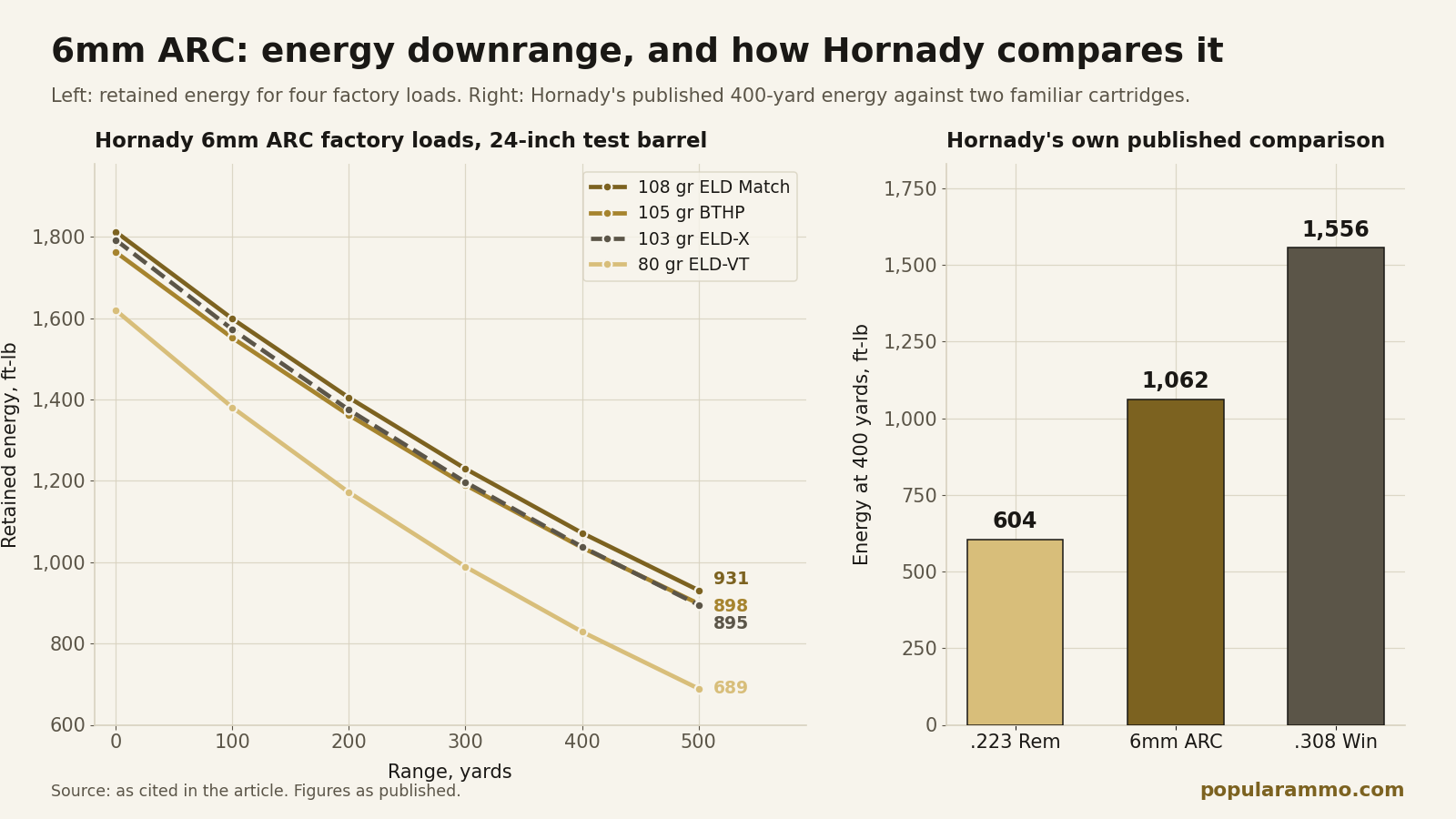
Here’s how I read this chart
The left panel shows how much energy four Hornady 6mm ARC loads still carry at each distance, in foot-pounds. All four start between 1,600 and 1,813 ft-lb and lose roughly half of it by 500 yards. The heavier, higher-BC bullets start lower on the graph in some cases but fall away more slowly, which is why the lines cross. The right panel is Hornady’s own published comparison of energy at 400 yards against two familiar cartridges — it is Hornady’s number, not ours.
The crossing lines in the left panel are the whole argument for the 6mm ARC. The 80-grain ELD-VT is the fastest load in the catalog at the muzzle and the weakest of the four by 300 yards. The 108-grain ELD Match starts slowest of the four and finishes strongest. Ballistic coefficient is what separates them, and it is published on the box.
What a shorter barrel costs
Here is the honest problem with every published 6mm ARC figure: the 24-inch test barrel. Very few 6mm ARC rifles have one. Ruger’s factory offering has a 16.10-inch barrel. Faxon lists 16, 20, 22 and 24-inch options. The AR-15 the cartridge was built for is usually 16 or 18 inches.
Only one loader publishes from a short barrel. Black Hills states an 18-inch test barrel on its 6mm ARC page, and its figures are noticeably lower:
| Load | Maker | Barrel | Velocity | Energy |
|---|---|---|---|---|
| 103 gr ELD-X | Hornady | 24 in | 2,800 fps | 1,793 ft-lb |
| 103 gr ELD-X | Black Hills | 18 in | 2,550 fps | 1,487 ft-lb |
| Difference | — | 6 in | 250 fps | 306 ft-lb |
That is not a barrel-length study and I am not presenting it as one. Two different companies loaded the same bullet with their own powder charges and tested in their own barrels. The 250 fps gap contains the barrel difference and the load difference together, and no published data separates them. What it does tell you is that the 24-inch figures are the ceiling, not the expectation — and that a real 16-inch AR will land below both rows.
Hornady publishes a velocity-versus-barrel-length graphic on its 6mm ARC page, but it is an image with no data table behind it, so there are no numbers to quote from it.
How Hornady compares it to .223 and .308
Hornady’s own commercial sell sheet puts the 6mm ARC against the two cartridges most buyers are choosing between. These are Hornady’s published figures for its own cartridge, so read them as a manufacturer’s case rather than an independent one — but they are at least stated on the record, with a basis given.
| Measure | .223 Rem | 6mm ARC | .308 Win |
|---|---|---|---|
| Recoil, 10-lb rifle | 3.7 ft-lb | 6.3 ft-lb | 13.7 ft-lb |
| Energy at 400 yards | 604 ft-lb | 1,062 ft-lb | 1,556 ft-lb |
| Magazine capacity | 30 rounds | 25 rounds | 20 rounds |
The recoil row is worth pausing on, because it is one of very few published recoil figures anywhere in the ammunition industry. Almost no maker publishes recoil for anything. Hornady does here, with a stated rifle weight, which is the minimum needed for the number to mean something.
Hornady’s stated position on the two neighbours, quoted directly: against the .308, “the 6mm ARC delivers substantially less recoil allowing shooters to spot their own shots”; against the .223, it “achieves substantially better ballistics… less drop, less wind deflection and the ability to shoot accurate groups at much greater distance.” Against the 6.5 Grendel — the cartridge it shares a bolt with — Hornady claims only “comparable performance from a wider assortment of bullets.”
Where the cartridge came from
Hornady states the origin plainly on its own sell sheet: the 6mm ARC was “tested, selected and fielded by a specialized group within the U.S. DoD for its multipurpose combat rifle program.” The company’s June 2020 press release repeats the same wording and quotes ballistician Jayden Quinlan framing the design question as “what can we do with today’s technology to maximize the performance of the AR-15 platform?”
No Department of Defense document naming the cartridge is public, so the DoD connection rests on Hornady’s own statement of it.
What nobody publishes
- Any 6mm ARC figure from a 16-inch barrel — the most common barrel length for the cartridge, and no loader publishes to it.
- Federal’s and Barnes’ test barrel length — neither states one, so their velocities cannot be compared cleanly with Hornady’s.
- A Hornady twist recommendation in visible page copy, for any 6mm ARC load.
- G7 ballistic coefficients for the 105-grain BTHP, the 90-grain CX or the Frontier FMJ — Hornady publishes G1 only for those three.
- Any ballistic coefficient at all for the Frontier FMJ or for either Black Hills load.
- Copper crusher pressure figures — SAAMI prints “crusher pressures not established” for this cartridge in all three tables.
- Barrel life — Hornady’s marketing uses the word “efficient… for optimum all-range performance and barrel life,” but publishes no round count.
Where to go next
If you are weighing the 6mm ARC against what you already own, 223 vs 5.56 covers the chamber question in the cartridge it is most often replacing, 6.5 Creedmoor vs 308 covers the same high-BC argument one platform up, and my caliber comparison chart puts it beside everything else. Hunters will find field coverage at Popular Outdoorsman.
To see the 6mm ARC beside 25 other rifle cartridges at true scale, with SAAMI case lengths and bullet diameters, use my rifle caliber chart.
Sources
- ANSI/SAAMI Z299.4-2025, centerfire rifle standard — 6mm ARC cartridge and chamber drawing, velocity and pressure table, proof table, standard velocity and pressure test barrel drawing
- SAAMI, Generally Accepted Firearms and Ammunition Interchangeability, 8 October 2021; and Generally Accepted Cartridge and Chamber Names, same date
- Hornady product pages for items 81608, 81602, 81604, 81603, 81612 and FR710; the hornady.com 6mm ARC landing page; the 6mm ARC commercial sell sheet; and the Hornady press release of 3 June 2020
- Federal product pages GM6ARCBT1 and AE6ARC1; Barnes 32475 and its published ballistics file; Black Hills Gold 6mm ARC category page
- Ruger American Rifle Ranch Gen II specification sheet, model 46926; CMMG bolt carrier group and magazine listings; Faxon Firearms barrel-length article


Ammunition reference desk
Three charts readers come back to: what a round costs today, what a cartridge name really measures, and what shipping and tax add.
| .22 LR | 6.59¢ |
| 9mm Luger | 26.98¢ |
| 5.56 NATO | 44.95¢ |
| .270 Win | .278 in |
| .30-30 Win | .309 in |
| .308 Win | .309 in |
| Case price | $269.80 |
| Shipping and tax | +$18.89 |
| Per round | 28.87¢ |
Reader Favorites