Rifle Caliber Chart: 26 Cartridges Drawn to Scale
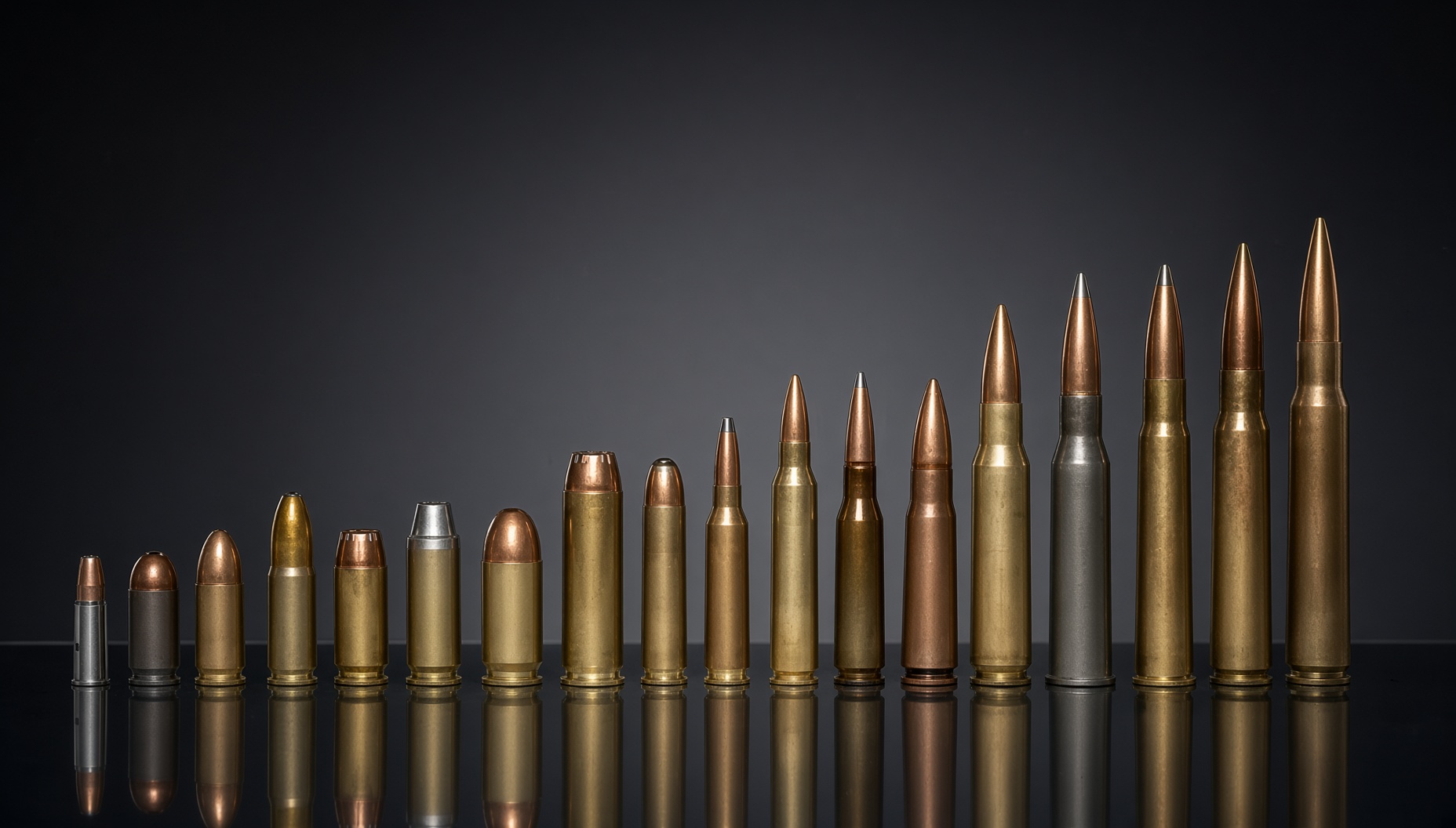
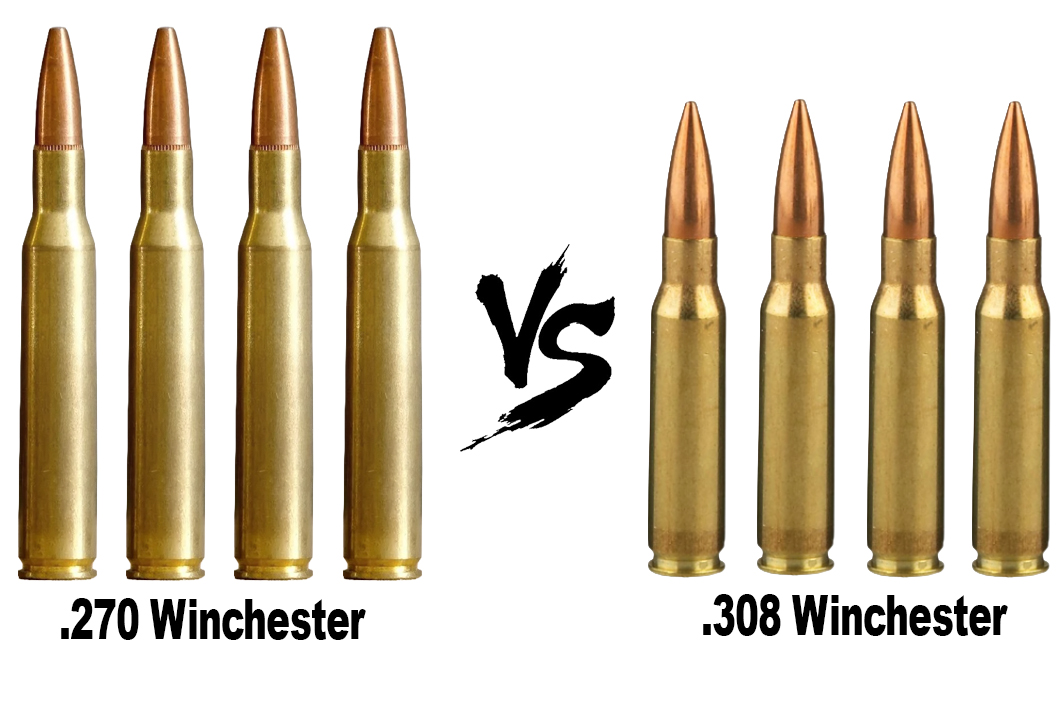
A cartridge name almost never gives the bullet size. A .270 Winchester fires a .278-inch bullet; a .30-30 fires a .309. This chart draws 26 to scale.
Last updated: September 21, 2026 · Originally published September 10, 2026
A cartridge’s name almost never tells you the size of its bullet. A .270 Winchester fires a .278-inch bullet. A .30-30 fires a .309. A 7.62×39 fires a .311, which is not a .308 at all. This chart is drawn from the standard’s own dimensions, so you can see what the numbers actually are.
What I want you to walk away with
- Twenty-six common rifle cartridges, drawn to one scale from ANSI/SAAMI’s published case lengths, head diameters, overall lengths and bullet diameters.
- The name usually matches the bore — the narrowest measurement in the barrel — and not the bullet, which is always wider.
- Size and caliber are different things. A .223 Remington is longer than a .30 Carbine; a 350 Legend is fatter than a .308 and shorter than a .30-30.
- The .270 Winchester and the 7mm Remington Magnum have the identical .277-inch bore — the same hole, named two entirely different ways.
- The .50 BMG is not in the SAAMI standard at all. Neither are 5.56×45 NATO or 7.62×51 NATO.
Here’s how I read this chart
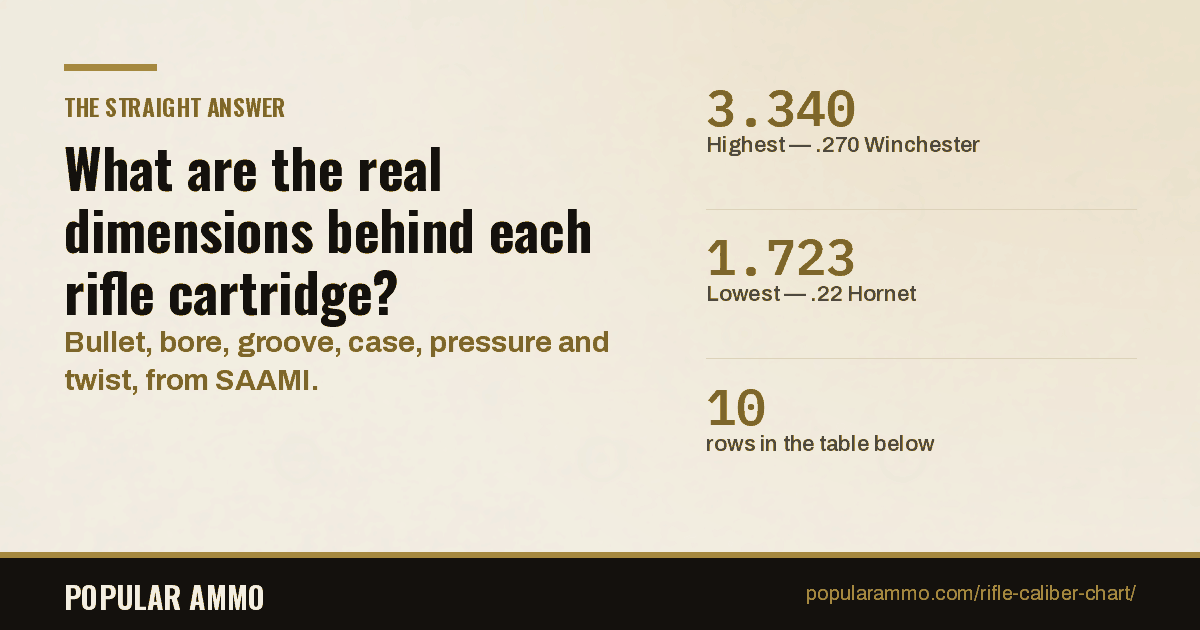
Every number in this table is a published figure, copied from the source named underneath it — none of it is my own measurement. The card shows the top rows; the complete table is further down this page. Read across a row to compare one entry, and down a column to compare them all on the same measure.
The chart
Here’s how I read this chart
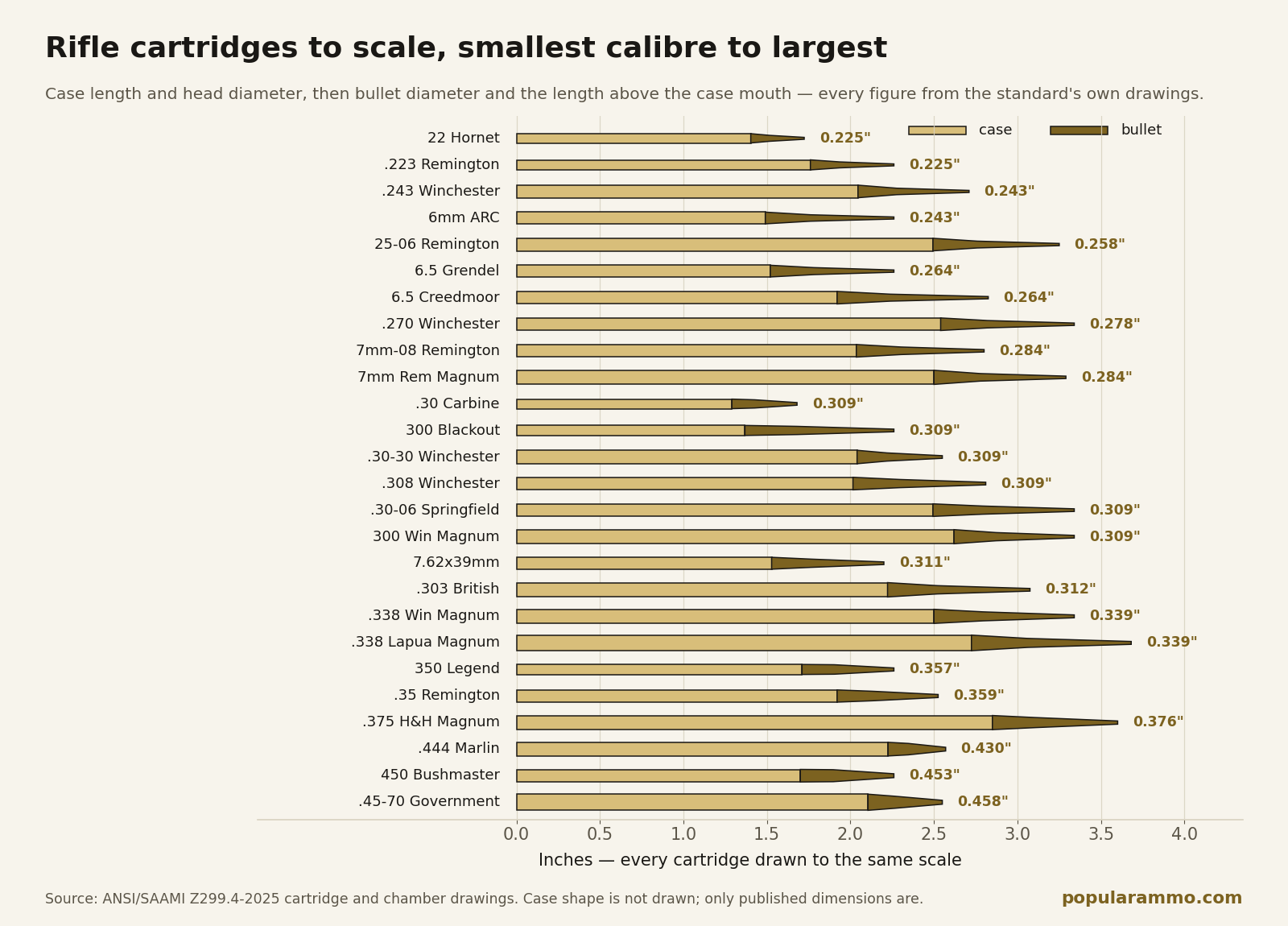
Every cartridge is drawn at the same scale, so lengths and widths are directly comparable between rows. The pale block is the case — its length and its width at the base are the standard’s published figures. The dark shape is the bullet, drawn at its published diameter, filling the distance between the case mouth and the published maximum overall length. Rows are ordered by bullet diameter, smallest at the top. The number on the right is that bullet diameter in inches. What the drawing does not do is guess at the case’s shoulder and taper — those are on SAAMI’s own drawings and I have not invented them.
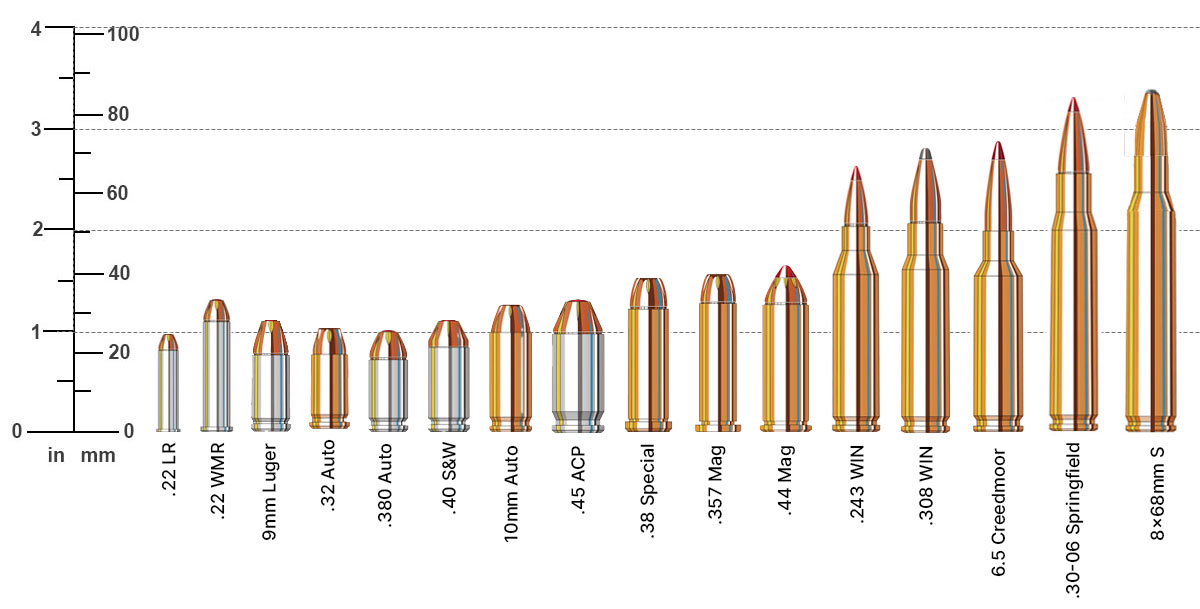
The first thing the chart shows is that caliber and size are separate questions. Ordered by bullet diameter, the lengths jump about: a .30 Carbine sits between a .308 Winchester and a .30-06 in bullet diameter and is barely half the length of either. A 350 Legend has a bigger bullet than a .338 Lapua Magnum and is an inch and a half shorter.
Quick answers
Why is a .270 bullet .278 inches?
Because the name is the bore and the bullet has to fill the grooves. A .270 Winchester barrel has a .270-inch bore measured across the lands and a .277-inch groove diameter; the bullet is .278 so it seals against the grooves. That is normal, not an anomaly — most cartridge names work this way.
Is .308 the same as .30-30 and .30-06?
Same bullet, different cartridges. All three take a .309-inch bullet in a .300-inch bore with a .308-inch groove. They differ in case length, pressure and case shape: 2.015, 2.0395 and 2.494 inches of case respectively, at 62,000, 42,000 and 60,000 psi. The bullet is interchangeable; the ammunition is absolutely not.
What is the biggest rifle cartridge?
Of those SAAMI standardizes, the .458 Winchester Magnum and the .45-70 Government carry the widest bullets at .459 and .458 inches. The .50 BMG is bigger still and is not in the standard — I searched for it and it is absent from the names list, the drawings, the pressure tables and the proof tables.
Why do some cartridges have two names?
Because the industry uses inches and millimeters interchangeably. The .243 Winchester and the 6mm ARC have identical bore, groove and bullet dimensions — .237, .243 and .243 inches — and one is named in inches while the other is named in millimeters. Same geometry, two naming systems.
Does a bigger bullet mean more power?
No, and the chart shows why. The .22-250 Remington has one of the smallest bullets here and is loaded to 65,000 psi. The .45-70 Government has one of the largest and is loaded to 28,000. Pressure, case capacity and bullet weight all matter, and diameter alone settles none of them.
The full table
Every figure here is from the cartridge and chamber drawing for that cartridge in the current standard. Pressures are maximum average pressure by piezoelectric transducer.
| Cartridge | Bullet | Bore | Groove | Case | Max OAL | Head | MAP | Twist |
|---|---|---|---|---|---|---|---|---|
| .22 Hornet | .2245 | .217 | .222 | 1.403 | 1.723 | .350 | 49,000 | 1:16 |
| .223 Remington | .2245 | .219 | .224 | 1.760 | 2.260 | .378 | 55,000 | 1:12 |
| .22-250 Remington | .2245 | .219 | .224 | 1.912 | 2.350 | .473 | 65,000 | 1:14 |
| .243 Winchester | .243 | .237 | .243 | 2.045 | 2.710 | .473 | 60,000 | 1:10 |
| 6mm ARC | .2433 | .237 | .243 | 1.490 | 2.260 | .441 | 52,000 | 1:7.5 |
| 25-06 Remington | .2575 | .250 | .257 | 2.494 | 3.250 | .473 | 63,000 | 1:10 |
| 6.5 Grendel | .2643 | .256 | .264 | 1.520 | 2.260 | .441 | 52,000 | 1:8 |
| 6.5 Creedmoor | .2644 | .256 | .264 | 1.920 | 2.825 | .472 | 62,000 | 1:8 |
| .270 Winchester | .278 | .270 | .277 | 2.540 | 3.340 | .473 | 65,000 | 1:10 |
| 7mm-08 Remington | .2845 | .277 | .2837 | 2.035 | 2.800 | .473 | 61,000 | 1:9.5 |
| 7mm Rem Magnum | .2845 | .277 | .2837 | 2.500 | 3.290 | .532 | 61,000 | 1:9.5 |
| .30 Carbine | .309 | .300 | .308 | 1.290 | 1.680 | .360 | 40,000 | 1:20 |
| 300 AAC Blackout | .309 | .300 | .308 | 1.368 | 2.260 | .378 | 55,000 | 1:8 |
| .30-30 Winchester | .309 | .300 | .308 | 2.0395 | 2.550 | .506 | 42,000 | 1:12 |
| .308 Winchester | .309 | .300 | .308 | 2.015 | 2.810 | .473 | 62,000 | 1:12 |
| .30-06 Springfield | .309 | .300 | .308 | 2.494 | 3.340 | .473 | 60,000 | 1:10 |
| 300 Win Magnum | .309 | .300 | .308 | 2.620 | 3.340 | .532 | 64,000 | 1:10 |
| 7.62x39mm | .311 | .300 | .310 | 1.528 | 2.200 | .447 | 45,000 | 1:9.45 |
| .303 British | .3125 | .303 | .314 | 2.222 | 3.075 | .540 | 49,000 | 1:10 L.H. |
| .338 Lapua Magnum | .339 | .330 | .338 | 2.724 | 3.681 | .588 | 65,000 | 1:10 |
| .338 Win Magnum | .339 | .330 | .338 | 2.500 | 3.340 | .532 | 64,000 | 1:10 |
| 350 Legend | .357 | .346 | .355 | 1.710 | 2.260 | .378 | 55,000 | 1:16 |
| .35 Remington | .359 | .349 | .357 | 1.920 | 2.525 | .460 | 33,500 | 1:16 |
| .375 H&H Magnum | .376 | .366 | .376 | 2.850 | 3.600 | .532 | 62,000 | 1:12 |
| .444 Marlin | .4305 | .424 | .430 | 2.225 | 2.570 | .514 | 42,000 | 1:38 |
| 450 Bushmaster | .4525 | .442 | .450 | 1.700 | 2.260 | .473 | 38,500 | 1:24 |
| .45-70 Government | .458 | .450 | .456 | 2.105 | 2.550 | .608 | 28,000 | 1:20 |
The name, the bore, the groove and the bullet
Read across any row of that table and you will usually find four different numbers where you expected one. Here are the clearest cases.
| Cartridge | Name | Bore | Groove | Bullet | What the name matches |
|---|---|---|---|---|---|
| .270 Winchester | .270 | .270 | .277 | .278 | The bore, and nothing else |
| .303 British | .303 | .303 | .314 | .3125 | The bore. The bullet is .0095 in over the name. |
| .30-30 / .308 / .30-06 | .30 | .300 | .308 | .309 | The bore. Three different numbers in common use for one bullet. |
| 7.62x39mm | 7.62 mm | 7.62 mm | 7.87 mm | 7.90 mm | The bore, in millimeters. The bullet is .311 in, not .308. |
| .35 Remington | .35 | .349 | .357 | .359 | Nothing exactly — it rounds the bore |
| 350 Legend | .350 | .346 | .355 | .357 | Nothing — the name falls between bore and groove |
| .444 Marlin | .444 | .424 | .430 | .4305 | Nothing — the name is .0135 in larger than the bullet |
| .243 Winchester | .243 | .237 | .243 | .243 | The groove and the bullet — one of the few that does |
The standard is quietly honest about this. Its own rule for ordering cartridges in its name list refers to “ascending numerical order of approximate caliber designation” — approximate, in the standard’s own word. SAAMI never defines “caliber” anywhere in the document, and never claims the number in a name is a measurement of anything in particular.
The sharpest illustration is a pair. The .270 Winchester and the 7mm Remington Magnum have exactly the same .277-inch bore. One is named for that bore in inches, rounded down to .270. The other is named for a nominal 7 millimeters, which matches neither its bore (7.04 mm), its groove (7.206 mm) nor its bullet (7.226 mm). Same hole in the barrel; two completely different names, arrived at two completely different ways.

What is missing from the standard
A caliber chart is only as complete as its source, so it is worth saying what is not in ours because it is not in SAAMI’s.
- .50 BMG — completely absent. No names-list entry, no drawing, no pressure table row, no proof entry, no test barrel. I searched the full document.
- 5.56x45mm NATO and 7.62x51mm NATO — both absent. The word “NATO” does not appear in the standard at all. Their commercial counterparts, the .223 Remington and the .308 Winchester, are standardized; the military cartridges are not.
- Wildcats and proprietary cartridges generally. Only a SAAMI voting or associate member company may submit a cartridge for standardization, and it must arrive with pressure and velocity data from a compliant ballistics range plus a supply of reference ammunition.
- Inactive cartridges. SAAMI’s own term: a cartridge no longer produced by a member company, with no current lot of reference ammunition, is classed inactive.
One more thing the standard does not do the same way for everyone
Nearly every velocity figure in the standard comes from a 24-inch test barrel. SAAMI states the rule directly: “All standard test barrels shall be 24 inches long (610 mm). Exterior ballistic data for all centerfire rifle cartridges shall be based on this length.”
But there is a short list of exceptions, and two cartridges on this chart are on it: the 7.62×39 is tested at 20 inches and the 350 Legend at 16. So when you compare a published 7.62×39 velocity with a published .223 velocity, you are comparing a 20-inch figure with a 24-inch one. That is not an error in the standard — the exceptions exist because those barrel lengths reflect the rifles the cartridges are actually used in — but it is a difference nobody mentions.
What nobody publishes
- A definition of “caliber” — SAAMI uses the word eight times in the rifle standard and never defines it. There is no glossary in the document at all.
- Recoil for any cartridge. I built a recoil chart from SAAMI’s formula instead, showing every input.
- A rule for how cartridges are named. The standard publishes the one recognized name for each cartridge and no reasoning behind any of them.
- Case capacity — nowhere in the standard, for any cartridge.
Where to go next
What is a caliber explains the bore, groove and bullet relationship in detail with a diagram, my rifle recoil chart covers the same cartridges by recoil, and my caliber comparison chart takes in handgun and shotgun rounds as well. Hunters matching a cartridge to game will find field coverage at Popular Outdoorsman.
Sources
- ANSI/SAAMI Z299.4-2025 centerfire rifle standard, approved 10 February 2025 — cartridge and chamber drawings for all twenty-six cartridges; velocity and pressure tables; the test barrel length rule and its exceptions list; the full and abbreviated names list and its ordering rules
- SAAMI, How Does a Cartridge Become a SAAMI Standard and What is the Benefit?, 13 January 2025
- SAAMI, Generally Accepted Cartridge and Chamber Names, 8 October 2021
Ammunition reference desk
Three charts readers come back to: what a round costs today, what a cartridge name really measures, and what shipping and tax add.
| .22 LR | 6.59¢ |
| 9mm Luger | 26.98¢ |
| 5.56 NATO | 44.95¢ |
| .270 Win | .278 in |
| .30-30 Win | .309 in |
| .308 Win | .309 in |
| Case price | $269.80 |
| Shipping and tax | +$34.88 |
| Per round | 30.47¢ |
Reader Favorites