8.6 Blackout Ammo: Loads, Twist and Ballistics
SAAMI standardized 8.6 Blackout on 29 January 2026 at 62,000 psi, but its 1-in-6 twist is not the fast 1-in-3 barrel makers actually sell.
Last updated: September 21, 2026 · Originally published September 10, 2026
8.6 Blackout ammo became a SAAMI-standardized cartridge on 29 January 2026 — and the standard specifies a 1-in-6 twist, while the fast 1-in-3 twist that made the cartridge famous is what barrel makers actually sell. That one discrepancy tells you most of what is unsettled about this cartridge.
What I want you to walk away with
- SAAMI accepted 8.6 BLACKOUT on 29 January 2026 at a maximum average pressure of 62,000 psi, with a reference load of 200 grains at 2,200 fps.
- SAAMI’s chamber drawing specifies a 1-in-6 twist, marked OPTIONAL, and its test barrel is 16 inches at 1-in-6. Q, Faxon and Ballistic Advantage publish and sell 1-in-3.
- Subsonic loads dominate the catalog: 280 to 350 grains at roughly 950 to 1,050 fps, most of them tuned to a 12-inch barrel.
- The fast-twist terminal claim is published by barrel and ammunition makers, not by SAAMI, and no maker in this set publishes measured wound-cavity figures.
- Steinel is the only loader publishing full downrange tables. Most publish a muzzle velocity and nothing else.
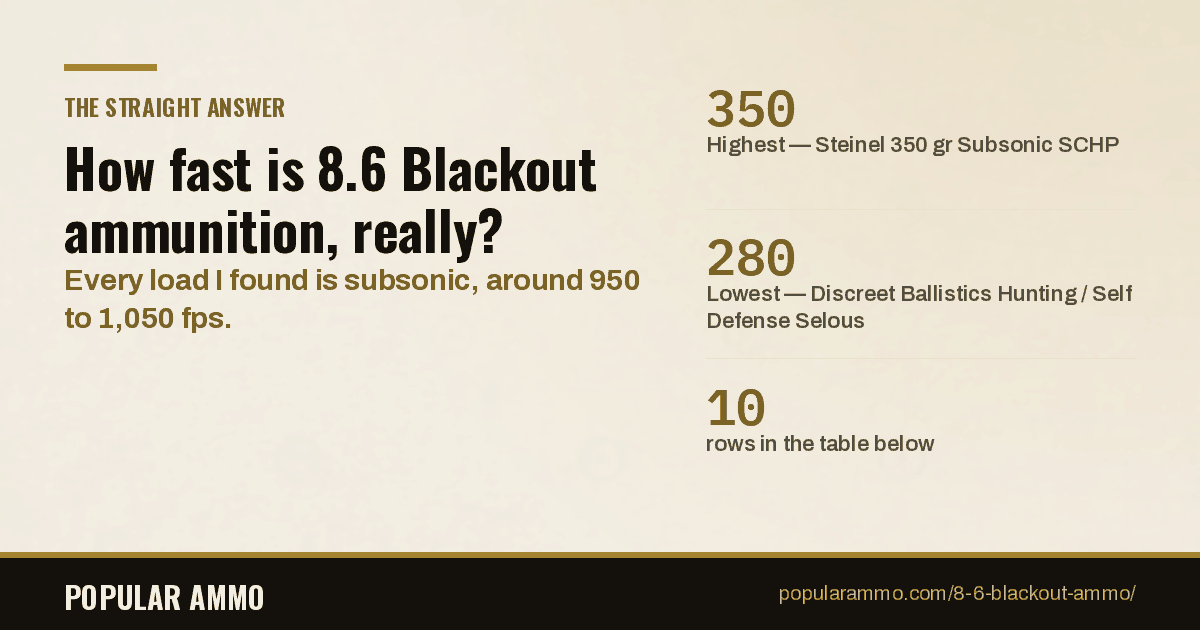
Here’s how I read this chart
Every number in this table is a published figure, copied from the source named underneath it — none of it is my own measurement. The card shows the top rows; the complete table is further down this page. Read across a row to compare one entry, and down a column to compare them all on the same measure.
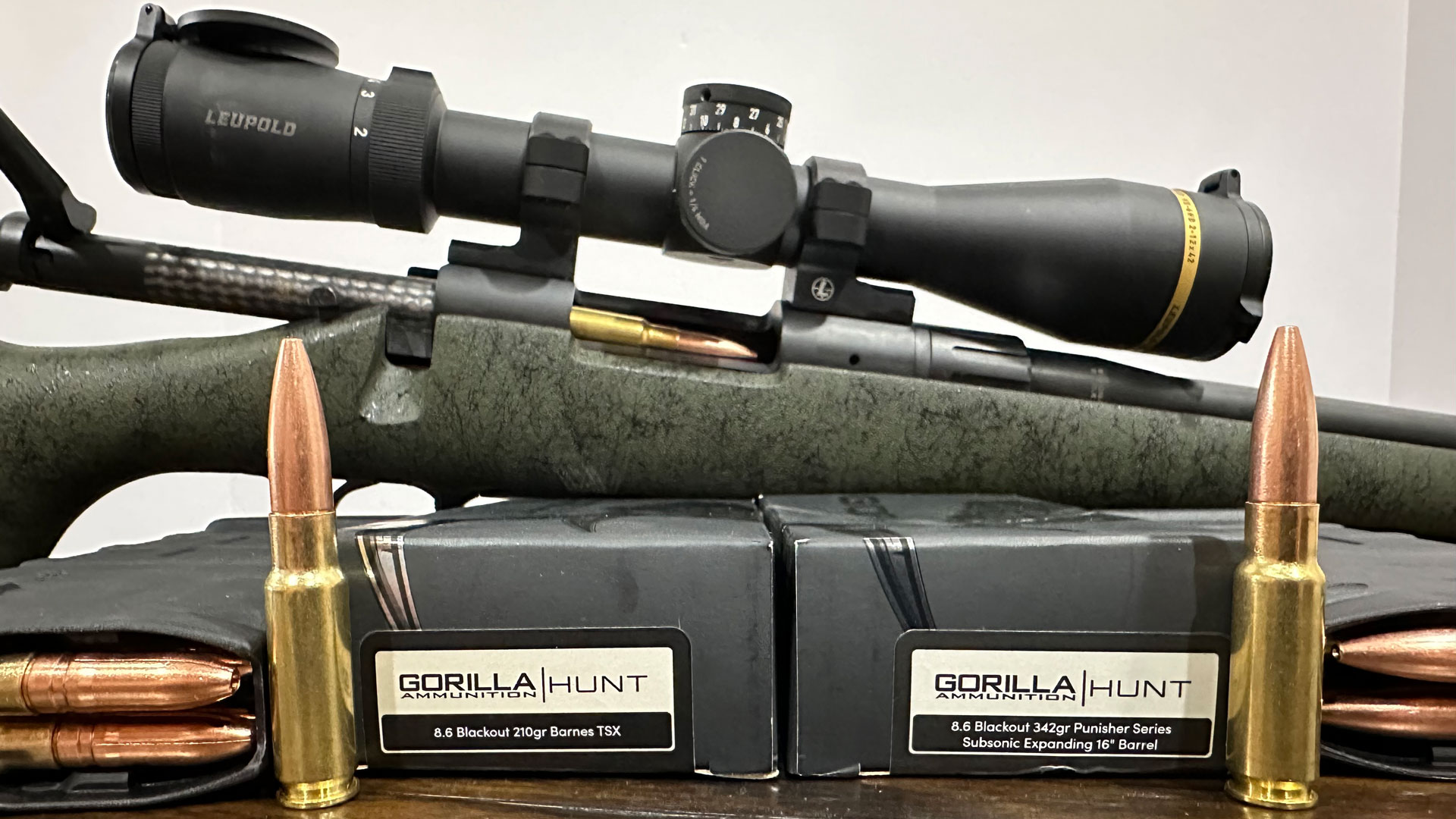
What is 8.6 Blackout ammo?
8.6 Blackout is a .338-caliber cartridge built on a shortened, necked-up 6.5 Creedmoor case, designed by Q LLC to run heavy subsonic bullets through a short suppressed barrel on a standard .308-family bolt face. Faxon, which makes barrels for it, publishes the lineage directly: “It starts with 6.5 Creedmoor brass necked up to .338 caliber… while maintaining the standard .308 bolt face found on any AR10 or .308-family bolt action.”
The concept is the same one behind .300 Blackout, scaled up: a fat, heavy, slow bullet that stays below the speed of sound so a suppressor has the easiest possible job, from a rifle short enough to be manageable with a can on the end.
Quick answers
Is 8.6 Blackout ammo SAAMI standardized?
Yes, since 29 January 2026. SAAMI’s announcement records it as “introduced by Q, LLC, with a 200-grain bullet traveling at a velocity of 2,200 fps and a Maximum Average Pressure of 62,000 psi.” The public introduction drawing was posted on 7 April 2026 and is listed among cartridges “recently approved… not yet incorporated into the official SAAMI Standards documents.”
What twist does 8.6 Blackout ammo need?
This is the open question. SAAMI’s drawing gives 1 turn in 6 inches, marked optional, and its velocity-and-pressure test barrel is 1-in-6. Q’s own product copy describes a 1-in-3 twist system, Faxon publishes both figures side by side as “Original 1:3T” and “SAAMI 1:6T”, and every Ballistic Advantage 8.6 barrel in the catalog is 1-in-3.
Is 8.6 Blackout ammo subsonic or supersonic?
Both are catalogd, but the subsonic side is far deeper. Subsonic loads run 280 to 350 grains at about 950 to 1,050 fps. Supersonic loads run 190 to 235 grains at roughly 1,600 to 2,150 fps.
What barrel length is 8.6 Blackout ammo loaded for?
Twelve inches, more often than not. Fort Scott states one load is “TUNED FOR A 12″ BARREL”. Gorilla quotes velocities from 12-inch barrels. Steinel publishes separate loads for 8, 10.5, 11.5 and 16-inch barrels — the only maker in this set to break its catalog out that way.
Does Q sell 8.6 Blackout ammo?
Not as of this writing. Q’s own site catalogs brass, dies, muzzle devices and rifles; I found no loaded ammunition listing. The loading is done by others.
What does SAAMI specify for 8.6 Blackout ammo?
| Specification | Value (in) | Value (mm) |
|---|---|---|
| Bullet diameter | .339 − .003 | 8.61 − 0.08 |
| Case length | 1.685 − .020 | 42.80 − 0.51 |
| Cartridge overall length | 2.560 min – 2.810 max | 65.02 – 71.37 |
| Bore diameter | .330 | 8.38 |
| Groove diameter | .338 | 8.59 |
| Grooves | 6 | |
| Twist | 1 turn in 6.00 in, right hand — marked OPTIONAL | |
| Maximum average pressure | 62,000 psi (transducer) | |
| Crusher pressure limit | Not established — SAAMI’s own wording | |
| Reference load | 200 gr at 2,200 fps | |
| Test barrel | 16.000 in, twist 1 turn in 6.00 in | |
SAAMI does not state a parent case on the drawing. Faxon does, and its published figure of 6.5 Creedmoor (modified) is consistent with the case dimensions above.
One number to treat with care: Faxon’s spec table lists an overall length of 2.260 inches, which sits below SAAMI’s 2.560-inch minimum and below the loaded lengths three ammunition makers publish — Fort Scott at 2.800 and 2.650 inches, Steinel at 2.750, Gorilla at 2.62. I note the difference rather than resolving it; the SAAMI window and the loaders’ published lengths agree with each other.
The twist question: 1-in-3 or 1-in-6?
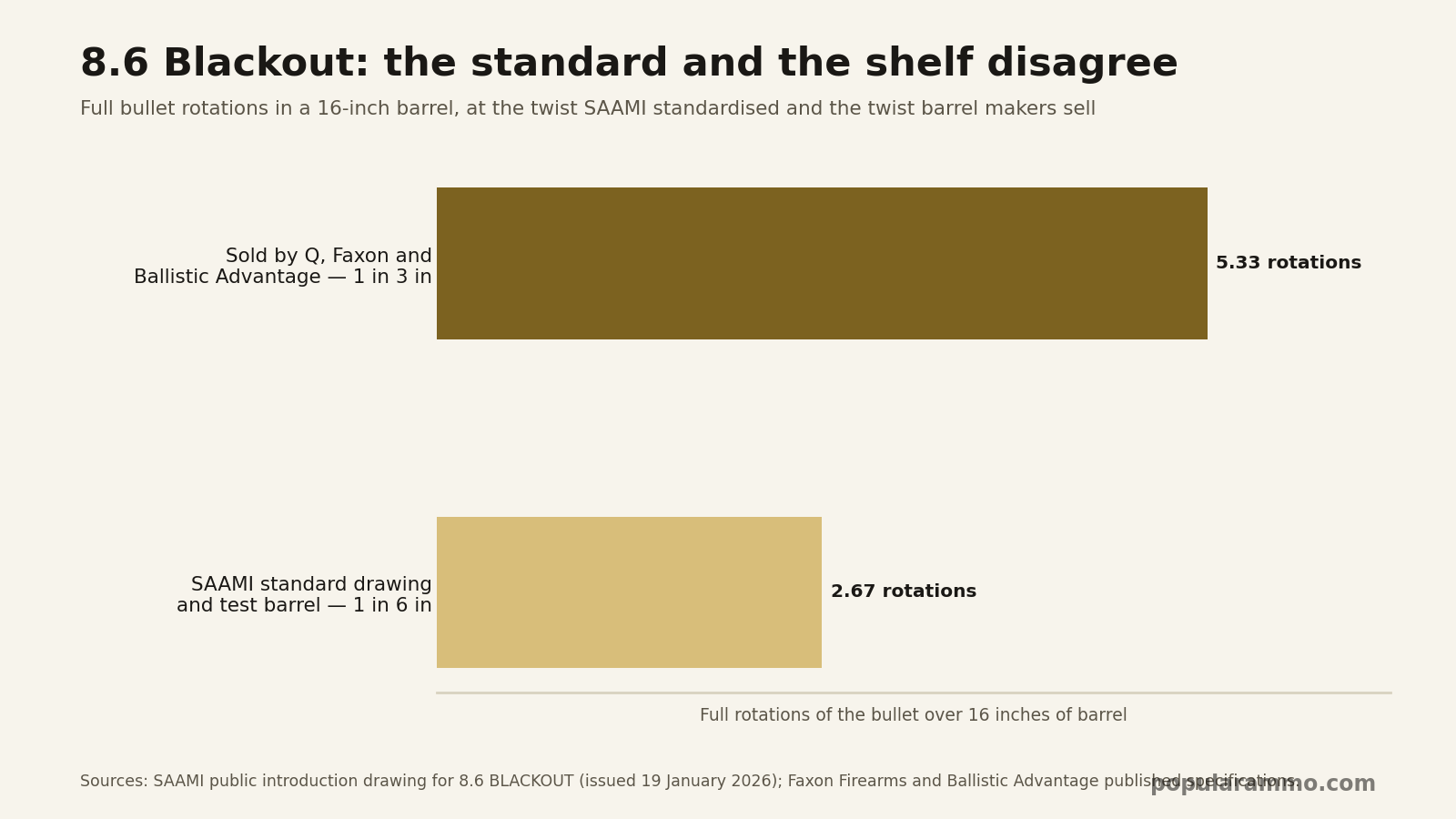
Here’s how I read this chart
Rifling is the spiral grooving inside a barrel that spins the bullet to keep it pointing forwards. Twist rate describes how tight that spiral is. The bars show how many full turns the bullet makes traveling down a 16-inch barrel: a 1-in-3 twist spins it more than five times, a 1-in-6 twist not quite three. The chart exists because the industry standard and the barrels actually on sale currently specify different numbers.
This is the most interesting thing about 8.6 Blackout ammo right now, and it is entirely on the record.
The cartridge’s public identity is the extreme twist. Faxon explains the reasoning in its own words: “Most rifle barrels use 1:7 to 1:10 twist rates. 8.6 Blackout’s original specification demands a fast 1:3 twist — one rotation every 3 inches. This extreme spin rate is intentional: at subsonic velocities, the bullet enters the target spinning at maximum RPM, causing it to yaw and fragment violently, creating wound channels far beyond what velocity alone could produce.” Q’s own rifle copy describes “a purpose-built 8.6 BLK system – 1:3 twist, subsonic stabilization, big bullets, big energy.”
SAAMI standardized 1-in-6, and marked it optional. Faxon publishes both, labeled “Twist Rate (Original) 1:3T” and “Twist Rate (SAAMI) 1:6T”. Ballistic Advantage’s entire 8.6 barrel range — 8, 12.5, 14.5 and 16 inch — is 1-in-3.
What this means for a buyer is practical rather than theoretical. Ammunition makers are loading for what is being sold: Discreet Ballistics states its Selous projectile “is designed specifically to take full advantage of the additional rotational kinetic energy produced by 1:3 twist barrels,” and Steinel describes a load as “designed to maximize penetration while maintaining dependable expansion, especially when paired with fast-twist 1:3 barrels.” If you are buying a barrel, the twist you choose is a real decision, and the standard and the market currently point in different directions.
One caution on the terminal claims. They are published by barrel makers and loaders. They are not part of the SAAMI standard, and no maker in this set publishes measured wound-cavity dimensions. The closest thing to a measurement anyone publishes is Discreet Ballistics’ statement that “950fps impacts produce immediate expansion and 19″ of penetration in calibrated clear ballistics gelatin.” One penetration figure, from the company selling the bullet.
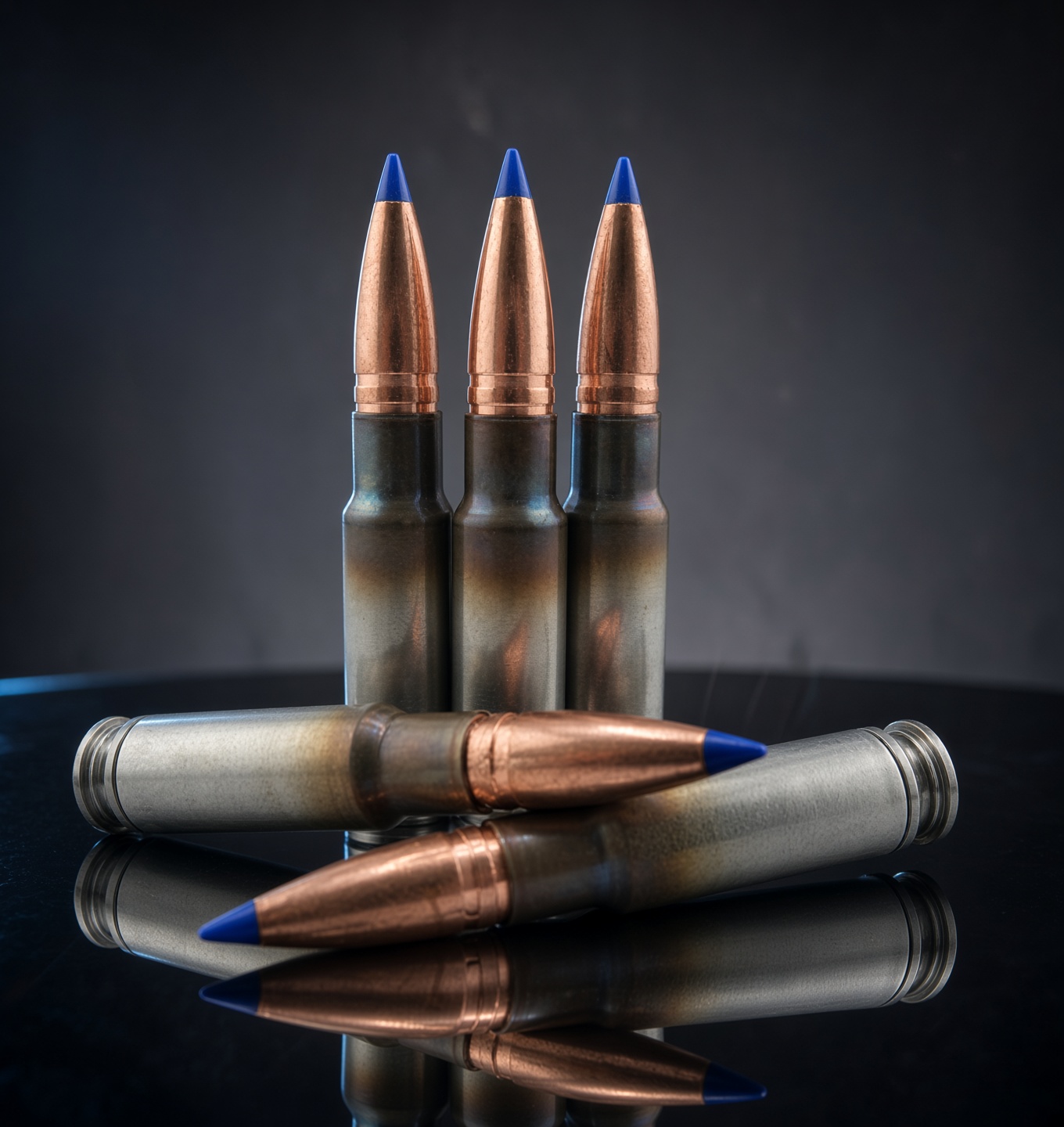
What 8.6 Blackout ammo is available, and what the makers publish
| Maker and load | Gr | Sub / super | Velocity | Stated barrel | BC |
|---|---|---|---|---|---|
| Steinel 350 gr Subsonic SCHP | 350 | Subsonic | 1,000 fps | 16 in | .53 |
| Steinel 350 gr Short Barrel Load | 350 | Subsonic | 990 / 1,030 fps | 8 in / 11.5 in | — |
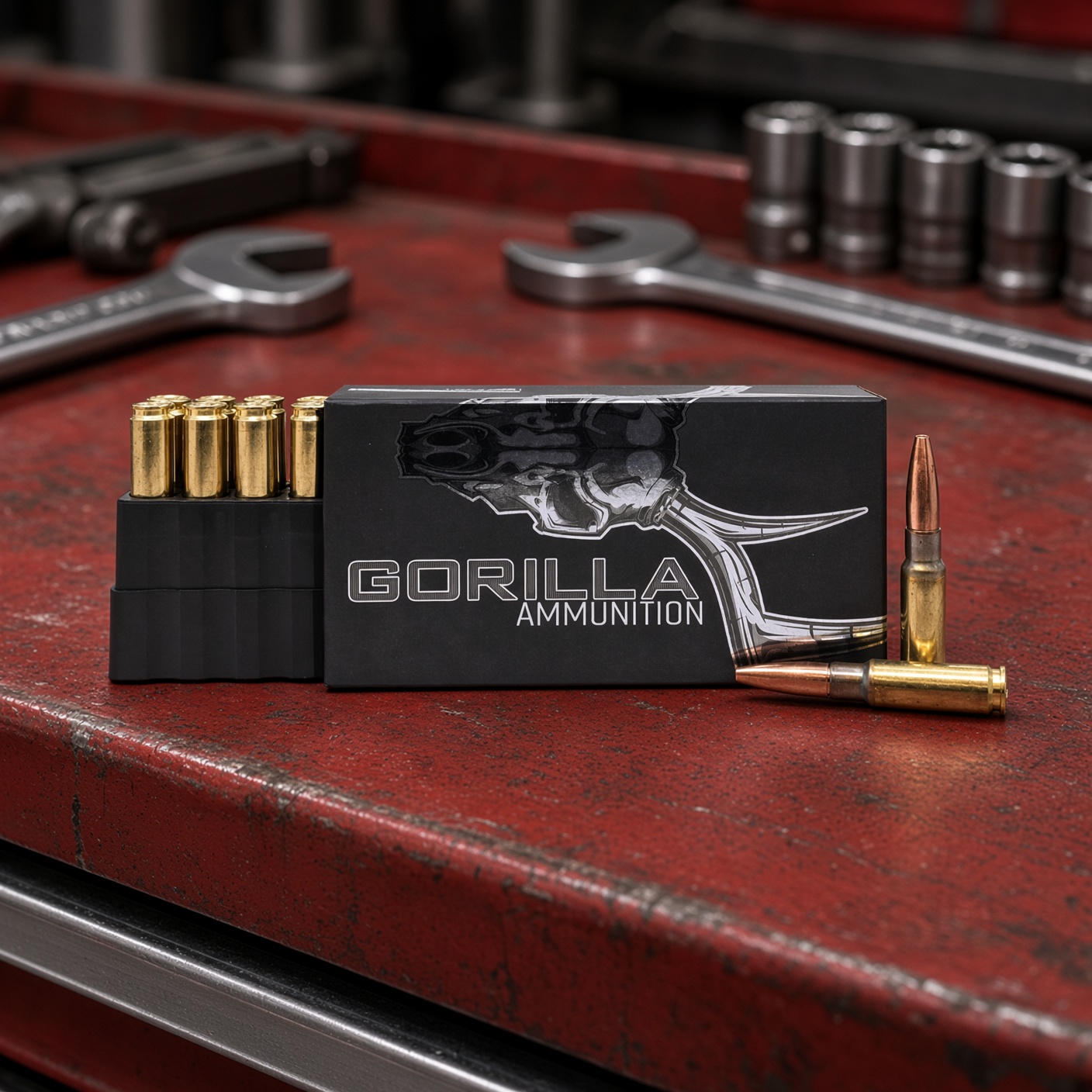
| Gorilla Pork Shredder Expanding | 342 | Subsonic | 1,000 fps | 12 in | — |
| Gorilla 300 gr Sierra MatchKing | 300 | Subsonic | 1,020 fps | 12 in | .750 |
| Steinel 300 gr Subsonic BTHP, AR optimized | 300 | Subsonic | 970 / 1,050 fps | 10.5 in / 16 in | — |
| Steinel 300 gr Subsonic BTHP, bolt optimized | 300 | Subsonic | 950 / 1,030 fps | 10.5 in / 16 in | — |
| Underwood 300 gr HP Boat Tail | 300 | Subsonic | 950 fps (601.6 ft-lb) | 12 in | — |
| Fort Scott Sub-Munition SCS TUI | 285 | Subsonic | 1,056 fps | 12 in, 1:3 | .700 |
| Discreet Ballistics Hunting / Self Defense Selous | 280 | Subsonic | ~1,000 fps | 8, 12 or 16 in offered | .324 |
| Discreet Ballistics Recce MSC | 280 | Subsonic | 950–1,000 fps | 8 or 12 in offered | .555 |
| Fort Scott SCS TUI | 235 | Supersonic | 1,600 fps | 12 in, 1:3 | — |
| Gorilla 210 gr Barnes TSX | 210 | Supersonic | 2,040 fps | 12 in | — |
| Steinel 210 gr Supersonic SCHP | 210 | Supersonic | 1,950 fps (1,773 ft-lb) | 16 in | — |
| Gorilla 190 gr Fracturing | 190 | Supersonic | 2,000 / 2,150 fps | 12 in / 16 in | — |
Two makers are worth singling out for what they publish rather than what they sell. Steinel is the only loader in this set publishing full downrange tables, and it publishes a separate load for short barrels — a level of detail that is rare in any cartridge, let alone one this young. Fort Scott publishes complete load recipes on its product pages, including powder and charge weight; I do not reproduce charge weights here, and neither should any page that is not the maker’s own.
How far does subsonic 8.6 Blackout ammo actually carry?
Steinel’s published table for its 300-grain subsonic, from a 16-inch barrel with a 100-yard zero, answers this better than any general statement:
| Range (yd) | Velocity (fps) | Energy (ft-lb) | Trajectory (in) |
|---|---|---|---|
| Muzzle | 1,050 | 734 | −1.5 |
| 50 | 1,034 | 712 | +3.3 |
| 100 | 1,018 | 691 | 0.0 |
| 150 | 1,004 | 671 | −11.7 |
| 200 | 991 | 654 | −32.0 |
| 250 | 978 | 637 | −61.2 |
| 300 | 966 | 621 | −99.4 |
Read the velocity column and the trajectory column together. A heavy subsonic bullet holds its speed remarkably well — 1,050 fps at the muzzle and still 966 fps at 300 yards, an 8 per cent loss. What it does not do is hold its line: more than eight feet of drop at 300 yards. The energy is there at distance; the aiming problem is what limits it.
For contrast, Steinel’s 210-grain supersonic from the same 16-inch barrel starts at 1,950 fps and 1,773 ft-lb and is at 1,599 fps and 1,192 ft-lb at 300 yards, with 29.8 inches of drop. That is the trade the cartridge offers in one comparison.
What nobody publishes about 8.6 Blackout ammo
- Muzzle energy is published only by Underwood and Steinel. Fort Scott, Gorilla and Discreet Ballistics publish velocity without energy.
- Ballistic coefficient is published by Fort Scott, Discreet Ballistics, and by Gorilla and Steinel on one load each. Underwood publishes none.
- Downrange tables are published by Steinel alone.
- Q publishes no loaded ammunition and no terminal-performance mechanism text of its own — its technical data page hosts the SAAMI drawing.
- The cartridge’s original public introduction date is not stated on any manufacturer or standards page I could retrieve. SAAMI gives acceptance dates only.
- Recoil and wind drift are published by nobody.
Who is 8.6 Blackout ammo for?
On the published evidence, it is for a suppressed short-barrelled rifle where the shooter wants a much heavier subsonic bullet than .300 Blackout can offer, and is prepared to accept a steep trajectory beyond 150 yards to get it. Every mainstream load is tuned around a 12-inch barrel, the supersonic side of the catalog is thin, and the twist standard and the market have not yet converged.
None of that is a criticism of the cartridge — it is a four-year-old design that reached a formal standard in 2026, and the catalog reflects that. It does mean anyone buying into it should read the barrel twist and the barrel length on the box, because for this cartridge more than most, both change the answer.
Where to go next
The obvious comparison is my 300 Blackout vs 5.56 breakdown, which covers the subsonic-versus-supersonic trade in the cartridge 8.6 was scaled up from, and my 223 vs 5.56 article explains why chamber specifications and headstamps are not the same question. For how cartridge names map to actual bullet diameters, see the caliber comparison chart. For host and suppressor pairing, see Popular Suppressors.
Sources
- SAAMI, Public Introduction drawing, 8.6 BLACKOUT, issued 19 January 2026, posted 7 April 2026
- SAAMI, announcement of acceptance of new cartridges, 29 January 2026
- SAAMI, cartridge and chamber drawings index, “Newly Accepted Cartridge and Chamber Designs”
- Q LLC: 8.6 BLK technical data page and Boombox rifle page
- Faxon Firearms: 8.6 BLK specification page and buyer’s guide
- Ballistic Advantage 8.6 Blackout barrel catalog
- Steinel Ammunition: five 8.6 BLK product pages with published downrange tables
- Gorilla Ammunition, Fort Scott Munitions, Discreet Ballistics and Underwood Ammo product pages
Ammunition reference desk
Three charts readers come back to: what a round costs today, what a cartridge name really measures, and what shipping and tax add.
| .22 LR | 6.59¢ |
| 9mm Luger | 26.98¢ |
| 5.56 NATO | 44.95¢ |
| .270 Win | .278 in |
| .30-30 Win | .309 in |
| .308 Win | .309 in |
| Case price | $269.80 |
| Shipping and tax | +$34.88 |
| Per round | 30.47¢ |
Reader Favorites