44 Magnum Ammo: Ballistics and Barrel Length
The number missing from most 44 Magnum boxes is the test barrel: one load runs 1,466 fps from a revolver and 1,935 fps from a carbine.
Last updated: September 21, 2026 · Originally published September 11, 2026
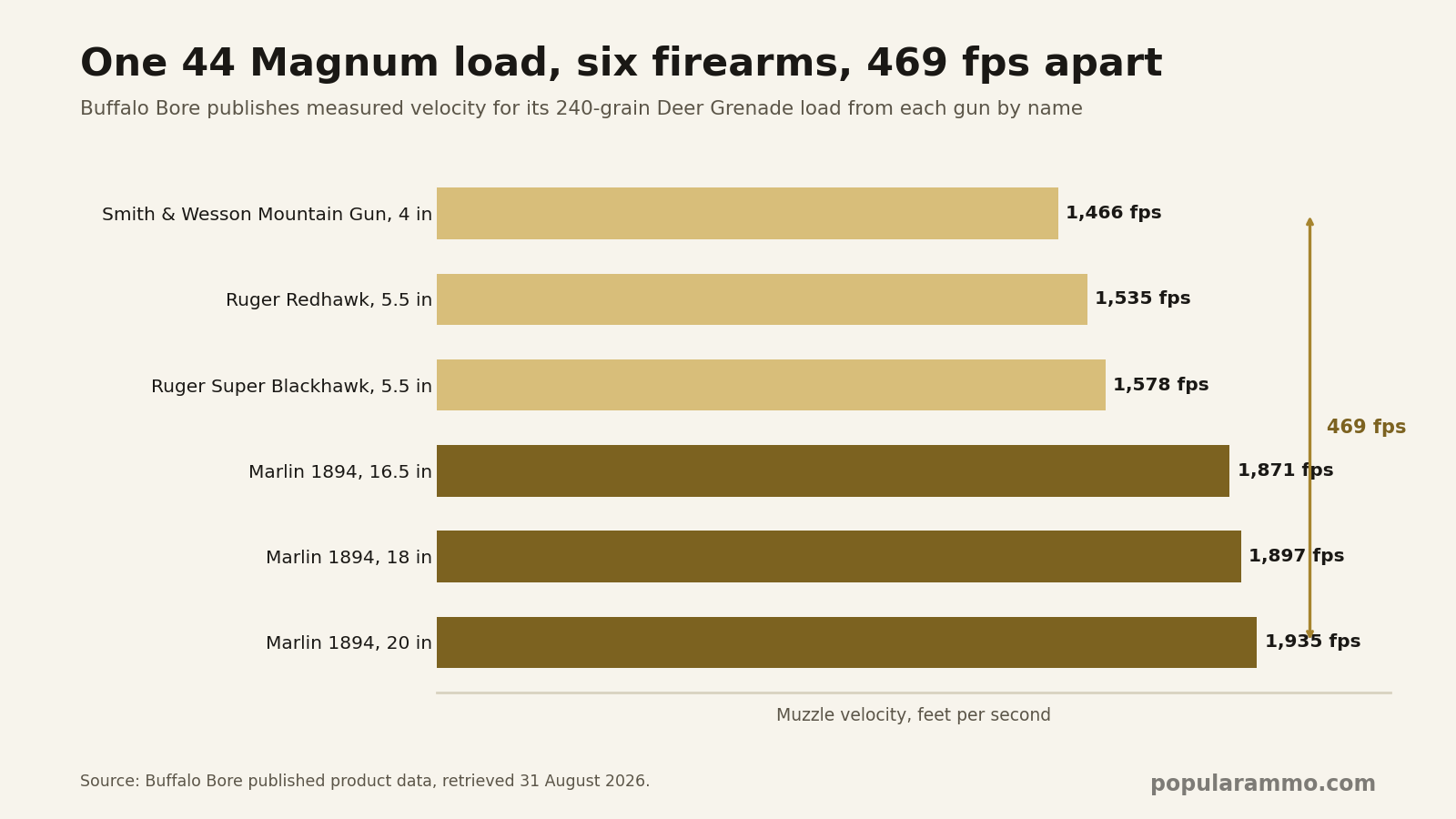
The most important number on a box of 44 Magnum ammo is one most boxes do not print: the barrel it was measured in. One published load runs 1,466 fps from a four-inch revolver and 1,935 fps from a twenty-inch carbine — a 469 fps spread, same ammunition, same maker, same page.
What I want you to walk away with
- SAAMI sets a maximum average pressure of 36,000 psi by transducer, or 40,000 CUP by copper crusher, for a 240-grain reference bullet.
- SAAMI specifies two test barrels for this cartridge — a solid 8.275-inch barrel and a vented 5.763-inch barrel with a .008-inch gap simulating a revolver’s barrel-cylinder gap — and publishes both velocity columns.
- Federal prints the barrel as a spec field: 4-V, 6-V, 6.5-V and 20. Hornady prints V Barrel (7.5″) or (8″). Winchester, Remington and Underwood publish no barrel length at all.
- Heavy hard-cast loads at 340 grains carry published firearm lists, and both makers that sell them name the revolvers by model.
- No maker in this set publishes a ballistic coefficient for loaded 44 Magnum ammo, and none publishes data past 100 yards.
Here’s how I read this chart
Every number in this table is a published figure, copied from the source named underneath it — none of it is my own measurement. Read across a row to compare one entry, and down a column to compare them all on the same measure.
What makes 44 Magnum ammo different from other handgun cartridges?
Two things, and they compound. It is loaded to more than twice the pressure of standard .45 ACP, and it is chambered in both revolvers and lever-action rifles. The first gives it energy. The second means a single published velocity can be wrong by 30 per cent for your gun.
Remington acknowledges the effect in prose on its caliber page: “Chambering the 44 Rem Mag into a rifle platform can improve accuracy and performance over range in part due to a longer barrel.” What Remington does not do — and almost nobody does — is publish both numbers.
Quick answers
How much velocity does a rifle add to 44 Magnum ammo?
On Buffalo Bore’s published figures for one 240-grain load: 1,466 fps from a 4-inch S&W, 1,578 fps from a 5.5-inch Ruger Super Blackhawk, and 1,935 fps from a 20-inch Marlin 1894. Their 265-grain load shows 1,372 fps from a 4-inch revolver and 1,657 fps from an 18-inch carbine.
What does “4-V” mean on a Federal spec sheet?
Federal uses it as its barrel-length field — 4-V, 6-V and 6.5-V on revolver loads, and plain 20 on its HammerDown rifle load. SAAMI uses “vented” for the test barrel that simulates a revolver’s cylinder gap. Federal does not define the V on those pages, so I report the convention rather than assert the link.
Is 44 Magnum ammo good for bear defense?
Several makers position loads that way in their own words. Federal describes its 300-grain Solid Core as deep-penetrating for “tough game like bears and hogs” and “dangerous animal defense.” Hornady markets its 240-grain DGH as backcountry defense. Underwood describes hard cast flat nose bullets as designed “whether fending off wild hogs or black bears.”
Can I shoot the heavy 340-grain loads in any .44 Magnum revolver?
No, and both makers say so explicitly. Buffalo Bore’s 340-grain +P+ names the approved revolvers and adds: “We get hundreds of emails asking if this load can be fired in S&W revolvers or some firearm other than what is in the above list. The answer is NO.” Underwood publishes a near-identical list for its 340-grain +P+.
How far does 44 Magnum ammo shoot?
No maker in this set publishes data past 100 yards. Federal’s charts are zeroed at 25 yards with sights 0.9 inches above the bore. That tells you how the industry expects the cartridge to be used.
What does SAAMI specify for 44 Magnum ammo?
| Specification | Value |
|---|---|
| Case length | 1.285 − .020 in |
| Cartridge overall length | 1.535 in min – 1.610 in max |
| Rim diameter | .514 − .010 in |
| Barrel bore / groove diameter | .417 in / .429 in, 6 grooves |
| Rifling twist | 1 turn in 20 in, right hand — marked OPTIONAL |
| Maximum average pressure, transducer | 36,000 psi |
| Maximum average pressure, crusher | 40,000 CUP |
| Solid test barrel | 8.275 ± .010 in |
| Vented test barrel | 5.763 ± .010 in, with a .008 in gap |
| Velocity measured | Instrumental, at 15 feet |
The bullet diameter on the SAAMI drawing is given for a lead bullet at .4320 − .0060 inches and footnoted “BULLET PROFILE IS SHOWN FOR ILLUSTRATIVE PURPOSES ONLY”. Component makers publish the jacketed figure: Barnes lists .429 inches, Hornady .430.
The two test barrels are the part worth dwelling on. SAAMI’s own footnote explains why they exist: “Vented barrel velocities are provided for information only. Vented test barrels are used for the establishment of catalog velocity values for cartridges normally chambered in revolvers.” In other words, the standard itself acknowledges that a number from a sealed barrel does not describe a revolver — so it publishes both. For a 240-grain bullet the paired figures run as far apart as 1,150 fps vented against 1,500 fps solid.
The barrel-length question, in published numbers
Here’s how I read this chart
Every bar is the same box of ammunition, fired from a different gun. The pale bars are revolvers, the dark bars are lever-action rifles. Feet per second is how fast the bullet is traveling as it leaves the barrel. The arrow marks the difference between the slowest and fastest: 469 feet per second, from one cartridge, decided entirely by what it was fired out of.
Buffalo Bore is the only maker in this set that publishes velocities gun by gun, and the result is the clearest illustration of the point anywhere in the cartridge’s literature.
| Firearm | Barrel | Published velocity |
|---|---|---|
| Marlin 1894 | 20 in | 1,935 fps |
| Marlin 1894 | 18 in | 1,897 fps |
| Marlin 1894 | 16.5 in | 1,871 fps |
| Ruger Super Blackhawk | 5.5 in | 1,578 fps |
| Ruger Redhawk | 5.5 in | 1,535 fps |
| Smith & Wesson Mountain Gun | 4 in | 1,466 fps |
Four hundred and sixty-nine feet per second between the top and bottom rows. Note also that the two 5.5-inch revolvers differ from each other by 43 fps — the barrel-cylinder gap and chamber throats vary between guns, which is exactly why SAAMI vents its revolver test barrel.
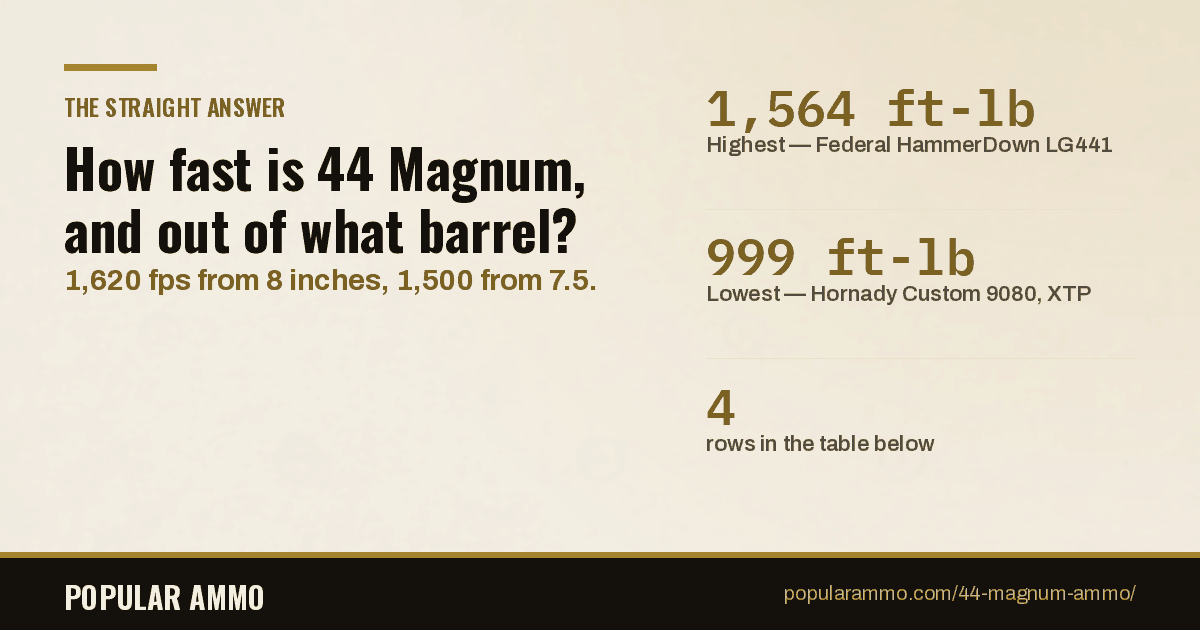
The same pattern shows up across Federal’s catalog, though Federal publishes only one barrel per load. Its 270-grain HammerDown, from a 20-inch barrel, publishes 1,615 fps and 1,564 ft-lb. Its 300-grain Solid Core, from a 6.5-inch vented barrel, publishes 1,150 fps and 881 ft-lb. Those are different guns, not different cartridges.
44 Magnum ammo ballistics: what the makers publish
| Load | Gr | Muzzle velocity | Muzzle energy | Stated barrel |
|---|---|---|---|---|
| Hornady Backcountry Defense 90868, DGH | 240 | 1,620 fps | 1,398 ft-lb | 8 in test barrel |
| Federal HammerDown LG441 | 270 | 1,615 fps | 1,564 ft-lb | 20 |
| Remington UMC 23744 | 180 | 1,610 fps | 1,036 ft-lb | not published |
| Hornady Custom 9080, XTP | 200 | 1,500 fps | 999 ft-lb | V Barrel (7.5″) |
| Winchester Big Bore X44MBB | 240 | 1,485 fps | 1,175 ft-lb | not published |
| Hornady Handgun Hunter 9083, MonoFlex | 200 | 1,475 fps | 966 ft-lb | V Barrel (8″) |
| Federal Power-Shok C44B | 180 | 1,460 fps | 852 ft-lb | 4-V |
| Hornady LEVERevolution 92782, FTX | 225 | 1,410 fps | 993 ft-lb | 7.5 in |
| Hornady Custom 9085, XTP | 240 | 1,350 fps | 971 ft-lb | V Barrel (7.5″) |
| Underwood 723, hard cast LFN | 305 | 1,325 fps | 1,189 ft-lb | not published |
| Federal Fusion F44FS1 | 240 | 1,290 fps | 887 ft-lb | 4-V |
| Federal Barnes Expander P44XB1 | 225 | 1,280 fps | 818 ft-lb | 6-V |
| Winchester Super X X44MS, Silvertip | 210 | 1,250 fps | 729 ft-lb | not published |
| Federal American Eagle AE44A | 240 | 1,230 fps | 806 ft-lb | 4-V |
| Remington HTP 23010 | 240 | 1,180 fps | 742 ft-lb | not published |
| Federal Swift A-Frame P44SA | 280 | 1,170 fps | 851 ft-lb | 6-V |
| Hornady Custom 9088, XTP | 300 | 1,150 fps | 881 ft-lb | V Barrel (7.5″) |
| Federal Solid Core P44SHC1 | 300 | 1,150 fps | 881 ft-lb | 6.5-V |
| Federal Personal Defense HST P44HST1S | 230 | 1,085 fps | 601 ft-lb | 4-V |
Sort that table by velocity and you are largely sorting it by barrel length, not by how hot the load is. Federal’s 180-grain Power-Shok from a 4-inch barrel and Hornady’s 200-grain XTP from a 7.5-inch barrel are 40 fps apart on paper; in the same gun they would not be.
Winchester is a special case worth flagging. Its 44 Magnum product detail pages display “There is no ballistics data available at this time.” The muzzle velocity and energy figures above come from Winchester’s own category listing, which does carry them. No barrel length is published on either surface.
Heavy hard-cast 44 Magnum ammo and the firearm lists
At the top of the pressure range, two makers sell a 340-grain hard cast load at a published 1,425 fps and 1,533 ft-lb, and both publish a list of firearms it may be used in. Buffalo Bore’s list runs to Ruger Redhawk, Super Redhawk, Super Blackhawk and Vaquero; Freedom Arms Model 83; all-steel Taurus Raging Bull; Colt Anaconda; Magnum Research BFR; and Dan Wesson revolvers, plus several single-shot rifles. Underwood publishes essentially the same list and adds: “Due to the pressures generated by this +P+ loading, it is not safe for use in all firearms… Firearms outside of these categories should not be assumed safe. Always confirm your firearm’s strength before use.”
These are not general warnings; they are exclusions by model. A revolver chambered in .44 Magnum is not automatically a revolver for every load sold in .44 Magnum, and the makers of these loads say so first.
Hornady, which does not sell a hard cast load, publishes a competing design argument for its jacketed DGH bullet: “Unlike hard cast bullets, the jacketed DGH® (Dangerous Game Handgun) bullet produces no lead smoke for faster follow-up shots.” I report both positions; each maker is describing its own product, and I take no view on either.

What nobody publishes about 44 Magnum ammo
- Ballistic coefficient. Not published by any maker in this set on loaded ammunition. Barnes publishes one — .166 for the 225-grain XPB — but only inside its reloading data sheet, and without stating the drag model.
- Test barrel length. Not published by Winchester, Remington or Underwood.
- Data past 100 yards. No maker publishes it.
- The cartridge’s origin. I could not find a date of introduction on any manufacturer page. The only primary date I can cite is the SAAMI drawing’s issue date of 29 May 1979, which is a standards date and not the cartridge’s birthday. I would rather say that than repeat a figure I cannot source.
- Recoil. Published by nobody, in this cartridge or any other.
How to choose 44 Magnum ammo without being misled by the numbers
Match the published barrel to your gun. If a load publishes from a 20-inch barrel and you shoot a 4-inch revolver, expect several hundred feet per second less — Buffalo Bore’s own table shows how much. If a maker publishes no barrel at all, treat the velocity as a catalog figure rather than a prediction.
Then read the firearm list, if there is one. For standard-pressure 44 Magnum ammo there usually is not, and none is needed. For the heavy hard-cast loads there always is, and it is the manufacturer telling you which guns they built the load around.
Where to go next
My 9mm vs .45 ACP comparison covers the same energy-versus-capacity argument at defensive handgun pressures. For what the bullet types in the table above actually are, see ammo types explained. For how cartridge names map to bullet diameters, see the caliber comparison chart. Hunters carrying a revolver in the field will find related coverage at Popular Outdoorsman.
Sources
- ANSI/SAAMI Z299.3-2022 centerfire pistol and revolver standard — .44 Remington Magnum drawing, pressure tables, vented and solid test barrel specifications and velocity tables
- Hornady product pages: 9080, 9085, 9088, 92782, 9083, 90868
- Federal product pages: AE44A, P44HST1S, C44B, F44FS1, P44XB1, P44SA, P44SHC1, LG441
- Winchester handgun category listing and Super-X product pages
- Remington product pages: 23010, 23744, and the .44 Rem Magnum caliber page
- Buffalo Bore product pages: Heavy .44 Magnum +P+ 340 gr, Dangerous Game 265 gr, Deer Grenade 240 gr
- Underwood Ammo: 305 gr hard cast and 340 gr +P+ product pages
- Barnes VOR-TX 44 Rem Mag product page and published .44 Rem Mag reloading data
.357 Magnum against .44 Magnum →
Ammunition reference desk
Three charts readers come back to: what a round costs today, what a cartridge name really measures, and what shipping and tax add.
| .22 LR | 6.59¢ |
| 9mm Luger | 26.98¢ |
| 5.56 NATO | 44.95¢ |
| .270 Win | .278 in |
| .30-30 Win | .309 in |
| .308 Win | .309 in |
| Case price | $269.80 |
| Shipping and tax | +$34.88 |
| Per round | 30.47¢ |
Reader Favorites