12 Gauge Shotgun Shells: Sizes, Loads and the Law
Shell length and chamber length are the two numbers that matter: a shell too long for the chamber still fits, and it raises pressure.
Last updated: September 21, 2026 · Originally published September 11, 2026
The most important number on a box of 12 gauge shotgun shells is the shell length, and the most important number on your shotgun is the chamber length — because a shell that is too long for the chamber raises pressure, and it will still fit. Everything else on this page is detail by comparison.
What I want you to walk away with
- SAAMI recognizes three 12 gauge shell lengths — 2¾, 3 and 3½ inches — with a maximum average pressure of 11,500 psi for the first two and 14,000 psi for 3½.
- A shorter shell in a longer chamber is fine. The reverse is not. SAAMI publishes that in as many words, and the reason is that the shell mouth opens into the forcing cone and constricts it.
- Shot sizes are a diameter, not a rank: #9 is 0.080 in and 000 buck is 0.360 in. SAAMI and Federal publish the same figures.
- Federal waterfowl law requires non-toxic shot, defined by composition in 50 CFR 20.21(j) — fourteen approved types, each under 1 per cent residual lead.
- Nobody publishes a pattern percentage, pellet energy or recoil for any load I checked, and only one maker still prints dram equivalent.
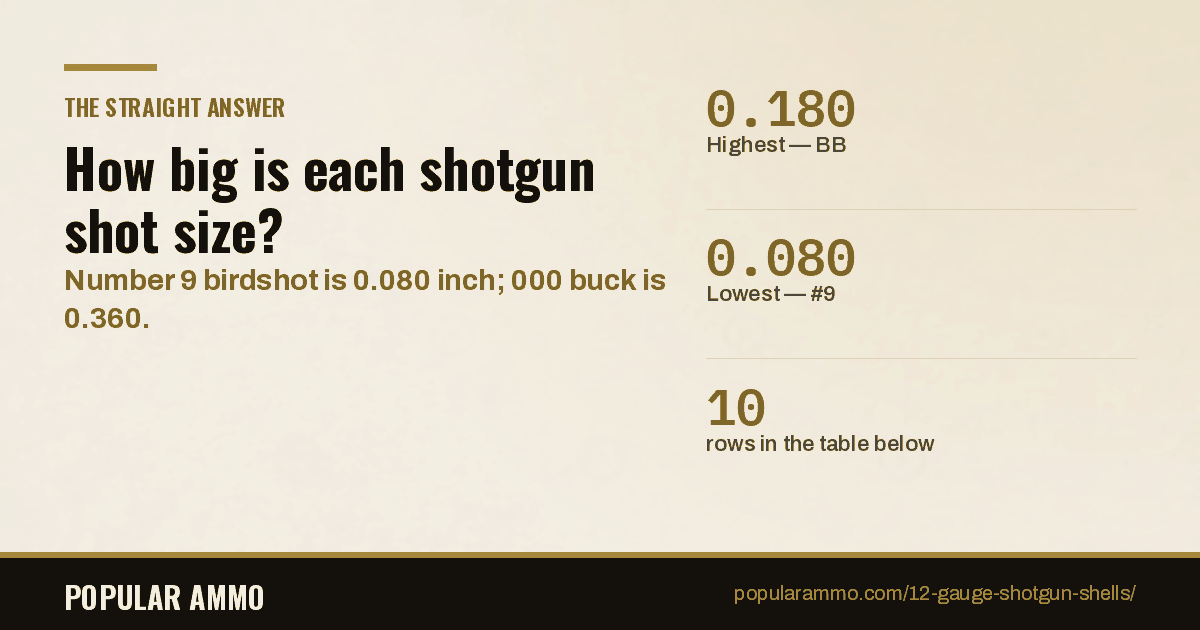
Here’s how I read this chart
Every number in this table is a published figure, copied from the source named underneath it — none of it is my own measurement. The card shows the top rows; the complete table is further down this page. Read across a row to compare one entry, and down a column to compare them all on the same measure.
What do the numbers on a box of 12 gauge shotgun shells mean?
A shotgun shell box carries four or five figures and they measure completely different things. Shell length is a physical dimension and a safety matter. Payload is the weight of shot inside, in ounces. Shot size is the diameter of each pellet. Velocity is how fast the payload leaves the barrel. Dram equivalent, if it is there at all, is a historical hangover.
Winchester’s own explanation of the last one is worth quoting because it tells you how old the convention is: “Centuries ago, shotshells were loaded with black powder measured in drams; 16 of which equal one ounce.” It is a comparison to a black powder charge nobody has used in a century.
Quick answers
Can I shoot 2¾ inch shells in a 3 inch chamber?
Yes. SAAMI states it plainly: “Using shorter shells in a longer chamber, such as firing 12-gauge 1¾” or 2¾” shells in either 12-gauge 3″ or 3½” chamber, is acceptable.” It also says to check with the firearm maker that the shorter shell will cycle in a semi-automatic.
Can I shoot 3 inch shells in a 2¾ inch chamber?
No. SAAMI: “The reverse is NOT TRUE as the longer shell will produce higher-than-expected pressure either by design or from the mouth of the shell opening into the forcing cone of the shorter chamber and creating a constriction.” The shell will chamber. That is exactly why the rule needs stating.
What shot size do I need?
It depends entirely on the quarry, and the makers publish their own recommendations. Federal’s steel guidance runs #6 or #4 for teal, #3 or #4 for medium ducks over decoys, #2 or BB for mallards, and #1, BB or BBB for geese. For deer and defense the answer moves to buckshot or a slug.
Why is steel shot sized differently from lead?
Because steel is less dense, so a steel pellet of a given diameter weighs less and carries less energy. Federal publishes the densities: lead “about 11”, steel “less than 8”, bismuth “about 9.6” grams per cubic centimeter. What no manufacturer I checked publishes is a simple lead-to-steel size conversion — see below.
How much does a 12 gauge kick?
No maker publishes a recoil figure for any load. SAAMI publishes the formula and uses a 12 gauge load as its worked example, but that is a method demonstration, not load data.
What does SAAMI specify for 12 gauge shotgun shells?
| Specification | Value |
|---|---|
| Recognized shell lengths | 2¾ in (70 mm), 3 in (76 mm), 3½ in (89 mm) |
| Shell length uncrimped, 2¾ | 2.760 − .100 in |
| Shell length uncrimped, 3 | 3.010 − .100 in |
| Shell length, 3½ | 3.510 in |
| Bore diameter, smooth bore | .725 + .020 in |
| Bore diameter, rifled | .719 + .002 in |
| Maximum average pressure, 2¾ and 3 in | 11,500 psi |
| Maximum average pressure, 3½ in | 14,000 psi |
One point on units, because it is a common source of confusion. Shotshell pressure used to be quoted in lead units of pressure, from the old crusher method. The current standard does not use LUP at all — it publishes psi from a piezoelectric transducer. SAAMI’s own explanation is that LUP and CUP designate the crusher method while psi is reserved for the transducer method, and that figures from the two systems are not mathematically convertible. If you see a 12 gauge pressure quoted in LUP, it is coming from an older document.
SAAMI also publishes lot statistics rather than a single-shell ceiling: a maximum average pressure, a maximum probable lot mean and a maximum probable sample mean, footnoted to a sample size of ten. There is no published figure for the highest pressure any one shell may produce.
Shot sizes: what the numbers actually measure
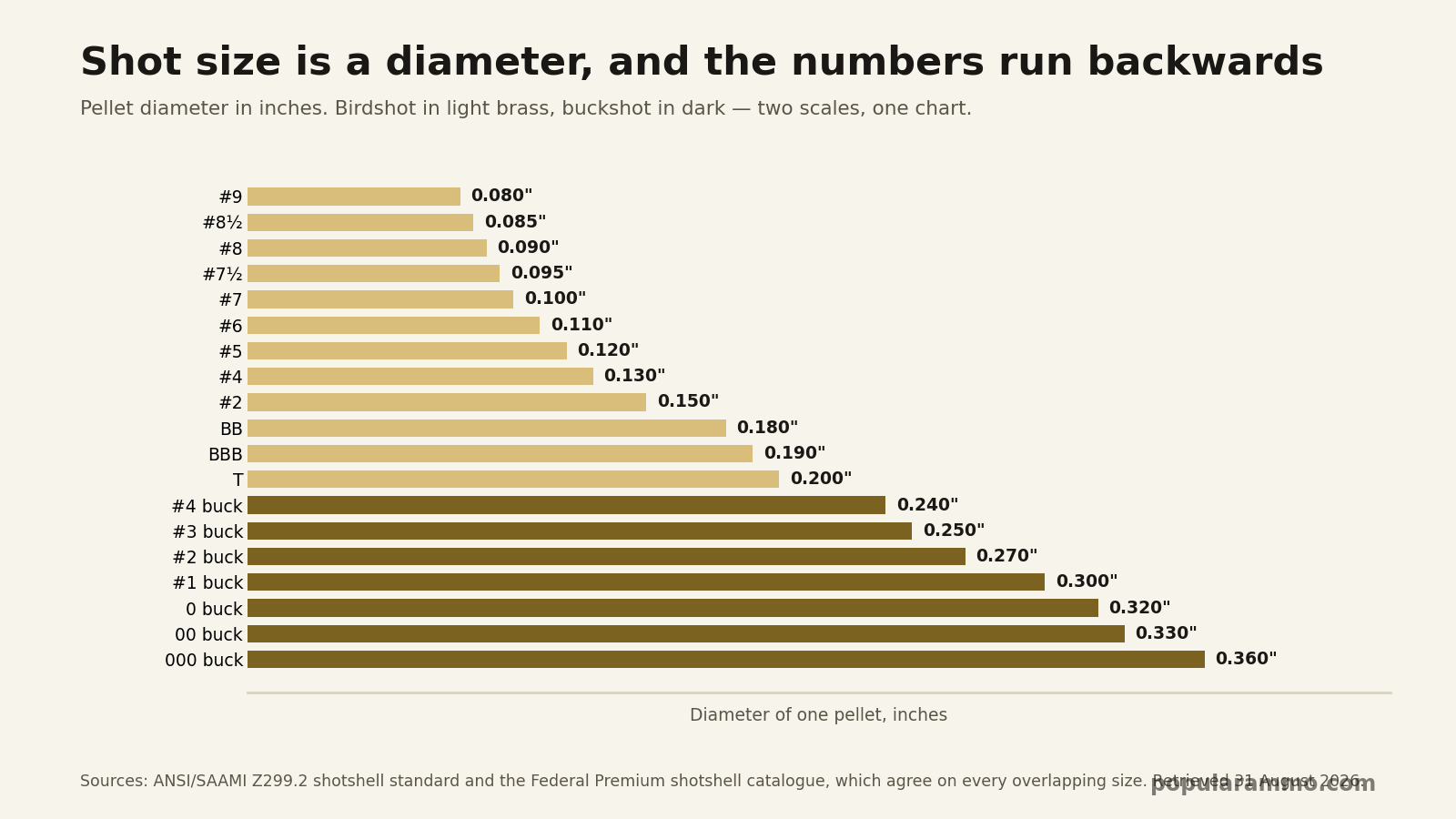
Here’s how I read this chart
Every bar is one shot size, and the length of the bar is the actual diameter of a single pellet in inches. The numbering runs backwards on birdshot — a #9 pellet is smaller than a #2 — and then switches to a different scale for buckshot, where more zeros means bigger. That is the whole reason the chart exists: the names tell you nothing about the size until you have seen them lined up.
Shot size is a diameter in inches, and the number runs backwards — the bigger the number, the smaller the pellet. Buckshot has its own scale that runs the other way once you reach zeros. SAAMI and Federal publish the same diameters, which is worth knowing because it means this table is not one company’s opinion.
| Birdshot | Diameter (in) | Buckshot | Diameter (in) |
|---|---|---|---|
| #9 | 0.080 | #4 buck | 0.240 |
| #8½ | 0.085 | #3 buck | 0.250 |
| #8 | 0.090 | #2 buck | 0.270 |
| #7½ | 0.095 | #1 buck | 0.300 |
| #7 | 0.100 | 0 buck | 0.320 |
| #6 | 0.110 | 00 buck | 0.330 |
| #5 | 0.120 | 000 buck | 0.360 |
| #4 | 0.130 | ||
| #2 | 0.150 | ||
| BB | 0.180 | ||
| BBB | 0.190 | ||
| T | 0.200 |
I have deliberately left pellets-per-ounce out of that table. SAAMI publishes it as a matrix that varies with the antimony content of the shot, from 0.5 to 6 per cent, and a single column lifted out of that matrix would be presented as more certain than it is. If you need a pellet count, take it from the load you are actually buying.

What is in a box of 12 gauge shotgun shells today
| Use | Load | Length | Payload | Velocity |
|---|---|---|---|---|
| Target | Winchester AA, AA127 | 2¾ in | 1⅛ oz #7½ lead | 1,145 fps |
| Target | Winchester AA Handicap, AAHA127 | 2¾ in | 1⅛ oz #7½ lead | 1,250 fps |
| Target | Fiocchi Shooting Dynamics 12SD18H7 | 2¾ in | 1⅛ oz #7½ lead | 1,200 fps |
| Upland | Winchester Super X High Brass, X126 | 2¾ in | 1¼ oz #6 lead | 1,330 fps |
| Upland | Fiocchi Field Dynamics HV 123HV4 | 3 in | 1¾ oz #4 lead | 1,330 fps |
| Waterfowl | Federal Speed-Shok WF143 | 3 in | 1⅛ oz #2 steel, 141 pellets | 1,550 fps |
| Waterfowl | Winchester DryLok Super Steel SSH1232 | 3 in | 1¼ oz #2 steel | 1,450 fps |
| Waterfowl | Estate HV Magnum Steel HVST123SF | 3 in | 1⅛ oz steel | 1,500 fps |
| Turkey | Winchester Double X, STH1235 | 3 in | 1¾ oz #5 lead | 1,300 fps |
| Turkey | Winchester Double X, XXT12L5 | 3½ in | 2¼ oz #5 lead | 1,150 fps |
| Buckshot | Federal P156 00 | 2¾ in | 00 buck, 12 pellets | 1,290 fps |
| Buckshot | Federal P158 000 | 3 in | 000 buck, 10 pellets | 1,225 fps |
| Slug | Remington Slugger 20300 | 2¾ in | 1 oz rifled slug, 438 gr | 1,560 fps |
| Slug | Hornady American Whitetail 86271 | not stated | 325 gr InterLock | 1,825 fps |
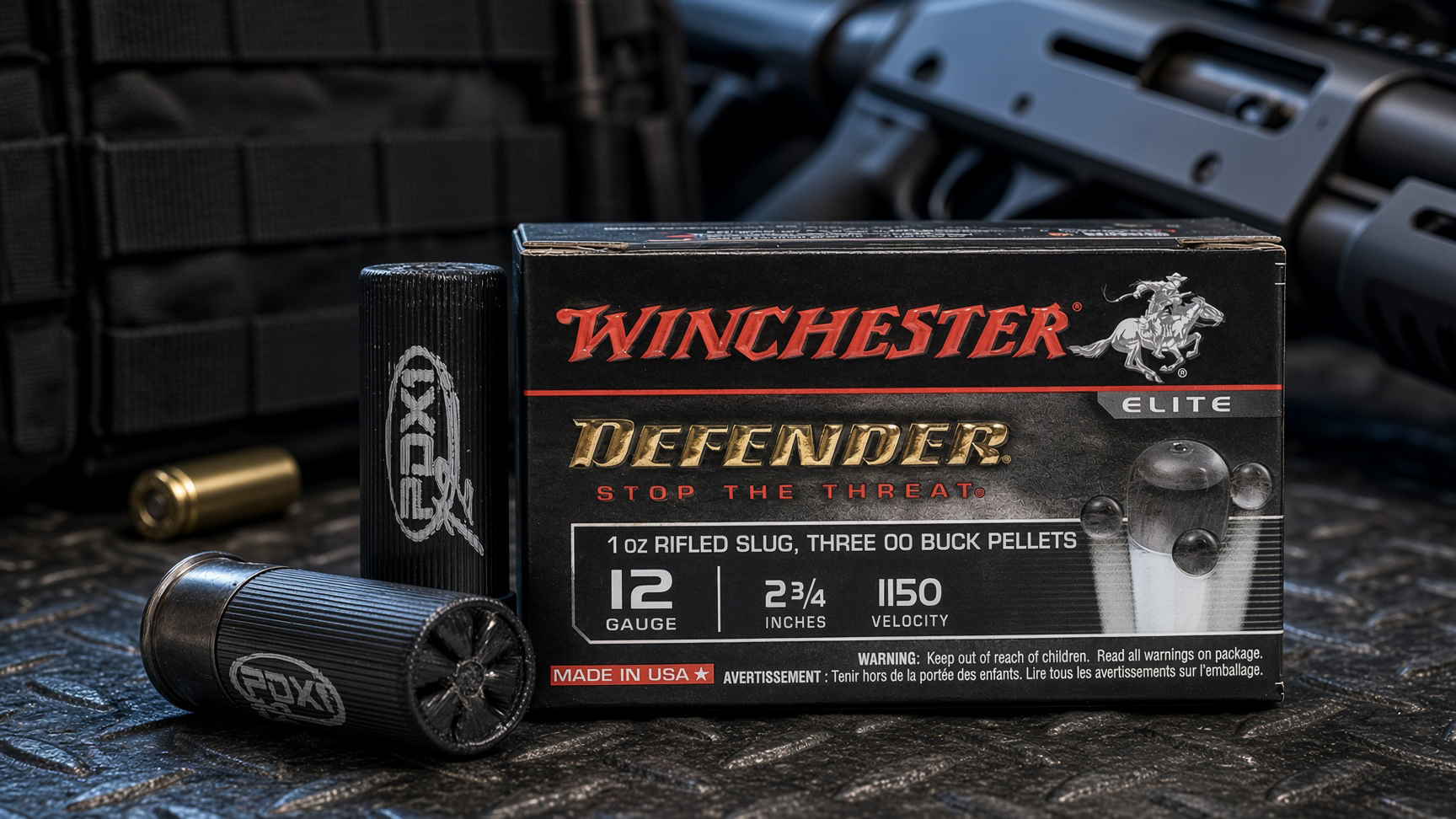
| Defense | Winchester Defender S12PDX1 | 2¾ in | 1 oz slug plus three 00 buck | 1,150 fps |
| Defense | Winchester Defender SB1200PD | 2¾ in | 00 buck, 9 pellets | 1,145 fps |
Read the turkey rows against each other and you can see what a 3½ inch chamber actually buys. Winchester’s 3 inch load sends 1¾ ounces of #5 at 1,300 fps; the 3½ inch load sends 2¼ ounces of the same shot at 1,150 fps. Half an ounce more payload, 150 fps slower. The longer shell is not a more powerful version of the shorter one — it is a different trade.
Two of these loads publish a muzzle energy figure and they are both slugs: Remington’s Slugger at 2,367 ft-lb and Hornady’s American Whitetail at 2,403 ft-lb. No shot load in the set publishes energy at all.
One sourcing note. Winchester’s individual product pages do not carry ballistics — checking the page for AA127 returns “There is no ballistics data available at this time.” The Winchester figures above come from the category listings, which do carry them.
Non-toxic shot: what the law actually says
Federal law does not ban lead shot generally. It requires approved non-toxic shot for waterfowl hunting, and it defines approval by composition rather than by brand. The regulation is 50 CFR 20.21(j), and the prohibition covers the taking of “ducks, geese (including brant), swans, coots and any other species” in non-toxic shot zones.
Fourteen shot types are approved, each specified by percentage composition: bismuth-tin, iron (steel), iron-tungsten, iron-tungsten-nickel, copper-clad iron, corrosion-inhibited copper, tungsten-bronze, tungsten-iron-copper-nickel, tungsten-matrix, tungsten-polymer, tungsten-tin-iron, tungsten-tin-bismuth, tungsten-tin-iron-nickel, and tungsten-iron-polymer. Every approved type “must contain less than 1 percent residual lead.”
The US Fish and Wildlife Service defines the category itself as “any shot type that does not cause sickness and death when ingested by migratory birds,” and records that the lead shot ban phased in from the 1987-88 season and became nationwide in 1991.
Steel versus lead, and the sizing question nobody actually answers
You will read everywhere that you should go up one or two shot sizes when you switch from lead to steel. I went looking for a manufacturer publishing that rule and could not find one. Six manufacturer surfaces were checked, including Federal’s shot size guidance and its waterfowl pages, Winchester’s waterfowl section, and two Remington explainers.
What is published is the physics underneath it. Federal publishes the densities in grams per cubic centimeter: lead “about 11”, steel “less than 8”, bismuth “about 9.6”. And Federal does publish a size-jump rule — but for a different swap, steel to bismuth: “if you’re used to shooting steel and want to make the change to bismuth, it’s like a two shot-size jump. If you’re used to shooting No. 2 steel for duck, you’d want to migrate to No. 4 shot.” Note that one runs down in number, because bismuth is denser than steel.
The closest thing to the lead-to-steel rule from an official source is Texas Parks and Wildlife’s hunter education material, which describes steel as “lighter, keeps its shape after firing, narrower pattern doesn’t carry as far” against lead’s “heavier, flattens and deforms, wider pattern, carries farther”, and advises that “when hunting waterfowl, a larger size of shot will be more effective.”
So the principle is sound and it is published. The specific one-or-two-size conversion is folklore that the industry has not put its name to, and I am not going to be the first.
What nobody publishes about 12 gauge shotgun shells
- Pattern percentage. Not published for a single load in this set, by anyone. It is arguably the most useful number a shotshell could carry, and it does not exist on any product page or in the standard.
- Pellet energy. Never published per pellet. Energy appears only on the two slug loads.
- Recoil. Not published by any maker.
- Dram equivalent. Estate publishes it, in numeric form on target loads and as “HDCP” and “MAX” tokens elsewhere. Federal, Winchester, Remington, Fiocchi and Hornady publish none.
- Buckshot payload weight. Buckshot is sold by pellet count, not ounces, and the makers do not publish a weight.
- Pellet counts on lead birdshot loads. Only the steel Speed-Shok load published one.
How to choose 12 gauge shotgun shells without guessing
Start at the gun, not the box. Read the chamber length off the barrel, and treat it as a ceiling. Then match the shell to the job: fine shot and moderate speed for clays, larger shot for birds, non-toxic shot wherever waterfowl rules apply, buckshot or a slug for deer and defense where they are legal. And when a load recommends itself for a quarry, that is the manufacturer’s own guidance, which is worth exactly as much as the testing behind it — which they do not publish either.
Where to go next
My 12 gauge vs 20 gauge comparison covers the recoil and payload trade against the smaller bore, and .410 ammo covers the smallest common shotshell in the same detail. For how the shot sizes here relate to bullet diameters elsewhere, see the caliber comparison chart. Bird hunters will find field coverage at Popular Outdoorsman.
Sources
- ANSI/SAAMI Z299.2 shotshell standard — chamber and shell lengths, bore diameters, pressure tables, shot size table
- SAAMI, Generally Accepted Firearms and Ammunition Interchangeability, 8 October 2021 — the chamber length rule
- SAAMI FAQs — pressure measurement systems and why LUP, CUP and psi are not convertible
- Federal Premium shotshell catalog — shot size diameters; Speed-Shok, Buckshot and Give ‘Em the Bismuth pages
- Winchester AA, Super X, DryLok, Xpert, Double X and Defender category pages; What’s On a Box of Shells
- Remington Slugger 20300; Hornady American Whitetail 86271; Fiocchi and Estate Cartridge product pages
- 50 CFR 20.21(j), approved non-toxic shot types; US Fish and Wildlife Service non-toxic shot guidance
- Texas Parks and Wildlife Department hunter education, shotshells
Ammunition reference desk
Three charts readers come back to: what a round costs today, what a cartridge name really measures, and what shipping and tax add.
| .22 LR | 6.59¢ |
| 9mm Luger | 26.98¢ |
| 5.56 NATO | 44.95¢ |
| .270 Win | .278 in |
| .30-30 Win | .309 in |
| .308 Win | .309 in |
| Case price | $269.80 |
| Shipping and tax | +$34.88 |
| Per round | 30.47¢ |
Reader Favorites