20 Gauge Shells: Loads, Pressure and the 12 Gauge Trade
A 3-inch 20 gauge shell is not a higher-pressure shell than a shorter one: SAAMI rates both lengths at the same 12,000 psi ceiling.
Last updated: September 21, 2026 · Originally published September 11, 2026
A 3-inch 20 gauge shell is not a higher-pressure shell than a 2¾-inch one — SAAMI rates both at 12,000 psi, and tells proof houses to use the 2¾-inch proof load for guns with 3-inch chambers. The longer shell buys payload, not pressure. That is the opposite of how .410 works, and it is the single most useful thing to know about 20 gauge shells.
What I want you to walk away with
- SAAMI recognizes 2¾ and 3 inch 20 gauge. There is no 3½ inch — that exists only in 10 and 12 gauge.
- Maximum average pressure is 12,000 psi for both lengths, across every load class the standard publishes.
- SAAMI’s proof instruction is explicit: “Use 20-gauge 2¾” proof loads for firearms with 3″ chambers.”
- Bore diameter is .615 inches smooth, and the standard does publish rifled 20 gauge barrels — .609 bore, .618 groove — which .410 does not get.
- Missouri’s conservation department puts the comparison plainly: the 12 gauge “is more powerful and more versatile”; the 20 gauge’s “recoil is lighter than that of a 12-gauge, and the guns are lighter, too.”

Here’s how I read this chart
Every number in this table is a published figure, copied from the source named underneath it — none of it is my own measurement. The card shows the top rows; the complete table is further down this page. Read across a row to compare one entry, and down a column to compare them all on the same measure.
What is 20 gauge, and where does it sit?
Gauge is a count. Twenty lead balls of bore diameter weigh one pound, which works out to a .615 inch bore — against .725 for a 12 gauge. Less bore means less payload for the same pressure, and less payload means less recoil in a gun of the same weight.
That is the whole trade, and a state agency states it better than most marketing does. Missouri’s Department of Conservation, in its own conservation magazine: “Of the two, the 12-gauge is more powerful and more versatile,” and of the 20 gauge, “Its recoil is lighter than that of a 12-gauge, and the guns are lighter, too.”
Note the second half of that. A 20 gauge shotgun is usually built lighter as well as bored smaller, and a lighter gun recoils harder for a given load. Some of the recoil advantage is given back by the gun.
Quick answers
Can I shoot 2¾ inch shells in a 3 inch 20 gauge?
Yes. The general shotshell rule holds: a shorter shell in a longer chamber is fine, the reverse is not. Confirm with the gun maker that a semi-automatic will cycle the lighter load.
Is a 3 inch 20 gauge shell more powerful?
It carries more shot, not more pressure. SAAMI rates both lengths at 12,000 psi and instructs that the 2¾-inch proof load be used for 3-inch chambered guns. Compare that with .410, where the 3-inch shell is rated a thousand psi higher and gets its own proof load.
Is 20 gauge enough for deer?
The makers build for it. Federal’s 3-inch Trophy Copper sabot slug publishes a 275-grain projectile at 1,900 fps; Remington’s Accutip publishes 260 grains at the same speed. What no maker publishes is a terminal performance figure, so the answer beyond “they sell it for that” is not ours to give.
Is 20 gauge a good starter gauge?
It is the usual recommendation, and the reason given in the Missouri material is recoil and gun weight rather than anything about the shot. Bear in mind that a very light gun undoes part of the recoil saving.
Is there a 3½ inch 20 gauge?
No. The standard carries 3½ inch shells for 10 and 12 gauge only.
What does SAAMI specify for 20 gauge shells?
| Specification | 2¾ inch | 3 inch |
|---|---|---|
| Recognized in the standard | Yes (70 mm) | Yes (76 mm) |
| Bore diameter, smooth bore | .615 + .020 in | .615 + .020 in |
| Rifled barrel, bore / groove | .609 / .618 in | .609 / .618 in |
| Maximum average pressure, all load classes | 12,000 psi | 12,000 psi |
| Proof load | 20,000 to 21,500 psi | “Use 20-gauge 2¾” proof loads for firearms with 3″ chambers” |
| Maximum rifled slug diameter | .606 in | |
| Test barrel rule | All 2¾ and 3 inch loads tested in 3 inch chamber test barrels; a 2¾ inch chamber is optional for lead shot and slugs, and not recognized for non-lead shot | |
The rifled barrel row is worth noticing. SAAMI publishes rifled barrel specifications for 12 and 20 gauge, and for nothing else — no rifled .410, no rifled 28. If you want a shotgun that shoots sabot slugs with a rifled bore to a published standard, those are your two options.
What 20 gauge shells are catalogd today
| Use | Load | Length | Payload | Velocity |
|---|---|---|---|---|
| Target | Federal Gold Medal Paper GMT224 | 2¾ in | ⅞ oz #8 | 1,250 fps |
| Target | Federal Top Gun TG20 | 2¾ in | ⅞ oz #8 | 1,210 fps |
| Target | Remington Premier Nitro Sporting Clays 28860 | 2¾ in | ⅞ oz #7½ | 1,300 fps |
| Target | Remington Gun Club 20236 | 2¾ in | ⅞ oz #9 | 1,200 fps |
| Upland | Federal Upland Quail Forever PF204 | 2¾ in | 1 oz #7½ | 1,350 fps |
| Upland | Federal Prairie Storm FS Lead PFX258FS | 3 in | 1¼ oz #5 | 1,300 fps |
| Upland | Federal Game Load Heavy Field H202 | 2¾ in | 1 oz #6 | 1,165 fps |
| Upland | Remington Nitro Pheasant 28651 | 3 in | 1¼ oz #5 | 1,185 fps |
| Waterfowl steel | Federal Speed-Shok WF209 | 3 in | ⅞ oz #2 steel | 1,550 fps |
| Waterfowl steel | Federal Black Cloud FS PWBX209 | 3 in | 1 oz #4 steel | 1,350 fps |
| Waterfowl steel | Remington Sportsman Hi-Speed R20009 | 2¾ in | ¾ oz #7 steel | 1,425 fps |
| Turkey | Fiocchi Golden Turkey TSS 203TSS9 | 3 in | 1⅜ oz #9 TSS | 1,225 fps |
| Turkey | Remington Wingmaster HD 20763 | 3 in | 1⅛ oz #4 | 1,300 fps |
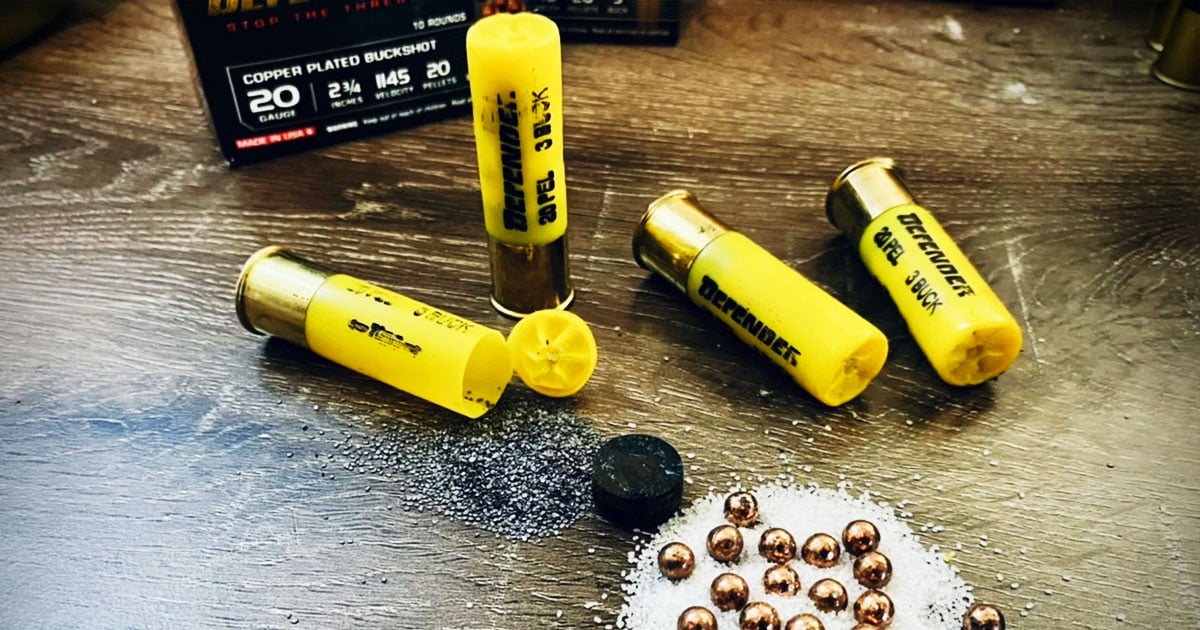
| Buckshot | Remington Express Buckshot 20630 | 2¾ in | #3 buck | 1,220 fps |
| Slug, sabot | Federal Trophy Copper P209 TC | 3 in | ⅝ oz, 275 gr | 1,900 fps |
| Slug, sabot | Federal Trophy Copper P208 TC | 2¾ in | ⅝ oz, 275 gr | 1,700 fps |
| Slug, sabot | Remington Accutip 20498 | 3 in | ⅗ oz, 260 gr | 1,900 fps |
| Slug, rifled | Remington Slugger High Velocity R28608 | 2¾ in | ½ oz, 219 gr | 1,800 fps |
| Slug, reduced recoil | Hornady Custom Lite 86233 | 2¾ in | 250 gr FTX | 1,600 fps from a 24 in barrel |
| Defense | Federal Personal Defense PD204 2B | 2¾ in | #2 buck | 1,325 fps |
Hornady’s Custom Lite slug is the only load in this set that publishes both a test barrel length and a downrange curve: 1,600 fps at the muzzle from 24 inches, 1,445 at 50 yards, 1,308 at 100, 1,193 at 150 and 1,103 at 200. Everyone else publishes a muzzle figure and nothing else.
Compare the two Federal Trophy Copper rows and you can see what the longer shell actually does with a slug: the same 275-grain projectile, 1,700 fps from the 2¾-inch shell and 1,900 fps from the 3-inch. Same pressure ceiling, more room for propellant.
20 gauge versus 12 gauge, on published figures
Here’s how I read this chart
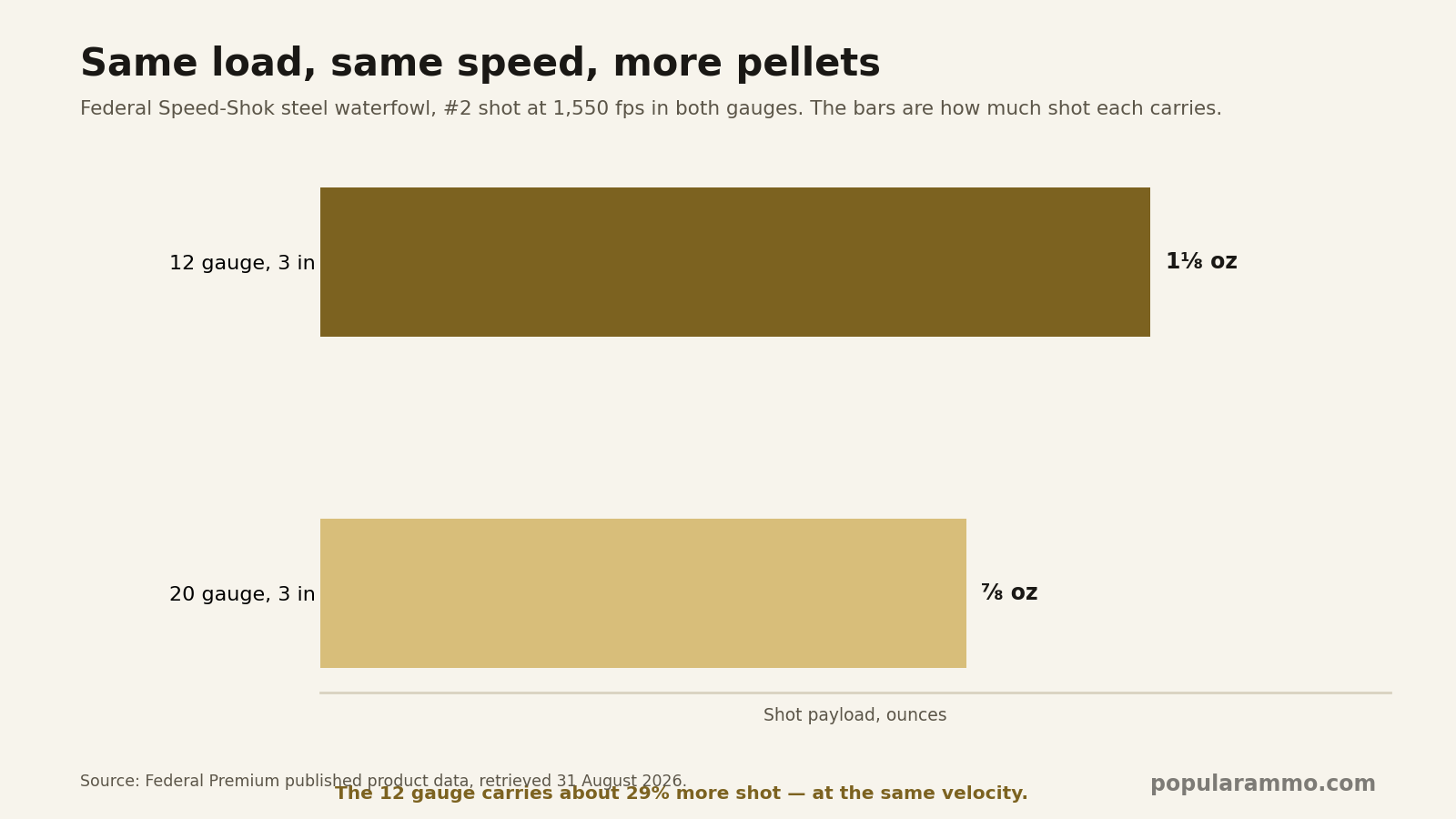
This is the same product from the same maker in two gauges — Federal’s Speed-Shok steel waterfowl load, both leaving at the same 1,550 feet per second. The bars show how much shot each one carries, in ounces. The 12 gauge is not throwing its pellets faster; it is throwing about 29 per cent more of them. That is the whole gauge difference in one picture.
The clean comparison is same-maker, same-product, both gauges. Federal’s Speed-Shok steel waterfowl load publishes ⅞ ounce of #2 at 1,550 fps in 20 gauge, and 1⅛ ounce of #2 at 1,550 fps in 12 gauge. Identical speed, identical shot size, and the 12 gauge is carrying about 29 per cent more shot down the same path.
That is the difference in one line: more pellets in the pattern, not faster ones. Whether it matters depends entirely on what you are shooting at and how far away it is.
On recoil, I can quote and not calculate. Missouri’s conservation department: the 20 gauge’s “recoil is lighter than that of a 12-gauge, and the guns are lighter, too.” No ammunition maker publishes a recoil figure for either gauge, in this or any other cartridge I have surveyed, so a numeric comparison would have to come from a formula with inputs nobody publishes.
What nobody publishes about 20 gauge shells
- Pattern percentage — absent from every load, as it is across all shotshells.
- Recoil — no maker, any gauge.
- Payload weight on buckshot loads — Remington’s Express Buckshot and Federal’s Personal Defense publish shot size but no ounce weight.
- Test barrel length — only Hornady’s Custom Lite slug states one.
- Downrange data — only that same Hornady load publishes any.
Where to go next
My 12 gauge vs 20 gauge comparison takes the payload and recoil trade further, 12 gauge shotgun shells covers the shot size scale and the non-toxic shot law in full, and .410 ammo covers the smallest of the three. Bird hunters will find field coverage at Popular Outdoorsman.
Sources
- ANSI/SAAMI Z299.2 shotshell standard — 20 gauge smooth bore and rifled barrel drawings, pressure and velocity tables, proof load table, test barrel notes, rifled slug table
- Federal product pages: Top Gun, Gold Medal Paper, Master Class, Game Load Heavy Field, Upland Quail Forever, Prairie Storm FS, Black Cloud FS, Speed-Shok, Trophy Copper and Personal Defense
- Remington product pages: Premier Nitro Sporting Clays, Gun Club, Nitro Pheasant, Express Extra Long Range, Sportsman Hi-Speed Steel, Wingmaster HD, Express Buckshot, Accutip and Slugger High Velocity
- Fiocchi Golden Turkey TSS; Estate Cartridge Super Sport and High Velocity Hunting; Hornady Custom Lite 86233
- Missouri Department of Conservation, Missouri Conservationist, “A Shotgun Approach”
Ammunition reference desk
Three charts readers come back to: what a round costs today, what a cartridge name really measures, and what shipping and tax add.
| .22 LR | 6.59¢ |
| 9mm Luger | 26.98¢ |
| 5.56 NATO | 44.95¢ |
| .270 Win | .278 in |
| .30-30 Win | .309 in |
| .308 Win | .309 in |
| Case price | $269.80 |
| Shipping and tax | +$34.88 |
| Per round | 30.47¢ |
Reader Favorites