.300 Win Mag Ammo: Loads, Recoil and Best Hunting Rounds
300 Win Mag ammo fires a .30-caliber bullet of 150 to 200 grains at 2,750 to 3,275 fps, under a SAAMI pressure limit of 64,000 psi.
Originally published: October 25, 2026
Safety and legal note. Know your target and what is beyond it, every time. Fire only ammunition marked .300 Win Mag in a rifle chambered for it; the .300 WSM and .300 Weatherby Magnum are separate cartridges. Velocities below are each maker’s published figures, and your barrel will differ. Check your state’s hunting rules, including any lead-free rule where you hunt. Popular Ammo has no affiliate or paid relationship with any maker named here.
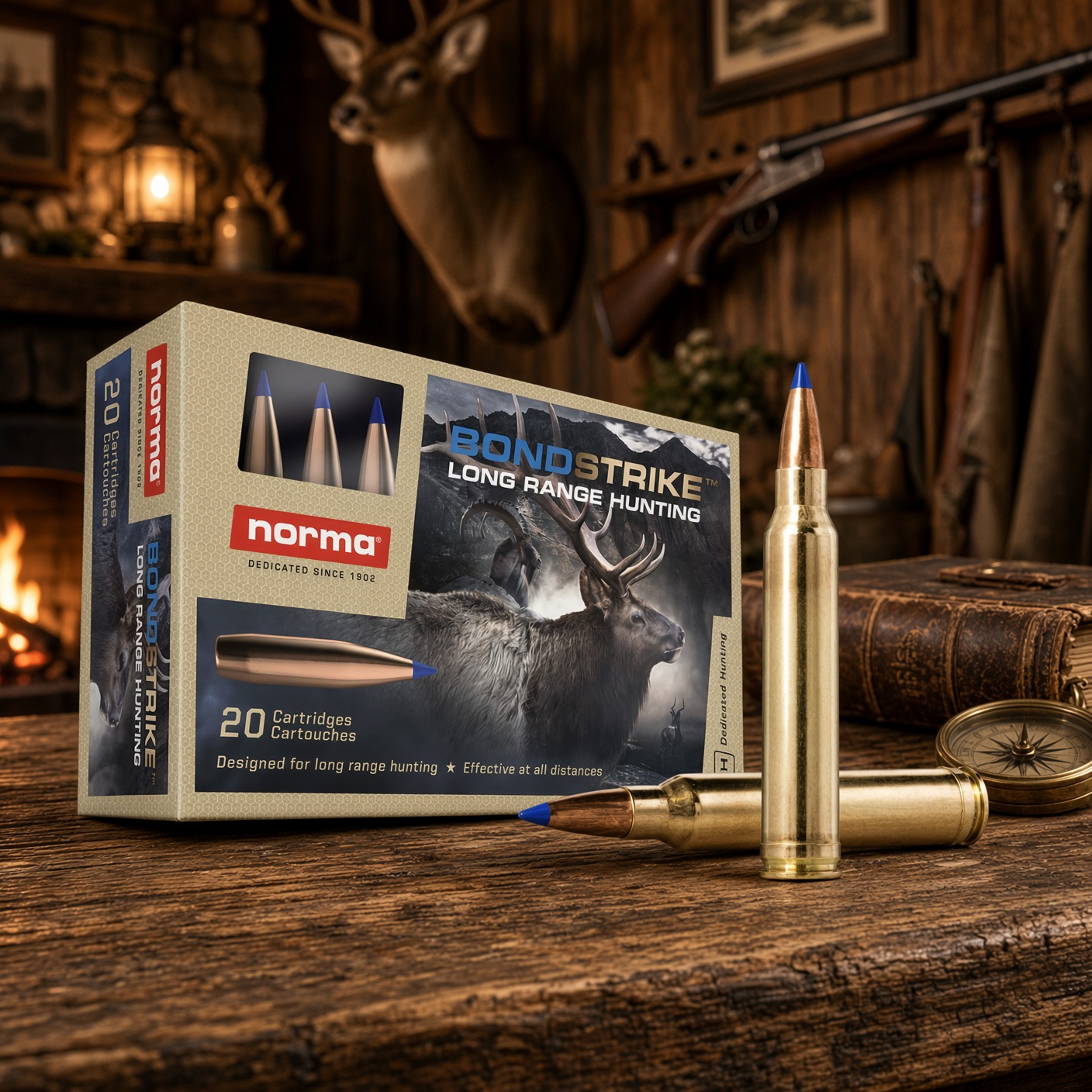
300 Win Mag ammo is factory-loaded .300 Winchester Magnum, the cartridge most hunters shorten to “Win Mag,” and it is what people buy when a .30-06 feels a little short for the country they hunt. With the same 180-grain Federal Power-Shok bullet it leaves the muzzle at 2,960 fps against the .30-06’s 2,700, and it still carries 1,570 ft-lb at 500 yards, close to the 1,671 the .30-06 has left at 300. More reach, more kick, same bore. Fire only ammo whose headstamp matches your barrel, and check your state’s bullet rules before you buy for elk.
Every fall somebody walks up to the counter with an elk tag in one hand and a new .300 in the other, and the question is always the same: which box? So let’s skip the campfire arguments and put 13 factory loads side by side, with the makers’ own numbers.
300 Win Mag Ammo at a Glance
- Pressure: SAAMI sets 64,000 psi maximum average pressure, against 60,000 for the .30-06, and tests it in a 24-inch barrel.
- Speed: the 13 loads below run from 2,750 fps (Nosler’s 200-grain Partition) to 3,275 fps (Hornady’s 150-grain InterLock).
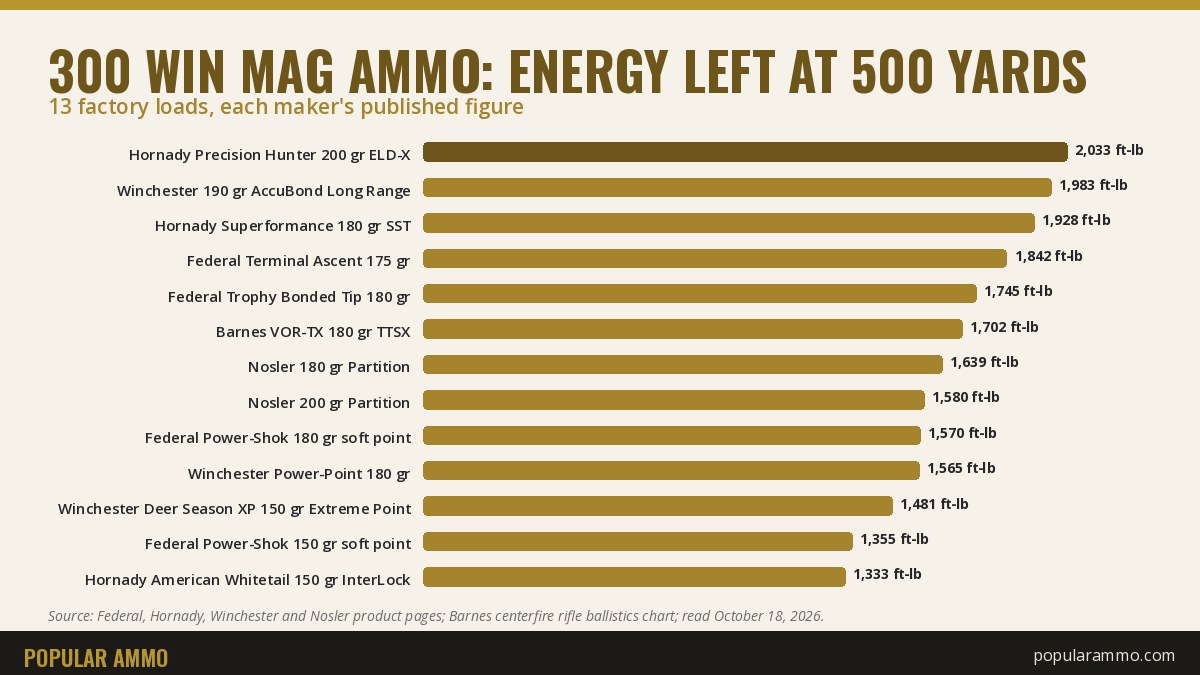
- Reach: Hornady’s 200-grain ELD-X keeps 2,033 ft-lb at 500 yards, the most in the table.
- Recoil: 38.4 ft-lb in an 8-pound rifle by SAAMI’s formula, about half again the .30-06’s 25.4.
- Price: $61.99 to $120.95 for a box of 20 where the maker sells direct, about $3.10 to $6.05 a round.
300 Win Mag Ammo by Bullet Weight
In .300 Winchester Magnum ammunition, bullet weight plays a major role in matching the load to the job. Lighter bullets in the 150- to 165-grain range leave the barrel at higher velocities, producing a flatter trajectory and reduced recoil that make them excellent for long-range target work or plinking where maximum speed and minimal drop matter most. Mid-weight 180-grain bullets are the classic all-around choice for hunting, offering a strong balance of velocity, energy, and penetration that works well on deer and elk at typical field distances. Heavier 200- to 220-grain bullets sacrifice some velocity for greater mass and sectional density, which improves energy retention and deep penetration on large, tough game or at extreme long range, though they generate more recoil and a slightly more curved trajectory.
| Load (maker item) | Muzzle velocity | Energy at 300 / 500 yd (ft-lb) | Best for (my pick) |
|---|---|---|---|
| 150 grain | |||
| Federal Power-Shok 150 gr soft point (300WGS) | 3,150 fps test barrel not listed |
1,975 / 1,355 | Deer at normal ranges; the lowest bullet momentum in the table |
| Hornady American Whitetail 150 gr InterLock (8204) | 3,275 fps 24-in test barrel |
2,026 / 1,333 | Deer; fastest load in the table |
| Winchester Deer Season XP 150 gr Extreme Point (X300DS) | 3,260 fps test barrel not listed |
2,138 / 1,481 | Deer (Winchester’s own label) |
| 175 to 180 grain | |||
| Federal Power-Shok 180 gr soft point (300WBS) | 2,960 fps test barrel not listed |
2,200 / 1,570 | Deer and other big game; tied with the 150-grain Power-Shok for the lowest maker price here |
| Winchester Power-Point 180 gr (X30WM2) | 2,960 fps test barrel not listed |
2,196 / 1,565 | Deer; plain soft point |
| Hornady Superformance 180 gr SST (82193) | 3,130 fps 24-in test barrel |
2,591 / 1,928 | Deer at longer range; fastest 180 here |
| Federal Terminal Ascent 175 gr (P300WTA2) | 3,030 fps test barrel not listed |
2,426 / 1,842 | Elk and long range, bonded |
| Federal Trophy Bonded Tip 180 gr (P300WTT1) | 2,960 fps test barrel not listed |
2,334 / 1,745 | Elk, bonded |
| Nosler Trophy Grade 180 gr Partition (61056) | 2,950 fps test barrel not listed |
2,247 / 1,639 | Elk; my first pick |
| Barnes VOR-TX 180 gr TTSX (21538) | 2,960 fps 24-in test barrel |
2,303 / 1,702 | Elk where lead-free is required |
| 190 to 200 grain | |||
| Winchester Expedition Big Game 190 gr AccuBond Long Range (S300LR) | 2,900 fps test barrel not listed |
2,525 / 1,983 | Long range on deer and elk |
| Hornady Precision Hunter 200 gr ELD-X (82002) | 2,860 fps 24-in test barrel |
2,587 / 2,033 | Long range; most energy at 500 yd |
| Nosler Trophy Grade 200 gr Partition (60069) | 2,750 fps 24-in test barrel |
2,168 / 1,580 | Elk at moderate range; tied with the ELD-X for the heaviest bullet here |
Velocity and energy are each maker’s published figures, read October 18, 2026: Federal, Hornady, Nosler and Winchester from their product pages, Barnes from its published centerfire rifle ballistics chart. Hornady, Barnes and Nosler’s 200-grain page list a 24-inch test barrel, the same length SAAMI uses; Federal, Winchester and Nosler’s 180-grain page do not list one. I left out loads the maker shows as unavailable or prints no ballistics for, including Federal’s 200-grain Terminal Ascent and Nosler’s 180-grain AccuBond. The method behind every number on this site is on how I get these numbers.
Look at the energy column before you look at the muzzle column. The 150-grain loads leave fastest, but Hornady’s 150-grain InterLock starts at 3,572 ft-lb and is down to 1,333 by 500 yards, while its 200-grain ELD-X starts at 3,632 and still has 2,033. Light bullets win the drag race and lose the marathon.
300 Win Mag vs 30-06
Is the .300 just a .30-06 with an attitude? Pretty close, on paper. SAAMI lists a 1-in-10 twist for both, and it caps both cartridges at the same 3.340-inch overall length; the .300 gets its extra speed from a longer, fatter case and 4,000 psi more pressure.
| Measure | .300 Win Mag | .30-06 Springfield |
|---|---|---|
| Maximum average pressure (SAAMI, transducer) | 64,000 psi | 60,000 psi |
| Maximum case length (SAAMI) | 2.620 in | 2.494 in |
| Maximum cartridge length (SAAMI) | 3.340 in | 3.340 in |
| Rifling twist (SAAMI) | 1 in 10 | 1 in 10 |
| Power-Shok 180 gr, muzzle velocity | 2,960 fps | 2,700 fps |
| Power-Shok 180 gr, energy at 300 yd | 2,200 ft-lb | 1,671 ft-lb |
| Power-Shok 180 gr, energy at 500 yd | 1,570 ft-lb | 1,111 ft-lb |
Specs from ANSI/SAAMI Z299.4, the centerfire rifle standard; Power-Shok figures from Federal’s product pages for items 300WBS and 3006B. Our 30-06 ammo page covers the other side of this table, and the rifle caliber chart draws both cases to scale.
The gap that matters is out past 300 yards. At 500 the .300’s 180-grain soft point carries 1,570 ft-lb against the .30-06’s 1,111, about 41 percent more. Inside 300 yards on a whitetail, I have never met a deer that could tell the difference.
Which Bullet for Elk?
For elk I hand people a 175- or 180-grain bullet built to hold together, and I do not lose sleep over which brand. Every one of them starts around 2,950 to 3,030 fps, so the construction is the choice:
- Bonded core: Federal says its Trophy Bonded Tip has bonding that “maximizes weight retention,” with a solid copper shank behind it. Its Terminal Ascent is also bonded.
- Partition: Nosler says the Partition‘s rear core stays intact, “retaining more than two-thirds the original bullet weight for deep penetration.”
- All copper: Barnes says its TTSX gives “double-diameter expansion” and “maximum weight retention,” and it is the one to buy where your state or your land requires lead-free.
A plain soft point like the Power-Shok 180 will kill an elk too. Remember, though, that an elk shoulder is a lot of animal to get through, and Federal sells its Trophy Bonded Tip on “bone-crushing penetration” for exactly that reason. That is the job bonded and partition bullets were built for, so that is where my money goes.

Long Range: The 190 to 200 Grain Loads
If you plan to shoot across a canyon, the heavy, sleek bullets earn their price. Hornady’s 200-grain ELD-X, Winchester’s 190-grain AccuBond Long Range and Federal’s 175-grain Terminal Ascent all keep more than 1,800 ft-lb at 500 yards. Hornady explains why the ELD-X stays useful out there: inside about 400 yards it expands and keeps 50 to 60 percent of its weight, and past 400 its tip drives back to start expansion and it keeps 85 to 90 percent.
Energy is only half of long range, though. For drop and wind at each distance, Guns and Gadgets Daily’s .300 Win Mag ballistics chart works out three loads to 600 yards and opens each one in a calculator. Do you feel lucky at 500? Well, luck should have nothing to do with it: zero with the exact load you hunt, and practice at the distance you plan to shoot.
300 Win Mag Recoil
None of the 13 maker pages behind the table lists a recoil figure, so our rifle recoil chart calculates one with SAAMI’s free-recoil formula, using a published Hodgdon handload so the powder charge is known. For the .300 Win Mag that is a 180-grain bullet over 79.3 grains of powder at 3,088 fps.
| Rifle weight | .300 Win Mag, 180 gr | .30-06, 180 gr |
|---|---|---|
| 7 pounds | 43.9 ft-lb | 29.0 ft-lb |
| 8 pounds | 38.4 ft-lb | 25.4 ft-lb |
| 9 pounds | 34.2 ft-lb | 22.6 ft-lb |
Recoil computed with SAAMI’s formula at a gas factor of 1.75 from the Hodgdon maximum loads printed on our rifle recoil chart; I re-ran the arithmetic from those inputs with SAAMI’s printed constants. Factory loads are generally milder than maximum handloads, so expect somewhat less from a factory box.
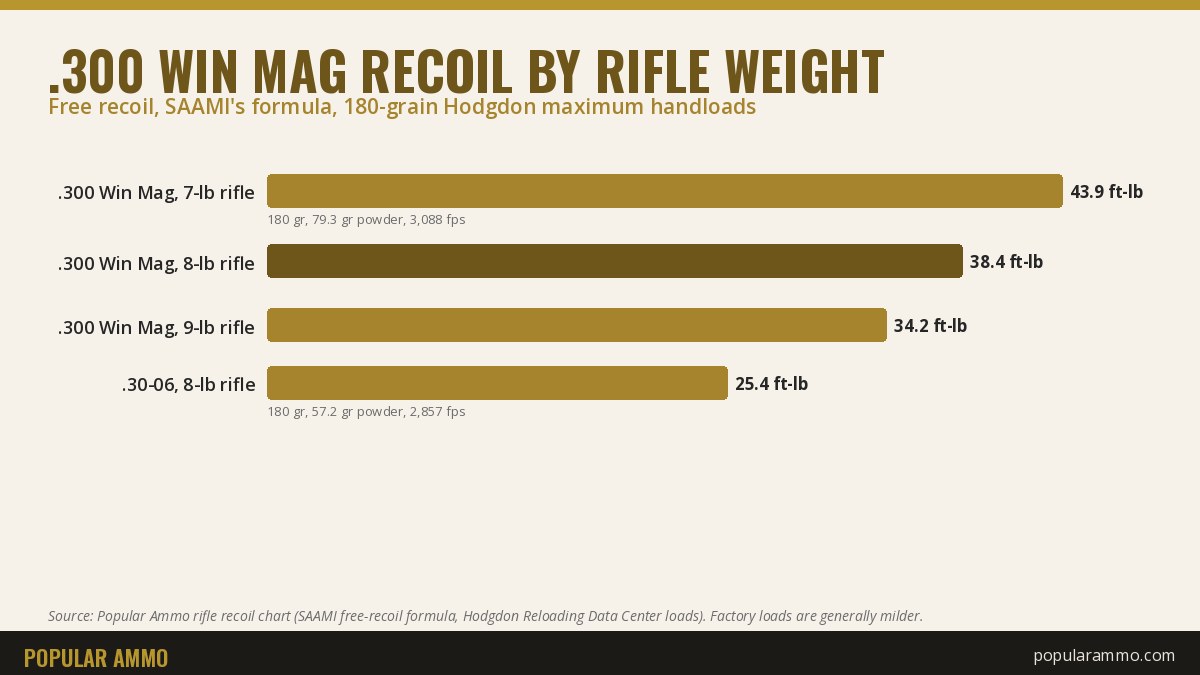
So the .300 hits your shoulder about half again as hard as a .30-06 in the same rifle. The cheapest fix is weight: going from a 7-pound rifle to a 9-pound one cuts the figure from 43.9 to 34.2 ft-lb, about 22 percent. A lighter bullet helps a little too, since the formula multiplies bullet weight by speed; a 150-grain Power-Shok at 3,150 fps works out to 472,500 against 532,800 for the 180 at 2,960. Makers do not print the powder charge, though, so I will not put a recoil number on a factory 150. Muzzle brakes and recoil pads change what you feel, but SAAMI’s formula does not measure either one.
Think about it this way: a shooter who flinches misses, and a missed elk is the MOST expensive shot in hunting. If the .300 makes you blink, a heavier rifle or a .30-06 with a good bullet is the better buy, and for deer alone our 6.5 Creedmoor ammo and .243 ammo pages cover two smaller cartridges.
What 300 Win Mag Ammo Costs
Magnum ammo is not cheap, and the premium bullets cost the most. At the makers’ own stores, Federal’s Power-Shok 180 is $61.99 a box, Barnes’ VOR-TX is $76.99, Federal’s Trophy Bonded Tip is $79.99 and Nosler’s Trophy Grade Partition is $120.95, each for 20 rounds. That works out to about $3.10 a round for the Power-Shok and $6.05 for the Nosler. Prices change, so check the maker before you buy.
Shop the soft points for practice and the bonded box for the hunt, and zero with the hunting load. Our cost per round calculator folds shipping and tax into the price, which matters on a $120 box.
Frequently Asked Questions
Does 300 Win Mag kick more than 30-06?
Yes. In a 7-pound rifle SAAMI’s formula gives 43.9 ft-lb for a 180-grain .300 Win Mag handload against 29.0 for a 180-grain .30-06, and in a 9-pound rifle it is 34.2 against 22.6. Either way, the .300 kicks about half again as hard.
What grain 300 Win Mag is best for elk?
A 175- to 180-grain bonded, partition or all-copper bullet. In the table that means Federal’s Terminal Ascent or Trophy Bonded Tip, Nosler’s 180-grain Partition or Barnes’ TTSX, all starting at 2,950 to 3,030 fps.
Can you shoot 300 WSM in a 300 Win Mag rifle?
No. SAAMI publishes the .300 WSM and the .300 Win Mag as separate cartridges with separate chamber drawings. Fire only ammo whose headstamp matches what is stamped on your barrel.
How far does 300 Win Mag carry its energy?
Further than most people can shoot well. Nosler publishes its 200-grain Partition out to 800 yards, where it still lists 956 ft-lb and 1,467 fps. Your effective range is set by your skill and conditions, not by the box.
Is 150 grain 300 Win Mag good for deer?
Yes. Winchester describes its 150-grain Deer Season XP as suitable for whitetail, mule and blacktail deer, and Hornady sells its 150-grain InterLock under the American Whitetail name. Both start above 3,250 fps.
Pick the bullet for the animal, not the muzzle velocity for the bragging rights, and zero with the exact box you will hunt with. The .300 Win Mag will do the rest, and your shoulder will tell you all about it.
Sources: SAAMI, ANSI/SAAMI Z299.4 Centerfire Rifle standard (.300 Win Mag and .30-06 pressure, dimensions, twist and test barrel); Federal Premium product pages for 300WGS, 300WBS, P300WTA2, P300WTT1 and 3006B (.30-06); Hornady product pages for items 8204, 82193 and 82002; Winchester product pages for X300DS, X30WM2 and S300LR; Nosler product pages for 61056 and 60069; Barnes, VOR-TX Rifle TTSX 300 Win Mag and Barnes, centerfire rifle ballistics chart; Popular Ammo rifle recoil chart (SAAMI free-recoil formula, Hodgdon load data).
Ammunition reference desk
Three charts readers come back to: what a round costs today, what a cartridge name really measures, and what shipping and tax add.
| .22 LR | 6.59¢ |
| 9mm Luger | 26.98¢ |
| 5.56 NATO | 44.95¢ |
| .270 Win | .278 in |
| .30-30 Win | .309 in |
| .308 Win | .309 in |
| Case price | $269.80 |
| Shipping and tax | +$18.89 |
| Per round | 28.87¢ |
Reader Favorites