How Far Can a Bullet Travel? Maximum Range by Cartridge
How far can a bullet travel? Birdshot about 300 yards, a .22 LR 0.87 to over 1.5 miles, a 9mm 1.12 miles, a .30-06 1.88 to 3.35 miles.
Originally published: October 23, 2026
Safety and legal note. Know your target and what is beyond it, every time. Each distance is what its source publishes for the load named; another load, angle, altitude or wind, or a ricochet, changes it, so treat these as minimums. Check your state’s hunting rules before shooting near homes, roads or livestock. Popular Ammo has no affiliate or paid relationship with any maker named here.
“How far can a bullet travel” is a question about maximum range, which hunter education calls the maximum projectile range. It is the farthest a bullet flies when the muzzle is tipped up at its best angle, before it falls back to earth. Effective range, where a bullet still does its job, is a different and much shorter number. Know your target and what is beyond it, because a miss keeps going.
Most of the numbers passed around for this one are guesses wearing a lab coat. So I went to people who plan for where bullets land: the Army and Marine Corps range-safety regulation, Iowa’s official hunter safety course, and Major General Julian Hatcher’s World War I era test firings.
Bullet Range at a Glance
- .22 LR: 1,400 meters (0.87 mile) in the Army’s tables; “over 1½ miles” in Iowa’s hunter course.
- 9mm: 1,800 meters (1.12 miles) for Army 9mm ball.
- Deer rifles: 7.62×51 M80 ball, 3,662 meters (2.28 miles) at sea level; Hatcher’s boat-tailed .30-06, 5,900 yards (3.35 miles).
- Shotguns: slugs and buckshot, 1,073 meters (0.67 mile); 7½ to 9 birdshot, 275 meters (301 yards).
- Straight up: a .30-06 service bullet took 49.2 seconds to come back; 32% of 118 people hit by falling bullets in one Los Angeles series died.
How Far Can a Bullet Travel, by Cartridge
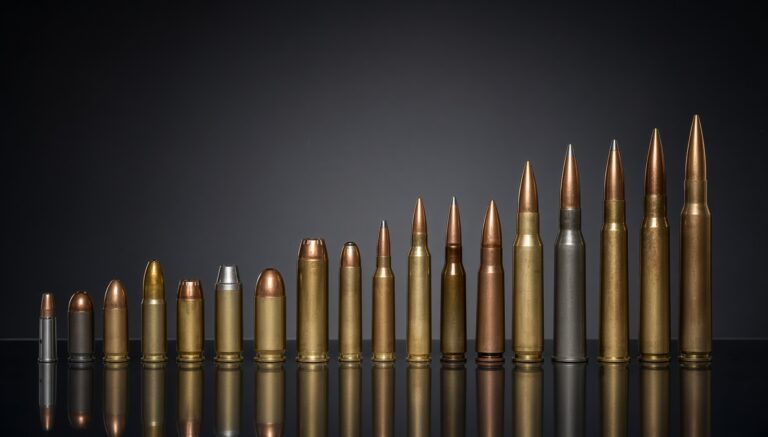
Let’s start with the table: each source’s own figure, converted to yards and miles. Where two numbers appear, the sources disagree; the next section explains why.
| Cartridge | Maximum range | Load and condition | Source |
|---|---|---|---|
| .22 LR | 1,531 yd (0.87 mi) to over 2,640 yd (1.5 mi) | Army Ball LR, 1,400 m; Iowa: “over 1½ miles,” no load or angle given | AR 385-63, Table 5-3; Iowa DNR course |
| 9mm | 1,969 yd (1.12 mi) | Army M882 ball and subsonic, 1,800 m | AR 385-63, Table 5-4 |
| .223 / 5.56×45 | 3,235 to 3,390 yd (1.84 to 1.93 mi) | Army M855 ball, 2,958 m at sea level; M193 ball, 3,100 m | AR 385-63, Tables 5-11 and 5-12 |
| .308 / 7.62×51 | 4,005 to 5,783 yd (2.28 to 3.29 mi) | Army M80 ball, 3,662 m at sea level; M118 Special Ball, 5,288 m | AR 385-63, Tables 5-18 and 5-20 |
| .30-06 | 3,300 to 5,900 yd (1.88 to 3.35 mi) | 150-gr flat base, 3,300 to 3,400 yd at about 29°; 172-gr boat tail, 5,900 yd at 2,700 fps | Hatcher’s Notebook, pp. 20 and 25 |
| 12-gauge slug | Over 800 yd (0.45 mi) to 1,173 yd (0.67 mi) | Army: slugs and shot larger than 7½, 1,073 m; Iowa: slugs “over 800 yards” | AR 385-63, Table 5-1; Iowa DNR course |
| 00 buckshot | Over 600 yd (0.34 mi) to 1,173 yd (0.67 mi) | Army: buckshot shares the slug zone, 1,073 m; Iowa: larger shot “over 600 yards” | AR 385-63, para. 5-2d and Table 5-1; Iowa DNR course |
| Birdshot | 200 to 350 yd (0.11 to 0.2 mi); Army, 301 yd (0.17 mi) | Army: 7½, 8 and 9 shot, 275 m; Iowa: small shot 200 to 350 yards | AR 385-63, Table 5-1; Iowa DNR course |
The Army figures are “Distance X” from AR 385-63, the range-safety regulation issued in May 2025. Distance X is the maximum distance a projectile travels when fired at a given elevation, the far end of a direct-fire danger zone. I converted meters to yards and miles. Iowa’s figures are mostly “over” numbers, Hatcher’s are measured test firings, and the Army’s are military loads; 223 vs 556 and 308 vs 7.62×51 cover the commercial side.

In over 20 years as a professional in the firearms industry, I have learned to read every number in that table as a floor, not a ceiling. Each one belongs to one load, and nobody can promise the box in your truck is that load. How a number earns a spot here is laid out in how I get these numbers.

Why the Sources Disagree
SAAMI, the industry body that publishes the cartridge standards, will not give one number either. It sends “How far will my shot or bullet travel?” to the ammunition maker, because there are too many loads for one answer. Four things move the number.
Bullet Shape
Same cartridge, same speed, very different answer. Hatcher’s crews found the 1906 service .30-06 load, a pointed 150-grain bullet with a flat base at 2,700 feet per second, topped out at 3,300 to 3,400 yards. The M1 load that replaced it used a 172-grain bullet with a 9-degree boat tail (a tapered base) and a slightly better nose. At the same 2,700 feet per second, it went 5,900 yards, 74% farther.
Even cut to 2,640 feet per second, the M1 load still went about 5,500 yards. The Army’s current tables show the same pattern in 7.62×51, where M80 ball carries 3,662 meters at sea level and M118 Special Ball carries 5,288. Garand owners will find modern loads sorted in our 30-06 ammo guide.
Why does shape matter that much? Hatcher figured a bullet fired upward at 2,700 feet per second is slowed by the air about 60 times as fast as by gravity. Drag climbs steeply with speed, too: three times as much at 600 feet per second as at 300, and nearly nine times as much at 1,000. A bullet that slips through the air keeps its speed, so it keeps flying.
Launch Angle
Hatcher’s crews found the .30-06 reached its maximum range at about 29 degrees above level and held it out to about 45 degrees, losing range above that. Nobody aims at 29 degrees on purpose, but a shot at a squirrel high in an oak can put the muzzle right in that window.
Altitude and Wind
Thinner air drags less. The Army’s M80 ball figure grows from 3,662 meters at sea level to 4,569 meters at 7,000 feet, a 25% jump. The regulation also adds 29 meters for every meter per second of tailwind (14.9 meters per knot). Iowa’s rifle and shotgun range charts show every bar longer at 12,000 feet than at sea level.
How the Number Was Made
Old numbers can be flat wrong. The handbooks of Hatcher’s day gave the 1906 .30-06 a maximum range of 4,700 yards, but the tables had only been fired out to about 1,800 yards and the rest was calculated. Those extreme-range figures came out about 38% too big.
Maximum Range vs Effective Range
Maximum range tells you where the bullet lands. Effective range tells you where it still does its job. Iowa’s course puts it in one line: “The effective killing range will always be less than the maximum projectile range.”
CCI said the same when a customer asked how to hold its .22 Stinger for coyotes at 300 yards: “Stinger will reach 300 yards, but it is not a coyote killer at that range.” Buckshot shows the gap best. A Virginia Department of Wildlife Resources writer put its effective range on deer at under 50 yards, “more in the 30-40-yard range.” The Army plans for the same pellets out to 1,073 meters, and our buckshot guide covers sizes, pellet counts and range.
For drop and energy at hunting distances, the Guns and Gadgets Daily ballistic calculator solves your load’s trajectory from its ballistic coefficient and muzzle velocity. That is the right tool for planning a shot (and the wrong one for a safety zone).
How Far Does a Bullet Travel Straight Up?
Up is the one direction where the bullet does come back, just not to you. The British figured their .303 Mk VII bullet, fired straight up, climbs to about 9,000 feet, taking 19 seconds to go up and 36 to come down. Hatcher’s crews timed a 150-grain .30-06 service bullet fired straight up at 2,700 feet per second: 49.2 seconds for the round trip.
Where it lands is anybody’s guess, and I mean that literally. At the Army’s Miami test station, a machine gun aimed straight up and adjusted to drop its shots near its platform fired more than 500 rounds, and only 4 landed on the platform, about 10 feet square. At Daytona Beach, the crews could not find a single returning bullet until balloons showed the winds aloft usually blew opposite to the wind on the ground.
How hard does it hit on the way down? Hatcher’s tests put the .30 caliber service bullet’s return speed at about 300 feet per second, or about 30 foot-pounds. That was under the 60 foot-pounds the Army of that day counted as enough for a disabling wound. Nose-first bullets fall faster than base-first ones, and bigger calibers fall faster still (he put a 718-grain .50 caliber machine gun bullet at nearly 500 feet per second).
Hospital records answer a different question than the Army asked, and the answer is ugly. Emergency physicians at King/Drew-UCLA Medical Center in Los Angeles reviewed 118 patients hit by falling bullets: 77% were struck in the head, and 32% died. Remember that next time somebody at a party wants to fire at the sky.
Ricochet Off Water, Rock and Steel
A bullet does not have to go where you aimed it to hurt somebody; it only has to bounce. Iowa’s course builds that into its third primary rule: have an adequate backstop, and “don’t shoot at a flat, hard surface or water.” A flat rock is a hard surface. So is the ice on a pond.
The Army’s tables show why. A .22 LR ball round that skips off earth or water can carry 155 meters (170 yards) to the side and climb 96 meters; off steel or concrete, 386 meters (422 yards) to the side and 245 meters up. A 9mm ball round behaves about the same, at 158 and 399 meters to the side. Notice the Army gives water the same ricochet numbers as dirt, which is why a pond is no backstop.
Backstops and What Is Beyond
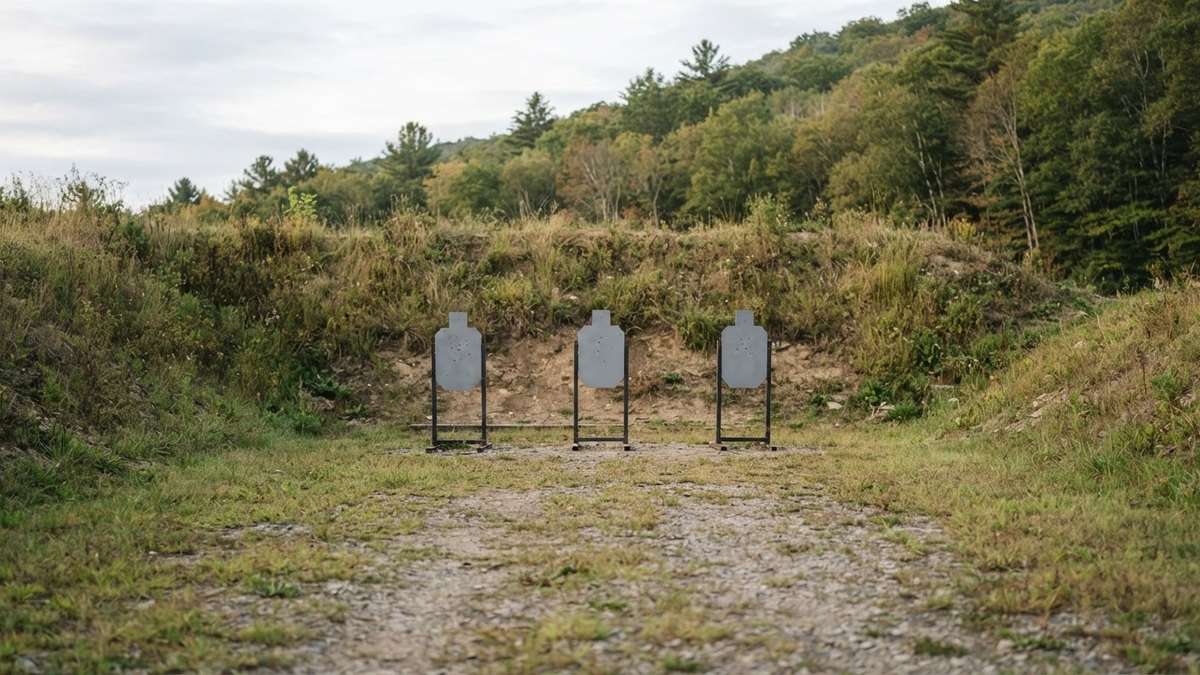
SAAMI’s fourth safety rule is short: “Be sure of your target and what’s beyond.” Iowa’s course spells out the backstop part. It must be “solid enough to capture fired bullets” and built of “a material that will not let the projectile ricochet.” My own test is simpler (and cheaper than a lawyer): if I would not bet my house on it stopping a deer slug, it is not a backstop.
Two more lines from that course belong taped inside every deer stand. The first: “If you cannot see what lies beyond the target, do not take the shot.” The second: bullets “can pass through game and continue on for some distance with deadly force.” A backstop has to stop EVERY round you fire, the pass-throughs and the misses alike.
Deer season is when this question stops being trivia. If your woods share a fence line with somebody’s back porch, your slug or rifle bullet can reach it. Pick the backstop before you pick the stand. For a rimfire around the place, our 22 LR vs 22 Magnum comparison covers pressure and energy.
How Far Can a Sniper Bullet Travel?
The Army does not label loads by job, so here are its longest-reaching rifle loads. Its .300 Winchester Magnum MK 248 MOD 1 load runs 6,294 meters (3.91 miles) at sea level, and the 300-grain .338 Lapua Magnum MK 330 runs 6,833 meters (4.25 miles), or 8,227 meters (5.11 miles) at 7,000 feet.
The .50 caliber M2 ball round sits at 6,500 meters (4.04 miles). The longest zone in the small-arms chapter goes to a .50 caliber saboted light armor penetrator tracer, the M962 SLAP-T: 9,560 meters (5.94 miles) at sea level. And the AK-47? The Army lists 7.62×39 ammunition “designed for AK series, SKS, RPK” at 4,100 meters (2.55 miles).
Frequently Asked Questions
How far does a 22 bullet travel?
Between 1,400 meters (0.87 mile), the Army’s figure for .22 LR ball, and “over 1½ miles,” the figure Iowa’s hunter course teaches. That course’s range chart labels its .22 bar “.22 LRHV,” the high-velocity long rifle, so plan for the longer number.
How far does a 9mm bullet travel?
About 1,800 meters (1.12 miles) for Army 9mm ball and subsonic. The Army’s M1152 and M1153 Modular Handgun System loads run 1,684 and 1,987 meters at sea level, and its .38 and .45 caliber loads 1,806 and 1,690, so handgun bullets cluster around a mile.
Can a bullet fired in the air kill someone?
Yes. CDC investigators counted 19 people hit by probable celebratory gunfire in Puerto Rico over New Year’s Eve and New Year’s Day, 2003 to 2004. One died, and the head was the most common wound site (36%). The report notes falling bullets can return to the ground at more than 200 feet per second.
How far does buckshot travel?
Iowa’s hunter course says larger shot “can travel over 600 yards.” The Army plans farther. Every 12-gauge load with shot larger than 7½, buckshot included, gets the same 1,073-meter zone as a slug. Only 7½, 8 and 9 shot drop to 275 meters.
Is a slug safer than a rifle near houses?
Safer, not safe. The Army’s zone for a 12-gauge slug is 1,073 meters (0.67 mile), about 29% of the 3,662 meters it gives 7.62×51 M80 ball at sea level. But 1,173 yards is still a long way past most back fences.
Every bullet you fire lands somewhere, and the only part you control is where you point it. Pick the backstop before you pick the shot, and if you cannot see what is behind the deer, let him walk. He will be back, and so will the neighbors.
Sources: U.S. Army and Marine Corps, AR 385-63/MCO 3570.1D, “Range Safety” (2025); Iowa DNR hunter safety course, “Importance of Safe Backstops”; “The Four Primary Rules of Firearm Safety”; “Know Your Firearm’s Range”; “Self-Control and Target Identification”; Julian S. Hatcher, “Hatcher’s Notebook” (1957), pp. 19-20, 25, 386, 513-516; SAAMI, “FAQs”; SAAMI, “Firearm Safety Rules”; CDC, MMWR, “New Year’s Eve Injuries Caused by Celebratory Gunfire, Puerto Rico, 2003”; Ordog et al., “Spent bullets and their injuries,” Journal of Trauma (1994); CCI Ammunition, “FAQ”; Virginia DWR, “Buckshot for Whitetails!”.

Ammunition reference desk
Three charts readers come back to: what a round costs today, what a cartridge name really measures, and what shipping and tax add.
| .22 LR | 6.59¢ |
| 9mm Luger | 26.98¢ |
| 5.56 NATO | 44.95¢ |
| .270 Win | .278 in |
| .30-30 Win | .309 in |
| .308 Win | .309 in |
| Case price | $269.80 |
| Shipping and tax | +$18.89 |
| Per round | 28.87¢ |
Reader Favorites