Green Tip Ammo Explained: What M855 Is, and Why It’s Legal
Green-tip ammo is 5.56 M855: a 62-grain bullet with a hardened steel penetrator over a lead core. It is legal to buy, own and shoot under federal law.
Last updated: September 22, 2026 · Originally published August 22, 2026
Green-tip ammo is 5.56×45mm M855 (NATO designation SS109) — a 62-grain bullet with a hardened steel penetrator seated in front of a lead core, identified by a green-painted tip. It is legal for civilians to buy, own, and shoot under federal law. It is legal because ATF granted it a “sporting purposes” exemption in 1986 under 18 U.S.C. § 921(a)(17)(C), and because the federal armor-piercing statute never restricted possession in the first place — it restricts manufacture, importation, and sale by manufacturers and importers. ATF’s 2015 proposal to pull that exemption was never finalized. In fact the exemption got wider: ATF Ruling 2026-1, signed June 15, 2026 and published July 2, 2026, extended it from complete cartridges to the bare projectiles and projectile cores — which legalized a component trade that had sat in a gray area for forty years. California, New Jersey, and Illinois have their own armor-piercing statutes; on their face, all three exclude M855, but New Jersey is the one state where possessing genuinely armor-piercing ammunition is itself a crime.
How to read this chart
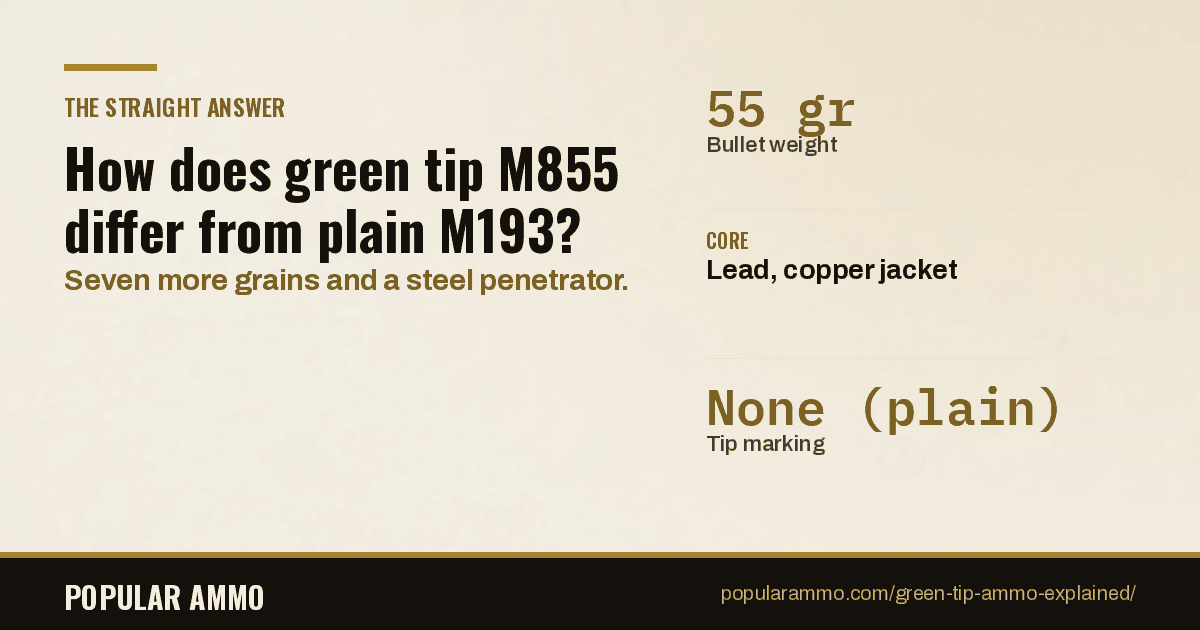
Every number in this table is a published figure, copied from the source named underneath it — none of it is my own measurement. Read across a row to compare one entry, and down a column to compare them all on the same measure.
What “green tip” actually means
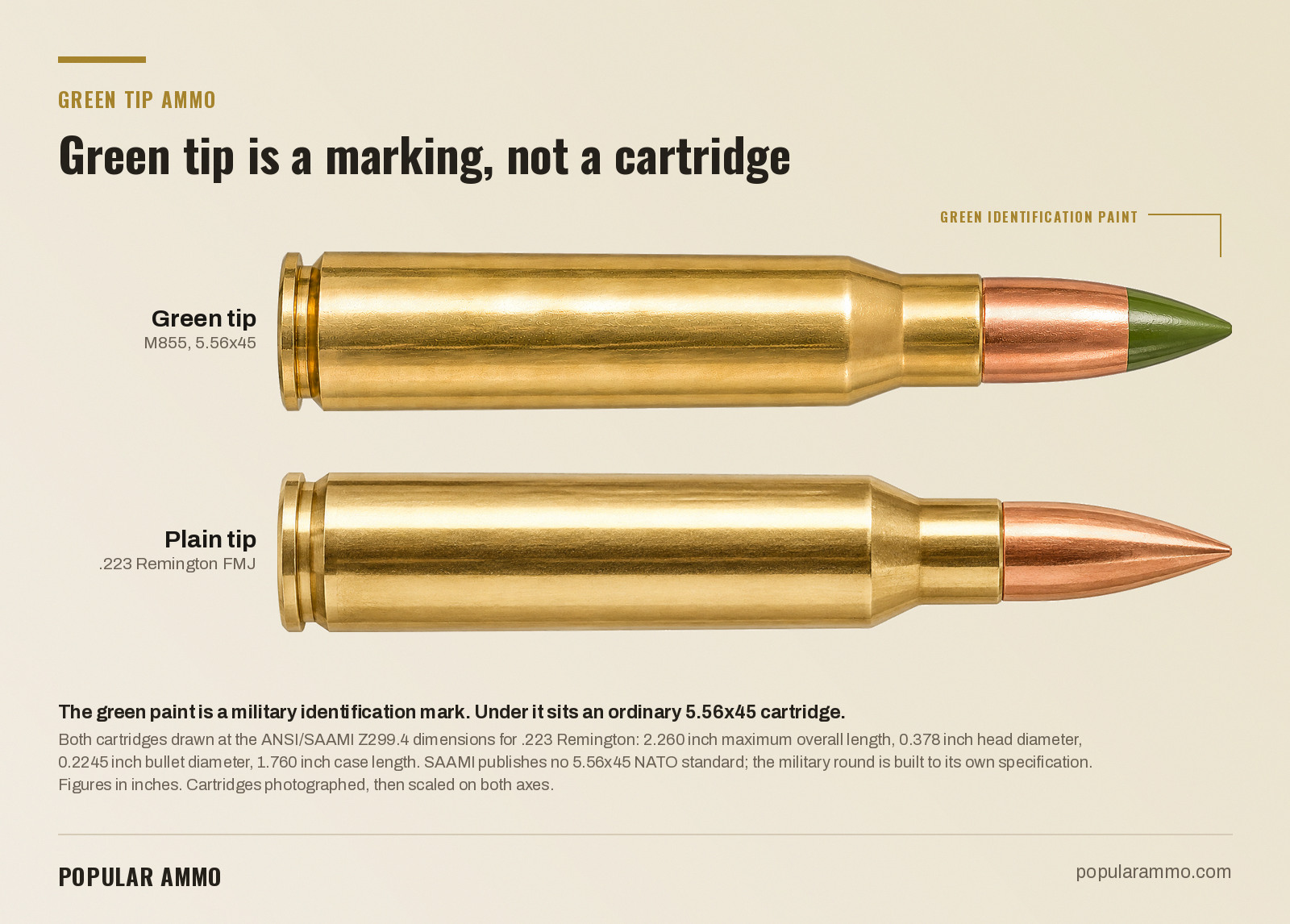
The green paint is a military identification mark, nothing more. Under the Army’s own ammunition data sheets, the 5.56mm M855 cartridge “is identified by a green bullet tip” — the same manual identifies M193 ball by a plain, uncolored tip. The color tells a soldier which round is in the magazine. It is not a warning label, and it is not a legal classification.
What sits under the paint is the part that matters. The M855 projectile is a layered thing: a copper jacket, a hardened steel penetrator at the front, and a lead slug behind it. The Army’s data sheet for M855 labels those components on a cutaway diagram — SLUG, PENETRATOR, JACKET, GREEN. ATF describes the same construction as “a projectile core consisting of a steel penetrator located forward of a lead core.”
Two things follow from that construction that people routinely get backwards. First, M855 is not solid steel; the steel is a tip insert, not the whole core. Second, the Army did not adopt it as an armor-defeating round for general use — the same data sheet states M855 is intended “for use against personnel and unarmored targets.”

The 2026 change most articles have not caught up to
On June 15, 2026, ATF Director Robert Cekada signed ATF Ruling 2026-1, “Exemption of SS109/M855 Projectiles and Projectile Cores.” ATF published it on July 2, 2026. The holding, in full:
“Held, the SS109/M855 cartridges, projectiles, and projectile cores are not subject to the restrictions in 18 U.S.C. § 922(a)(7)–(8), and may be manufactured, imported, and sold or delivered in accordance with the provisions of the GCA generally regulating manufacturing, importing, and possessing ammunition.”
The sentence that does the work is the next one: “This ruling hereby supersedes previous determinations exempting only complete SS109/M855 cartridges.”
Here is why that is a real change and not housekeeping. From 1986 until mid-2026, ATF’s position was that the sporting-purposes exemption attached to the loaded cartridge. A bare M855 bullet — the component a handloader buys by the thousand, or a small ammunition maker buys to assemble — was not clearly covered. Ruling 2026-1 closes that gap and puts the projectiles and the cores themselves inside the exemption.
If you load your own 5.56, this is the sentence you care about. If you only buy factory ammunition, nothing about your purchase changed.
Why it is legal — the precise mechanism
Two separate things make green tip lawful, and they are usually blurred together.
1. The armor-piercing statute does not ban possession
18 U.S.C. § 922(a)(7) makes it unlawful “for any person to manufacture or import armor piercing ammunition” outside of government, export, and authorized-testing carve-outs. § 922(a)(8) applies the same restriction to sale or delivery “for any manufacturer or importer.” That is the whole of it. There is no federal offense for a private citizen possessing armor-piercing ammunition. This is the single most misunderstood fact about the subject: even ammunition that is armor piercing under federal law is not federally illegal for you to own.
2. M855 carries a sporting-purposes exemption
The federal definition at 18 U.S.C. § 921(a)(17)(B) covers:
“(i) a projectile or projectile core which may be used in a handgun and which is constructed entirely (excluding the presence of traces of other substances) from one or a combination of tungsten alloys, steel, iron, brass, bronze, beryllium copper, or depleted uranium; or (ii) a full jacketed projectile larger than .22 caliber designed and intended for use in a handgun and whose jacket has a weight of more than 25 percent of the total weight of the projectile.”
Subsection (C) then carves out, among other things, “a projectile which the Attorney General finds is primarily intended to be used for sporting purposes.”
That (C) exemption is the one M855 rides on. ATF’s own framework document states it plainly: “In 1986, ATF exempted 5.56 mm (.223) SS109 and M855 ‘green tip’ ammunition containing a steel core.”
The popular explanation is probably wrong
You will read everywhere that green tip “isn’t armor piercing because the core isn’t entirely steel — there’s lead in it too.” That reading of § 921(a)(17)(B)(i) is textually plausible, and the lead-plus-steel construction is documented. But it is not the reason ATF gives.
ATF’s framework says the opposite by implication: it describes M855 as ammunition “previously exempted as ‘primarily intended to be used for sporting purposes'” that could “again be regulated as ‘armor piercing ammunition.'” You cannot withdraw an exemption from something that never needed one. ATF is treating M855 as inside the (B) definition and outside the ban because of the (C) exemption.
We looked for any ATF determination or court decision analyzing whether the M855 projectile actually satisfies the “constructed entirely” element. We did not find one. So: the sporting-purposes exemption is the verified legal basis. The “not entirely steel” argument is an argument, not a holding — and we are not going to present it as settled law when no source we can cite has ever adopted it.
What happened in 2015, and what did not
In early 2015 ATF published its “Framework for Determining Whether Certain Projectiles are ‘Primarily Intended for Sporting Purposes'” (Notice 2014R-15N). It proposed two narrow exemption categories and then said this about green tip:
“To ensure consistency, upon final implementation of the sporting purpose framework outlined above, ATF must withdraw the exemptions for 5.56 mm ‘green tip’ ammunition, including both the SS109 and M855 cartridges.”
Its reasoning was that the projectile “may be used in a handgun other than a single-shot handgun,” because “5.56mm projectiles loaded into the SS109 and M855 cartridges are commonly used in both ‘AR-type’ rifles and ‘AR-type’ handguns.”
It never happened. The framework was a notice on ATF’s website, not a Federal Register rulemaking — a full-text search of the Federal Register from 2015 forward returns zero documents for “primarily intended for sporting purposes,” zero for “SS109,” and zero for “green tip.” No final framework was ever issued, the 1986 exemption stayed in force continuously, and Ruling 2026-1 in 2026 rests on that same unbroken exemption.
A note on sourcing: a widely circulated quotation of ATF’s March 2015 statement withdrawing the proposal is reproduced on hundreds of sites. We could not locate it in any ATF-hosted or Federal Register document, so we are not quoting it. What we can verify is the outcome: no final framework, no rule, exemption intact.
M855 vs M193 vs Mk 262
| Spec | M193 (plain tip) | M855 / SS109 (green tip) | Mk 262 Mod 1 |
|---|---|---|---|
| Bullet weight | 55 gr | 62 gr | 77 gr |
| Core | Lead, copper jacket | Steel penetrator forward of a lead slug, copper jacket | Open-tip match / Tipped MatchKing — no penetrator |
| Tip marking | None (plain) | Green paint | None |
| Published muzzle velocity | 3,165 fps Federal American Eagle AE193 |
2,920 fps PMC X-TAC 5.56K |
2,750 fps Black Hills, 20″ test barrel |
| Military purpose as stated | “against personnel and unarmored targets” | “against personnel and unarmored targets” | Designated marksman / precision |
| Typical role today | Cheap bulk practice | Bulk practice, steel-core surplus-style plinking | Precision, longer range |
Velocities are the figures each manufacturer publishes for that specific product. Only Black Hills discloses its test barrel length (20″), so these three numbers are not a controlled head-to-head — treat them as product specs, not as a comparison test. Army data sheets give M193 at 3,250 fps measured 15 feet from the muzzle and M855 at 3,025 fps measured 78 feet from the muzzle; those two are measured at different distances and should never be presented as a clean comparison.
The twist-rate myth
“M855 requires a 1:7 twist” is one of the most durable pieces of misinformation in the AR world. The 1:7 twist in the M16A2 was adopted to stabilize the M856 tracer, which is longer than M855. A 1986 Army Research Institute analysis of M16A2 characteristics states that this amount of twist “was required to stabilize the tracer round at extended ranges,” and its authors recommended testing on the basis that “a 1:9 twist will provide for stability of a bullet similar to the new ball round.” Your 1:9 barrel will stabilize 62-grain green tip fine.
State law: the three we can verify
We are only naming states whose statutes we read. Anything else on this page would be guesswork, and guesswork about criminal statutes is worse than no answer.
| State | Statute | What it restricts | Does it reach M855 on its face? |
|---|---|---|---|
| California | Penal Code §§ 30315, 30320; definition at § 16660 | § 30315 criminalizes possession of “handgun ammunition designed primarily to penetrate metal or armor”; § 30320 covers manufacture, import, sale, transport as a felony | No, on two independent grounds. § 16660 expressly excludes “ammunition primarily designed for use in a rifle,” and separately requires a core “constructed entirely” of the listed metals |
| New Jersey | N.J.S. 2C:39-3(f), 2C:39-9(f); definition at 2C:39-1(gg) | Possession of armor-piercing ammunition is a crime of the fourth degree; manufacture and distribution likewise | Not as written — the NJ definition tracks the federal one and carries the same exclusions, including projectiles the U.S. Attorney General finds primarily for sporting purposes. But NJ is the state where possession itself is the offense, so the margin for error is smallest here |
| Illinois | 720 ILCS 5/24-2.1 | Class 3 felony to manufacture, sell, purchase, possess or carry an “armor piercing bullet” | No — the statute expressly excludes projectiles with soft cores such as lead or zinc alloys, and defers to the federal sporting-purposes and industrial findings |
Read that table as a starting point, not as legal advice. “On its face” is doing real work in that last column: no court in these three states has, so far as we could find, ruled specifically on M855. If you live in California, New Jersey, or Illinois and you are deciding whether to buy a case of green tip, talk to a lawyer in your state, not to a website.
For the other 47 states we did not verify statutes one by one, and we are not going to pad this page with a fifty-row table we cannot stand behind. ATF publishes a State Laws and Published Ordinances booklet for every state that reproduces the relevant statutory text; that is the right primary source if you want to check your own.
M855A1 and M995 are different rounds — do not assume the same answer
M855A1 is the Army’s lead-free replacement. Per the Army’s own account of its development, it “uses the same components as the M855 — a jacket, a penetrator, and a metal slug,” but the penetrator is “almost twice as heavy as the one used in the M855 and is fully exposed instead of hiding beneath the softer copper jacket,” and critically, “The slug is made of copper, making the projectile nonhazardous to the environment.”
That matters legally, and here is the honest state of play: a steel penetrator plus a copper slug means there is no lead in the core at all. Whether that makes the projectile “constructed entirely” from the listed metals under § 921(a)(17)(B)(i) turns on whether plain copper counts — and plain copper is not on the statutory list, which names brass, bronze, and beryllium copper. ATF has published no determination on M855A1 either way. Ruling 2026-1 addresses SS109/M855 only and does not mention it. We are stating the fact pattern; we are not going to invent the conclusion.
M995 is a different animal entirely. Its military specification is titled “CARTRIDGE, 5.56MM, ARMOR PIERCING, M995” — compare the M855 specification, titled “CARTRIDGE, 5.56MM, BALL, M855.” M995 is not covered by the 1986 exemption, is not covered by Ruling 2026-1, and we found no sporting-purposes exemption for it.
Practical notes for actually shooting it
- Steel-core rounds destroy steel targets. Most commercial ranges with AR500 steel ban them outright, and they are right to. Check before you show up with a case.
- Many indoor ranges ban it for backstop wear, independent of any legal question.
- Magnetic testing is how ranges screen it. A magnet sticking to the bullet tip is the field test, which is also why plenty of non-M855 steel-core imports get caught by the same rule.
- It is not a precision round. The two-piece core makes M855 less consistent than match ammunition. If you are chasing groups, Mk 262-class 77-grain match is the answer, not green tip.
What we could not verify
Publishing the gaps is part of the job. On this topic specifically:
- The exact wording and date of ATF’s March 2015 statement declining to finalize the framework. Widely quoted, not locatable in a primary source. We report the outcome instead.
- Whether the M855 projectile satisfies the “constructed entirely” element of § 921(a)(17)(B)(i). No ATF determination or court decision found.
- Any ATF classification determination for M855A1 or M995.
- Statutes in the 47 states not listed above.
- A published twist-rate requirement for Mk 262. The commonly repeated “1:8 or faster” has no source we could find.
Sources
- ATF Ruling 2026-1, “Exemption of SS109/M855 Projectiles and Projectile Cores,” signed June 15, 2026, published July 2, 2026 — ATF Firearms Rulings
- 18 U.S.C. § 921 and § 922 — Office of the Law Revision Counsel
- 27 CFR 478.11 and 478.148 — eCFR
- ATF, “Framework for Determining Whether Certain Projectiles are ‘Primarily Intended for Sporting Purposes'” (Notice 2014R-15N) — atf.gov
- TM 43-0001-27, Army Ammunition Data Sheets, Small Caliber Ammunition, Headquarters, Department of the Army, April 1994
- ARL-TR-5182, “Aerodynamic and Flight Dynamic Characteristics of 5.56-mm Ammunition: M855,” U.S. Army Research Laboratory, May 2010 — DTIC
- ARI Research Note 86-19, “Analysis of M16A2 Rifle Characteristics,” February 1986 — DTIC
- “Evolution of the M855A1 Enhanced Performance Round,” U.S. Army, November 26, 2010 — army.mil
- Cal. Penal Code §§ 16660, 30315, 30320 — California Legislative Information
- 720 ILCS 5/24-2.1 — Illinois General Assembly; N.J.S. 2C:39-3(f), 2C:39-9(f) — via ATF, State Laws and Published Ordinances – New Jersey
Researched and written 22 August 2026. Legal material on this page reflects federal law and the three state statutes named as of that date. This is reporting, not legal advice.
Related reading
- Ammo Types Explained: FMJ, JHP, Subsonic and More
- Caliber Comparison Chart: Bullet Sizes, Velocity and Energy
- Ammo Shortage Tracker: what the 2026 market actually looks like
- DOJ and ATF rule changes, tracked at Guns & Gadgets Daily


Ammunition reference desk
Three charts readers come back to: what a round costs today, what a cartridge name really measures, and what shipping and tax add.
| .22 LR | 6.59¢ |
| 9mm Luger | 26.98¢ |
| 5.56 NATO | 44.95¢ |
| .270 Win | .278 in |
| .30-30 Win | .309 in |
| .308 Win | .309 in |
| Case price | $269.80 |
| Shipping and tax | +$18.89 |
| Per round | 28.87¢ |
Reader Favorites