300 Blackout Ammo: Supersonic vs Subsonic Loads Explained
300 Blackout ammo comes in two families: supersonic loads of about 110 to 150 grains, and subsonic loads of about 190 to 220 grains near 1,000 fps.
Last updated: November 4, 2026 · Originally published October 4, 2026
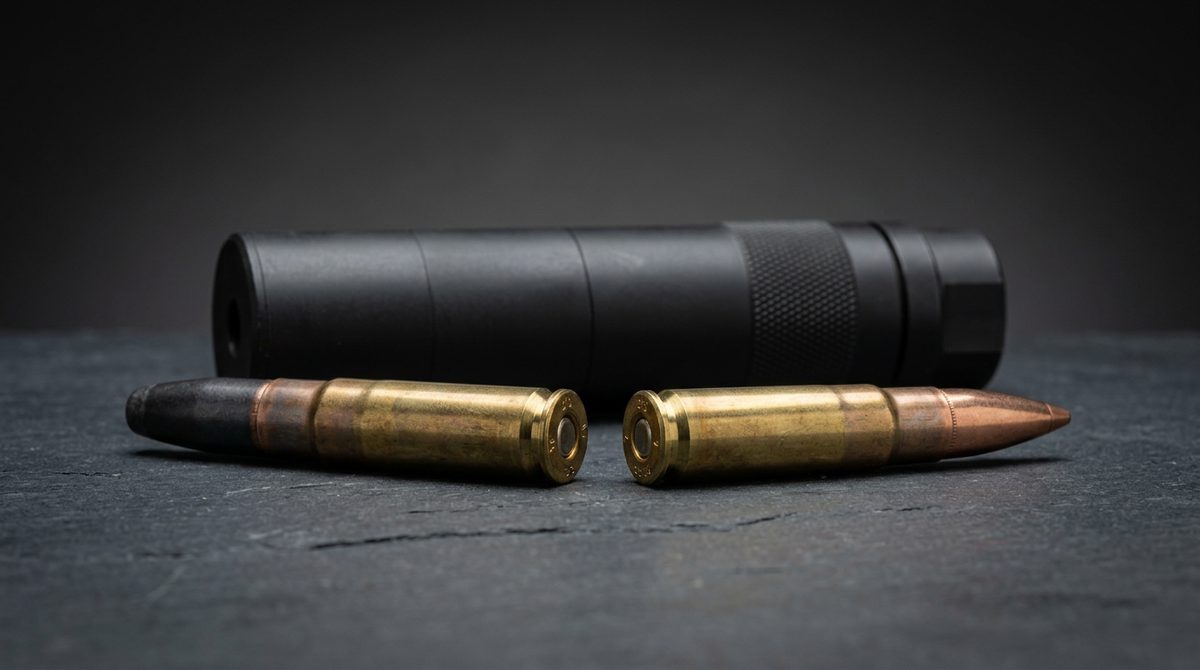
Supersonic and subsonic .300 Blackout will both run in the same rifle and the same magazines, but they are built for different jobs. A lighter supersonic load leaves the muzzle fast, shoots flatter, and carries more energy downrange. A heavy subsonic load stays under the speed of sound so a suppressor can actually quiet it, at the cost of more drop and a shorter practical range. Same cartridge, same gun, two specialties.

Here is what SAAMI sets for the cartridge, what the factory loads actually run, and the one mistake that destroys rifles.
Safety note. Never load or fire 300 Blackout in a 5.56 or .223 rifle. It chambers and can destroy the gun and injure the shooter. Keep the two cartridges in separate, clearly marked containers and magazines. Velocities below are each maker’s published figures from their test barrels, and your barrel may differ. Popular Ammo has no affiliate or paid relationship with any maker named here.
What I want you to walk away with
- SAAMI sets 55,000 psi maximum average pressure for 300 AAC Blackout, with a 1:8 twist.
- Supersonic factory loads run about 110 to 150 grains, 1,900 to 2,200 fps in the examples below.
- Subsonic loads run 190 to 220 grains at about 940 to 1,050 fps.
- It is the same .308 bullet diameter as a .308 Winchester, in a much shorter case.
- A 300 Blackout round fired in a 5.56 chamber can destroy the rifle. SAAMI lists it as unsafe.
What SAAMI Says About 300 Blackout
The spec sheet is short. Our rifle caliber chart, drawn from ANSI/SAAMI’s published dimensions, lists 300 AAC Blackout with a .308 inch bullet, a 1.368 inch case, a 2.260 inch maximum overall length, a 1:8 twist and a maximum average pressure of 55,000 psi. For comparison, the .308 Winchester in the same chart is listed at 62,000 psi with a 2.015 inch case.
That 1:8 twist is what lets the cartridge stabilize long, heavy subsonic bullets.
Supersonic vs Subsonic 300 Blackout Ammo
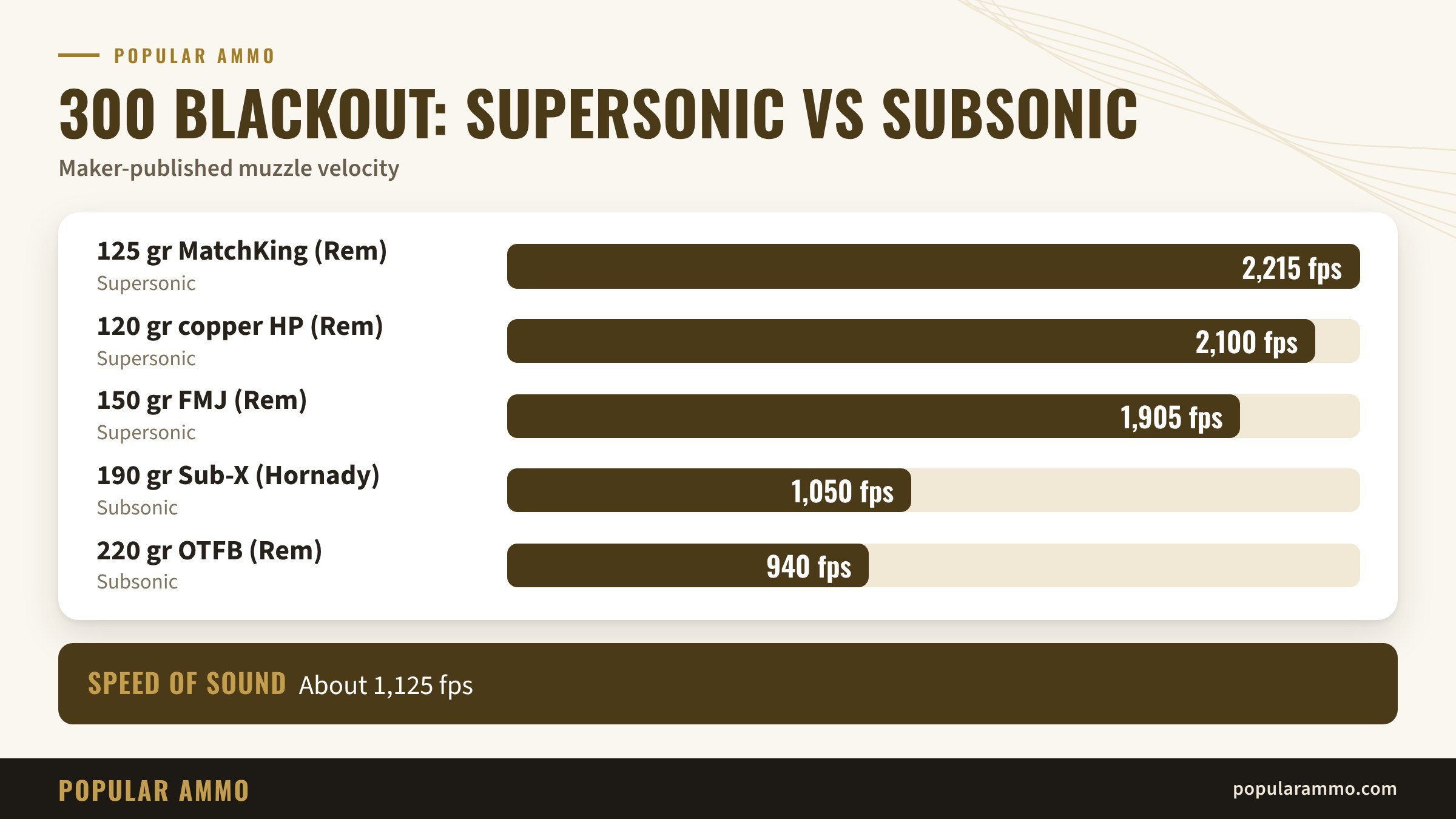
| Load | Bullet | fps |
|---|---|---|
| Rem. Premier Match | 125 gr MatchKing | 2,215 |
| Rem. Core-Lokt Copper | 120 gr copper HP | 2,100 |
| Rem. UMC | 150 gr FMJ | 1,905 |
| Hornady Subsonic | 190 gr Sub-X | 1,050* |
| Rem. Subsonic | 220 gr OTFB | 940 |
From Remington’s 300 Blackout product listing (items 21503, R27857, 20107, 28430) and Hornady’s product page (item 80877), checked September 2026. *Hornady lists its figure from a 16-inch test barrel; Remington does not list a barrel length. The top three are supersonic, the bottom two subsonic.
Supersonic ammo is the one for hunting at normal ranges and general shooting. Remington’s 120-grain copper hollow point is a hunting load; its 150-grain FMJ is a practice round. Subsonic ammo is for suppressed shooting, where the whole point is to stay under the speed of sound so there is no supersonic crack downrange. Hornady says its Sub-X uses powders “optimized for subsonic use” with a low flash signature.

Will Subsonic 300 Blackout Cycle My Rifle?
Do not assume it will. In the table above, subsonic loads leave the muzzle at roughly half the speed of supersonic ones, and rifles differ in how they handle that. Test your specific rifle with the exact subsonic load you plan to use before you count on it. If you shoot suppressed, our sister site Popular Suppressors covers 30 cal suppressors that fit this cartridge.
The Mistake That Destroys Rifles
300 Blackout will fit into a 5.56 or .223 chamber. It should never be fired there. As our full breakdown of 300 Blackout vs 5.56 explains, it will chamber and fire and typically destroy the upper receiver, barrel extension, bolt carrier and magazine, and SAAMI lists the combination as unsafe. Mark your 300 Blackout magazines, store the ammo apart, and never mix the two on the same bench.
A .30-06 or .308 led, with magnums and straight-wall cartridges tied for second.
Frequently Asked Questions
What is the best 300 Blackout ammo for hunting?
A supersonic expanding load, such as a 120-grain copper hollow point, inside the range your rifle and load can deliver it well. Check your state’s minimum caliber and ammunition rules for the game you hunt.
What grain is subsonic 300 Blackout?
Usually 190 to 220 grains. Hornady’s Sub-X is 190 grains at 1,050 fps, and Remington’s subsonic load is 220 grains at 940 fps.
Is 300 Blackout the same as 7.62×35?
Retailers such as MidwayUSA list it as 300 AAC Blackout (7.62x35mm). SAAMI’s name for the cartridge is 300 AAC Blackout.
Can I shoot 300 Blackout in a 5.56 rifle?
No. It can chamber and fire, and it typically destroys the rifle. SAAMI lists the combination as unsafe.
Pick the half of the family that fits the job, supersonic for hunting and practice, subsonic for suppressed shooting, and keep it far away from your 5.56 mags. That is the whole story of 300 Blackout. Our cost per round calculator will tell you what that decision costs per trigger pull.
Sources: ANSI/SAAMI cartridge dimensions and pressures, as compiled in the Popular Ammo rifle caliber chart; Remington, 300 Blackout product listing; Hornady, 300 Blackout 190 gr Sub-X Subsonic; Popular Ammo, 300 Blackout vs 5.56.
Ammunition reference desk
Three charts readers come back to: what a round costs today, what a cartridge name really measures, and what shipping and tax add.
| .22 LR | 6.59¢ |
| 9mm Luger | 26.98¢ |
| 5.56 NATO | 44.95¢ |
| .270 Win | .278 in |
| .30-30 Win | .309 in |
| .308 Win | .309 in |
| Case price | $269.80 |
| Shipping and tax | +$18.89 |
| Per round | 28.87¢ |
Reader Favorites