
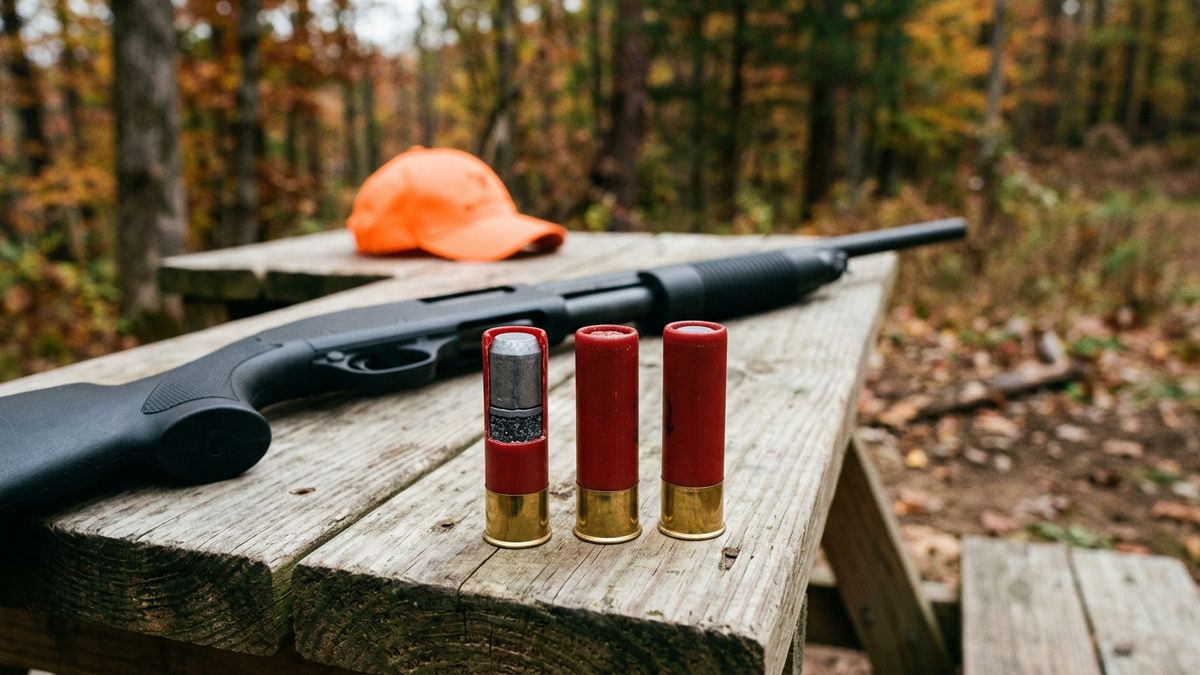
12 Gauge Slugs for Deer: Rifled, Sabot or Buckshot?
12 gauge slugs come in two kinds: rifled slugs for smooth barrels and sabot slugs for rifled barrels. Match the slug to the barrel first.
Last updated: October 17, 2026 · Originally published October 16, 2026
Not legal advice. This article is general information about hunting ammunition, written by a gunsmith and federal firearms licensee, not an attorney. Popular Ammo and Brand Avalanche Media are not a law firm. Deer rules change by state, zone and season, so confirm them in your state wildlife agency’s current regulations before you hunt. Speeds below are each maker’s published figures. No link on this site earns us a commission.
A 12 gauge slug is a one-ounce chunk of lead that flies like a thrown brick. And that is exactly the point. Nobody buys 12 gauge slugs for their sleek lines. You buy them because a deer at 80 yards in shotgun country needs one big, heavy hit.
So here is the first thing to know, before brand or price: the slug has to match the barrel. A rifled slug and a sabot slug are built for opposite barrels. Get that backward and you are paying good money for bad groups.

12 Gauge Slugs at a Glance
- SAAMI files rifled slugs under smooth-bore loads, and sabot slugs under rifled barrels and rifled choke tubes.
- Remington’s 1 oz Slugger lists 1,560 fps. Hornady’s 300 grain SST sabot lists 2,000 fps.
- At 100 yards, Federal’s rifled slug keeps 1,262 ft-lb. Hornady’s sabot keeps 1,793.
- Illinois allows shotguns for deer loaded with slugs only. Arkansas allows buckshot down to No. 4 buck.
- A Virginia wildlife agency writer found buckshot worked on deer at 30 to 40 yards with the gear he started on.

Which 12 Gauge Slugs Fit My Barrel?
Look at your barrel before you look at the 12 gauge slugs on the shelf. A smooth barrel has no grooves inside. A fully rifled barrel has spiral grooves, like a rifle. Some smooth guns take a rifled choke tube, which adds a short rifled section at the muzzle. Each one wants a different slug.
| Barrel | Rifled slug | Sabot slug | Buckshot |
|---|---|---|---|
| Smooth | Yes. Built for it | No. Waste of money | Yes, where legal |
| Smooth + rifled choke | Ask the choke maker | Yes, per SAAMI | Ask the choke maker |
| Fully rifled | No. Undersize | Yes. Built for it | Ask the barrel maker |
Built from ANSI/SAAMI Z299.2 (rifled slugs “intended to be fired from smooth-bore firearms”; sabot slugs “intended for use in rifled-barrel shotguns and/or rifled choke tubes”), Hornady’s SST page (“fully rifled barrels only”), and American Rifleman’s note that rifled slugs “do not properly engage the rifling.” Where no maker I checked says, the cell says to ask.
So the rule is short. Smooth barrel, rifled slug. Rifled barrel, sabot slug. Everything else is a question for whoever made your barrel or choke tube, and their manual beats my table. Also check your chamber length while you are in there. Our 12 gauge shotgun shells page covers why a 3 inch slug does not belong in a 2¾ inch chamber.
Rifled (Foster) Slugs
The rifled slug is the classic deer camp load. Despite the name, it is meant for a smooth barrel. SAAMI’s shotshell standard files rifled slugs under loads “intended to be fired from smooth-bore firearms.” Remington says the same thing in plainer words. Its Slugger line “provides the smooth bore user with a load that packs serious knock down performance,” and it “fits right in with any deer camp slug gun with a smooth bore.”
Now, what about a rifled slug in a rifled barrel? American Rifleman put it bluntly in 2023: rifled slugs “are inappropriate in rifled barrels, as they are undersize and do not properly engage the rifling.” (Yes, the “rifled” slug is the one that does not go in the rifled barrel. Whoever named these things owes us all an apology.)
Current Slug Loads and Speeds
Here are current 12 gauge slugs from three makers, with each maker’s listed speed. Remington lists these by SKU on its Slugger page, and Federal and Hornady list theirs the same way.
| Load | Shell | Slug | fps |
|---|---|---|---|
| Rem. Slugger 20300 | 2¾ in | 438 gr (1 oz) rifled | 1,560 |
| Rem. Slugger HV 28600 | 2¾ in | 383 gr (⅞ oz) rifled | 1,800 |
| Rem. Slugger HV 28604 | 3 in | 383 gr (⅞ oz) rifled | 1,875 |
| Rem. Managed Recoil 20290 | 2¾ in | 438 gr (1 oz) rifled | 1,200 |
| Federal Power-Shok F127 RS | 2¾ in | 438 gr rifled HP | 1,610 |
| Hornady SST 8623 | 2¾ in | 300 gr sabot | 2,000 |
From Remington’s Slugger page, Federal’s F127 RS page and Hornady’s 12 GA SST page, checked September 30, 2026. On October 4, 2026, Remington’s page marked the Managed Recoil Slugger (20290) Currently Unavailable; Remington’s other three loads in this table and Federal’s F127 RS were listed as available. Only Hornady states its test barrel (24 inches). Ounce weights for the Remington loads are converted from the grains Remington lists.
Notice the trade inside Remington’s own line. The ⅞ ounce high-velocity slug gives up 55 grains to the 1 ounce slug, and it runs 240 fps faster in the same 2¾ inch shell. Lighter and faster, or heavier and slower. Pick one, then stick with it once your gun is sighted in.
Sabot Slugs
A sabot slug is a smaller projectile carried in a plastic sleeve (the sabot, the little plastic jacket around the slug). It is built to take its spin from rifling. Without rifling there is no spin, and spin is the whole reason the slug costs more.
That is why the makers of sabot 12 gauge slugs are so firm about it. Hornady’s SST page says, word for word, “SST® Slugs are designed for use in fully rifled barrels only.” SAAMI’s standard files sabot slugs under loads “intended for use in rifled-barrel shotguns and/or rifled choke tubes,” and SAAMI tests them in rifled test barrels.
So does a sabot slug in a smooth barrel work? Well, it fires. But you have bought a premium spin-stabilized projectile and then denied it the spin. That is like buying a Corvette and only driving it in reverse. Put sabots in a rifled barrel, or in a rifled choke tube where the slug maker approves it, and nowhere else.
How Far Does a Slug Really Reach on Deer?

First, how these numbers were measured. Each maker publishes a downrange table for its own load. Hornady states a 24 inch test barrel and a 150 yard zero. Federal states a 100 yard zero with sights 0.5 inch above the bore, but no barrel length. Neither one is a group size.
| Range | Federal F127 RS rifled | Hornady SST 8623 sabot |
|---|---|---|
| Muzzle | 1,610 fps, 2,521 ft-lb | 2,000 fps, 2,664 ft-lb |
| 50 yd | 1,340 fps, 1,746 ft-lb | 1,816 fps, 2,196 ft-lb |
| 100 yd | 1,139 fps, 1,262 ft-lb | 1,641 fps, 1,793 ft-lb |
| Table ends | 125 yd: 1,068 fps, 1,110 ft-lb | 200 yd: 1,341 fps, 1,198 ft-lb |
Federal Power-Shok Rifled Slug F127 RS and Hornady 12 GA SST 300 gr FTX (item 8623) product pages, checked September 30, 2026.
Two things jump out. First, the sabot slug at 100 yards still carries more energy than the rifled slug at 50. Second, look at where each maker stops. Federal ends its rifled slug table at 125 yards. Hornady carries its sabot to 200 yards, where its own chart shows the slug 6.7 inches low with that 150 yard zero.
So here is my read of those tables for 12 gauge slugs on deer. A smooth barrel with rifled slugs is a 100 yard tool, give or take, and that matches where Federal stops printing numbers. A rifled barrel with sabots stretches it, and Hornady prints out to 200. Your own groups at the range set the real limit, though. Shoot the exact load you plan to hunt with, at the distances you plan to shoot.
Buckshot for Deer: Where Is It Legal?
This is the part the top-ranking pages wave off with “it varies by state.” Well, it does. So here are three real states, straight from the agencies, to show how far apart the rules sit.
- Illinois. The Illinois DNR’s deer page allows shotguns “loaded with slugs only, of not larger than 10 nor smaller than 20 gauge, not capable of firing more than three consecutive slugs.” No buckshot for deer.
- Arkansas. Arkansas Game and Fish allows shotguns in modern gun season. The exceptions include “buckshot in a .410 shotgun” and “shot smaller than No. 4 buckshot in any shotgun.” And during its alternative firearms season, “Shotguns with slugs are not allowed.”
- Massachusetts. Massachusetts limits deer shotguns to “No larger than 10 gauge,” usable “only during the shotgun deer season.” It also says “Rifled barrel shotguns are legal.” Then it bans rifles and handguns in the woods during any season when deer may be hunted with a shotgun.
Three states, three different answers. That is why I will not give you a blanket yes or no. Read your own state’s current regulations, and read the zone and the season too.
Where buckshot is legal, it is a close-range load. A Virginia Department of Wildlife Resources blog writer said that as a young hunter he learned buckshot’s effective range on deer was “less than 50 yards,” and “more in the 30-40-yard range” in practice. He adds that shells and chokes have improved since, so longer shots are now possible. The same writer made patterning his gun the top priority, and I agree with him. Federal’s 2¾ inch Power-Shok 00 buck (F127 00) holds nine pellets at 1,325 fps. Federal markets it for “hogs, deer or predators.” Pattern it at your real hunting distance before you trust it on a deer.
Recoil and Reduced-Recoil Slugs
Here is the fight that happens on the shoulder instead of the forum. 12 gauge slugs kick, and nobody is surprised. But no ammo maker I checked publishes a recoil figure for any 12 gauge load, so I will not invent one.
What the makers do publish is speed. Remington’s Managed Recoil Slugger moves the same 438 grain slug at 1,200 fps, against 1,560 fps for the standard Slugger. Same slug, 360 fps slower, and Remington named it Managed Recoil for a reason (Remington marked it unavailable when I checked on October 4, 2026, so call your shop before you count on it). It is still a full ounce of lead. If you are setting up a smaller shooter, also look at our 12 gauge vs 20 gauge comparison, because Illinois, for one, allows a 20 gauge for deer.

What SAAMI Says About 12 Gauge Slugs
The governing document is ANSI/SAAMI Z299.2, the shotshell standard. First, the method. SAAMI measures pressure by transducer and lists slug velocities at 3 feet and 15 feet from the muzzle. It fires rifled slug loads through test barrels with a .031 inch choke constriction, and sabot loads through rifled test barrels.
Then the number. For 12 gauge slugs in 2¾ and 3 inch shells, rifled or sabot, the maximum average pressure is 11,500 psi. SAAMI also footnotes its 1⅜ ounce rifled slug entry: the original load at that payload was a 1 ounce rifled slug with three 00 buck pellets riding along. (So the slug-and-buckshot combo is not a new idea. It is just wearing a new box.)
If you are pricing a season’s worth of practice, our cost per round calculator includes shipping and tax. Remington’s Slugger comes five to a box, so the per-shot number adds up fast.
A .30-06 or .308 led, with magnums and straight-wall cartridges tied for second.
Frequently Asked Questions
What are the best slugs for a 12 gauge?
The best 12 gauge slugs are the ones that match your barrel and group well in your gun. Use rifled slugs like Remington’s Slugger in a smooth barrel, and sabots like Hornady’s SST in a fully rifled barrel.
Can I shoot sabot slugs in a smooth bore?
The gun will fire them, but Hornady says its SST slugs are for “fully rifled barrels only.” Without rifling, the sabot never gets the spin it was built for.
What is the effective range of a 12 gauge slug?
Federal’s rifled slug table ends at 125 yards, and Hornady’s sabot table runs to 200. Your own groups at the range set the real limit for your gun.
Is buckshot legal for deer?
Only in some states. Illinois allows slugs only, while Arkansas allows No. 4 buckshot and larger in modern gun season. Check your state’s current rules.
Will a rifled slug work in a rifled barrel?
Not well. American Rifleman says rifled slugs are undersize and do not properly engage the rifling. Use sabots in a rifled barrel instead.
So match your 12 gauge slugs to the barrel, keep buckshot inside 40 yards where it is legal, and read your state’s rules every season. And if you live where a slug gun is the only choice, check whether your state now allows a straight-wall rifle, because Popular Outdoorsman has a full rundown of straight-wall cartridge rifles for exactly that hunter. Either way, the deer still has to cooperate.
Sources: ANSI/SAAMI Z299.2 shotshell standard; Remington, Slugger rifled slug; Federal, Power-Shok Rifled Slug F127 RS; Federal, Power-Shok Buckshot F127 00; Hornady, 12 GA SST Slug 300 gr FTX; American Rifleman, slugs for rifled and smooth bores; Illinois DNR, Hunt Illinois deer; Arkansas Game and Fish Commission, deer regulations; Massachusetts Division of Fisheries and Wildlife, deer hunting regulations; Virginia DWR, buckshot for whitetails.
Ammunition reference desk
Three charts readers come back to: what a round costs today, what a cartridge name really measures, and what shipping and tax add.
| .22 LR | 6.59¢ |
| 9mm Luger | 26.98¢ |
| 5.56 NATO | 44.95¢ |
| .270 Win | .278 in |
| .30-30 Win | .309 in |
| .308 Win | .309 in |
| Case price | $269.80 |
| Shipping and tax | +$18.89 |
| Per round | 28.87¢ |
Reader Favorites


