Best 9mm Self-Defense Ammo: What the Published Test Data Actually Shows
Federal HST 124gr, Speer Gold Dot 124gr +P and Hornady Critical Duty 135gr +P carry the deepest published record, at roughly 55 to 60 cents a round.
Last updated: October 5, 2026 · Originally published August 22, 2026
The three 9mm defensive loads with the deepest published track record are Federal HST 124gr, Speer Gold Dot 124gr +P, and Hornady Critical Duty 135gr +P. All three are duty-grade, all three are widely available, and all three cost about 55–60¢ a round in 50-round law-enforcement packaging. But the usual reason given for picking them — “they land inside the FBI’s 12–18 inch window” — does not survive contact with the actual public test data. In the largest published gel dataset, fired from a compact 3.5-inch barrel, four of the six most-recommended 9mm loads penetrated past 18 inches, and one went 21.22″. The right way to choose is: pick a bonded or well-proven expanding load, then verify it feeds and cycles in your pistol over at least a couple hundred rounds. That second step matters more than which of these three names is on the box.
How we produced this page — read this first
Popular Ammo does not run a gelatin lab. We do not own a calibrated block, we did not shoot these loads, and we are not going to imply otherwise. Every performance number on this page is published test data from a named third-party testing program, cited with its methodology and its date. Every specification is the manufacturer’s own published figure with its stated test barrel length. The price table further down is read automatically from Target Sports USA product pages and carries its own date; prices quoted in the text were checked on 22 August 2026.
Where a number does not exist, we say it does not exist rather than filling the cell.
The specs the manufacturers actually publish
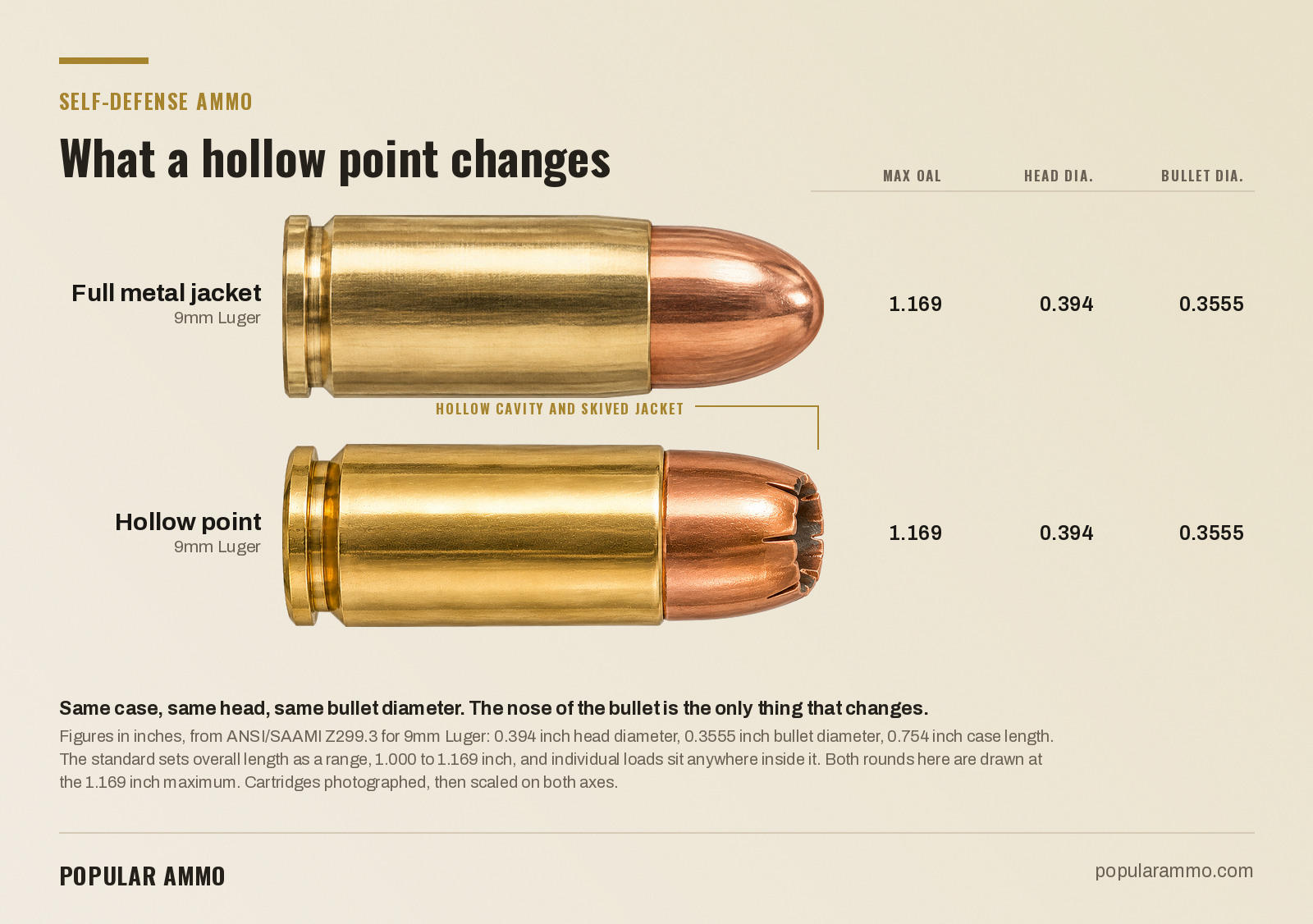
Start here, because this is the part that is unambiguous. These are each manufacturer’s own figures, all from 4-inch test barrels except where noted.
| Load | Weight | Muzzle velocity | Muzzle energy | Test barrel |
|---|---|---|---|---|
| Federal HST (P9HST1S) | 124 gr | 1,150 fps | 364 ft-lb | 4″ |
| Federal HST +P (P9HST3S) | 124 gr | 1,200 fps | 396 ft-lb | 4″ |
| Federal HST (P9HST2S) | 147 gr | 1,000 fps | 326 ft-lb | 4″ |
| Speer Gold Dot +P (23617GD) | 124 gr | 1,220 fps | 410 ft-lb | 4″ |
| Hornady Critical Duty +P (90226) | 135 gr | 1,070 fps | 343 ft-lb | 4″ |
| Winchester Ranger T-Series +P+ (RA9TA) | 127 gr | 1,250 fps | 441 ft-lb | Not published |
What none of them publish: not one of these four manufacturers puts a numeric expansion diameter or penetration depth on its product page. Federal’s HST page says the bullet “expands reliably” and delivers “nearly 100 percent weight retention.” Hornady says Critical Duty gives “consistent performance in FBI tactical handgun ammunition tests” with “excellent expansion, consistent penetration.” Those are marketing claims, not measurements. If you see a chart presenting expansion diameters as manufacturer specs, someone made them up or sourced them elsewhere without saying so.
Also note the Winchester line: 1,250 fps with no disclosed barrel length is not comparable to the 4-inch figures above it. We left the cell honest rather than guessing.
Defensive loads cost several times what bulk range ammunition does. The current price per round for twenty cartridges shows the gap, and what a case of plain 9mm runs today.

The published gel data — and the problem with it
The most complete public gel dataset covering these loads is Lucky Gunner Labs’ self-defense ammunition testing program. Its stated methodology: Clear Ballistics synthetic gel, a four-layer heavy clothing barrier (cotton t-shirt, cotton shirt, Polartec 200 fleece, denim), and for 9mm a Smith & Wesson M&P9c with a 3.5-inch barrel. Penetration measured from the gel face to the bullet’s resting point; expansion measured at the widest point with digital calipers.
| Load | Velocity (3.5″ bbl) | Penetration | Expansion | Inside 12–18″? |
|---|---|---|---|---|
| Federal HST 147gr | 972.6 fps | 15.24″ | 0.606″ | Yes |
| Speer Gold Dot 124gr +P | 1,141.2 fps | 16.78″ | 0.524″ | Yes |
| Hornady Critical Duty 135gr +P | 1,118.4 fps | 18.08″ | 0.468″ | Marginal — just over |
| Federal HST 124gr | 1,135 fps | 18.28″ | 0.606″ | No — over |
| Federal HST 124gr +P | 1,168.2 fps | 18.28″ | 0.659″ | No — over |
| Winchester Ranger T-Series 127gr +P+ | 1,207 fps | 21.22″ | 0.541″ | No — well over |
Three caveats that belong right next to that table, not buried at the bottom:
- This is not FBI protocol. Clear Ballistics synthetic gel is not the organic ordnance gelatin the FBI uses. The testers say so themselves. Numbers from synthetic gel are internally comparable to each other; they are not interchangeable with FBI results.
- This dataset is old. It was published in August 2016 and last expanded in 2021. As of this writing it is roughly a decade old. Bullet designs and lot-to-lot powder changes have moved since. It remains the best public head-to-head we can cite, which says something uncomfortable about how little independent testing gets published.
- 3.5 inches is a short barrel. Fired from a 4- or 5-inch service pistol these loads run faster and generally expand more, which usually means less penetration, not more. The table above is a compact-carry-gun picture.
What the FBI standard actually says
The “12–18 inches” everyone quotes is real and it is FBI-sourced — but its framing is asymmetric, and that changes how you should read the table above. The FBI’s published tabulation of its 10mm testing lists the criteria as “Minimum Acceptable—12″” and “Maximum Desirable—18″.” A 2014 FBI Training Division paper restates it: “the single most important factor in effectively wounding a human target is to have penetration to a scientifically valid depth (FBI uses 12″–18″).”
The FBI’s 1989 wound-ballistics analysis is blunter about priorities: “a handgun bullet MUST reliably penetrate 12 inches of soft body tissue at a minimum, regardless of whether it expands or not,” and “Penetration less than 12 inches is too little.” It also delivers the line most ammunition marketing would rather you not read: “Handgun bullets expand in the human target only 60-70% of the time at best,” and therefore “Expansion must never be the basis for bullet selection, but considered a bonus when, and if, it occurs.”
So 12″ is a hard floor; 18″ is a preference, and the penalty for exceeding it is over-penetration risk — a real concern in a house or an apartment, and one that scales with what is behind your target. A load at 18.3″ in synthetic gel from a snubby barrel is not disqualified. It is a tradeoff you should know you are making.
The source conflict we are not going to paper over
You will read constantly that 9mm and .45 ACP now perform “comparably.” The sources do not agree on that, and both sides of the disagreement are the FBI.
The FBI’s 1989 analysis: “Given adequate penetration, a larger diameter bullet will have an edge in wounding effectiveness… Of those that will penetrate, the edge is always with the bigger bullet.”
The FBI’s 2014 white paper: “There is little to no noticeable difference in the wound tracks between premium line law enforcement projectiles from 9mm Luger through the .45 Auto” — and, going further, that modern 9mm projectiles are “outperforming most of the premium line .40 S&W and .45 Auto projectiles tested by the FBI.”
And in the gel data, the .45 loads were not equivalent: Federal’s 230gr HST .45 expanded to 0.848″ against 0.606″ for the 124gr 9mm HST, and every .45 load tested landed inside 12–18″ while four of six 9mm loads went past 18″.
The defensible statement is narrow: premium 9mm has closed the gap enough that the FBI itself moved back to 9mm, and capacity and recoil then decide the argument. Anyone telling you the calibers are simply identical is overstating what the record supports.
What these cost right now
| Load | Where | Qty | Price | Per round | Stock |
|---|---|---|---|---|---|
| Federal HST 124 gr +P (P9HST3, LE) | Target Sports USA | 50 | $29.99 / $27.59 member | 60.0¢ / 55.2¢ | 99+ in stock |
| Speer Gold Dot 124 gr +P (53617, LE) | Target Sports USA | 50 | $29.99 / $27.59 member | 60.0¢ / 55.2¢ | 99+ in stock |
The table above reads each load’s own product page at Target Sports USA twice a day, and the date beside it is the date it was last confirmed. That is one retailer’s price, not a survey of the market, and loads it does not have in stock are left out. For more cartridges, see the ammo price tracker, whose case-lot prices are read from SGAmmo by the site several times a day.
Two buying notes from the 22 August 2026 check that save real money: the 50-round law-enforcement boxes are dramatically cheaper per round than the 20-round consumer boxes of the same ammunition — the identical HST in a 20-round retail box was running $1.60 a round when we checked, nearly three times the LE-box price. And “law enforcement” packaging is not restricted to police in most of the country; it is the same cartridge in a plainer box. Also worth knowing: Federal’s own site listed the 20-round HST 124gr +P as currently unavailable, and Ranger T-Series 127gr +P+ was out of stock everywhere we looked, with one retailer flagging it law-enforcement-only. Availability on defensive ammunition moves faster than prices do.
The picks
1. Federal HST 124gr — the default
The most consistent expander in the published data (0.606″ from a 3.5-inch barrel, matched only by the 147gr version of itself), universally available, and cheap in LE packaging. Its 18.28″ penetration is over the FBI’s preferred ceiling from a compact barrel — from a full-size 4- or 5-inch pistol expect more velocity, more expansion, and less penetration. If you want one answer and no further reading, this is it.
2. Speer Gold Dot 124gr +P — the one that landed in the window
16.78″ penetration and 0.524″ expansion from a 3.5-inch barrel: comfortably inside 12–18″ with room on both sides. Bonded construction, meaning the core is bonded to the jacket rather than merely seated in it, which is what keeps the bullet together through barriers. If over-penetration is your specific worry — an apartment, thin interior walls, neighbors — this is the pick from a short barrel.
3. Hornady Critical Duty 135gr +P — the barrier load
18.08″ and 0.468″ — the least expansion in the group, which is the design intent. Critical Duty’s polymer-filled FlexLock tip exists to keep the hollow point from plugging with fabric or wallboard. It is the load to pick if barrier performance matters to you more than raw expansion. Note the 25-round box, which makes it look pricier per box than it is per round.
Also fine, with a caveat: Federal HST 147gr
15.24″ penetration and the same 0.606″ expansion as the 124gr — the deepest-inside-window result of any load here. The tradeoff is 1,000 fps at the muzzle: a heavier, slower bullet needs a properly sprung pistol to cycle reliably, and subcompacts are where that goes wrong. Test it, don’t assume it.
The one to think twice about: Winchester Ranger T-Series 127gr +P+
21.22″ of penetration in synthetic gel is a long way past the FBI’s maximum desirable, and +P+ is not a SAAMI-standardized pressure designation — it is a manufacturer convention, which means your pistol’s manual may not cover it. It has a devoted following and a real service record. It was also out of stock at every retailer we checked. There are easier answers.
The part that matters more than the brand
Every load above is duty-grade. The difference between the best and worst pick here is smaller than the difference between ammunition that runs in your gun and ammunition that doesn’t.
- Test at least 200 rounds of your chosen carry load through your actual carry pistol, from your actual magazines. Not 20. Feed failures with hollow points are a real and gun-specific phenomenon, and 20 rounds will not surface an intermittent one.
- Match the load to your barrel length. Published velocities come from 4-inch test barrels. A 3-inch subcompact loses meaningful velocity, and a load that expands well at 1,150 fps may not at 1,020.
- Rotate the chambered round. Repeatedly chambering the same cartridge sets the bullet back into the case, raising pressure. Mark it and retire it.
- Buy practice ammunition in the same weight. A 124gr FMJ practice load recoils and shoots closer to point of aim with your 124gr defensive load than a 115gr will.
- +P is not free. More velocity, more recoil, more wear, and slower follow-up shots. If +P costs you a tenth of a second per shot, standard pressure was the better choice.
What we could not verify
- Any manufacturer-published numeric expansion or penetration figure for any of these six loads. None exists on any of the four manufacturers’ product pages.
- The test barrel length behind Winchester’s 1,250 fps figure for RA9TA.
- The commonly cited “14–16 inches is ideal” refinement of the FBI window. We found it in a manufacturer’s article, not in any FBI-authored document.
- Whether the current FBI protocol still uses the eight-event, 40-shot structure documented in 1989. We found no published revision.
- A current transactable price for Ranger T-Series 127gr +P+. Listed prices on out-of-stock pages are not prices.
Sources
- FBI Law Enforcement Bulletin, November 1989, “The FBI’s 10mm Pistol” (penetration criteria and test events) — DOJ Office of Justice Programs
- Urey W. Patrick, FBI Academy Firearms Training Unit, “Handgun Wounding Factors and Effectiveness,” 14 July 1989
- FBI Training Division, “Executive Summary of Justification for Law Enforcement Partners,” 2014
- Lucky Gunner Labs, self-defense ammunition ballistic testing (Clear Ballistics synthetic gel, four-layer denim barrier, S&W M&P9c 3.5″ barrel; published 2016, expanded 2021) — luckygunner.com
- Manufacturer specifications: Federal Premium HST, Speer Gold Dot, Hornady Critical Duty, Winchester Ranger T-Series
- Retail pricing read twice a day from each load’s own product page at Target Sports USA. Only loads in stock at a confirmed price are listed.
Researched and written 22 August 2026. Prices and availability change constantly; performance data does not. Nothing on this page is a substitute for testing your own pistol.
Related reading
- Ammo Types Explained: FMJ, JHP, Subsonic and More
- Caliber Comparison Chart: Bullet Sizes, Velocity and Energy
- Understanding 9mm +P Ammo
- Ammo Shortage Tracker: what 9mm actually costs right now
- How to load a pistol magazine — Guns & Gadgets Daily


Ammunition reference desk
Three charts readers come back to: what a round costs today, what a cartridge name really measures, and what shipping and tax add.
| .22 LR | 6.59¢ |
| 9mm Luger | 26.98¢ |
| 5.56 NATO | 44.95¢ |
| .270 Win | .278 in |
| .30-30 Win | .309 in |
| .308 Win | .309 in |
| Case price | $269.80 |
| Shipping and tax | +$18.89 |
| Per round | 28.87¢ |
Reader Favorites