
Reloading 9mm: Load Data, Press Choice and the SAAMI Specs
Reloading 9mm takes a press, a carbide die set, a scale and published data, inside SAAMI’s 35,000 psi and 1.169-inch limits.
Originally published: November 1, 2026
Safety and legal note. Reloading is safe only when you follow a powder or bullet maker’s published data, start at the starting load and wear safety glasses at the bench. This page prints no charge weights on purpose. Check your state and local rules on storing powder and primers. Hodgdon, RCBS and Nosler, named below, are sponsors of our Giving Thanks giveaway. No link on this site earns us a commission.
Reloading, or handloading, is the process of assembling your own ammunition from individual components including brass cases, primers, powder, and bullets, using a reloading press and a set of dies. Instead of buying factory-loaded rounds, you control the exact combination of components to tailor velocity, accuracy, or cost to your needs. While it requires attention to detail and a commitment to following published data, it is a straightforward skill that many shooters pick up with basic tools and a little practice.
9mm Luger is one of the best cartridges for learning the process. It is widely available, inexpensive to load, and supported by an enormous amount of free, pressure-tested load data published online by major powder manufacturers such as Hodgdon, Alliant, and Vihtavuori. These companies invest heavily in developing and sharing safe starting and maximum loads because they want reloaders to succeed without creating dangerous pressures. By sticking to the published data and the SAAMI specifications that govern case dimensions and maximum pressures, new reloaders can build consistent, safe 9mm ammunition while learning the fundamentals that apply to nearly every other cartridge.
Reloading 9mm at a Glance
- Pressure: SAAMI sets 35,000 psi for 9mm Luger and 38,500 psi for 9mm Luger +P.
- Length: a loaded round runs 1.000 inch minimum to 1.169 inches maximum; the case is 0.754 inch maximum.
- Free 9mm data: Hodgdon’s Reloading Data Center and Nosler’s 9mm Luger sheets, both free to read online.
- Dies: a carbide three-die set sizes without case lube and finishes with a taper crimp.
- Press: RCBS rates its Turret Press at 50 to 200 rounds an hour in progressive mode and its Pro Chucker 7 at about 600.

9mm Load Data: Where to Find It
The safest and most reliable 9mm load data comes directly from the powder manufacturers themselves, and most of it is available for free online. Companies such as Hodgdon, Alliant Powder, Vihtavuori, Accurate, and Winchester publish extensive, pressure-tested load tables on their websites that list specific powders, charge weights, bullet weights, and resulting velocities for 9mm Luger. These resources are designed to keep reloaders well inside SAAMI pressure limits, which is why manufacturers make the data so easy to access, they want you building safe ammunition rather than guessing. You can also cross-reference the free online data with current reloading manuals from the same companies or with SAAMI’s own published specifications, giving you multiple trusted sources before you ever charge a case.
| Source | Format and cost | 9mm bullet weights | The fine print |
|---|---|---|---|
| Hodgdon Reloading Data Center | Online search; filter by Pistol and cartridge | Hodgdon’s notes say most of its 9mm data is supersonic, with subsonic loads marked | Personal, non-commercial use only; Hodgdon’s rule is to begin at the START load |
| Nosler | Free 9mm Luger data page with a PDF sheet per weight | 115, 124 and 147 grain | Each sheet lists a 4-inch test barrel, the case’s water capacity and a tested overall length for that bullet |
| Hodgdon Reloading Manual | Printed manual; RCBS packs one in its Rock Chucker Supreme Elite Kit | Hodgdon’s printed data for the bench; find the 9mm Luger pages for your bullet weight | Use the newest edition, and check it against the free online data center |
Each row comes from Hodgdon’s, Nosler’s or RCBS’s own page or PDF, opened in October 2026. How I get these numbers explains the rules this site follows.
SAAMI Specs for Reloading 9mm
SAAMI stands for the Sporting Arms and Ammunition Manufacturers’ Institute, the organization that sets the official standards for how ammunition is made and how it performs. For a cartridge like 9mm Luger, SAAMI publishes the precise case dimensions, overall length limits, and maximum chamber pressure that manufacturers and reloaders are expected to follow. These standards exist so that ammunition works safely and consistently in any properly built 9mm firearm, regardless of who made the gun or the ammo.
Following SAAMI specifications takes the guesswork out of reloading and sets you up for success. When you stay within the published pressure limits and dimensional tolerances, you greatly reduce the risk of over-pressure loads, feeding problems, or excessive wear on your firearm. The free load data from powder manufacturers is already developed to these standards, so by using it and double-checking key measurements like overall length, you’re simply working inside a proven, industry-wide safety framework rather than inventing your own. It’s a practical guideline that keeps the process straightforward and reliable.
| Spec | SAAMI figure | What it means at the bench |
|---|---|---|
| Maximum average pressure | 35,000 psi (33,000 CUP by crusher) | The ceiling the published data was built under |
| 9mm Luger +P | 38,500 psi | Use data labeled +P, and only in a gun rated for +P |
| Cartridge overall length | 1.000 inch minimum, 1.169 inches maximum | Seat to the length your data sheet lists for your bullet |
| Case length | 0.754 inch maximum, minus 0.010 | Measure every batch; trim only cases longer than 0.754 inch |
| Bullet diameter | 0.3555 inch maximum, minus 0.0030 | Buy bullets sold for 9mm (.355), not .357 revolver bullets |
| Headspace | Chamber 0.754 inch minimum to 0.776 inch maximum, breech face to case mouth | The case mouth stops the round, so a heavy crimp is a mistake |
| Primer | Seated flush to 0.008 inch below the case head | Nosler’s 9mm sheets are shot with small pistol primers |
Pressure and dimensions are from SAAMI’s Z299.3-2022 standard (9mm Luger drawing revised June 23, 2021); primer size is from Nosler’s 9mm data sheets.
Look at that overall length row again. SAAMI gives a range, but every data sheet I opened lists a tested length for each bullet, and it changes with the bullet’s shape. (SAAMI gives the .40 S&W the same 35,000 psi ceiling, which I break down in 9mm vs 40 S&W.)
What You Need to Reload 9mm
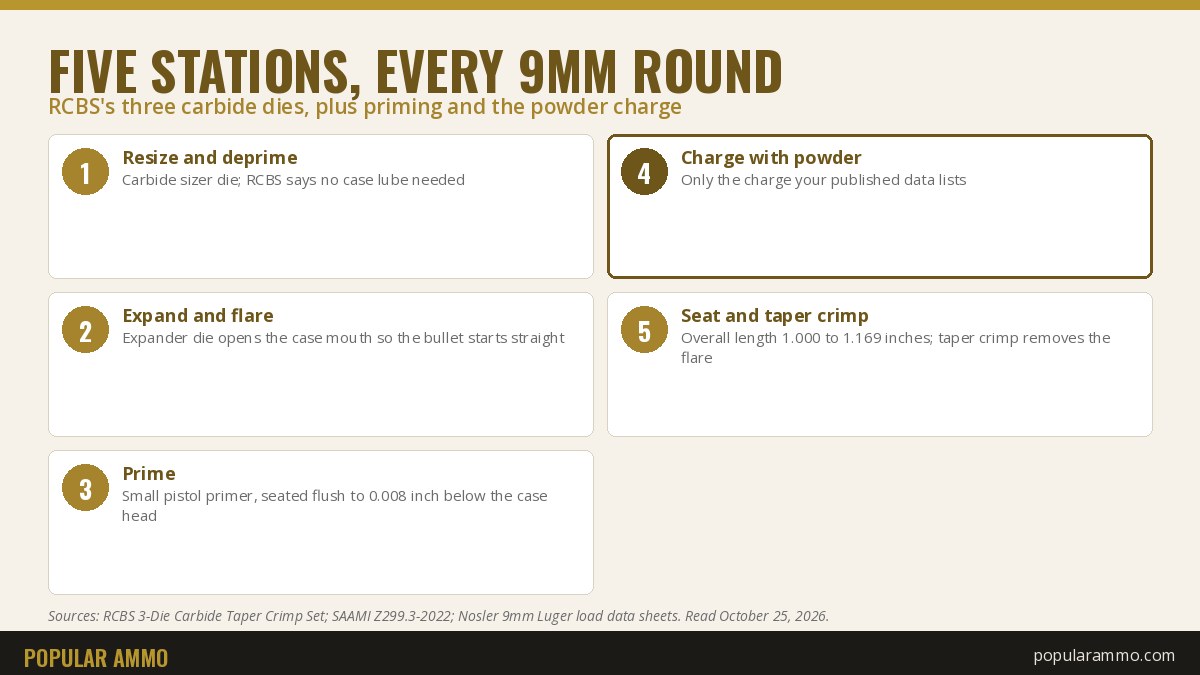
Every fired 9mm case passes through five stations. RCBS’s carbide three-die set handles three of them: the sizing die resizes the case while its decapping stem pushes out the spent primer, the expander die opens and flares the case mouth so the bullet starts straight, and the seating die seats the bullet and taper crimps. Priming and the powder charge go in between.
- A press. Single stage, turret or progressive; the next section sorts them out.
- A carbide 9mm die set. RCBS says the carbide ring in the sizer “eliminates the need for case lubrication,” and its 9mm set includes a sizer, an expander and a seater that taper crimps.
- A shell holder. RCBS’s die set lists none in the box, and the Rock Chucker kit lists none either, so add a 9mm shell holder to the order.
- A powder scale or dispenser. The Rock Chucker kit includes RCBS’s ChargeMaster Link electronic powder dispenser. A kitchen or postage scale is not a reloading tool.
- A dial caliper. You will measure overall length on every batch.
- Safety glasses. On during every step, and on anyone watching.
Kits cover most of this. RCBS’s Rock Chucker Supreme Elite Kit lists the single-stage press, a ChargeMaster Link electronic powder dispenser, a hand priming tool, a dial caliper, a loading block, a deburring chamfer tool and a Hodgdon reloading manual, and the kit list on RCBS’s page includes no dies or shell holders. So plan on buying a 9mm die set and shell holder to go with it.
Single Stage, Turret or Progressive?
Each type of reloading press has its own strengths, and the best choice depends on how much ammunition you want to make and how much precision you need. A single-stage press handles one operation at a time, such as sizing, priming, or seating, and is ideal for learning the process or producing carefully measured loads. A turret press lets you mount several dies at once and rotate between them, striking a practical balance between speed and control. A progressive press moves the case through multiple stations with every pull of the handle, making it the clear choice when you need high volume, such as bulk 9mm practice ammo.
Because each design does certain jobs better than the others, many reloaders eventually own more than one press. A single-stage or turret works well for developing accurate loads or handling specialty cartridges, while a progressive takes over when it’s time to load hundreds of 9mm rounds efficiently. Rather than forcing one press to do everything, using the right tool for the job keeps the process safer, more consistent, and more enjoyable over the long run.
| Press type | RCBS model | How it runs | RCBS’s speed or setup note |
|---|---|---|---|
| Single stage | Rock Chucker Supreme | One die, one step, across a batch of cases; change dies and repeat | 4.25-inch window; RCBS pitches it to novices and experienced loaders alike |
| Turret | Turret Press | Six-station turret head keeps dies mounted; runs in single-stage or progressive mode | 50 to 200 rounds an hour in progressive mode |
| Progressive | Pro Chucker 7 | Seven stations, auto-indexing; each pull of the handle finishes a round | About 600 rounds an hour; shell plate sold separately |
Speeds are RCBS’s own claims, read on its product pages in October 2026; Popular Ammo did not time any press.
Taper Crimp, Not Roll Crimp
Here is the 9mm detail that trips up revolver reloaders. RCBS explains that a taper crimp “gently straightens the case mouth to remove flare,” which suits semi-automatic cartridges that headspace on the case mouth, “like 9mm and .45 ACP,” while a roll crimp “turns the case mouth into a bullet’s cannelure to firmly lock it in place,”. RCBS adds that the taper crimp helps keep the bullet from setting back deeper into the case as the round feeds in a semi-auto firearm.
The job is to remove the flare, and that is ALL. Remember, that case mouth is the ledge the round stops on in the chamber (SAAMI measures 9mm headspace from the breech face to the case mouth), so squash it and you have moved the stop.

What Powder for 9mm Reloading?
Fast-burning pistol powders, from whichever data sheet matches your bullet. Across Nosler’s three 9mm sheets you will find Hodgdon-family powders such as Hodgdon HS-6, CFE Pistol and Titegroup, Hi-Skor 700-X, Winchester AutoComp, Accurate No. 5 and No. 7, and Ramshot True Blue. Each sheet lists only the powders tested with that bullet weight, so a powder on the 115-grain sheet may not appear on the 147.
Hodgdon’s reloading notes also list shotgun powders that have pistol data in its Reloading Data Center and work best in 9mm Luger, .38 Special, .45 Auto and .40 S&W, among them Longshot, HS6, Clays, Universal Clays, 700-X and Winchester WST. Hodgdon’s shop describes Winchester WinClean 244 as a ball powder “ideally suited to 38 Special, 45 Auto, and 9mm standard loads,” which I cover in WinClean 244 uses.
Two powders with similar burn speeds do not take the same charge (Hodgdon’s own Titegroup and HP-38 comparison in 9mm proves it), so never swap one for another off a burn-rate chart.
Pressure Signs and the Starting Load
Hodgdon calls it the golden rule: begin at the START load, which runs about 10% below maximum for most rifle cartridges “and up to 15% below for certain handgun calibers,” then work up. Never start at the maximum, and drop back to the starting load whenever you change a component.
Why does a 9mm care so much? Look at Nosler’s own sheets: the case behind its 115- and 124-grain data holds 10.0 grains, and the case behind its 147-grain data holds 8.4. Same cartridge, different brass, and less room means more pressure from the same charge. Hodgdon’s FAQ makes the same point about military 7.62×51 rifle cases, which it says run 3 to 4% smaller in volume, and its rule is to “change/vary only one parameter/component at a time.”
Watch the fired case. Hodgdon lists the case-head signs of high pressure as very flat primers, slightly cratered primers, ejector marks on the case head and stiff extraction, and says to reduce the load until they disappear. (Feeling lucky is a fine question for Clint Eastwood and a terrible one at a loading bench.)
Is Reloading 9mm Worth It?
Reloading 9mm is worth it for plenty of reasons beyond simply saving money on practice ammo. While you can lower the cost per round compared with buying factory bulk, many shooters handload because they want more control over performance. Custom loads can be tuned for better accuracy than most off-the-shelf 9mm, whether you’re chasing tighter groups at the range or dialing in a specific velocity for competition or training. Others reload to make specialty ammunition that is hard to find or no longer produced, such as reduced-recoil loads, specific bullet weights, or loads optimized for suppressed firearms.
Lead bullets are another common motivation. Factory 9mm is almost always jacketed, but reloading lets you use cast or swaged lead projectiles that are inexpensive and work well for high-volume practice. Some reloaders also develop loads for older or less-common 9mm firearms that benefit from a particular overall length or powder choice that commercial ammo doesn’t offer. In short, reloading turns 9mm from a generic commodity into something tailored to your gun and your goals.
You don’t need a large progressive press or a dedicated reloading room to make it worthwhile. Plenty of people produce excellent 9mm on a basic single-stage press, working in small batches of a couple hundred rounds at a time. For many, the process itself is part of the appeal, a quiet, methodical session in the garage where you can focus on the details, measure carefully, and end up with ammunition you made yourself. Whether you’re chasing accuracy, filling a gap that factory ammo can’t, or simply enjoying the craft, reloading 9mm offers practical benefits that go well beyond the cost of components.
Win a Reloading Bench in the Giving Thanks Giveaway
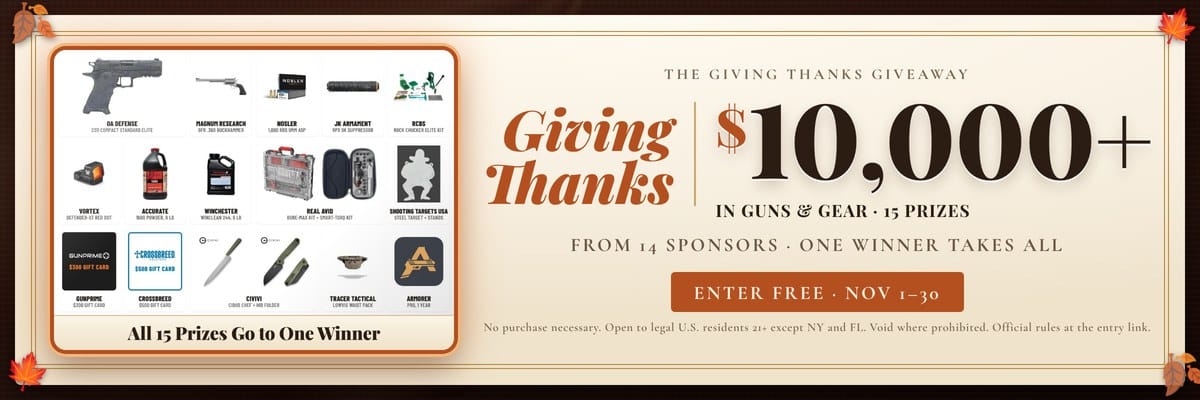
Three of the 15 prizes in our Giving Thanks $10,000+ Guns & Gear Giveaway land right on this page: an RCBS Rock Chucker Supreme Elite Kit, Winchester WinClean 244 powder from Hodgdon, and 1,000 rounds of Nosler 9mm 115-grain JHP ASP (the load I break down in 9mm hollow point). One winner takes all 15 prizes, worth $10,000+ in total. It is free to enter and runs November 1–30, 2026, for legal U.S. residents 21 and older, except in New York and Florida. No purchase necessary. Firearm prizes ship to the winner’s local FFL. The details and the entry form are on the Giving Thanks giveaway page at Guns and Gadgets Daily.
Enter the Giving Thanks giveaway here: fill in your name, email and date of birth below.
Giving Thanks $10,000+ Guns & Gear Giveaway
A .30-06 or .308 led, with magnums and straight-wall cartridges tied for second.
Frequently Asked Questions
Is reloading 9mm worth it?
It is if you shoot a lot or want loads you cannot buy, and less so if you shoot a box a month. Run your own prices through a reloading cost calculator, including what the press and dies cost, before you decide.
What powder should I use for 9mm reloading?
A fast pistol powder that appears in the data for your exact bullet. Nosler’s 9mm sheets include Hodgdon’s HS-6 and CFE Pistol, and Hodgdon’s Reloading Data Center adds shotgun powders such as Longshot and Universal Clays that carry 9mm data.
How many 9mm rounds can you load with 1 pound of powder?
Divide 7,000 by your charge weight in grains. One pound is 7,000 grains by definition, so a lighter charge from your data sheet loads more rounds from the same jug.
Do you need to trim 9mm brass?
Measure it first. SAAMI’s maximum case length is 0.754 inch, with 0.010 inch of tolerance below that, so straight 9mm brass that measures inside the range does not need trimming. Trim only the cases that run over the maximum.
Can you reload 9mm +P?
Yes, with data labeled +P and only for a pistol rated for +P. SAAMI sets 9mm Luger +P at 38,500 psi against 35,000 psi for standard 9mm, so +P data and standard data are not interchangeable.
Reloading 9mm is not hard; it is exacting. Get the data, measure every batch, and let the press be the boring part. Come see us at the bench when you have questions, and bring your data sheet.
Sources: SAAMI, “ANSI/SAAMI Z299.3-2022, Centerfire Pistol and Revolver”; Nosler, “9mm Luger (Parabellum)” load data, with the 115-grain, 124-grain and 147-grain sheets; Hodgdon Reloading Data Center; Hodgdon, “FAQs”; Hodgdon, “Reloading Education”; Hodgdon, “Winchester WinClean 244”; RCBS, “3-Die Carbide Taper Crimp Set”; RCBS, “Rock Chucker Supreme Elite Kit”; RCBS, “Rock Chucker Supreme Press”; RCBS, “Turret Press”; RCBS, “Pro Chucker 7 Progressive Reloading Press”; NIST, “Handbook 44, Appendix C”.
Ammunition reference desk
Three charts readers come back to: what a round costs today, what a cartridge name really measures, and what shipping and tax add.
| .22 LR | 6.59¢ |
| 9mm Luger | 26.98¢ |
| 5.56 NATO | 44.95¢ |
| .270 Win | .278 in |
| .30-30 Win | .309 in |
| .308 Win | .309 in |
| Case price | $269.80 |
| Shipping and tax | +$18.89 |
| Per round | 28.87¢ |
Reader Favorites